Showing posts with label success. Show all posts

Thursday, December 8, 2016

The Lessons Sports Teaches

This post originally appeared at the Fort Worth Weekly's website. To view it there : https://www.fwweekly.com/2016/12/07/sports-rush-where-sports-takes-you/


When you scored a touchdown for your peewee football team or converted a penalty in the high school soccer playoffs or legged out an infield single in beer league softball, you helped your sports team win. But how did that sport help you?

My entire family has long held a belief, shared by many in the athletic profession and beyond, that playing sports confers benefits far beyond the enjoyment one receives during the game itself. A recent speech by a sports professional reminded me why.

Regular readers of this blog, such as there are, may have noticed that I sometimes write about sports industry events at which I work, many of them charity-related. When I do, it is usually because Carla Rosenberg brought me in to assist her through her company, Matchpoint.

Ms. Rosenberg is a superstar in the charity event field. I keep working for her because she is one of those rare people who can see the big picture while also remaining mindful of the thousands of details executing a substantial gathering requires. Plus, she’s a genuinely nice person who can apparently put up with me.

She also knows the sports business, which makes sense when you know her background. She and I met when we both worked for the Texas Rangers. Before that, she played collegiate tennis for the University of Illinois after emigrating from South Africa where she was a top-flight junior player. Following the Rangers, she went on to a successful stint running the Dallas Stars Foundation. Now she organizes events and/or operates foundations for the likes of Marty Turco, Nancy Lieberman, Dirk Nowitzki, and others.

Something got Rosenberg to the point where she is this successful, and it was clearly either in spite of sports or because of them. In a recent talk she gave to employees at the North Texas Food Bank, she explained the role sports, and especially tennis, played in her development as an executive.

“The tangibles that come through playing athletics stay with you,” she said. She turned those tangibles into a series of philosophies she finds crucial to success.

She started with “Understanding winning & losing,” with an emphasis on the latter.
“The biggest lesson that I’ve actually learned is not from winning. It’s from losing. I’ve lost tennis matches. I’ve made mistakes at events and I just realized I can’t stay down.”

Her point was that losing happens in life as well as sports, and experiences on the field or court teach one to deal with it.

One thing I enjoy about working with Ms. Rosenberg is that she aims to leave as little to chance as possible. Rosenberg says she prepares for every meeting, conference call, and event because it causes her to feel the same assuredness she did when she played.

“When I used to step out on the court, I felt very confident. I felt like that was my safe haven. I felt very secure and I think it was because of all the practice and all the training and all the repetition that allowed me to feel that way.”

It’s nice to go into an event feeling comfortable, thinking we’ve got everything ready to go. Live events, however, sometimes take detours one could never anticipate. Technical issues, no-show celebrities, last-minute auction additions – one has to know how to deal with the unpredictable.

“Playing tennis in real time, under high-pressure situations, you have to make decisions,” she said.

We hear analysts talk about “going for shots.” One has to be decisive and execute with confidence, relying on the technique one has refined in practice. It works the same way in events, where having a clear idea of what is supposed to happen and why helps you find alternative solutions when reality doesn’t follow the script.

Not that such situations don’t make one uneasy. But one of Rosenberg’s topic headings suggested “You grow the most when you are uncomfortable.”

“I’ll use tennis as the metaphor. When I had an injury, it wasn’t that I failed. I had an injury. It forced me to step back. When I got back out on the court, again, I was rejuvenated. I had a different perspective,” she noted. “Sometimes when you’re uncomfortable, it’s OK. It’s the growing time.”

Sports and business both have their bottom lines. One must grow to the point where one can win some games, sets, and matches. Rosenberg learned that lesson when she vacationed in South Africa during Illinois’ winter break her senior year instead of training. When she returned, her coach dropped her several slots in the team’s ranking, suggesting he would play her in the line 6 singles position. After a lengthy rant to her father, Mr. Rosenberg asked her if she were finished.

“He goes ‘win your matches and you’ll play number one again,’ and I learned that very quickly. Produce results and you don’t have to do the talking.”

Results matter in tennis, sales, and all other walks of life. It turns out style matters, too. I don’t mean fashion sense or decorating acumen, although Rosenberg has a flair for both. An organizer who manages live events must keep her cool when circumstances rejigger themselves without asking. Ms. Rosenberg always does. Her junior tennis coach taught her that lesson one day when she played less than her best and let it show. He told her “when I look over at your court, I shouldn’t know if you’re winning or losing. It’s called poise.”
A lot of times, a good coach makes the difference in how well sports’ lessons take root.
“I was very lucky,” Rosenberg said. “I had an incredible tennis coach. It wasn’t about being a champion tennis player. It was about what kind of person are you going to be.”

The North Texas Food Bank isn’t a sports organization, but they sought out a sports person to speak with them – to coach them. They did it because her athletic background had given her far more than knowledge of odd-man rushes and forehand technique. It had provided tools she could use to succeed in many areas of business and life. Sports does that.

Rush Olson has spent two decades directing creative efforts for sports teams and broadcasters. He currently creates ad campaigns, television programs, and related creative projects for sports entities through Rush Olson Creative & Sports and FourNine Productions.


RushOlson.com
Linkedin.com/company/rush-olson-creative-&-sports
Facebook.com/RushOlsonCreativeandSports

Wednesday, November 9, 2016

What Does a Left Turn Sound Like?

This post originally appeared at the Fort Worth Weekly's website. To view it there : https://www.fwweekly.com/2016/11/09/racing-on-the-radio/

“Let’s go trackside and get it all started here in Texas.”

Now that Doug Rice had made the call, it should have been time for racers to start their engines. But instead of beginning Sunday’s AAA Texas 500, a crucial race in the NASCAR season, 40 cars sat on pit road under car covers. A brief rain shower had made the track too wet to race, and the Texas humidity made drying it, even with jet dryers, a challenge.

Texas Motor Speedway hosts two races each year, in April and November, in the highest tier of stock car racing, NASCAR’s Sprint Cup Series. Drivers once competed in automobiles you could buy at a dealership, though today’s high-performance racing vehicles only loosely resemble the Fords, Chevys, or Toyotas a fan might drive to the track. From humble roots in the South, NASCAR has become America’s most popular motor sport, with a season running from February’s iconic Daytona 500 to the season championship in Homestead, Fla., the weekend after next. In that final race, the National Association for Stock Car Auto Racing will declare the fastest of four pre-determined drivers the overall winner for 2016. In a playoff system called the “Chase for the Sprint Cup,” it has culled its highest-ranked drivers down to a final eight, and any of those who win one of the three races immediately preceding the Homestead event, including the one at TMS, would automatically qualify as one of those last four drivers with a chance to win the whole thing. And even for drivers not in the Chase, winning a race is huge.

Thus drivers and their support personnel waited anxiously for the track to dry, as did thousands of fans at TMS. In addition, a crew of 18 headset-wearing NASCAR enthusiasts was preparing to embark on its own marathon of sorts.
*****

They were the men and women of the Performance Racing Network, a company for which Rice has worked since 1988. PRN’s president and lead announcer also told me during the stoppage that he has learned to not let the weather bother him, because it’s all part of the gig.

PRN understands racing’s nuances. The company has been in business since 1981. It’s a property of Speedway Motorsports, Inc., the same group that owns Texas Motor Speedway.

The only other major radio network that covers all NASCAR Sprint Cup racing is Motor Racing Network. The Daytona Beach-based International Speedway Corporation owns MRN, as well as racetracks where NASCAR holds 19 of its 36 Sprint Cup races. They cover all the races held at those tracks, plus those at Dover and Pocono. PRN handles lap-by-lap coverage for the dozen races staged at SMI’s tracks and partners with the IndyCar Radio Network for the Brickyard 400. The Indianapolis Motor Speedway, site of the Verizon IndyCar Series racing circuit’s Indianapolis 500, hosts the Brickyard 400. Individual tracks can choose their radio broadcasters, though NASCAR controls all television rights.

Based in North Carolina at Charlotte Motor Speedway, PRN produces a number of NASCAR-themed radio talk shows as well, though Rice noted, “The main crux of what we do is cover live Sprint Cup and live Xfinity [Series] racing.”

Fans can listen to their productions on a number of outlets, including local affiliate radio stations, satellite radio, online, and at the track over a dedicated frequency on the scanners that fans can rent or buy at the race.

*****

Every time I’ve listened to a stock car race on the radio, I’ve come away amazed.

One announcer talks, then another, and then a third and a fourth. Each picks up where the other left off, somehow keeping up with cars traveling close to 200 miles per hour without interrupting a colleague. Then a wreck happens, and suddenly they’re narrating that chaos, and minutes later they’re talking to the driver whose race has ended. It all sounds so smooth to your ears and mine, but I know, behind the scenes, it can’t be.

Having worked in a lot of TV trucks covering sporting events with multiple cameras, I’ve seen how hectic it can get keeping up with a pair of teams playing with two or three announcers describing the action. So I always wanted to know how a crew could possibly manage a broadcast involving 40 teams on a mile-and-a-half playing surface with a half dozen or more commentators –– and all without the benefit of pictures.

The PRN folks, said NASCAR veteran Jeff Burton, who won 21 top-level races before moving into television, “have a passion for what they do, and they put a lot of work into making sure they bring what’s going on on the racetrack to the fan that’s not able to see it.”

PRN’s people spend their lives, and a lot of weekends, away from home, immersed in racing because, as PRN pit reporter Brad Gillie put it, they “live and breathe the sport.”

In some ways, they have a dream gig, one that millions of fans who religiously follow drivers like Burton no doubt envy. That doesn’t mean it’s an easy job. NASCAR’s complicated nature makes up part of the circuit’s appeal.

“Before the race ever starts,” Rice said Friday, “myself and whoever’s co-anchoring, we decide who’s calling the last lap. That way, there’s no scramble.”

After the green flag waves to begin the race, fans listening on their preferred device hear a succession of voices describing the action. Listeners might wonder how each broadcaster knows when to talk. It turns out they rely on some standard progressions as they follow the field of cars. Rice calls the action on the track’s frontstretch before turn announcer Rob Albright takes over.

“When I stop, Rob automatically knows to pick them up, and about turn one he will take them into turn two, halfway down the backstretch, and when he stops talking, Pat Patterson knows. He picks up the baton and takes it back to turn four, and [co-anchor] Mark [Garrow] and I alternate laps. That way, while one of us is talking, the other one can be looking up something or attending to other details. So that’s like a relay race.”

An automobile race never consists of one smooth sequence. Sometimes the focus must change from the cars circling the track to other areas of interest. Rice takes cues from a colleague in the booth.
“The director is the one that’s telling us when to go downstairs, which pit reporter to talk to.”

Wally Leavitt, who served as Sunday’s director, said, “I will keep track of the pit reporters primarily and who has who. If we got green flag or yellow flag pit stops, I will have to make sure that we get the throw down to them.”
“Let’s go down to Brad Gillie.” –– Doug Rice, cueing his pit reporter
“There’s four of us on pit road, and we basically divide up pit road into quarters,” Gillie explained. “We’re down there telling the story behind the curtain. Because in our sport, we’re unique in that we do get to be in the huddle. We do get to hear the strategy as it’s playing out.”

In painting the picture of whether or not those strategies succeed, the broadcasters don’t have actual pictures to help them.

“All we have is our voice,” Rice said. “It’s not like television. There is no ‘Ready [camera] one, take one.’ It goes off feel.”
“Watching up front now, Kevin Harvick starting to close the distance here to the leader.” – Pat Patterson, tracking the No. 4 car’s progress
In a television truck, a director bears the responsibility for choosing what goes on the air next. While scanning multiple camera monitors does require a great deal of skill, the TV director can use his eyes as well as his ears to select his next source. A radio director or on-air presenter can only listen. Every person on the crew must master the art of mentally processing multiple audio streams simultaneously.
“In my ear, I’m listening to the scanner and listening to their in-car communication,” Gillie said of the device he uses to hear what the drivers and pit crews say to one another during a race. “I’m scanning the drivers in my section of pit road that are relevant.”
“Kyle Busch wanted to come in much, much sooner.” – Brad Gillie, reporting what he had learned about a pit stop
“If I know there might be a developing story, I might lock it on a particular driver or something like that,” Gillie said. “If I have the race leader, I might spend more time listening to that channel.”

*****

Gillie also has to listen to his director and to what’s actually going out over the air, in case one of his on-air colleagues suddenly pitches to him.

Rice has to talk while monitoring three audio feeds, including the official race communication channel.

“In the booth,” he said, “I hear the director. I hear ‘program’ –– what’s going on the air –– and I monitor NASCAR. Their channel is in my ear, and I can hear everything the race director is saying. Mainly what I’m listening for are keys to a caution. He’ll say, ‘Debris, turn two’ and put out the yellow [caution] flag. So you kind of condition yourself to not hear all the other chatter, but I hear that, and I hear penalties.”
“He made two pit stops as the lucky dog car. That’s penalized him and cost him a lap.” Doug Rice, explaining a Kurt Busch mishap
Leavitt, who normally works for the IndyCar Radio Network but filled in with PRN at the races in Charlotte and Fort Worth, listens to all those sources plus the engineers.

“The hardest part is to make sure that you are listening to the person you really need to listen to, because everybody’s talking at once, and you need to make sure that you’re listening to the one source that you want to know the information from.”

Making sure all those sounds get to all those ears means an extensive technical operation under supervision of PRN lead engineer Harrill Hamrick, who mixes the show from a truck near the garages. In Fort Worth on Sunday, no technology could remedy one of a sports broadcaster’s most untenable situations.
 
“Weather always adds a huge unknown X factor to this,” Rice said.
“If weather comes in, it’s going to finish this race and for Carl Edwards, it could be Christmas come early.” –– Mark Garrow, after an exemplary pit stop gave Edwards the lead
 *****

During Sunday’s delay, Rice and his colleagues stayed on the air long enough to explain the situation to the audience and to speak to a special booth guest: Chuck Norris.

 
The former Walker, Texas Ranger star had come to the track to announce the names of the eight Chase drivers. He helped PRN fill time by talking about Chuck Norris facts. He likes them and finds them funny.
“Chuck Norris eats bullets for breakfast. Watch out when he burps.” – Norris, on the “Chuck Norris fact” that his 10-year old son suggested

The speedway displayed a variation on the meme on their Big Hoss video board, a mockup of Norris kicking Michael McDowell’s car into a wreck. When a real mishap occurs on the track, the normally jocular announcers treat it as nothing to laugh about.

“After he made the pit stop, one of the tires that came off the car blew right after they brought it over the wall, back into the pit. It blew right in the face of tire specialist Mason Jennings. His ears are ringing. The doctors came in and looked at it. They have taken him to the infield care center.” –– pit reporter Jim Noble describing an accident involving Paul Menard’s crew

“In the event of an accident,” Rice said, “we never, never, never speculate about a driver being injured. That’s why we have reporters that go to the infield care center, and somebody will be there. If there’s a serious injury, somebody’s going to come out and talk. I mean, I don’t care what the circumstances are. I don’t care what our turn announcers or pit reporters can see. You’re not a medical doc. Don’t speculate on it. Let somebody else do that.”

PRN’s veteran broadcasters know auto racing’s protocols. Still, a reporter like Gillie must often approach a driver during testy times, such as after a mechanical issue has forced his or her ride off the track.
“If the car goes to the garage, and it’s a part of the story of the race – because that’s our job is to tell the story of the race – then we’ll go down there, and it might be, ‘Hey, I’ve got a report from the garage. Here’s what happened to the car. They broke this.’ It might be I’ve got a report, and then five minutes later, I’ve got the driver because they’re out of the car, and we interview them.”

As official race broadcasters, PRN personnel have clearance to speak to drivers even as the race continues around them. Tone and approach become crucial to turning access into information.

“You’ve got to get the answer that you’re looking for, but the way you present the question might make all the difference in the world,” Gillie said. “I don’t think you want to go out there and just say, ‘You know, man, it looks like what you did was pretty stupid.’ ”
“Austin, would you call that a racing incident?” –– pit reporter Steve Richards after Austin Dillon’s car got knocked out of the race
Drivers understand broadcasters must cover the tough parts as well as the victories.

“They get it,” Gillie said. “Most all these drivers are wonderful about doing that.”
Burton believes the unique nature of motorsports helps foster collegiality between the contestants and those who cover them regularly.

“I think what makes our sport really, really special is that contact,” Burton said. “Think about the NFL. They’re with different broadcast people every week. The local [team] has their own radio station, but the network changes, as opposed to NASCAR. You’re with the same people pretty much every week. You’re either with PRN or MRN, or you’re with Fox or NBC [on the TV side]. And so you get to know everybody.

“I always viewed the broadcasters,” he continued, “whether it was radio or TV, when you interacted with them, they were coming to talk to you to get information to relay it to the fans, and I always viewed the broadcasters as a conduit to the fans.”
*****

By engaging with reporters, a driver does more than reach out to his followers. He or she also advances the business side of the sport. A driver who talks to the media will likely do so wearing clothing bearing corporate logos. He or she will almost invariably find a way to verbally namedrop one or more companies who pay for association with the race team.
“We had a good AAA Fusion capable of winning the race.” – driver Joey Logano in a post-race interview with Brad Gillie
Sponsors pay for the costs of running a race team. And like most media ventures, advertisers finance the Performance Racing Network.

“Our sales are done internally,” Rice said. “We have a three-person sales staff.”

He sees the audience that his salespeople take to market as pretty well defined.
“Speaking of the fans, Doug, we constantly say thank you to the NASCAR fans because they are die-hard.” – Mark Garrow, offering love to rain-soaked spectators
“People that are going to take time out of their day to listen to a race broadcast, they’re P1s,” Rice said, referring to the radio industry term for the most loyal listeners to a given outlet. “They know what they want, and it’s not our job to go out and spread the gospel of NASCAR. We’re preaching to the converted.”

In Fort Worth, the congregation can find PRN’s work on 95.9-FM The Ranch, whose bosses signed on this year to carry PRN’s Texas race broadcasts and tap into its listener base.
“A couple of Toyotas battling for the lead here at Texas Motor Speedway!” –– Doug Rice, excited about a tight contest
The Ranch also believes racing will appeal to its existing listeners.

“There’s synergy with our audience,” said Gerry Schlegel, president of LKCM Radio Group, which owns The Ranch. “That is a very Texas-centric audience. We kind of have this wide-open attitude, no-limits kind of attitude, which reflects very well with the spirit of Texas Motor Speedway.”
The station also worked a promotional deal with the racetrack that bills itself as “No Limits, Texas.”

TMS has “put together a great relationship with the Ranch, not just for the broadcast that PRN does but for a lot of the other stuff that Texas [Motor Speedway] does as the official radio station,” said Gillie, who graduated from Euless Trinity High School, lives in Fort Worth, and formerly worked for the speedway.

One might interpret NASCAR followers’ transfer of loyalty from sport to sponsor as naïve, an example of less-than-sophisticated thinkers being influenced by advertising. More likely, it represents a true understanding by those fans of how such relationships work. Brands want to cultivate those fans’ loyalty through their sponsorships. By providing them what they want, fans do their part to ensure the viability of their favorite drivers and their favorite sport.

Such is the NASCAR culture. As sports fans, and racing fans in particular, it perhaps reflects a desire to feel a bond with something beyond the grind of everyday jobs and challenges. We all wear the shirts, caps, and underwear of our favorite sports teams. Sports radio broadcasts, perhaps more than any other mass medium, serve much the same function by allowing us to bring our passions into our spaces, at our desks, on our commutes.
“I had to bring my Thanksgiving pants.” –– Doug Rice, during a booth visit by a Miss Sprint Cup spokeswoman, referencing a dinner Sprint had bought them
*****
With the NASCAR season’s final pair of races at non-SMI tracks, PRN’s AAA Texas 500 broadcast represented its final one of 2016. However, they won’t sit idle until February’s Daytona races restart NASCAR’s calendar.

“We have a big meeting at PRN,” Rice said, “basically outlining the calendar for next year. What are we going to do better? What are our new initiatives going to be?”

As much planning as PRN staffers will do in their short offseason, when the time comes to race again, they will once more find themselves dealing with situations at the track that nobody expected. In fact, when it comes to a NASCAR broadcast, the unpredictable parts take top priority.

“One cardinal rule that we have maybe above all else is live action on the track supersedes everything,” Rice said, “whether it’s a pit report or somebody that’s supposed to be interviewed in the booth. If there’s live action going on on the racetrack, especially a battle for the lead, that trumps everything else and until that’s settled, Brad’s pit report, or this person we’ve got to interview, or this story, or this piece of salesmanship can wait.”
“Trouble in turn four!” –– Pat Patterson, interrupting a sponsored segment to report a wreck
To establish proper priorities, and create the workflows to accomplish them, one has to understand the essence of one’s business. It’s a lesson Rice learned at the first running of the Brickyard 400 in 1994 from a pair of seasoned colleagues at the IndyCar Radio Network.

“They’re probably 20, 30 years older than me. And I’d met them the day before, so they knew who I was. So one of them was sitting there having coffee, and he looks at me he goes, ‘So what is it you do again?’

“And I said, ‘Well, I’m with Performance Racing Network. We broadcast NASCAR races.’

“He goes, ‘That’s not what you do.’

“And I’m like. ‘Yeah, it is.’

“He said, ‘No, that’s not what you do at all. You’re in the transportation business,’ and I said, ‘What are you talking about?’

“He goes, ‘It’s your job when you’re broadcasting that race to transport the guy driving down the interstate, or working in his garage, or out on his bass boat, from where they are to where you are.’ He said, ‘If you can get that battle won in their head, and they are mentally at the racetrack with you, that’s what you do. You’re in the transportation business.’

“I went, ‘OK, you’re right.’ And I think about that every race we do.”

*****

At Sunday’s event, they never got to transport the listener to the finish line for the waving of the checkered flag. Though the race did eventually start after a six-hour delay, a second downpour ended the contest several laps short of the planned 500-mile run. NASCAR officials informed Carl Edwards he had won as the cars sat idling on pit road. We’ll never know which announcer would have called the winner across the finish line.

It’s all part of the unpredictability of sport. This sport, and bringing it to those who love it, is what PRN is all about. They have, in fact, found the right business.

“They make magic,” Schlegel said. “These guys are incredible. The description, it’s very high-energy, super-fast pace. They cut from one person to the next. They’re describing exactly what they see in front of them, sparks flying off the fenders. You can hear the engines and the energy is unlike any other kind of broadcast.

“They really pull you in like you’re at the race. It’s remarkable.”

Rush Olson writes the Fort Worth Weekly’s sports blog and produces sports content and related endeavors through his companies Rush Olson Creative & Sports and FourNine Productions. Read more of his interview with Jeff Burton in this week’s Sports Rush blog post, found in the Blotch section at fwweekly.com.

RushOlson.com
Linkedin.com/company/rush-olson-creative-&-sports
Facebook.com/RushOlsonCreativeandSports



Friday, October 28, 2016

Who Deserves It The Most?

This post originally appeared at the Fort Worth Weekly's website. To view it there : http://www.fwweekly.com/2016/10/26/sports-rush-which-baseball-curse-is-worse/


There will be joy in Mudville. Either the Chicago Cubs or the Cleveland Indians will win the World Series this season.

 I have a t-shirt that reads “World Champions, 1908, Chicago Cubs.” It’s theoretically funny because that was the last time the franchise took home the title. They haven’t played in a Fall Classic since 1945, where they lost to the Detroit Tigers. Cleveland finished 11 games back that year, but three years later won their most recent world’s championship.

Both teams have come close since those postwar days, but a merciless collusion of Cinderellas, overzealous fans, and goat owners has conspired to deny them the prize. No Ernie Banks, Jim Thome, or Milton Bradley could seem to push them through.

Each franchise has changed its fate in part by adding components from a club that previously occupied a “haven’t won since before there was TV” slot. Theo Epstein and Jon Lester went from the Red Sox to the Cubs. Terry Francona and Mike Napoli left the Bostonians for Lake Erie’s shores.
Both clubs’ woes have immortalized them in pop culture. The Cubbies had WGN-TV’s national reach and Harry Caray’s thunderous personality. The Indians had Rick Vaughn, Willie Mays Hays, and the movie Major League. Both vehicles served to engender widespread sympathy for the teams’ desperate but loyal fans.

I wouldn’t argue they don’t deserve the support. My father grew up going to games in Wrigley Field and I’d love for him to see them win a Series in his lifetime. His brothers passed away in their eighties having never gotten to see the spectacle.

Do Cubs and Indians fans deserve it more, however, than, say, the fans of a team who has never won? Pretty much all clubs have had some form of heartbreak, and it’s tough to rank a Nelson Cruz moment over that of a Steve Bartman or a Jose Mesa. Hey, I’ve at least got a 1908 World Champs shirt. I can only get a Rangers equivalent by buying it off a kid in some faraway obscure country.
Eight MLB teams have never won a title : Seattle (Pilots)/Milwaukee, Houston, Washington/Texas, Seattle (Mariners), San Diego, Montreal/Washington, Tampa, and Colorado. The two oldest, the Texas-based teams, entered the Majors in 1961. Montreal/Washington and Seattle (Mariners) have never even participated in a World Series. Milwaukee and Washington are somewhat special cases because previous franchises based in those cities won titles (in 1957 and 1924, respectively) before they moved.

The math indicates at least one team will always be at least 30 years between titles (the Mets, for instance, were the 1986 winners and haven’t lifted the trophy since). How long would they have to go before they would belong in the same sympathy stratosphere as the winless-since-their-1977-inception Mariners?

One reason many have ranked the Cubs at the top of the commiseration list has been the loyal support of its fans. For the last 30+ years, they have regularly filled Wrigley even when the players underperformed on the diamond.  Cleveland had some strongly attended seasons, too, but its fans’ affinity hasn’t proven as consistent as the loyalty shown in Wrigleyville. Of the never-wons, the Rockies have led MLB in attendance five times and the Mariners twice. The Rangers came close off a World Series appearance and the Astros finished second when they opened the Astrodome, but for the most part these teams have not threatened to win the fan loyalty battle either.

Should we add overall sports droughts to our compassion calculations? Cleveland’s basketball team just ended their city’s, which dated to 1964. Chicagoans have had the Blackhawks, and the Seahawks, Mavericks, Lightning, Broncos, and Dynamo have provided non-baseball sports celebrations over the last couple of decades for some cities on the list. San Diego and Milwaukee have waited 53 and 45 years, respectively, for a parade.

So for whom should a neutral fan cheer hardest? Maybe take a page from my brother-in-law. He comes from Bulgaria and has no traditional baseball loyalties. At the beginning of each season, he adopts a team picked to finish near the bottom. If they do better than expected, Alex can be happy. If they finish where predicted, there’s no disappointment. Choose any team on this list and if a World Series title arrives in due course, you’ll be happy. If not, it’s just what you’re used to anyway.
This week, though, you can cheer for the Cubs or the Indians. Enjoy a historic World Series. And maybe next year will be the year the Rangers lay to rest whatever curse has landed them in the same column with the 1908 titlists.


Rush Olson has spent two decades directing creative efforts for sports teams and broadcasters. He currently creates ad campaigns, television programs, and related creative projects for sports entities through Rush Olson Creative & Sports and FourNine Productions.


RushOlson.com
Linkedin.com/company/rush-olson-creative-&-sports
Facebook.com/RushOlsonCreativeandSports

Wednesday, July 20, 2016

An ex-NFLer Talks Football Without Athletic Scholarships

This post originally appeared at the Fort Worth Weekly's website. To view it there : http://www.fwweekly.com/2016/07/19/sports-rush-an-ex-nfler-talks-football-without-athletic-scholarships/

When we think of college football in Texas, we tend to think of the big FBS institutions, like Texas, Texas A&M, and TCU. A lot more schools field teams than just those we see televised every Saturday, however. One of those places is my alma mater, San Antonio’s Trinity University. They play Division III football, a level that offers no athletic scholarships. So how do they fit into the landscape of a football-crazed state?

I asked Jerheme Urban, Trinity’s head football coach, about what he does to field a team, what their goals, and what he saw as a player going from Trinity to the National Football League. Check it out in this video.


Rush Olson has spent two decades directing creative efforts for sports teams and broadcasters. He currently creates ad campaigns, television programs, and related creative projects for sports entities through Rush Olson Creative & Sports and FourNine Productions.


RushOlson.com

Linkedin.com/company/rush-olson-creative-&-sports

Facebook.com/RushOlsonCreativeandSports

Thursday, April 28, 2016

Not Your Mother's Basketball

This article originally appeared in the Blotch section of the Fort Worth Weekly's website. To read it on that site :http://www.fwweekly.com/2016/04/27/sports-rush-my-mothers-basketball/


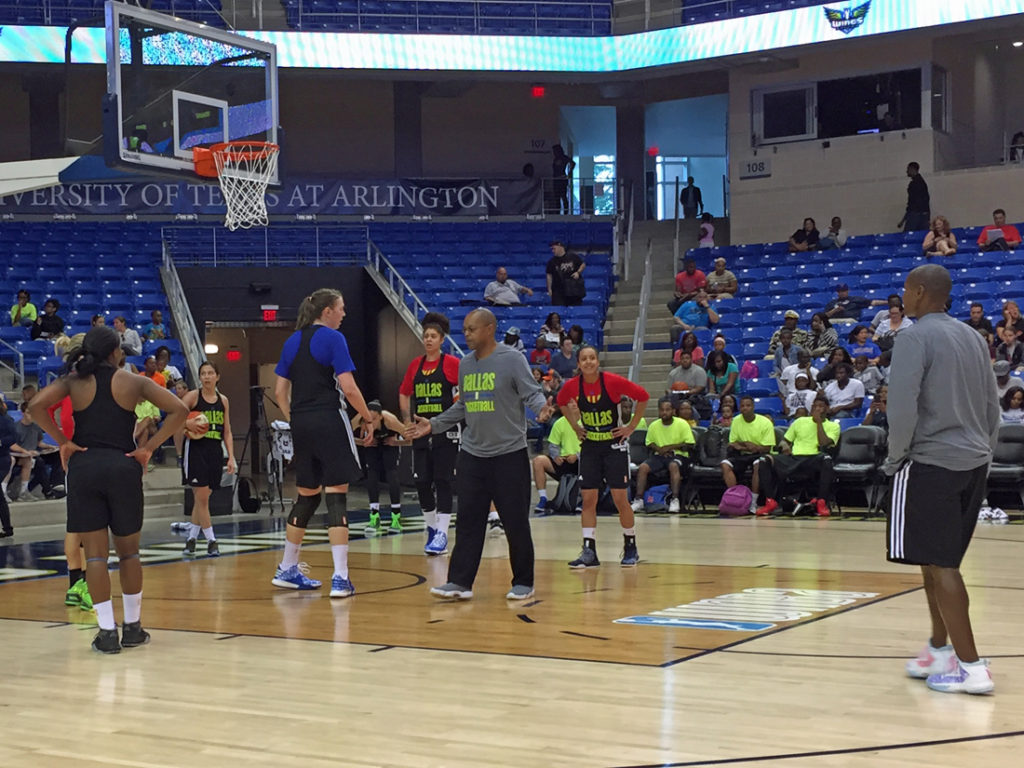
Wings_Practice_4423_1100

The WNBA’s Dallas Wings want you to know this is not your mother’s basketball game.

“My style of play is to get a lot of shots up and run,” said Wings head coach Fred Williams.

When I say “your mother’s basketball game,” I definitely mean your mother, not my mother. My mom once scored 57 points in a 1950s high school hoops game in Virginia. It was the old six-on-six version of the sport, but we can still surmise she got a lot of shots up and moved a good bit that day. So watching women’s hoopsters getting up and down the floor will be nothing new to her, but if you (or your mom) were expecting a plodding game from the area’s new women’s pro team, the Wings expect to show you differently.

“We get a lot of stereotypes as women playing in the professional ranks that our game is slower and less athletic,” said Wings forward Plenette Pierson. “Just to have a fast-paced game really changes things.”

Williams described his squad’s style of play as “up-tempo, fast break, you’ll see us do a little run-and-jump defense, a lot of traps.”

As he began training camp with Sunday’s open practice at UT-Arlington’s College Park Center, Williams mandated a number of full-court drills as he started implementing his preferred approach.

“It’s an up and down style. We want to try to get to 90 possessions each game,” guard Skylar Diggins said. “Coach Williams wants us up and down the court and to push the tempo. We want to control the tempo on both sides of the ball. That’s why you see us going up and down a lot in the first practice, getting ready for that.”

Diggins will play her third season in Williams’ system in 2016, having been part of the team when it was based in Tulsa. She missed much of last year with a knee injury, including an opening-round playoff loss. With the former All-Star back, Williams expects his core to be a strong one.

“We’ve been one of the top-scoring teams in the league the last couple of years with the same personnel,” he noted of a group that led the Western Conference in points-per-game in 2015. He also expects some off-season additions will improve his club’s ability to execute his preferred style of play.

“We’ve added some speed with (1st-round pick Aerial) Powers in there with us and I think with (2nd-round pick Ruth) Hamblin in there in the middle, it’s going to open it up for our shooters from the outside.”

One of those shooters came to the team in March via a trade with the Los Angeles Sparks.
“You’ve got to have a nice veteran player who has won championships in this league that can step in in the perimeter area and knock down some threes for you,” said Williams of new guard Erin Phillips.
The Australian Olympian, who already had a house in McKinney, feels Williams’ preferred tempo will fit her game.

“I’m a shooter, so the faster the ball moves, the quicker it gets in your hands and the quicker you can get a shot off as well. It gives you more space to play,” she said. “It’s a really fun way to play as a player.”

Williams hopes his players aren’t the only ones who find his favored pace enjoyable.

“I call it a fan-friendly atmosphere for the family. If (the players) do that (play up-tempo) and play well, these fans will come out and watch us,” the coach suggested.

If you do, you’ll see some fast-breaking ball. In truth, if you thought modern women’s basketball was a slow game, you probably should have realized long ago those stereotypes weren’t accurate. Some folks have known since the 1950s.

You can see for yourself when the Dallas Wings open their regular season home schedule May 21.


Rush Olson has spent two decades directing creative efforts for sports teams and broadcasters. He currently creates ad campaigns, television programs, and related creative projects for sports entities through his company, Rush Olson Creative & Sports.


RushOlson.com

Linkedin.com/company/rush-olson-creative-&-sports

Facebook.com/RushOlsonCreativeandSports
Thursday, April 21, 2016

Sowing Dreams

This article originally appeared in the Blotch section of the Fort Worth Weekly's website. To read it on that site : http://www.fwweekly.com/2016/04/20/sports-rush-sowing-dreams/


It’s one thing to break new ground. It’s another to continue to plow it, plant seeds in it, and nurture it year after year.

Last Thursday, a group of prominent sports figures (and a handful of entertainers) congregated in North Texas for the purpose of cultivating the future. The likes of Jerry Jones, Larry Fitzgerald, Rick Carlisle, and Toby Keith came at the behest of a Basketball Hall of Famer. The celebs’ host has always pushed boundaries.

Nancy Lieberman became the youngest basketball player to medal in an Olympics, the first to play in a men’s professional league, the first to be the head coach of a men’s professional team in the NBA Developmental League, and, just last year, only the second woman to serve as a full-time NBA assistant coach. What got all the prominent people to attend Lieberman’s annual Dream Ball gala, however, didn’t have to do with honoring her on-court achievements. It had to do with how she took her experiences, considered the people who helped her accomplish them, and looked to recreate their impact for others.

“All of us in this room are beneficiaries of people who reached down and pulled us up. I love that Nancy is doing that, not only on her own, but bringing all of us,” event host Mike Tirico of ESPN told the crowd.

Her Nancy Lieberman Charities aims to create opportunities for young people through basketball and educational initiatives, reflecting how assistance in those areas contributed to Lieberman’s own advancement.

“While your playing time is fleeting, the ability to turn almost every minute that you were on the court turn into a lifetime of recognizing a need and recognizing how to leverage your experiences, your career, into something that benefits a lot of people,” Cowboys owner Jerry Jones said in an interview a few days prior to the event, “Nancy’s arguably as good or better than anybody I’ve ever met.”

The Dream Ball raises funds for the non-profit’s programs, as the charity looks to facilitate another generation of groundbreakers. They honored Keith, Mavericks General Manager Donnie Nelson, and Cowboys Executive Vice President and Chief Brand Officer Charlotte Jones Anderson for their careers and philanthropic endeavors. Anderson summed up Lieberman’s philosophy from the podium as she accepted her award.

“You have many firsts associated with you, and I’m sure many people ask you what is it like to be the first.  Your response is ’It’s actually my obligation to make sure I’m not the last.’”
When people like Anderson and Lieberman break through in non-traditional sports environments, they succeed for more than just themselves. For one thing, they show the establishment a new way to win. Last week, we also celebrated the anniversary of Jackie Robinson and Branch Rickey showing baseball a new way to win, one that was quickly copied to the betterment of all.

The innovators also show the way to those who come after them, by example, and in the case of Lieberman and her guests, though personal investment of resources.

“It was my dream to be on the court because it was a safe environment. Nobody cared if I was a girl. Nobody cared if I was white or young or old. It was all about ‘could you play,’” Lieberman told Tirico on the stage. Her organization builds basketball courts at places like Boys and Girls Clubs so others can have the same experience and show that they, too, can play.

Eventually, as newcomers prove how irrelevant traits like skin color or gender or national origin are to the question of whether or not they can contribute to a franchise, more people like them get chances. Rick Carlisle introduced Donnie Nelson at the Dream Ball and spoke of the way the honoree’s efforts had demonstrated that non-Americans could play championship-quality basketball. Nelson’s open-minded outlook led him to hire a female coach for his D-League team, mostly because he and his bosses knew she understood hoops. The season she coached them, the Texas Legends made the D-League playoffs, the only time they have done so since moving to Frisco.

That season, Lieberman showed she could coach men effectively. At the Dream Ball, she and her attendees showed how the seeds sown by groundbreakers can blossom into opportunities well beyond their own fields, or courts, or continents.


Disclosure : Nancy Lieberman Charities once paid me for AV work I did on its behalf.


Rush Olson has spent two decades directing creative efforts for sports teams and broadcasters. He currently creates ad campaigns, television programs, and related creative projects for sports entities through his company, Rush Olson Creative & Sports.


RushOlson.com

Linkedin.com/company/rush-olson-creative-&-sports

Facebook.com/RushOlsonCreativeandSports

Sunday, January 3, 2016

Making Your Investment in Sport Work


So you’re an investor and you love sports. Can you feed your passion by getting financially involved with a sporting entity and still maintain the fiscal discipline that made you a good investor in the first place? The answer is yes, and the key is to have a clear idea of what to look for and what to expect.

If you love sport, some of your return will be non-monetary. You’re going to enjoy feeling a part of a team, or moving your favorite sport forward, or seeing your investment on television, or interacting with elite athletes, or rewarding your hometown’s loyal fans. Those are worth a lot, but you’d still like to recover your investment, too.


I’m a sports business guy, not an investment guy, but I’ve been on the inside of a lot of teams and media outlets and seen what worked and what didn’t. If you’re an experienced investor, you know how to assess rate of return and the intricacies of the finance world. The sports business is different from every other industry, however, and being a sports fan doesn’t necessarily equate to mastery of the sport management trade. Here then, are some insider insights into what to look for.

Let’s start high profile. If you buy into a major league team, you’re looking to win and you’ll pay for it. Expect cash calls for the purpose of bettering the team on the field, especially in non-salary-cap sports like Major League Baseball and European football (soccer). You may make some money during your ownership experience, but the monetary return most likely comes when you sell. NASCAR has historically been an exception, with team sales yielding little value, though that may change with proposed new ownership rules.

Minor league sports represent a low-margin business. You’ve got to truly love the game, but also realistically assess how much that love means to you and how much you can afford to lose feeding it. At the lower levels in the U.S., franchises have historically moved and folded frequently. The right situation can still be a fun and profitable investment, but you have to approach it realistically.

Whether you buy a big or small team, quick cash probably isn’t what you should expect.

You don’t have to buy into a pro team to get into sports, of course. Marketing agencies, television/media projects, and a host of ventures aimed at those who play, attend, and work at sports have the potential to produce value. In fact, many feel a sports background is ideal preparation for becoming an entrepreneur. For what should you look at in the wider sports world?

Connections : If the venture requires an entrée into the world of big-time sports to work, do the organizers have them? If they just have a good idea but not the ability to reach busy decision-makers, this might not be the place to sink your money.

The Smell Test : Even if you’re not an experienced sports businessperson, your sense of sport from the fan’s perspective still counts for something. Does the idea sound cool? Is it something you’d like to see happen? Is it something you’d be passionate about? Because some of your return comes from your enjoyment of the project, passion for the concept counts for something.

Content : Does the venture have the ability to tap into the huge content engine that is sport? We’ve all read about some of the huge TV deals teams and leagues have signed recently. In a fragmented media world, sports retains the ability to deliver the eyeballs of desirable demographic groups. Does the venture have a television and/or radio presence? Can it effectively tap into the digital content space?

Growth Potential : Sports is a saturated market, but there are still profitable niches to be found. Digital technology has pushed the envelope in sport as it has in every other industry. As the world shrinks, international sports initiatives become more viable. Finding untapped markets or disrupting current ones has never been easier (not that it’s easy, by any means).

You may have a passion to grow your favorite sport and see its popularity increase, be it cricket, rugby (union or league), pickleball, jai alai, sumo, or whatever. Is there a venture that furthers that goal while also potentially turning a profit?

Value You Can Add : Can your background or expertise make the venture more viable? It’s important to realize what you don’t know, of course. You shouldn’t take over the draft room or coach the defense just because you bought the team, But if your, say, finance or technical background can help the endeavor grow, that might make it even more enjoyable to be a part of (while also reducing risk). The likes of Mark Cuban, Ted Leonsis, and Bill Veeck brought more than a checkbook to their franchises.

Any investment carries monetary risk (I think I’m supposed to say that somewhere here in case you make your investment decisions based on emails retrieved from your spam folder). That’s true in sports as anywhere else. Luckily, sports also provides a psychic satisfaction that’s hard to reproduce elsewhere. It’s why those of us who have made it our careers invest time, money, and passion into it. At some level or other, we’re all invested - hopefully this article helped you decide which kind of investment might work for you.


Rush Olson has spent two decades directing creative efforts for sports teams and broadcasters. He currently creates ad campaigns and related creative projects for sports entities through his companies, FourNine Productions and Rush Olson Creative & Sports. If you’d like to further discuss points raised in this post, email him any time at rush@rusholson.com.


Wednesday, December 30, 2015

Could This Sport Help You Keep Your Resolutions?

This post originally appeared on the Blotch page at the Fort Worth Weekly. To read it on that site :http://www.fwweekly.com/2015/12/29/resolve-to-pickleball-in-2016/


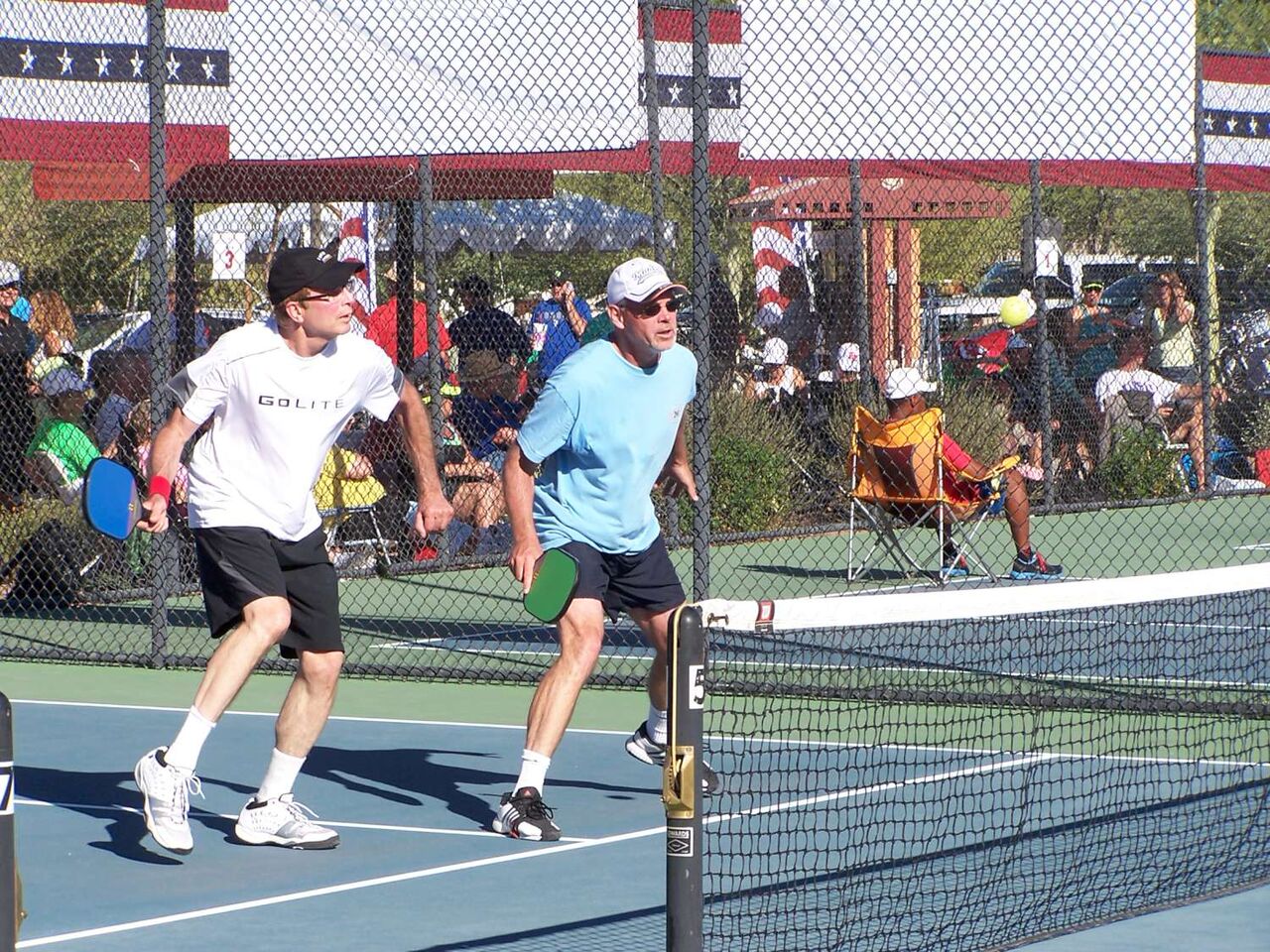
Photo courtesy of Richard Kaiser
You’re about to make a New Year’s resolution, aren’t you? This is the year you’re going to start exercising, right?

Maybe you’re thinking you’ll get back into tennis or racquetball, but you’re not sure your older joints will take the pounding as well as they did when you were 22. Also, you might have sold your racquets at your mom’s garage sale and are leery of the expense of acquiring new ones. I recently played a sport that might solve your problem. It’s called pickleball.
Now, to be clear, I don’t want to discourage you from getting into tennis, racquetball, MMA, or whatever you want to try. Those are all great sports, and whichever one helps you keep that resolution is fine by me. If you already like racquet sports, though, or think you would, it’s worth exploring pickleball, too.

If you’ve ever played another racquet sport competitively, you’ll pick it up quickly. I played high school tennis, but I haven’t played the sport regularly since then (and I wasn’t that good back in the day –– just ask my former double partners). Within minutes, however, I was keeping rallies going and playing games. One of my playing partners, defending senior (50-plus) national singles, doubles, and mixed doubles champion Scott Moore, says a short learning curve is not terribly unusual for former tennis, racquetball, squash, badminton, and table tennis players.

Did you notice how I casually worked in that I was playing with a national champion? I played doubles with Moore and his family and the points and matches were competitive. Do I think he pulled out all his tricks? No way. But my ancient racquet-sport muscle memory allowed me (and him, I am pretty sure) to have a rewarding pickleball experience the first time I played. In fact, Moore said one of the sport’s appeals is that even a player of his level can have a good time playing with partners of varying ages and abilities.

You actually use a paddle, not a racquet, and the ball resembles a wiffle ball. You can lay four pickleball courts out on a tennis court at one time, though you do need to add a few lines to make it just right. The net is basically a small version of a tennis net.


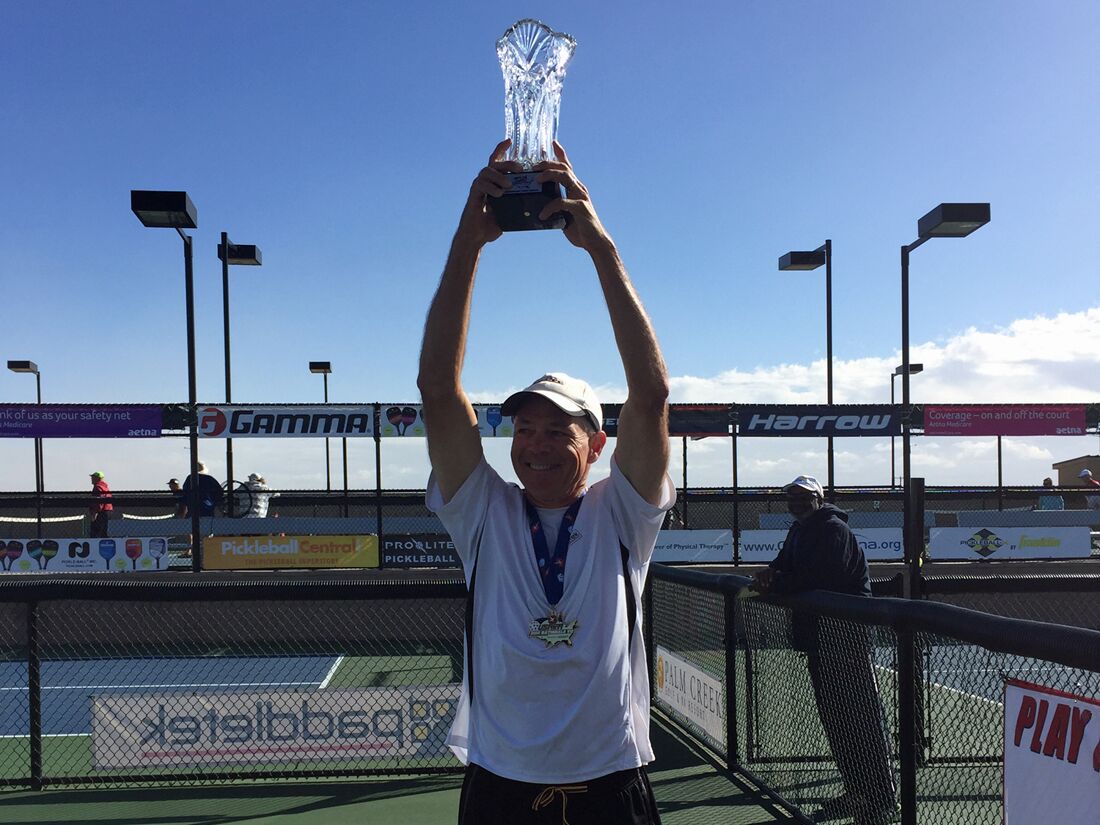
Photo courtesy of Richard Kaiser

The court’s smaller size means you’ve got a lot less ground to cover than some other sports, especially if you play doubles (as most pickleballers do). The rules and scoring are simpler than tennis’s (no loves, deuces, or tie-breakers to worry about).

Are you considering making pickleball part of your resolution planning? It turns out that a New Year’s resolution from a couple years ago is what got Moore serious about pickleball. He had grown up in Fort Worth playing tennis and later tried other racquet sports, too. He discovered pickleball a few years ago, and when he started playing it a lot, he found he had natural talent. As 2013 turned into 2014, Moore resolved to get good enough to win on a national level.

“I embarked on a year-long journey of working out, eating healthier, and practicing and stretching 5-6 days a week, all with the end goal in mind,” he said.

He trained hard enough to lose 20 pounds, and became a world-class player.

Eventually both he and his son/training partner Daniel won regularly in singles and doubles at the biggest competitions in the country.

They are now professional players, and Scott Moore, who currently lives in Colorado Springs, said they earned about $5,000 each in 2015. His own results were remarkable.


“I became the first ever trifecta winner at the Tournament of Champions, and at nationals as well,” he noted. Daniel Moore won big, too, and the father believes his eldest son to be the best pickleball player in the world.

The USA Pickleball Association hosts tournaments and bills the sport, which has been in existence since 1965, as one of the fastest growing in the country. It has proven especially popular in retirement communities, and pickleball seems to be seen as a more viable lifetime sport even than tennis because of its lower movement requirements. I also think younger children might find it an easy entry into the world of racquet sports because of the smaller courts. The cost of entry is often lower than some other sports, with a good paddle costing $70 (and cheaper ones less) and durable balls upwards from $3. Net systems, if needed, are under $200. Scott Moore represents paddle manufacturer Paddletek, and more firms seem to be getting into the sport, as global brand Wilson did in 2013.

Tennis clubs have started to embrace pickleball as a way to retain and recruit members. Some of Fort Worth’s private clubs have lined courts (we played at Rivercrest), but the sport hasn’t taken off in Texas yet. Perhaps your resolution will jumpstart it.

By the way, actual pickles have a lot of nutritional value, if you don’t have a dietary issues with salts and avoid the ones with substantial sugar. So a resolution that involved eating more pickles and playing some pickleball might really make 2016 a happier new year.


Rush Olson has spent two decades directing creative efforts for sports teams and broadcasters. He currently creates ad campaigns and related creative projects for sports entities through his company, Rush Olson Creative & Sports.


RushOlson.com

Linkedin.com/company/rush-olson-creative-&-sports

Facebook.com/RushOlsonCreativeandSports