I just tried the hottest trend in sports recovery.
Or at least as hot as you can get at 240 degrees below zero.
When you play sports your whole life, you inevitably run (or stumble)
into situations where you have to “put some ice on it.” We’ve all
filled plastic bags from the freezer to place on sprained ankles and
sore shoulders. The method I sampled is an ice bag on steroids (ok, bad
choice of recovery metaphor there).
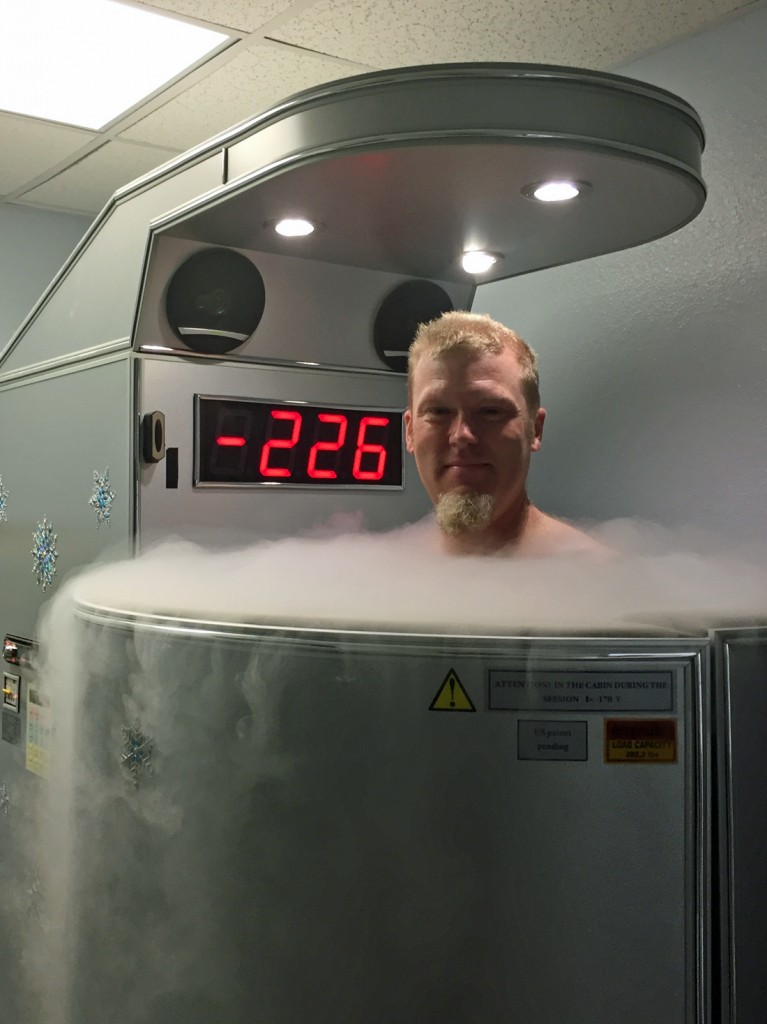
Wearing only gloves, socks, and a pair of plaid boxer shorts (your
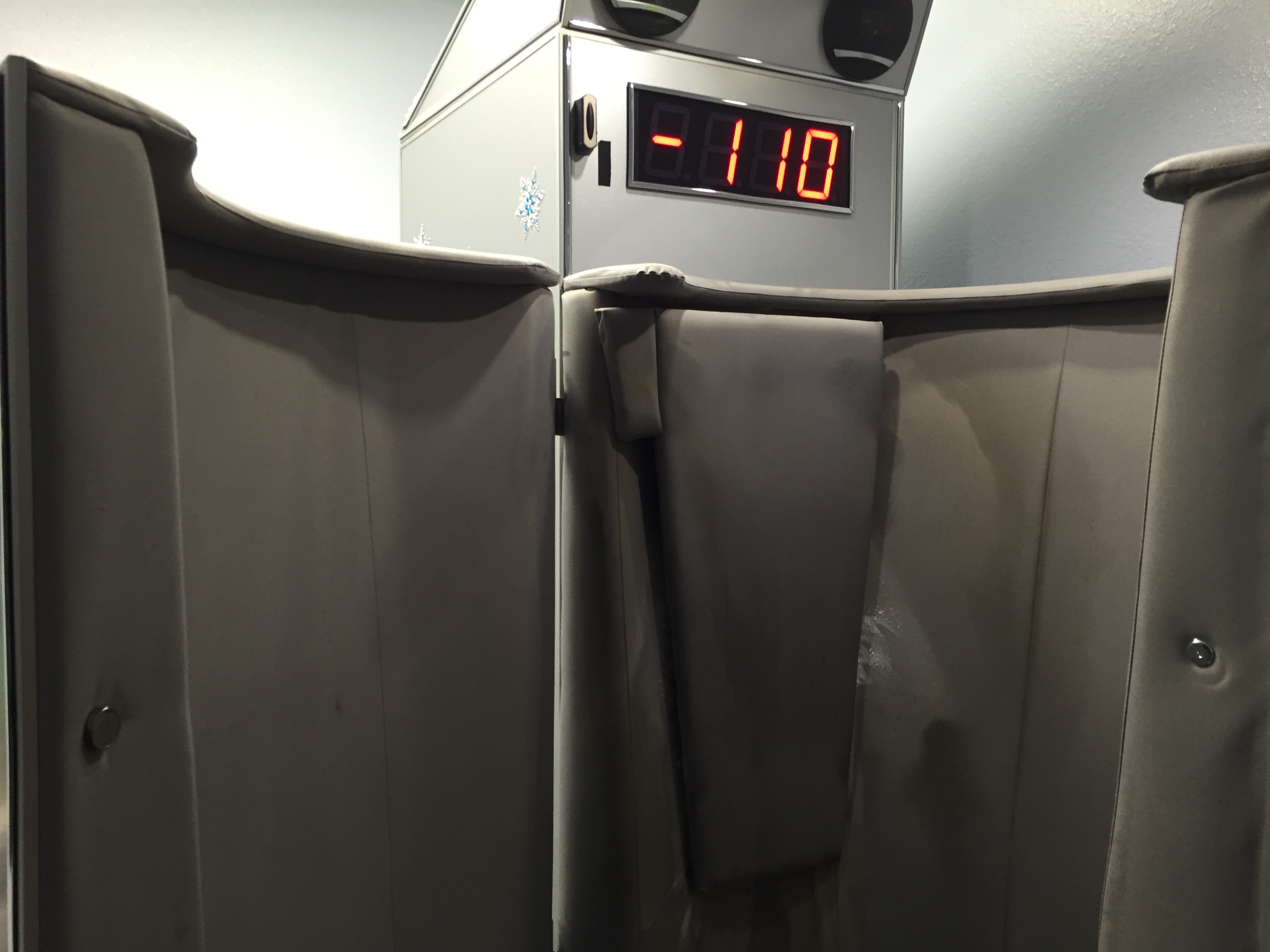
underwear selection may vary), one steps into a shoulder-high cylinder
which floods with chilled nitrogen gas. Then the chamber gets cold.
Really cold. Snow Miser cold.
I had my session at C3 Cryo Club in Burleson. Owner Lisa Flynn
monitored the machine as it rapidly lowered the numbers on the attached
thermometer.
“The cryotherapy starts to work on your body when the temperature
reaches minus 166 in the chamber. The temperature will drop to minus
240, minus 250, sometimes minus 260 for about 30 seconds while you’re in
the chamber,” Flynn explained.
I had played softball the night before and run more than usual
(fallen over more, too). I hoped the cryotherapy would alleviate some of
the inevitable muscle soreness. Flynn became aware of cryotherapy
thanks to an injury of the diamond.
“My son was a freshman in high school, 14 years old. He rolled his
ankle running to first base. The trainer told us we needed to take him
to have an x-ray. It swelled up pretty bad. He had a high ankle sprain.
The orthopedic told us he’d be out of playing three to five weeks. So he
came to the trainer and he went and did cryotherapy every other for two
weeks, so he did six treatments. After that sixth treatment, he was
back on the field running, sliding, playing like he’d never gotten hurt
before.”
Athletes at all levels
have started using the procedure, most prominently in place of ice
baths. After her son’s experience, Flynn, a nurse by profession, began
to investigate the procedure before eventually opening her own shop.
“We discovered that cryotherapy was actually developed in the 70s in
Japan and it was originally developed for rheumatoid arthritis patients.
However, it had gotten popular here in the United States in 2011,
actually in Texas in 2011, when the Dallas Mavericks used it for their winning season.” Flynn’s cryo users consist of more than just players seeking a championship.
“A lot of people will come in with joint pain, inflammation, just in
general throughout their body. They may be or may not be diagnosed with
rheumatoid arthritis, fibromyalgia, (or) lupus,” she explained, “It has
helped symptoms with those clients so they can have a better quality of
life. It doesn’t necessarily cure it, but it does help with the
inflammation they experience in their bodies.”
The science behind the treatment involves fooling your body into rushing blood to a core it believes is in mortal danger. Research is ongoing. How did it make me feel? I felt cold. Duh.
I grew up in Texas. I don’t like cold. I’d rather it be 100 every day
than ever drop below 60. Luckily, the operator (Lisa Flynn in my case)
talks to the subject the whole time to take one’s mind off one’s
goosebumps. She also doesn’t leave the groceries in the freezer too
long.
“We control the time that you’re in there. You cannot stay in there
any longer than three minutes,” Flynn said. “Some people, two minutes,
that’s it, every time they get in. The average time is two and a half
minutes.”
It was hard for me to evaluate whether I felt better afterward than I
would have otherwise after just a single cryo session. But the
endurance athlete who recommended it uses it regularly and plenty of
other sportspersons do as well. I may have a better idea after the next
time I play softball and don’t use it. In the meantime, you can guess
what I’ll be thinking about every time the air conditioner comes on.
Rush Olson has spent two decades directing creative efforts for
sports teams and broadcasters. He currently creates ad campaigns,
television programs, and related creative projects for sports entities
through Rush Olson Creative & Sports and FourNine Productions.
It’s one thing to break new ground. It’s another to continue to plow it, plant seeds in it, and nurture it year after year.
Last Thursday, a group of prominent sports figures (and a handful of
entertainers) congregated in North Texas for the purpose of cultivating
the future. The likes of Jerry Jones, Larry Fitzgerald, Rick Carlisle,
and Toby Keith came at the behest of a Basketball Hall of Famer. The
celebs’ host has always pushed boundaries.
Nancy Lieberman became the youngest basketball player to medal in an
Olympics, the first to play in a men’s professional league, the first to
be the head coach of a men’s professional team in the NBA Developmental
League, and, just last year, only the second woman to serve as a
full-time NBA assistant coach. What got all the prominent people to
attend Lieberman’s annual Dream Ball gala, however, didn’t have to do
with honoring her on-court achievements. It had to do with how she took
her experiences, considered the people who helped her accomplish them,
and looked to recreate their impact for others.
“All of us in this room are beneficiaries of people who reached down
and pulled us up. I love that Nancy is doing that, not only on her own,
but bringing all of us,” event host Mike Tirico of ESPN told the crowd.
Her Nancy Lieberman Charities aims to create opportunities for young
people through basketball and educational initiatives, reflecting how
assistance in those areas contributed to Lieberman’s own advancement.
“While your playing time is fleeting, the ability to turn almost
every minute that you were on the court turn into a lifetime of
recognizing a need and recognizing how to leverage your experiences,
your career, into something that benefits a lot of people,” Cowboys
owner Jerry Jones said in an interview a few days prior to the event,
“Nancy’s arguably as good or better than anybody I’ve ever met.”
The Dream Ball raises funds for the non-profit’s programs, as the
charity looks to facilitate another generation of groundbreakers. They
honored Keith, Mavericks General Manager Donnie Nelson, and Cowboys
Executive Vice President and Chief Brand Officer Charlotte Jones
Anderson for their careers and philanthropic endeavors. Anderson summed
up Lieberman’s philosophy from the podium as she accepted her award.
“You have many firsts associated with you, and I’m sure many people
ask you what is it like to be the first. Your response is ’It’s
actually my obligation to make sure I’m not the last.’” When people like Anderson and Lieberman break through in
non-traditional sports environments, they succeed for more than just
themselves. For one thing, they show the establishment a new way to win.
Last week, we also celebrated the anniversary of Jackie Robinson and
Branch Rickey showing baseball a new way to win, one that was quickly
copied to the betterment of all.
The innovators also show the way to those who come after them, by
example, and in the case of Lieberman and her guests, though personal
investment of resources.
“It was my dream to be on the court because it was a safe
environment. Nobody cared if I was a girl. Nobody cared if I was white
or young or old. It was all about ‘could you play,’” Lieberman told
Tirico on the stage. Her organization builds basketball courts at places
like Boys and Girls Clubs so others can have the same experience and
show that they, too, can play.
Eventually, as newcomers prove how irrelevant traits like skin color
or gender or national origin are to the question of whether or not they
can contribute to a franchise, more people like them get chances. Rick
Carlisle introduced Donnie Nelson at the Dream Ball and spoke of the way
the honoree’s efforts had demonstrated that non-Americans could play
championship-quality basketball. Nelson’s open-minded outlook led him to
hire a female coach for his D-League team, mostly because he and his
bosses knew she understood hoops. The season she coached them, the Texas
Legends made the D-League playoffs, the only time they have done so
since moving to Frisco.
That season, Lieberman showed she could coach men effectively. At the
Dream Ball, she and her attendees showed how the seeds sown by
groundbreakers can blossom into opportunities well beyond their own
fields, or courts, or continents.
Disclosure : Nancy Lieberman Charities once paid me for AV work I did on its behalf.
Rush Olson has spent two decades directing creative efforts
for sports teams and broadcasters. He currently creates ad campaigns,
television programs, and related creative projects for sports entities
through his company, Rush Olson Creative & Sports.
If you visit Surprise, Arizona for Rangers spring
training, you probably won’t find yourself needing to source several
bags of whole pecans. You likely won’t find yourself at the mall seeking
the cheesiest temporary tattoos you can find. And you almost certainly
won’t have to haul a drum kit, keyboard, and complete horn section to
the visiting clubhouse. But should one of the above circumstances
arise, let me know. I may be able to help you.
From 2001 to 2012, I attended every Rangers spring training,
primarily for the purpose of gathering video and audio elements to
create commercials and other media productions for the team. The Rangers
ran a pretty lean shop, so as the producer/writer/director of the
spots, I typically also served as prop master,
When we shot in Arlington, I knew plenty of places to buy, borrow, or
shoplift props. The ballpark had a whole store full of them downstairs.
A closet in my old room at my parents’ Fort Worth home became known as
“the prop closet” after I raided it multiple times in search of old
baseball cards and other sports memorabilia needed for commercials.
Digging up unusual items presents more of a challenge in remote
locales, and you never know what a given concept will require. The first
time I found myself in need of spring training props beyond bats and
balls came in 2002 in Port Charlotte, Florida.
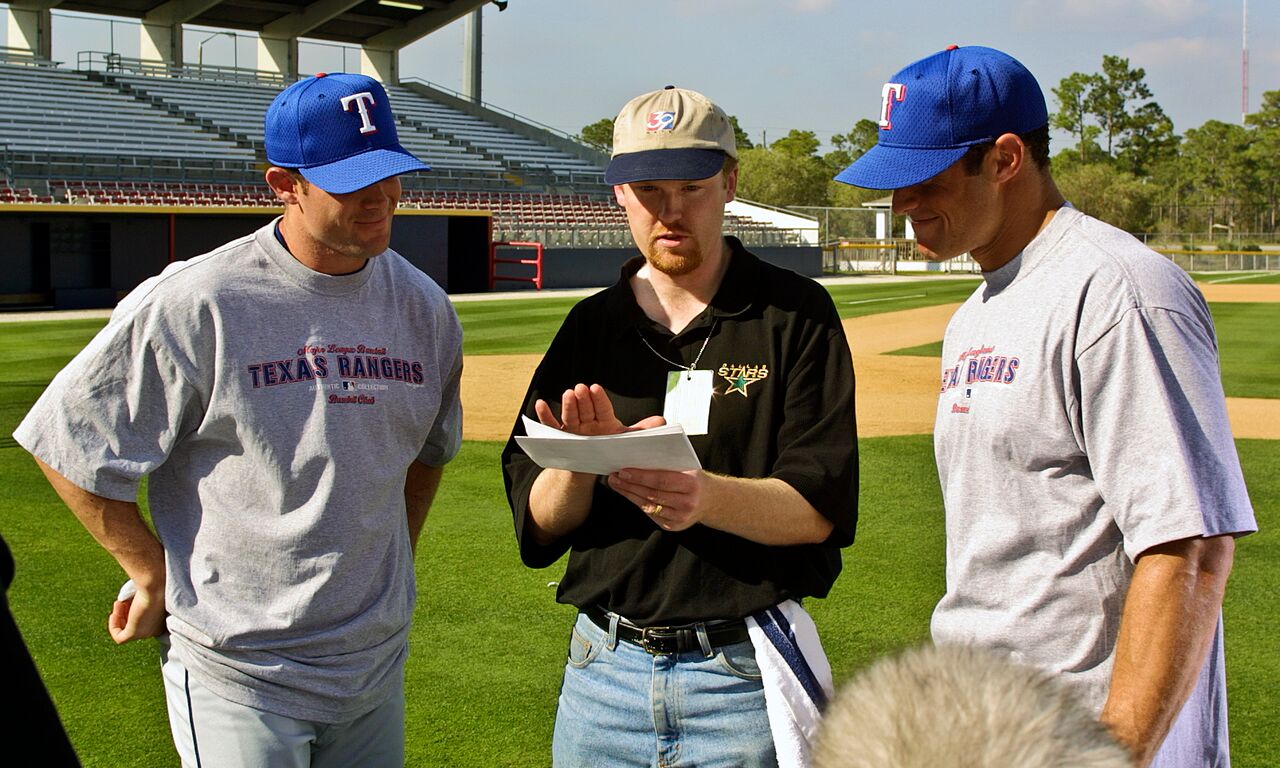
Courtesy Brad Newton/Texas Rangers In the offseason, I had
run across a list compiled by the prestigious National Hot Dog and
Sausage Council of hot dog-eating dos and don’ts.
I built a series of commercials around these official guidelines. It
turns out you aren’t supposed to eat hot dogs off fine china, so I was
faced with needing to find some dishes we could abuse in a tiny Florida
town. I turned to a staple of prop people everywhere, the local Goodwill
store. Soon enough, we had a tea set and plates to use in Michael Young’s first career commercial.
We ended up not destroying them, and I had no intention of stuffing
them into my luggage, so I donated them back to the store. Somewhere,
someone is eating off the same second-hand plates a future All-Star did.
I can tell you where the Goodwill is in Surprise, Arizona,
too. I found an owl sculpture for a Park Place Dealerships Triple Play
spot that former third baseman Hank Blalock found hilarious. Later, we
would put it in random people’s offices at the ballpark. It is probably
still floating around up on the fourth floor somewhere. Goodwill was no
help, however, when it came to finding whole pecans.
The ad campaign in 2011 revolved around Texas symbols like
bluebonnets, longhorns, and, in this case, the state tree. The premise
of the spot was that Nolan Ryan (team president at the time) had planted
a pecan tree in the ballpark. Texans know shelling pecans can be a
difficult task, so power-hitter Nelson Cruz had supposedly been
recruited to help by mashing them off a tee, assisted by then-hitting
coach Thad Bosley. I needed pecans still in their shells, and Arizona is
not the pecan haven North Texas is. I finally found some in a co-op
grocery down in Tempe and Cruz scattered them around the batting cage.
We had used the same batting cage in 2005 for applying temporary
tattoos. For that project, I needed to scour the local mall for a
selection of the goofiest looking ones. I didn’t write the commercial
this time. The idea came from first baseman Mark Teixeira, and he
scripted it with input from Young and Blalock. Blalock had attained some
notoriety for his body art, and Teixeira and Young amusingly imitated
him with limited success.
I returned to Tempe for some custom wardrobe for a 2012 spot. We
couldn’t schedule the shoot until the last minute and needed custom
t-shirts done lickety-split. A college town seemed like the place to
find what we needed, and Brand X Custom T-shirts
delivered them. For this particular spot, I also shipped out the entire
stock of prop clothing I kept at the ballpark for use in videos.
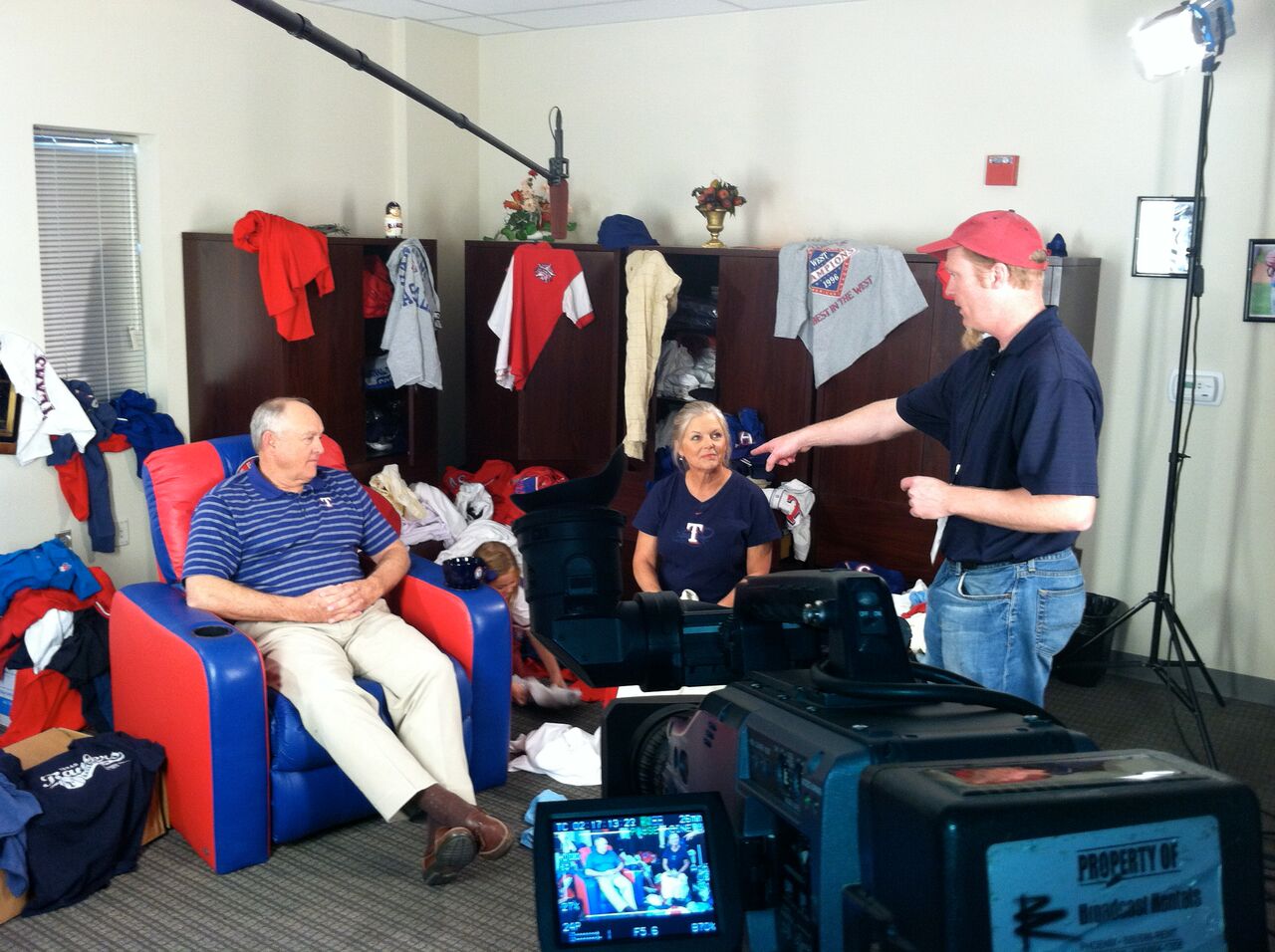
Courtesy Tim George/Texas Rangers
We
needed a lot, because the premise of this spot was that for Nolan Ryan
t-shirt day, we would actually be giving away Nolan’s own shirts. His
wife had ostensibly tired of them cluttering the closets and was getting
rid of all his ratty old tees. The crafty Hall of Famer had snuck out
an old favorite, however, and worn it to game with his grandkids (the
spot did co-star some actual Ryan grandchildren). The piece had five
alternating endings, which meant Nolan had to change five times to get
all the shirts in. As he trudged upstairs to change for the third or
fourth time, he said to me (jokingly, I am pretty sure), “Why’d I agree
to do this again?”
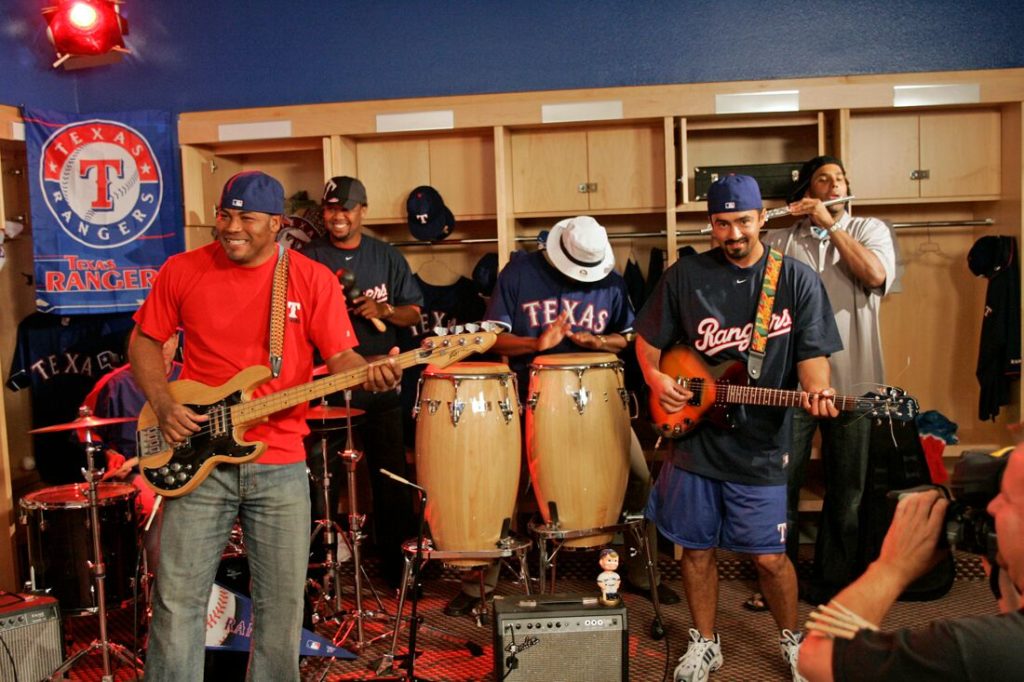
The bulkiest haul I had to track down came for a spot in 2005. In an
effort help Spanish-speaking fans identify with the ballclub, a TV spot
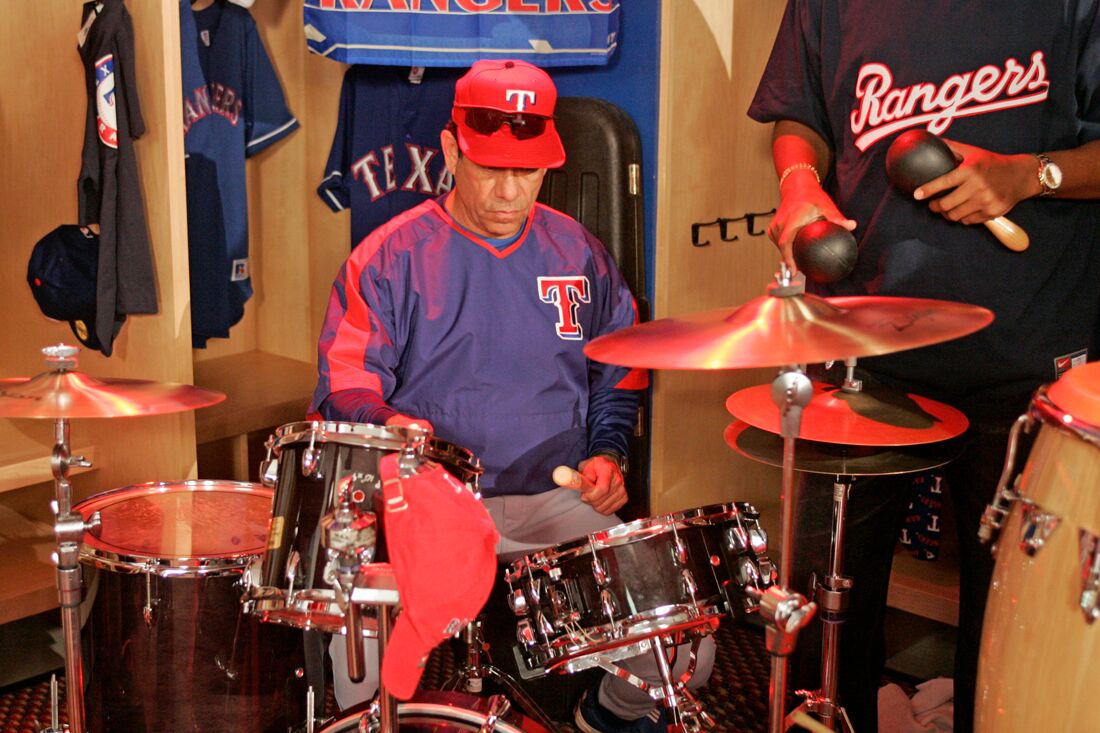
was to suggest that Rangers baseball moved with a Latin Rhythm. We
wanted to shoot it music video-style with all the Latin players. Some
friends at local studio Dallas Audio Post
helped me track down a backline company in Phoenix to supply a drum
kit, keyboards, horns, and everything we needed to supplement my own
guitar, bass, and amps (brought on the van from Texas). We mostly just
let the players pretend to jam as the spot’s music cut played, while our
videographers Eric Koski and Tim George, plus then-team photographer Brad Newton,
gathered images.
Courtesy Brad Newton/Texas Rangers
In putting the script together, I had scoured the
dictionary for words that might apply to both music and baseball, and it
turned out that we could make wordplay off the words for drumming and
hitting, That worked great, since the hitting coach at the time, Rudy
Jaramillo, spoke Spanish. He finished off the spot, and we also made an English version out of it, plus a longer music video.
The players apparently enjoyed it, because in 2010 Frankie Francisco
asked my Rangers colleague Hugo Carbajal and me to recreate the video.
He had missed the first shoot rehabbing an injury but thought it would
be a good bonding exercise for the players. We got to do it all over
again and it was a blast just like the first time, only now in high-definition thanks to advances in technology over the years.
I probably can’t be as helpful navigating Surprise as I could have
back in, say, 2009. My favorite wine bar closed and who knows if the
fish taco place and the Greek restaurant still exist. But if you need
unshelled pecans, a rental trombone, or a t-shirt reading “Chicks Dig
the Fastball,” I might be able to assist.
Rush Olson has spent two decades directing creative efforts for
sports teams and broadcasters. He currently creates ad campaigns,
television programs, and related creative projects for sports entities
through his company, Rush Olson Creative & Sports.
This post originally appeared on the Blotch page at the Fort Worth Weekly. To read it on that site : http://www.fwweekly.com/2016/01/19/love-sports-style/
courtesy Brad Newton/Texas Rangers
Two people attending a sporting event often share
an emotional rollercoaster. They experience ups and downs, hanging on
what happens next. They calm their nerves by telling themselves it’s
only a game, even though they know it’s much more.
And if everything goes well in the end, they go out on a second date together.
On Friday, Feb 5, the Fort Worth Weekly will host LOVE FW: A Curated Singles Event. The brains behind the Weekly’s fine Xs & Ohs blog
have created it, and if you’re single in Fort Worth, you should really
sign up. Hell, they’re holding it at a brewery. Even if you’ve declared a
moratorium on dating, you surely haven’t given up beer (in fact, a
relationship with beer often accompanies dissatisfaction in
relationships with the opposite gender).
So now that you’ve signed up, thanks for coming back to read the rest of this column, which, like my other Fort Worth Weekly
material, involves sports. What if you meet someone at LOVE FW and
you’re wanting to figure out where to take this fascinating individual
on an actual date? If you’re still reading, you like sports, so why not
take him or her on a sports date?
A trip to a game has some advantages for a first date. It’s low
pressure, with no awkward need to slow dance when the band breaks into
“Every Rose Has Its Thorn.” The action on the floor/court/ice can break
up awkward silence with the occasional “Wow, did you see him deke that
guy into next week!” Because you’re in a casual atmosphere, it removes
some pressure to dress up. A game tends to end with a good portion of
the evening still left, too, so you can always go elsewhere when it’s
over. Once the date is set, I expect it is probably a good idea to go ahead
and buy the game tickets. Advance purchase assures no “oh, um, let’s
just get frozen yogurt” moments when you show up and the arena is sold
out, plus it makes it tougher for the person you’re courting to back out
if you’ve messaged him or her a photo of the tickets. In today’s world,
resale markets help you unload them anyway in case the
not-yet-significant other gets cold feet or meets someone with better
seats. One cautionary note for sports first-daters: beware the kiss cam.
This scoreboard feature picks out random couples in the crowd and shows
them on the video board. The expectation is for the pair to then kiss
each other. If things are going really well, of course, that may be just
what you want. Otherwise, if you spot it before your companion does,
that would be a superb moment to offer to head to the concourse for a
round of beers or pretzels. I am particularly sensitive to this
phenomenon as I know a lot of the crew members who work the shows. Cruel
directors and camera operators like nothing better than to embarrass
unfortunate friends on a night out.
So where should you go? Certainly if both of you like a certain team
or sport that’s in-season, pick that one. Otherwise, I have a few ideas
for you.
None of these jaunts carry huge price tags. Of course, you can always
splurge for VIP packages, and yes, if you can afford to hire a private
jet and fly to the Champions League final, do that. If you’re out with
someone who’s meh about sports, you may need to consider adding an extra
high-end element so he or she can tell friends about the trip to the
suite or the pit passes. For the most part, though, let’s assume you
just want a fun North Texas sports experience with a little pizzazz.
Texas Rangers Buy tickets in Globe Life Park’s Lexus Club Terrace on the left field
side, ideally sections 210 and 211. The location tends to get what
passes for a summer breeze, plus you have a good view of the game and
the main scoreboard. You’re not in the zone, however, where you’re
likely to get hit by a foul ball if you’re paying more attention to your
paramour than the game. From a date standpoint, it also offers
air-conditioned bars just above the seating section. They work well if
you want to cool off and just chat over a beverage.
Before or after the game, I like Birraporetti’s in Arlington for
their Caprese salad, quality house wines, and relaxed atmosphere.
If you’re wild about a Rangers fan and can’t wait around for baseball season, you can arrange a flower delivery from team mascot Rangers Captain in the days leading up to Valentine’s Day.
Dallas Mavericks/Stars You’ve got a ton of lovely upscale dining and drinking options in and
around American Airlines Center. If you’re not a high roller, and are
sitting in the top level, consider the Dr Pepper Fan Zone. If you just
want to go somewhere and converse, I have never seen it crowded or
noisy. They don’t serve alcohol, but there’s something appealing about
just sharing a Dr Pepper. It might even be classified as “cute.” You can
always head to one of the bars later.
Fort Worth Stock Show Rodeo The rodeo just started and runs another couple of weeks. You might be
hard-pressed to go with someone you meet at LOVE FW, as the final
performance happen the following day. However, keep it in mind until
then and by all means for next year. In addition to watching some of the
best cowboys, cowgirls, and bucking stock in the world, you have the
whole Stock Show through which to wander. If you want to mix in some
culture before your sports, visit a museum beforehand. Kimbell members
park free in the facility’s parking lot.
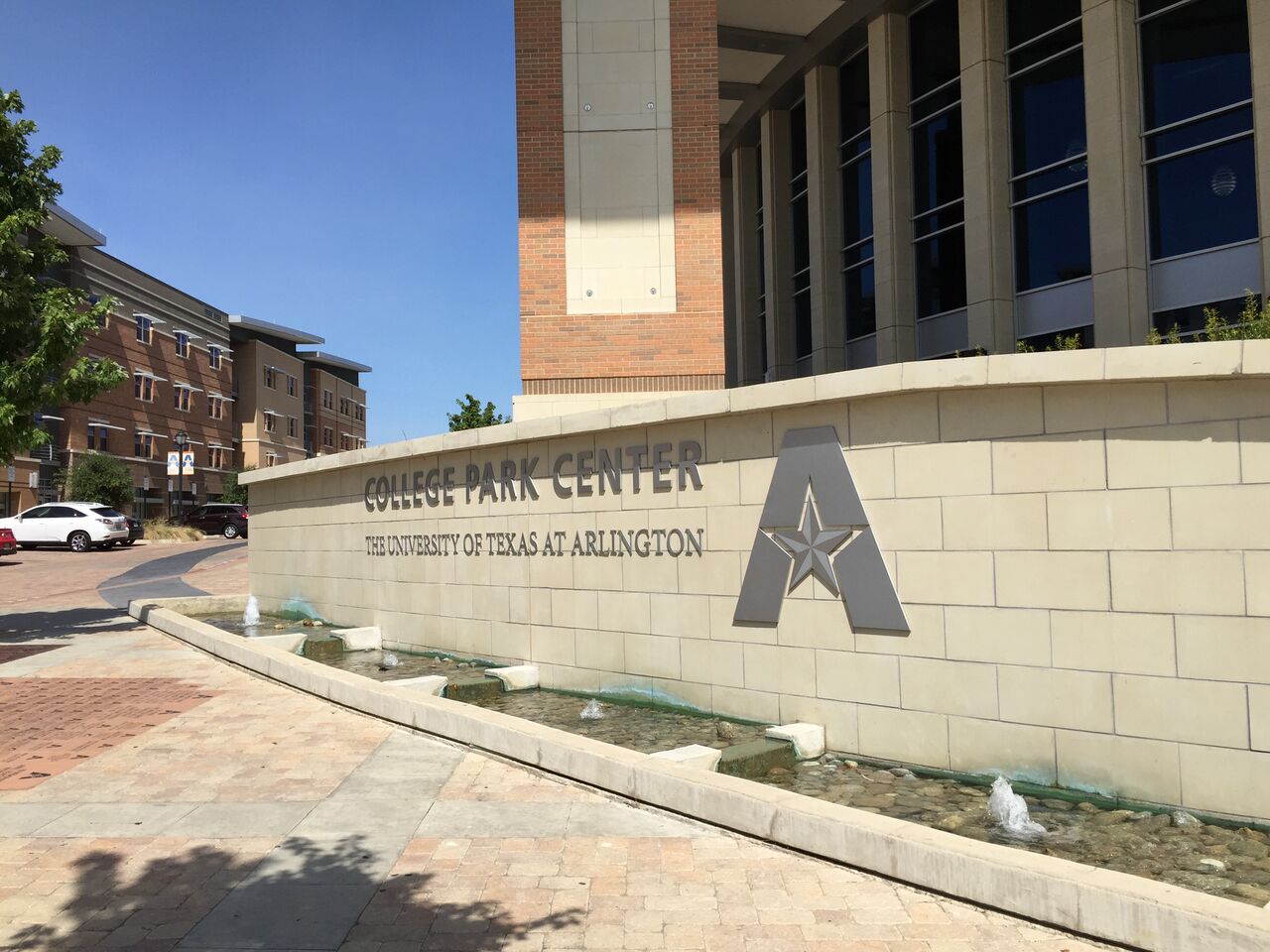
College Park Center This might be the best value in local sports, especially given the
way the Texas-Arlington men’s basketball team has been playing. They do a
lot of double-headers, so you can see both the women’s and men’s teams
for $7.00 – $20.00. What I especially like about the UTA game experience
is nearby downtown Arlington. I’m partial to the Grease Monkey, but you
have lots of good options for pre- or post-game socializing. This
summer, the WNBA’s Dallas Wings will play at College Park Center. My
guess is that a guy who shows respect for the women’s game might impress
a sports-minded female.
Pro Wrestling It’s part sport, part spectacle, and a good way find out if your
partner takes him or herself too seriously. You’ve got Wrestlemania 32
coming up at AT&T Stadium on April 3rd. There are also a number of
periodic local smaller-scale wrestling events going on at any given
time. I noticed that VIP Wrestling is putting on a “Love, Lies, and Lariats” show on February 12th in Arlington.
Ride The Bike Differences in ability levels make a lot of participatory sports
experiences with someone you barely know potentially problematic.
Suggesting you do an iron distance triathlon together if he hasn’t
trained for one likely won’t get you far. However, casual cycling,
perhaps followed by a coffee or other beverage might set a nice tone.
Choose somewhere picturesque and not too taxing. Fort Worth’s Trinity
Trails provide some excellent options, I like to start by the Stockyards
and ride through Trinity Park past the zoo.
Sports Charity Events Attending a sportsy fundraiser offers a casual good time and the
do-gooder component can’t hurt your chances of making a good impression.
Some of these can get a bit pricy, but they also often provide a tax
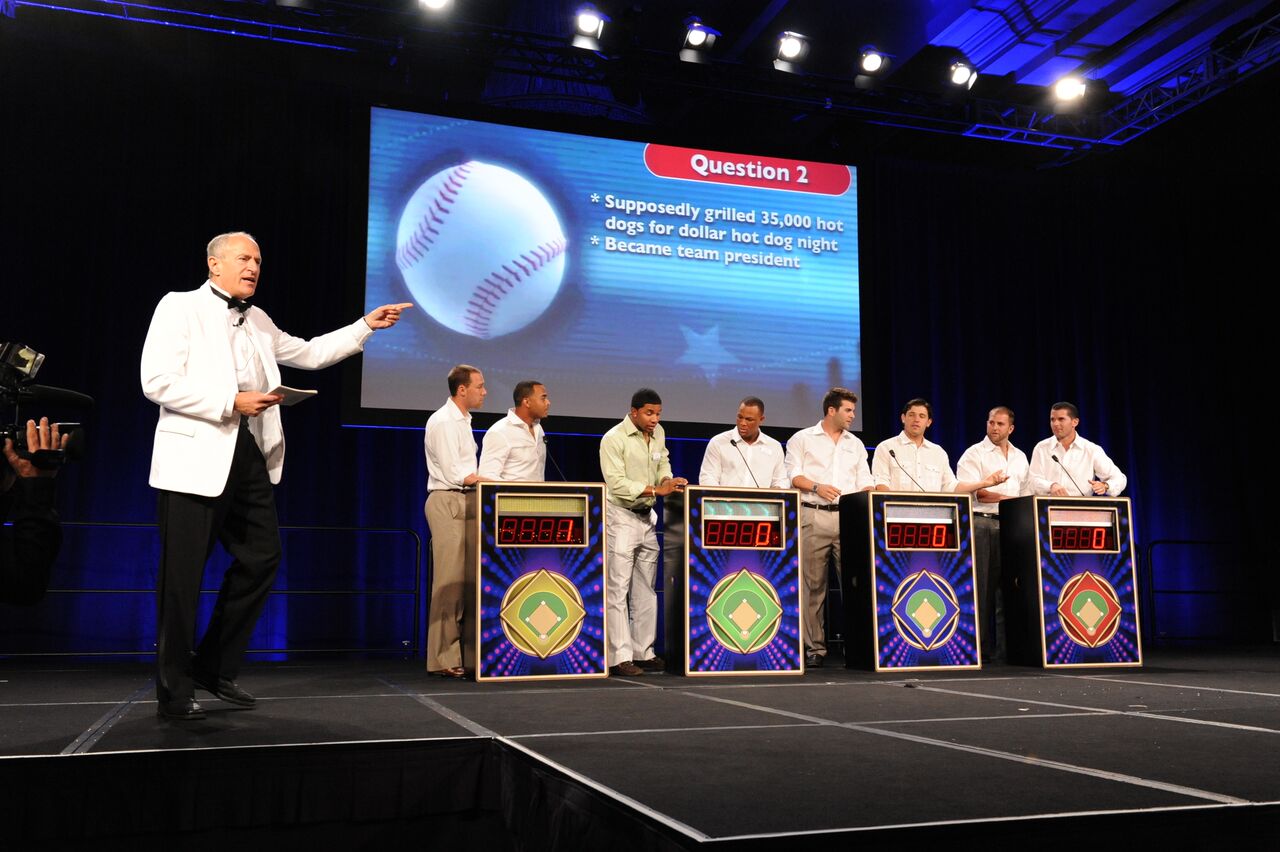
deduction. I worked for years on the Park Place Dealerships Texas Rangers Triple Play Game Show Spectacular
and think it would be a fun first date. Many others probably would,
too. Charity golf tournaments generally work on a scramble format, which
allows a high-handicapper to have a good time playing with someone
better.
Bowling If you don’t want to go to a game, ride a bike, or attend a
non-profit event, you and your sports friend can always go bowling. Or,
if you somehow discover you’re both truly dedicated keglers, consider a
trip to the International Bowling Museum and Hall of Fame. It’s located in Arlington and offers a wealth of displays you can browse in your shoes with the sizes printed on the outside. Final Tips • Do your homework but don’t be a geek. If you know the names of the
teams competing, their relative position in the standings, and some
basic rules, that should get you through most situations. Spending the
entire night explaining the intricacies of the left-wing lock probably
isn’t what this is all about. The caveat to that assertion is that if
you casually note that the Mavericks just switched to their half-court
trap and your date suggests they need to get more aggressive on those
double-teams, then the sports talk is on.
• Don’t bring your baseball glove. Not on the first date.
• Don’t eat a Choomongous (the Rangers’ 2-foot Korean beef sandwich). It’s probably best to choose more graceful food.
• Wearing a team shirt to the game is probably fine, but leave the
costumes at home. The same goes for painting team logos on your face.
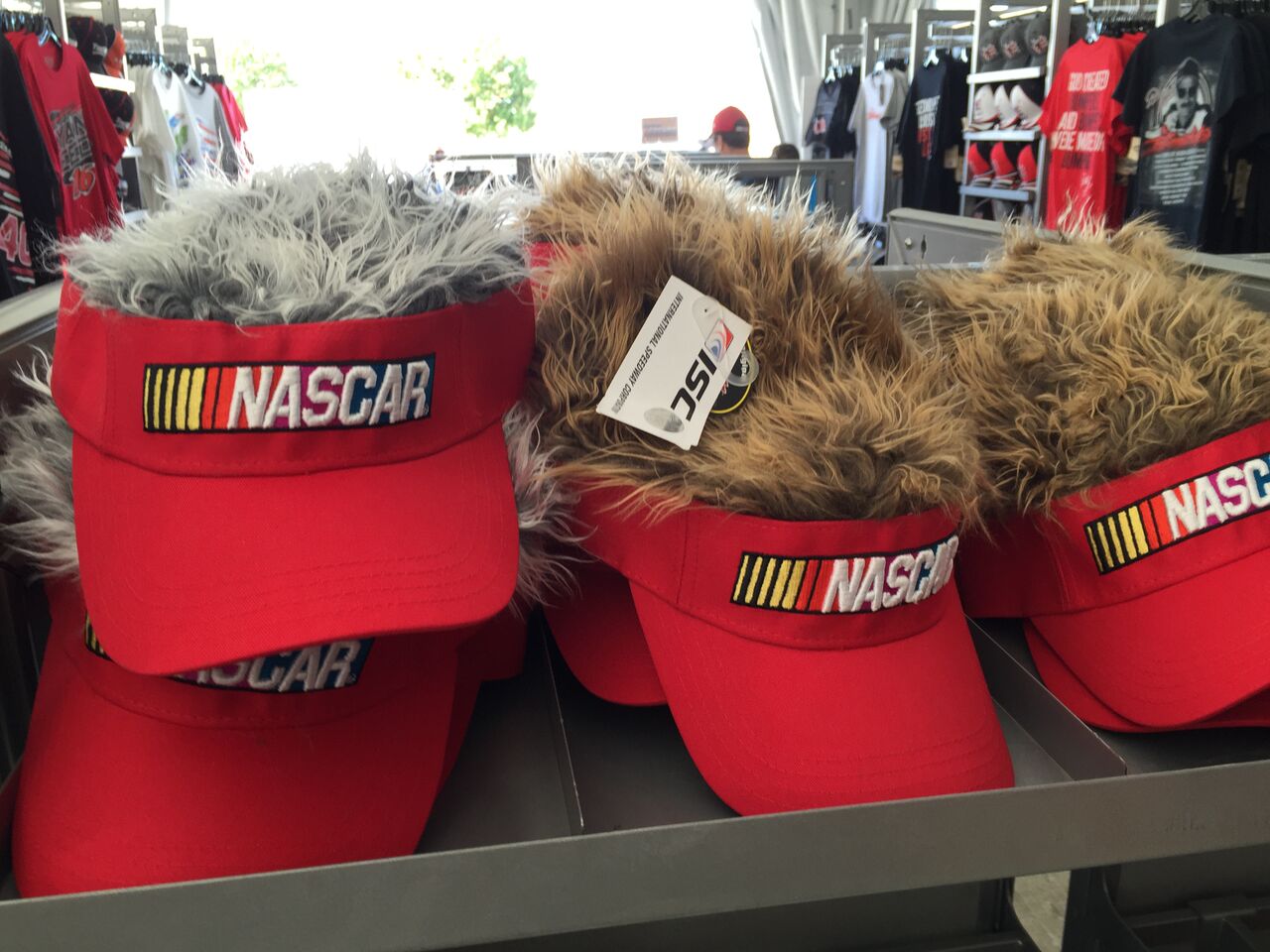
Avoid puckheads, blockheads, and flair hair, too.
• Manage your fandom. If your seatmate hates your team, be cool,
laugh, and remember it’s just a game. If you only want to date Rangers
fans, Major League baseball has a deal with match.com to allow you to meet those of like allegiance.
Conclusion Most of the suggested experiences don’t just work for first dates, so
those of you already in relationships can certainly keep them in mind
with Valentine’s Day coming up. My last sports date was to a baseball
game in Mexico City. If you want to hear all the details about it, or
let me know about your favorite sports date spot, let’s chat February
5th at LOVE FW. Rush Olson has spent two decades directing creative efforts for sports teams and broadcasters. He currently creates ad campaigns, television programs, and related creative projects for sports entities through his company, Rush Olson Creative & Sports.
This post originally appeared on the Blotch page at the Fort Worth Weekly. To read it on that site : http://www.fwweekly.com/2016/01/13/football-is-different/
Football is different from other sports. The ball’s not round, certain players aren’t allowed to touch said
ball, and a game can fill 100,000 seat stadiums once a week with fans
wearing colors not found in nature.
Should conference alignments reflect its unique character? A
basketball game last week served as a reminder of how football’s
singularity affects the rest of the collegiate sports world. In men’s hoops last Monday, the West Virginia University Mountaineers
visited their non-historical rival, the Texas Christian Horned Frogs.
The ‘Eers traveled roughly a thousand miles to the game, just as their
baseball, swimming & diving, women’s basketball, and volleyball
teams did or will do this year. A number of TCU’s teams visit
Morgantown, too. Why go some 1600 kilometers to play these games? It’s
because football is different. Football always has been the alpha male in the nation’s university
environment. There was once a College Football Association to negotiate
big schools’ TV contracts in the sport. No such equivalent existed for
golf or cross country. Teddy Roosevelt never held a summit to explore making the pole vault safer.
Football has always gotten special treatment, and it’s easy to
understand why. The gridiron game is the most popular spectator sport in
college athletics. Reputations, egos, and huge dollars depend on it.
Those dollars, in fact, drive much of athletic departments’
decision-making. Football’s large roster size and marketing needs, among
other things, make it an expensive sport in which to field a team,
especially at the FBS level. Choices get made, then with an eye to
maximizing the revenue the football program generates.
Certainly any purveyor of sporting contests aims to generate maximal
economic returns. Football plays a unique role in college athletics,
however, because it is often relied upon to create enough revenue to pay
not only for its own costs but also those of sports which do not
generate enough funds from sales of tickets, broadcast rights,
sponsorships, and “Beat Bama” shirts, plus donor contributions, to pay
for themselves. Men’s basketball and, on rare occasions, other sports at
certain schools occasionally pay for themselves as well. There’s not necessarily anything wrong with this arrangement. Fans
are certainly entitled to prefer watching one sport over another. If the
monies they contribute and facilitate indirectly (like sponsorship and
broadcast rights sales) allow students proficient in sports besides the
fans’ favored one to realize the benefits intercollegiate athletics
provide, that seems a reasonably happy result.
Not all schools break even on their athletic programs, of course. The Washington Post
looked the public universities (because government institutions must
make the data available) in the Power Five conferences. 28 of the 48
schools they examined lost money on athletics. A USA TODAY
study found that more than 200 Division I public institutions didn’t
bring in enough income to cover athletic operating costs. In cases where
departments don’t fund themselves, student fees tend to make up the difference.
The Post noted that proponents of intercollegiate athletics cite
benefits beyond athletic budgets, including publicity that increases
applications. Athletic participation certainly also provides benefits to
students involved in both the sports themselves and ancillary
activities like band, student radio, and valet parking for suiteholders.
It’s an inexact calculation as to whether the costs of
intercollegiate athletics outweigh the benefits, and we won’t get into
that debate here. But given that even the biggest football schools often
don’t pay their own costs, if we could come up with a way for them to
run more efficiently, we should take a look at it. That would seem
especially important given that many of the institutions in question are
public ones, with taxpayers ultimately on the hook for yearly cost
overruns plus the infrastructure student-athletes utilize outside the
athletic sphere. Given the prevalence of government student aid, that
likely holds true for most private institutions as well, since those
loans and grants might pay for student athletic fees that subsidize
unprofitable athletic departments.
Which brings us back to TCU versus West Virginia (a 95-87 WVU win).
They played each other Monday because they’re in the same conference.
They’re both Big XII members in large part because of football. When the
conference had openings, would either school have gotten in if they
didn’t bring national football profiles? No way. Football pedigree
clearly factored in the decision more than, say, traditional rivalry or
geographic proximity. So did the conference affiliation make sense from a football
perspective? Perhaps so. Did it make sense from a wider perspective? To
determine that, let’s look at it through two lenses : student-athlete
benefit and overall effect on the state of Texas.
Student-athletes are conceivably supposed to be the most important
thing about college athletics. The lessons they learn from playing are a
valuable part of their preparation for life. They aim to put in enough
time to get the benefits of their sport(s), but not so many hours that
their commitment hurts other academic and extracurricular performances.
Football, as previously noted, is different from other sports. You
play once a week, usually on Saturdays. Whether you play at WVU or Maine
Tech or the Sorbonne, your travel time isn’t too different.
Other sports play more frequently and often on school days. The more
long road trips students endure, the more classes they miss.
Likewise, a half-dozen lengthy football road trips may not cost that
much, and may well be worth the cost if you consider them vital to your
gridiron success. Multiple long journeys from baseball, softball,
basketball, and the rest of your department’s teams, however, quickly
add much larger costs. For the unprofitable schools mentioned earlier,
those costs get covered by state resources (like tuition collection,
endowment depletion, property tax revenue) that could be directed
elsewhere.
A pair of state schools in Texas also field teams that travel to West
Virginia annually. They (and their fans) used to be able to travel the
much-shorter distances to College Station, Texas for games of similar
caliber. However, the public Texas A&M University made a
football-related move to the Southeastern Conference and now makes its
own trips to Alabama, South Carolina, and Florida.
Do these moves make sense from a student-athlete perspective? Maybe
they do from a football standpoint. For the rest of the athletes,
however, they miss more class and likely have fewer games their families
can attend. The athletic experience they get from playing a Texas
school of their caliber is no different from that gained playing one
from further away. So we can conclude that football-based conference
realignments may well not benefit non-football athletes.
Do the moves benefit the states in which the schools are placed? If
long road trips create a lesser academic experience for student-athletes
at the schools, that isn’t good. From a fiscal perspective, it seems
likely they spend a lot of unnecessary money on non-football travel. The
state’s residents may also be hurt economically from scheduling. Let’s
face it, a Texas vs. Texas A&M game in any sport is going to be a
bigger draw than A&M vs. Vanderbilt or the Longhorns vs. WVU. When
the Aggies travel to TCU, Baylor, and Texas Tech, the sales tax dollars
generated at local restaurants and hotels stay in-state instead of going
to Mississippi or Georgia coffers.
The Aggies may make the case that they bring more TV money to Texas
from their move to the SEC than they would have if they had stayed in
the Big XII. Indeed, the $31.2 million distribution their conference gave them exceeded the $25.2 million Big XII schools pulled in from theirs. However, each Big XII school retains its rights to so-called third-tier games,
and revenue from those might well have come very close to making up the
difference. One has to also factor in losses from travel and in-state
rivalries to perform a true analysis of the costs and benefits to the
state as a whole.
These issues aren’t limited to Texas, either. The Rutgers to
Minnesota, Miami (FL) to Boston College, and Arizona to Washington State
sojourns leave a lot to be desired, too.
So what’s the solution? If the conference alignments work for
football but not for other sports, perhaps the solution is to give
football its own special treatment. Set up conferences for that sport
that are as national in scope as you want them to be and put the other
sports into conferences that make more sense geographically.
Would it work? We already have single-sport conferences in sports
without universal participation, like Hockey East or the Midwestern
Intercollegiate Volleyball Association, and a number of non-football
Division I conferences. BYU’s and Notre Dame’s league arrangements cover
most of their sports while leaving football independent. It’s not like
colleges have placed any value on stability of conference membership in
the last 20 years anyway. Frog fans, remember the WAC and the Mountain
West? Or those car trips to Southwest Conference road games?
What would it take to blow up the conference structure? It might need
to start with legislation from some budget-minded legislators (if
that’s not an oxymoron) in affected states – probably large ones. Or
perhaps it could result from a movement started by university presidents
eager to make their bottom lines look more robust.
One of the trickiest parts would be the unraveling of current
conference television deals, especially those with league-specific
networks attached, like the Big Ten Network and the SEC Network. They
need the non-football sports to provide enough programming for them to
work. It’s possible they could transition to becoming general-interest
collegiate sports networks (ESPNU 2, for instance), initially retaining
the rights to the individual schools they currently serve through the
incumbent system.
Men’s basketball, the second-largest revenue generator among collegiate sports derives most of its take
from the March Madness TV deal. It would have to recalibrate the way it
splits its money, too, since some of it gets distributed at the whim of
conferences. It would take some complicated negotiation, but it could
be done.
One hurdle will be stakeholders invested in the current conference
system. I sympathize, because they have worked hard to build conference
brands over the years. I suggest they embrace the change, because this
solution would actually create more conferences. More conferences means
more jobs for people like you and me.
In the long run, would a split of football into its own conferences
mean more jobs for better-educated student athletes and for Texans who
see more monies stay in-state? At the very least, it sounds like a good
research project for some bright student-athlete Econ majors – once she
gets back from that tennis trip to Morgantown, that is. Rush Olson has spent two decades directing creative efforts
for sports teams and broadcasters. He currently creates ad campaigns, television programs, and
related creative projects for sports entities through his company, Rush
Olson Creative & Sports.
This post originally appeared on the Blotch page at the Fort Worth Weekly. To read it on that site : http://www.fwweekly.com/2016/01/05/forbidding-football/
In the sport of American
football, violence sometimes begets more violence. I tackle you, you
stiff-arm me, your teammate tries to block my buddy, who tries to shove
him into both of us, the safety flies in over the top, and we all end up
in a heap on the ground. Then we get back up, if we can, and we do it
again.
In a recent column in The Guardian
newspaper, a writer named Dave Bry suggested we not do it again. In
fact, he prefers to go beyond a mere recommendation. He would have us
walk off the field and never come back via a legislative ban on the
entire sport.
The issue of football’s brutality has found itself much in the news
in the past few years. A new Will Smith movie, “Concussion,” has
propelled it even more deeply into the pop culture landscape. Bry’s
piece, entitled “American football is too dangerous, and it should be
abolished,” presents a balanced summary of many of the sport’s injury
issues and some arguments for and against getting rid of it. At the end
of the article, after determining the NFL won’t give up wearing helmets,
he opines, “Which leaves us with one moral option: illegalize it, the
whole operation.” And then the column stops.
Bry didn’t present a vision for what the world would look like when
the USA has banned football. It’s possible he just didn’t have the
space, and that an upcoming column will detail his football-free future.
I decided not to wait, however, because you can only properly evaluate a
proposed policy if you consider how it will work once implemented. You
don’t want to trade for Herschel Walker and then realize later he doesn’t really fit your offensive scheme.
Firstly, you’d have to think about how you might implement the
proscription. Perhaps the Super PAC Mr. Bry founds will facilitate the
election of enough anti-gridiron legislators to override the veto of,
say, Patriots fan Bernie Sanders, Walker’s former New Jersey Generals
boss Donald Trump, or Packers fan Gary Johnson.
Would compromises have to have been made to buy votes? Would existing
football interests be able to capture the political process and turn it
to their interests? For the sake of argument, let’s assume not. Let’s
say the Anti-Touchdown League gets its own Volstead Act, no preceding constitutional amendment required.
So once you’ve gotten the bill passed, what do you do?
Well, there’s a lot of existing football equipment out there already
that could be used by miscreants to continue to play the game. One would
assume that you’d want to rid the country of those tools. Could you use
a mandatory buyback scheme, like they did in 1996 with citizens’ guns in Australia?
If so, how would the takings clause of the 5th Amendment require the
government to compensate those from whom it took the pigskins, helmets,
goalposts, shoulder pads, tackling dummies, and playbooks? You’d need to
make sure you raised taxes or borrowed money to fund an appropriations
bill for the FEA (Football Enforcement Administration) to pay for both
the buyback and the enforcement of the ban. You’d also have to figure
out if it were OK to repurpose, say, football cleats for other sports
and a helmet as an unconventional flower vase or if that stuff all has
to go to the incinerator.
You’d need to make a decision, too, on whether or not to permit
entities like the Pro Football Hall of Fame to exist or the Texas Sports
Hall of Fame to have football exhibits. You’d think today’s feds would
frown on, say, a shrine dedicated to the interstate raw milk sales,
imported haggis, or off-the-reservation gambling they prohibit. Do
freedom of speech issues exist here? If so, you’d need to plot how you
could get around them to keep people from glorying in the achievements
of, say, George Preston Marshall.
In his column, Bry identified his most culpable culprits for the evil
that is football. He writes, “The onus is on us, the fans (and, more
directly, the team owners) who pay the players to hurt themselves for
our enjoyment.” The ban on football companies would probably not be too
different from scuttling breweries at the start of Prohibition. But if
the much more numerous team fanbases bear the brunt of the blame here,
restrictions to stop football fandom would seem crucial to the ban’s
success. If you decide the Grambling Legends Hall of Fame’s
tributes to the likes of Tank Younger and Doug Williams would allow
football fans to continue being football fans, do those areas need to be
replaced with boxing or CrossFit exhibits and should the memorabilia in
question be burned? While we’re on that subject, you’d need to plan for all the football
writers, broadcasters, and bloggers you’d put out of business. Does the
takings clause apply to their capital investments? And moving forward,
are you allowed to write about football, or would that be giving
material aid to the enemy? Might we need to shut down portions of that
internet?
Moving on to enforcement, you’ll need to give the FEA sufficient
powers to stamp out the vestiges of the sport. You’d need a training
budget to ensure the gridiron gendarmes could recognize whether youths
in the park were actually playing, say, rugby or whether they needed to
spend a few days in juvy. For organized matches, is the referee
sufficiently diligent in calling forward passes or is he letting a few
too many go uncalled? You’d need to be very precise about what
activities are and aren’t permitted in the presence of tackling. Perhaps
this effort could double as a jobs program for the on-field officials
who lost their jobs in the industry’s purge. You’d also want to add
safeguards to ensure the authorities wouldn’t abuse the law, using it as
a pretext to harass disfavored groups. After all, nearly 70 percent of NFL players are African-American.
You’d need to determine the criminal penalties to be visited on those
die-hards who continued to block, tackle, and cheerlead in defiance of
the ban. You’d have to somehow compute the damage caused to society or
identifiable victims and make the prison sentences (and potential civil
settlements) reflect those calculations. Would effective deterrence
require some sort of three-strikes-and-you’re-out law for recidivistic
touchdown celebrants (as I unashamedly mix sports metaphors)? You’d have work to do internationally, too. The NFL has spent a lot
of money marketing the game overseas. It’s not the biggest sport in the
world, but it has a loyal following some places. You’d want to try
pressure other countries into forbidding it as well and to negotiate
treaties allowing extradition for Americans caught running fly patterns
in, say, Moscow or Beijing. Canada’s likely to be a tough one here, as
they have their own long football tradition. Might a wall along our
northern border be needed to prevent our footballers from working
illegally as Argonauts or Alouettes? Once Mr. Bry has figured out the answers to all the points raised
above, nobody will play American football anywhere in the world, apart,
perhaps, from certain rogue lawless states. Somalia might become the
world’s leading producer of linebackers.
Of course, you could have some bold commentators continue to address
the issue of the football ban, couching it in terms of so-called
“legitimate policy discussion.” What if you had someone write, for
instance :
“The problem, of course, lies with some basic truths about human
behavior. There is a strong demand for football in America. As long as
those footballs are illegal, there will be great financial reward to
anyone who can provide them.”
or
“The football trade has become as powerful a force in the Mexican
economy as any legally sanctioned one. Powerful enough, it seems, to
overwhelm any attempts the government might make at cracking down on the
collateral effects.”
The phrases above came from a lucid author who puts words together very well. In one of his recent columns, he wrote about his “individualistic positions on . . . drug use (legalize it).” The passages above came from an article
that same David Bry penned for BET, but I took some liberties with
them. I substituted the word “football” whenever the word “drugs”
occurred in the original. You do have to try to anticipate collateral effects when banning
stuff, for sure. Eliminating a violent black market is indeed among
them. Would a football ban create a black market? How big would it be?
Would the violence associated with such a market beget more violence
than that which currently results from football? Would it create any
additional unintended consequences? As Mr. Bry begins his campaign to
eliminate American football, he will probably want to perform a thorough
cost-benefit analysis.
Epilogue : In another column,
Mr. Bry called for a ban on dogs in New York City. My sister and I used
to play football with our dog, Fuzzy, when we were kids, though not in
NYC. We played tackle. My parents took home movies of it. If the U.S. implements the full Bry agenda, I may be in some trouble.
Rush Olson has spent two decades directing creative efforts
for sports teams and broadcasters. He currently creates ad campaigns
and related creative projects for sports entities through his company,
Rush Olson Creative & Sports.