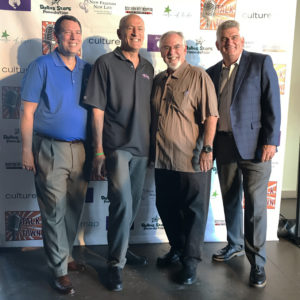
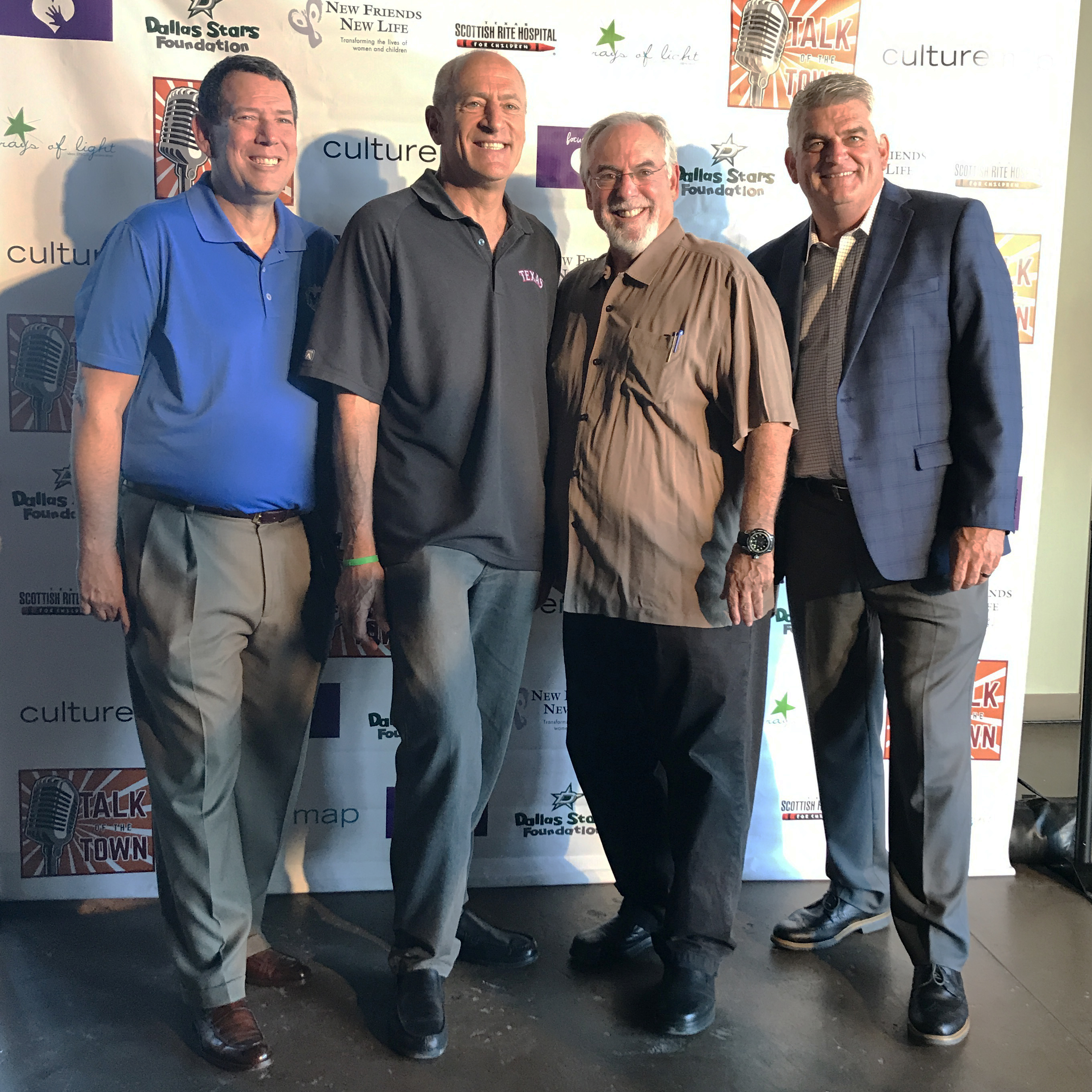
The meetup came at the Dallas Stars’ media day in September, 2015.
The team had just hired Dave Strader as its play-by-play announcer and
he had come over to Frisco’s Dr Pepper Arena to observe the goings-on. I
chatted with him and his new broadcast partner, Daryl Reaugh. The whole
conversation might have lasted a minute. I remember Dave being nice and
then I went on to whatever other production duties had presented
themselves.
I re-connected with Dave earlier this year. The Stars announcer was
scheduled to join his radio counterparts from the Mavericks, Rangers,
and Cowboys to swap stories and raise money for charities. I had taken
on some producing duties for this event, called Talk of the Town, and
needed to work with him on the show. What made it tricky was that we
didn’t know if he would be there.
Since
I had last seen Dave Strader, the Hockey Hall of Fame had honored his
broadcasting excellence by naming him the 2017 recipient of the Foster
Hewitt Memorial Award. Dave had also contracted cholangiocarcinoma, a
punishing cancer of the bile duct.
We had shot funny (I hope) promotional videos
with Eric Nadel, Brad Sham, and Chuck Cooperstein to promote the event.
Dave didn’t get to participate in those because he was undergoing
treatment. But he retweeted
and promoted and did everything he could to support his fellow
broadcasters, the event, and the charity he had chosen to benefit from
it, the Dallas Stars Foundation.
We had discussed trying to have him participate live via an
electronic connection if we could work out the technical details, but I
honestly wasn’t sure what to expect and what kind of strength he would
have. Then, shortly before the event, we found out good news: Dave would
be well enough to fly in and attend the event.
We needed to add his elements to the program. I had collected
play-by-play excerpts for all the other announcers and now I got to ask
Dave what he wanted. He asked for a Red Wings call,
his last as a team broadcaster for that Original Six team. A connection
helped me get that from Detroit. He also sent us a voicemail recording
sportscasting icon Marv Albert had left him after the Foster Hewitt
announcement.
Then, abruptly, Dave’s treatment schedule changed. He wouldn’t be
able to make it to Dallas for Talk of the Town. But he felt he would be
strong enough to join via Skype if we could make the technical details
work (which, luckily, we could). And that evening, we dialed him up and
found out he indeed was very much robust enough to connect and
contribute.
I had Dave make his entrance in the middle of the program because I
wasn’t sure of his stamina. I wish I had dropped him from the beginning,
because he gave a fantastic performance. He told great stories,
interacted with his fellows, and gave the audience one of the best
memories of any charity event I’ve ever worked. I’ll never forget how
moved the table of Dallas Stars employees seemed when he appeared on the
video screen. When he signed off, they and the rest of the crowd gave
him a well-deserved standing ovation. Talk of the Town might have been the last time he got to use his
voice in a live broadcast-style setup to entertain sports fans. It
seemed to truly energize him and I think that makes all of us who took
part in it feel pretty good.
I had one other regret from the evening. When we were talking about
calls to find, Dave had written this: “I would love to have the call
of Jamie Benn’s OT goal from Feb 18…my first game game back after my
cancer diagnosis. I would also like the clip of Razor’s comment as the
players skated over to salute me at the end of the game.”
In hindsight, I desperately wish I had made the extra effort to
include that call, which due to exigent circumstances that week, was
more of a challenge that it normally would have been. I remember
thinking that I would for sure use it for next year’s event, when he
would hopefully make a triumphant in-person appearance.
I only met Dave the one time, and communicated with him via email, phone, and Skype a bit. Yet somehow his passing resonated deeply. It didn’t require much exposure to the man to see his passion for people and a deep-seated fervor for life.
Many Stars
fans (and those of the other teams for whom he called games) never had
the pleasure of meeting Dave even once, but I bet they could tell the
same things I could, thanks to the zeal with which Dave broadcast hockey games (and the other sports he did as well).
Many in the hockey business called Dave Strader “The Voice.” Luckily, his voice will live on in the work he did and the calls
you’ll be able to listen to online and in hockey shows for years to
come. And in the memories of those who knew him, even just a little bit.
Thursday night, someone asked a group of noted play-by-play
men about the most difficult venues in which to call a game. New York
City native Chuck Cooperstein of the Mavericks, the subject of this
post’s video interview, reluctantly cited his beloved Madison Square
Garden’s subpar sightlines. The Rangers’ Eric Nadel noted that he loved
Chicago’s venerable Wrigley Field in general, but not its lilliputian
broadcast booth. (He observed that early broadcasters “apparently were
very small people.”) Brad Sham from the Cowboys placed Washington, D.C.
first. He also named them second, third, and on up through number 32.
Sham explained that the visiting radio booth is low and in the corner
and he has to call certain distant plays using the monitors in the
instant replay booth next door. photo by Carrie AdamsAt the Talk of the Town event, radio announcers for North Texas’s top
four pro sports teams assembled to swap inside stories about their
profession. The audience could submit queries on note cards and the
venues question was one of the first moderator John Rhadigan read. Dave
Strader wasn’t on stage at that point and we didn’t find out his answer
to it. The Stars’ announcer had planned to attend, but a recent
complication in his cancer treatment prevented him from being physically
onsite. It didn’t stop him from participating, however. A few minutes
after the broadcast booth discussion, Rhadigan introduced a classic call
of a Steve Yzerman playoff overtime goal, one Strader had made as the
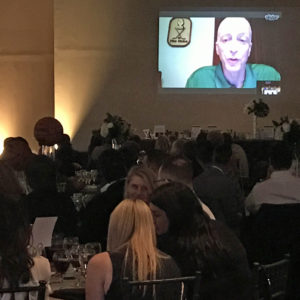
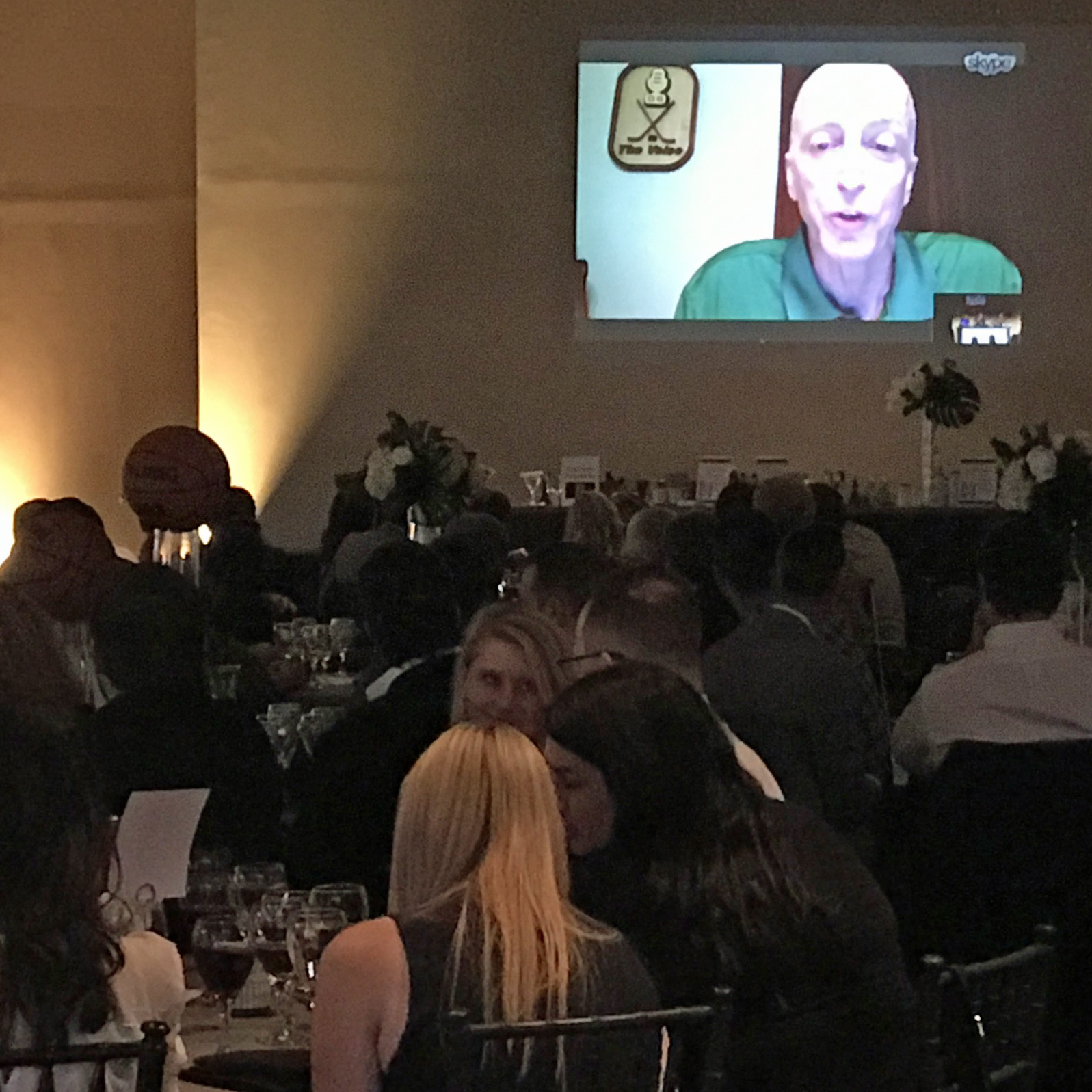
voice of the Detroit Red Wings. As it ended, the skinny but energetic
hockey broadcaster appeared on the video screen via Skype and described
how they had just watched his final call as a Red Wings team
broadcaster. photo by Carrie AdamsStrader then stuck around virtually, contributing his viewpoint to
every question and clearly enjoying the night. After the event, he
tweeted “Thank you for having me! It meant a lot.” I’m sure the
experience raised his spirits, and it lifted the room up a lot, too.
Perhaps my most enduring memory of a fully enjoyable evening will be of
the occupants of the Dallas Stars’ table, including former Stars forward
Vern Fiddler, watching their colleague on the screen and clearly being
moved by the sight.
In
addition to serving as a pick-me-up for Strader and his Stars
colleagues, the event also benefited five charities dedicated to serving
less-fortunate children. Earlier in the evening, after Sham had
described the challenges of having no depth perception when calling a
Cowboys-Redskins game, he had added a caveat.
“The one thing you won’t hear us do is complain about it. Because one
of the things I think we all understand,” explained the longtime
announcer, “Is there’s a line of people three times around the stadium
who would do it for free.”
Sham and the rest clearly appreciate what they have. In a night filled with great stories, that message was truly a lasting one.
Rush Olson has spent two decades directing creative efforts for
sports teams and broadcasters. He currently creates ad campaigns,
television programs, and related creative projects for sports entities
through Rush Olson Creative & Sports and FourNine Productions.
With the NASCAR circuit visiting Texas Motor Speedway this past
weekend, the Fort Worth Weekly took a look at the broadcasters who bring
the action to those who can’t make it to the track. We did a story on
the Performance Racing Network (PRN), who create the radio broadcasts,
which you can read here.
We also interviewed former driver Jeff Burton, who now works on NBC’s
television coverage as a race analyst. He won the first Cup race of his
career at Texas in 1997, among 21 total wins at the highest level of
stock car racing. What follows are excerpts from that interview.
The radio guys at PRN actually got Burton his first broadcasting
gig. It came in Indianapolis while he was still an active driver,
working on the network’s coverage of NASCAR’s second-level racing
series.
“We just asked him if he would come and work in the booth for
the Xfinity (Series) race,” PRN President Doug Rice said. “I’ve known
Jeff for a long time and he was very anxious to come up and do it. He
was excellent. I mean, you just knew it. He’s got a good vocabulary,
He’s got a good speaking voice. He’s got great knowledge. You knew he
was going to be good.”
Those traits helped Burton move from that one-time radio gig into
his current NBC position. It may have also seemed a natural move because
he grew up finding ways to watch races.
“We made watching the races a big part of our weekend. I can
remember dragging a TV out into the backyard with a lot of extension
cords plugged into each other so we could play basketball and watch a
race. All of the three boys of the Burtons, we all liked racing. We all
liked watching it.”
When he drove, Burton decided it was in his best interest to pay attention to the media accounts of his sport.
“My experience has been that drivers always want to watch the
replays of the races they won. The talk show thing, there’s been some
times when I didn’t want to listen. But there were times I didn’t want
to listen and I did, like when Jeff Gordon and I had our incident in
Texas many years ago. I got up early that next morning, was going to the
gym and I’m, like, ‘Do I want to turn this on?’ And I made myself. And
then I made myself sit in the car in front of the gym for, like, 30
minutes listening to it. and because it was – I don’t want to listen to
it, but I just felt like I needed to. And then, I listen to it because I
enjoyed it. I just enjoy it. I don’t listen to it all the time by any
means, but when I was a driver, it helped me to see a different
perspective. When you’re in the forest, you can’t see the trees. And I
always liked it when fans would call in and even though I would disagree
with a fan or I would agree with a fan, either way it made me see
things in a different light and I thought that was healthy to understand
that the sport is more than just about me.”
As a former driver, Burton uses his connections to help him prepare
for a broadcast. He knows how to time his communications with drivers.
“My job is different from a pit road reporter. I’m more of an
analyst, so I have a luxury those guys don’t have that when someone
needs to cool off, I don’t have to talk to them right then. I can wait
until a Tuesday or a Thursday. What I try to do is to catch people when I
think it’s good for them or I try to give them enough time to get back
to me. So there’s times I text people on Sunday mornings. And that’s
what I try to do with the drivers on Sunday mornings is just send them
texts, because they’re busy and it’s, in many cases for those guys,
easier to just text me back. Because I don’t need a paragraph. I just
have a simple question. So I just try to put the driver in a situation
where they have time to get back to me, that time to respond to me. They
don’t have to do it immediately. When I say they don’t have to, they’re
all so good about working with us. The drivers are phenomenal at
spending time with us and giving us answers, trying to help us
understand what they’re dealing with.”
Knowledge of how drivers approach their craft informs Burton’s commentary as well.
“I have opinions about all sorts of things based on my
experience with those things and that goes for drivers as well. And then
my opinion is also shaped based on how I see them interact with others
and what the situation is. To be honest, my personality is such that I
always try to give someone the benefit of the doubt. When I drove and I
got wrecked, rarely did I just come out and say ‘Hey, the dude just
wrecked me on purpose,’ because typically, I didn’t feel like they did.
Whereas, opposed to some other drivers, if you just bump into them, they
think you did it on purpose every single time. Not everybody, but
that’s just different personalities. So I’m more apt to give someone the
benefit of the doubt than I am to say, ‘Hey, you just wrecked him on
purpose.’
“But I have to call it like I see it. Matt Kenseth and I, for
example, were great teammates. When he won his championship, I
celebrated with him just like I won the championship because I was truly
happy for him. But when he does something like when he wrecked [Joey]
Logano last year in Martinsville, I said, ‘You know, NASCAR’s going to
have to step in. They can’t allow that.’ But on the same token, I
disagreed with the severity of the punishment. But not because it was
Matt Kenseth, just because it was different than they had ever done
before.”
Burton’s prep work also involves making sure he keeps abreast of
the latest big-picture developments in the sport. He also believes it’s
important to keep his immediate focus on what’s going on in the current
race.
“Calling a race, in my role, is very much about understanding
what has been going on in the sport prior to this race. What are they
dealing with? What improvements have they made? Where have gone
backwards? Where are their struggles? Where are their strengths? What’s
going on in this sport? What’s the tire for this weekend? For my role,
it’s more about staying current in understanding the sport than it is
about stats and about those kind of things.
“Steve (Letarte, Burton’s booth colleague) and I are analysts.
We don’t have to know that Jimmie Johnson – I’m making this up – that
Jimmie Johnson going into this week had not won a Martinsville race in
the last six races. We don’t specifically have to know that. We just
have to know that he won a bunch there, but lately hadn’t had the same
success. We’re not stat guys, but we need to understand the flow of each
race team, what they’re struggling with, what they’re doing well, what
is their situation, and then let the race happen. Because the race is
the story, and what happened in Martinsville last week matters for this
week, but only because the Gibbs guys had a little conflict during the
race. Jimmie Johnson won the race, which means he’s locked in [to a
chance to race for the season championship]. Kevin Harvick had problems
with speed. Carl Edwards has a huge hole to dig out of. So that’s why
last week’s race matters. But what happens this week is what matters the
most this week. This week’s the most important race ever in the history
of NASCAR.”
Incidentally, Burton did actually remember the stats correctly.
Johnson had, in fact, not won a race in Martinsville since April of
2013, exactly six races prior to his triumph there on October 30th.
When he decided to move into the broadcast booth, Burton wanted to
make sure his network would share his vision for covering his sport.
“NBC approached me with a plan about how they wanted to be
involved in the sport and I liked what they wanted to do. I liked the
game plan. I liked how they wanted to bring the race to the fans, how
they wanted to be involved in the sport. I can’t say to you that I was
getting ready to retire and said I want to be a broadcaster. What
happened with me was that a lot of people within the sport for several
years had said that maybe I should look into that. Maybe because I
wasn’t winning any more, they were looking at something else for me to
do [laughs]. People within the sport were saying maybe that I would be
good at that and I really hadn’t thought about it. Some people were
thinking about it for me, I think, which was flattering.
“So when NBC approached me, my question wasn’t, ‘What is my
job?’ My question, my first question, was, ‘Explain to me how you want
to do it? What happens when I have to criticize NASCAR? Or what happens
when I have to criticize the driver or what happens when we have a
difficult situation that I have to say something to make someone mad, or
what happens when . . .’ I just had all this list of questions, because
if I was going to do it, it was because I wanted to bring the sport to
the fans and be able to inform the fans, be educational. Help the fans
understand the sport in greater detail. Not that our fans are ignorant,
but it’s hard to know more about racing than it is other sports because
they don’t teach you in PE how to play racing. You learn as a kid how to
dribble the basketball. You learn the rules of basketball. You learn
baseball. You learn soccer, all the things, but nobody teaches racing. A
lot of people’s kids play sports, so it’s easier to know more about the
other sports. It’s harder to know more about NASCAR and I have always
felt that the fans wanted to know as much as they possibly could know,
but they were disadvantaged. So my question was, ‘Are we going to be
able to do a broadcast that’s informative, that’s more centered around
information and the race than it is considered entertainment.
“I want racing to be fun, because racing is fun and the race
has got to be fun. The race has got to be exciting. The race has got to
be all these things. It can’t be me.
“The show is on the track, it’s not in the booth. And so I just
wanted to make sure NBC fit what I thought it should be and it all
lined up.”
(Photo by: Gerardo Mora/NBC Sports)
Once a part of NBC’s team, Burton found himself matched with
veteran broadcaster Rick Allen and Steve Letarte, the former crew chief
for Dale Earnhardt, Jr.
“We all come from different backgrounds, so Steve has taught me
a lot about things that I thought already knew about in regards to what
his role was and what does being a crew chief, what does that really
mean. He’s taught me a lot and I’d like to think I’ve taught him a lot
about being a driver. I think the main thing that I think we’ve done a
really good job of it, that we truly, we all three committed to each
other that we were going to hold each other accountable. We were all
lucky to be in this position we have to worked our ass off, because the
fans deserve our commitment and the teams deserve our commitment and the
sport deserves our commitment. It’s not a part-time job.”
They also added another voice to the booth when Earnhardt, Jr. found himself unable to race after suffering a concussion.
“Steve and Dale know each other really well obviously and they
know each other better than I know Dale. I’ve known Junior forever but I
hadn’t spent the time with Junior that Steve has. But we’ve done enough
socially as well as racing against each other a lot, we have a lot of
respect for each other. We spent 10-15 minutes talking, you know, ‘Hey,
look, why don’t we do this,’ basically it was, ‘We’re just talking
racing.’ Don’t make it complicated. We’re just talking racing. It
doesn’t have to be complicated. Let Rick get us in and out of
commercials. Let Rick lead us to things. Let Rick do all the things that
he’s so damn good at and then it’s just the three of us talking about
what we’re watching. ‘The goal is, Dale, like at Talladega, we want you
to explain to the fans, why do you do what you do? There’s a reason that
you make a move when you make it. Like, let’s put you in whatever car
we’re following and say, ok, I would do this or I would do that and
why.’ It’s just that simple. Let’s don’t make it complicated. And I
think he’s so comfortable with Steve, and he’s been around me enough to
know that I’m pretty easy to get along with that he just got in there
and was comfortable and just sat in there and rolled along time and had a
good time. We have a good time. We laugh and carry on and cut up. We
have a good time. We wanted him to come in and have a good time.”
Another current driver much on Burton’s mind just completed his
first race on the NASCAR Craftsman Truck Series a week ago in
Martinsville. Burton’s 16-year old son Harrison could someday advance to
the levels his father covers, presenting a potential dilemma for his
dad.
“I will do my best not to do that. It would be difficult to do
that. We’re a ways away from having to worry about it and so I’m not
going to worry about it until I have to. We’re a minimum of two years
away from that having to happen. We’d have to really think about that. I
believe in my heart that you have to be impartial. I can’t be pulling
for a guy. I can feel good for somebody. I can feel bad for somebody.
“But we had that wonderful, wonderful moment with Dale Jarrett
and Ned Jarrett when Dale won the Daytona 500 [when CBS had Ned call the
last seconds of a race won by his son in 1993]. But what people don’t
know is that Ned Jarrett felt bad about it. He felt like in some way
that wasn’t fair to other people. And he was uncomfortable about it.
Because that’s Ned. He wanted everybody to understand that he was trying
to do his job the best he could and I think that that was a great
moment, but it can only be a moment. It can’t be a weekly thing. Ned
couldn’t pull for Dale every single week. He could do it that one time
because it was the Daytona 500. It was a special moment. They had the
camera on him. It was awesome. It was great, but it was because it was a
huge event. It was a singular moment. It wasn’t every single week.
“So if we got to that point, I would really have to take a step
back, make sure that I was representing the sport and all the drivers
in the way that it needed to be, because I’ll tell you that everybody
deserves from the media impartiality. They deserve facts. They deserve
honest information. That’s what the fans deserve.”
One thing Burton made clear. When he left driving, it wasn’t to retire.
“We didn’t retire. We took another position. That, in a
nutshell, is it. People ask me how retirement’s going. I’m like, ‘Who
retired? I changed my position, but I didn’t retire.’ Retired means I’m
going fishing Tuesday, Wednesday, Thursday, Friday, Saturday. I haven’t
retired.”
Rush Olson has spent two decades directing creative
efforts for sports teams and broadcasters. He currently creates ad
campaigns, television programs, and related creative projects for sports
entities through Rush Olson Creative & Sports and FourNine
Productions.
“Let’s go trackside and get it all started here in Texas.”
Now that Doug Rice had made the call, it should have been time for
racers to start their engines. But instead of beginning Sunday’s AAA
Texas 500, a crucial race in the NASCAR season, 40 cars sat on pit road
under car covers. A brief rain shower had made the track too wet to
race, and the Texas humidity made drying it, even with jet dryers, a
challenge.
Texas Motor Speedway hosts two races each year, in April and
November, in the highest tier of stock car racing, NASCAR’s Sprint Cup
Series. Drivers once competed in automobiles you could buy at a
dealership, though today’s high-performance racing vehicles only loosely
resemble the Fords, Chevys, or Toyotas a fan might drive to the track.
From humble roots in the South, NASCAR has become America’s most popular
motor sport, with a season running from February’s iconic Daytona 500
to the season championship in Homestead, Fla., the weekend after next.
In that final race, the National Association for Stock Car Auto Racing
will declare the fastest of four pre-determined drivers the overall
winner for 2016. In a playoff system called the “Chase for the Sprint
Cup,” it has culled its highest-ranked drivers down to a final eight,
and any of those who win one of the three races immediately preceding
the Homestead event, including the one at TMS, would automatically
qualify as one of those last four drivers with a chance to win the whole
thing. And even for drivers not in the Chase, winning a race is huge.
Thus
drivers and their support personnel waited anxiously for the track to
dry, as did thousands of fans at TMS. In addition, a crew of 18
headset-wearing NASCAR enthusiasts was preparing to embark on its own
marathon of sorts.
*****
They were the men and women of the Performance Racing Network, a
company for which Rice has worked since 1988. PRN’s president and lead
announcer also told me during the stoppage that he has learned to not
let the weather bother him, because it’s all part of the gig.
PRN understands racing’s nuances. The company has been in business
since 1981. It’s a property of Speedway Motorsports, Inc., the same
group that owns Texas Motor Speedway.
The only other major radio network that covers all NASCAR Sprint Cup
racing is Motor Racing Network. The Daytona Beach-based International
Speedway Corporation owns MRN, as well as racetracks where NASCAR holds
19 of its 36 Sprint Cup races. They cover all the races held at those
tracks, plus those at Dover and Pocono. PRN handles lap-by-lap coverage
for the dozen races staged at SMI’s tracks and partners with the IndyCar
Radio Network for the Brickyard 400. The Indianapolis Motor Speedway,
site of the Verizon IndyCar Series racing circuit’s Indianapolis 500,
hosts the Brickyard 400. Individual tracks can choose their radio
broadcasters, though NASCAR controls all television rights.
Based in North Carolina at Charlotte Motor Speedway, PRN produces a
number of NASCAR-themed radio talk shows as well, though Rice noted,
“The main crux of what we do is cover live Sprint Cup and live Xfinity
[Series] racing.”
Fans can listen to their productions on a number of outlets,
including local affiliate radio stations, satellite radio, online, and
at the track over a dedicated frequency on the scanners that fans can
rent or buy at the race.
*****
Every time I’ve listened to a stock car race on the radio, I’ve come away amazed.
One announcer talks, then another, and then a third and a fourth.
Each picks up where the other left off, somehow keeping up with cars
traveling close to 200 miles per hour without interrupting a colleague.
Then a wreck happens, and suddenly they’re narrating that chaos, and
minutes later they’re talking to the driver whose race has ended. It all
sounds so smooth to your ears and mine, but I know, behind the scenes,
it can’t be.
Having worked in a lot of TV trucks covering sporting events with
multiple cameras, I’ve seen how hectic it can get keeping up with a pair
of teams playing with two or three announcers describing the action. So
I always wanted to know how a crew could possibly manage a broadcast
involving 40 teams on a mile-and-a-half playing surface with a half
dozen or more commentators –– and all without the benefit of pictures.
The PRN folks, said NASCAR veteran Jeff Burton, who won 21 top-level
races before moving into television, “have a passion for what they do,
and they put a lot of work into making sure they bring what’s going on
on the racetrack to the fan that’s not able to see it.”
PRN’s people spend their lives, and a lot of weekends, away from
home, immersed in racing because, as PRN pit reporter Brad Gillie put
it, they “live and breathe the sport.”
In some ways, they have a dream gig, one that millions of fans who
religiously follow drivers like Burton no doubt envy. That doesn’t mean
it’s an easy job. NASCAR’s complicated nature makes up part of the
circuit’s appeal.
“Before the race ever starts,” Rice said Friday, “myself and
whoever’s co-anchoring, we decide who’s calling the last lap. That way,
there’s no scramble.”
After the green flag waves to begin the race, fans listening on their
preferred device hear a succession of voices describing the action.
Listeners might wonder how each broadcaster knows when to talk. It turns
out they rely on some standard progressions as they follow the field of
cars. Rice calls the action on the track’s frontstretch before turn
announcer Rob Albright takes over.
“When I stop, Rob automatically knows to pick them up, and about turn
one he will take them into turn two, halfway down the backstretch, and
when he stops talking, Pat Patterson knows. He picks up the baton and
takes it back to turn four, and [co-anchor] Mark [Garrow] and I
alternate laps. That way, while one of us is talking, the other one can
be looking up something or attending to other details. So that’s like a
relay race.”
An automobile race never consists of one smooth sequence. Sometimes
the focus must change from the cars circling the track to other areas of
interest. Rice takes cues from a colleague in the booth.
“The director is the one that’s telling us when to go downstairs, which pit reporter to talk to.”
Wally Leavitt, who served as Sunday’s director, said, “I will keep
track of the pit reporters primarily and who has who. If we got green
flag or yellow flag pit stops, I will have to make sure that we get the
throw down to them.”
“Let’s go down to Brad Gillie.” –– Doug Rice, cueing his pit reporter
“There’s four of us on pit road, and we basically divide up pit road
into quarters,” Gillie explained. “We’re down there telling the story
behind the curtain. Because in our sport, we’re unique in that we do get
to be in the huddle. We do get to hear the strategy as it’s playing
out.”
In painting the picture of whether or not those strategies succeed, the broadcasters don’t have actual pictures to help them.
“All we have is our voice,” Rice said. “It’s not like television. There is no ‘Ready [camera] one, take one.’ It goes off feel.”
“Watching up front
now, Kevin Harvick starting to close the distance here to the leader.” –
Pat Patterson, tracking the No. 4 car’s progress
In a television truck, a director bears the responsibility for
choosing what goes on the air next. While scanning multiple camera
monitors does require a great deal of skill, the TV director can use his
eyes as well as his ears to select his next source. A radio director or
on-air presenter can only listen. Every person on the crew must master
the art of mentally processing multiple audio streams simultaneously.
“In my ear, I’m listening to the scanner and listening to their
in-car communication,” Gillie said of the device he uses to hear what
the drivers and pit crews say to one another during a race. “I’m
scanning the drivers in my section of pit road that are relevant.”
“Kyle Busch wanted to come in much, much sooner.” – Brad Gillie, reporting what he had learned about a pit stop
“If I know there might be a developing story, I might lock it on a
particular driver or something like that,” Gillie said. “If I have the
race leader, I might spend more time listening to that channel.”
*****
Gillie also has to listen to his director and to what’s actually
going out over the air, in case one of his on-air colleagues suddenly
pitches to him.
Rice has to talk while monitoring three audio feeds, including the official race communication channel.
“In the booth,” he said, “I hear the director. I hear ‘program’ ––
what’s going on the air –– and I monitor NASCAR. Their channel is in my
ear, and I can hear everything the race director is saying. Mainly what
I’m listening for are keys to a caution. He’ll say, ‘Debris, turn two’
and put out the yellow [caution] flag. So you kind of condition yourself
to not hear all the other chatter, but I hear that, and I hear
penalties.”
“He made two pit stops as the lucky dog car. That’s penalized him and cost him a lap.” – Doug Rice, explaining a Kurt Busch mishap
Leavitt, who normally works for the IndyCar Radio Network but filled
in with PRN at the races in Charlotte and Fort Worth, listens to all
those sources plus the engineers.
“The hardest part is to make sure that you are listening to the
person you really need to listen to, because everybody’s talking at
once, and you need to make sure that you’re listening to the one source
that you want to know the information from.”
Making sure all those sounds get to all those ears means an extensive
technical operation under supervision of PRN lead engineer Harrill
Hamrick, who mixes the show from a truck near the garages. In Fort Worth
on Sunday, no technology could remedy one of a sports broadcaster’s
most untenable situations.
“Weather always adds a huge unknown X factor to this,” Rice said.
“If weather comes in, it’s going to finish this race and for Carl Edwards, it could be Christmas come early.” –– Mark Garrow, after an exemplary pit stop gave Edwards the lead
*****
During Sunday’s delay, Rice and his colleagues stayed on the air long
enough to explain the situation to the audience and to speak to a
special booth guest: Chuck Norris.
The former Walker, Texas Ranger star had come to the track
to announce the names of the eight Chase drivers. He helped PRN fill
time by talking about Chuck Norris facts. He likes them and finds them
funny.
“Chuck Norris eats
bullets for breakfast. Watch out when he burps.” – Norris, on the
“Chuck Norris fact” that his 10-year old son suggested
The speedway displayed a variation on the meme on their Big Hoss
video board, a mockup of Norris kicking Michael McDowell’s car into a
wreck. When a real mishap occurs on the track, the normally jocular
announcers treat it as nothing to laugh about.
“After he made the pit stop, one of the tires that came off the
car blew right after they brought it over the wall, back into the pit.
It blew right in the face of tire specialist Mason Jennings. His ears
are ringing. The doctors came in and looked at it. They have taken him
to the infield care center.” –– pit reporter Jim Noble describing an accident involving Paul Menard’s crew
“In the event of an accident,” Rice said, “we never, never, never
speculate about a driver being injured. That’s why we have reporters
that go to the infield care center, and somebody will be there. If
there’s a serious injury, somebody’s going to come out and talk. I mean,
I don’t care what the circumstances are. I don’t care what our turn
announcers or pit reporters can see. You’re not a medical doc. Don’t
speculate on it. Let somebody else do that.”
PRN’s veteran broadcasters know auto racing’s protocols. Still, a
reporter like Gillie must often approach a driver during testy times,
such as after a mechanical issue has forced his or her ride off the
track.
“If the car goes to the garage, and it’s a part of the story of the
race – because that’s our job is to tell the story of the race – then
we’ll go down there, and it might be, ‘Hey, I’ve got a report from the
garage. Here’s what happened to the car. They broke this.’ It might be
I’ve got a report, and then five minutes later, I’ve got the driver
because they’re out of the car, and we interview them.”
As official race broadcasters, PRN personnel have clearance to speak
to drivers even as the race continues around them. Tone and approach
become crucial to turning access into information.
“You’ve got to get the answer that you’re looking for, but the way
you present the question might make all the difference in the world,”
Gillie said. “I don’t think you want to go out there and just say, ‘You
know, man, it looks like what you did was pretty stupid.’ ”
“Austin, would you call that a racing incident?” –– pit reporter Steve Richards after Austin Dillon’s car got knocked out of the race
Drivers understand broadcasters must cover the tough parts as well as the victories.
“They get it,” Gillie said. “Most all these drivers are wonderful about doing that.”
Burton believes the unique nature of motorsports helps foster
collegiality between the contestants and those who cover them regularly.
“I think what makes our sport really, really special is that
contact,” Burton said. “Think about the NFL. They’re with different
broadcast people every week. The local [team] has their own radio
station, but the network changes, as opposed to NASCAR. You’re with the
same people pretty much every week. You’re either with PRN or MRN, or
you’re with Fox or NBC [on the TV side]. And so you get to know
everybody.
“I always viewed the broadcasters,” he continued, “whether it was
radio or TV, when you interacted with them, they were coming to talk to
you to get information to relay it to the fans, and I always viewed the
broadcasters as a conduit to the fans.”
*****
By engaging with reporters, a driver does more than reach out to his
followers. He or she also advances the business side of the sport. A
driver who talks to the media will likely do so wearing clothing bearing
corporate logos. He or she will almost invariably find a way to
verbally namedrop one or more companies who pay for association with the
race team.
“We had a good AAA Fusion capable of winning the race.” – driver Joey Logano in a post-race interview with Brad Gillie
Sponsors pay for the costs of running a race team. And like most
media ventures, advertisers finance the Performance Racing Network.
“Our sales are done internally,” Rice said. “We have a three-person sales staff.”
He sees the audience that his salespeople take to market as pretty well defined.
“Speaking of the
fans, Doug, we constantly say thank you to the NASCAR fans because they
are die-hard.” – Mark Garrow, offering love to rain-soaked spectators
“People that are going to take time out of their day to listen to a
race broadcast, they’re P1s,” Rice said, referring to the radio industry
term for the most loyal listeners to a given outlet. “They know what
they want, and it’s not our job to go out and spread the gospel of
NASCAR. We’re preaching to the converted.”
In Fort Worth, the congregation can find PRN’s work on 95.9-FM The
Ranch, whose bosses signed on this year to carry PRN’s Texas race
broadcasts and tap into its listener base.
“A couple of Toyotas battling for the lead here at Texas Motor Speedway!” –– Doug Rice, excited about a tight contest
The Ranch also believes racing will appeal to its existing listeners.
“There’s synergy with our audience,” said Gerry Schlegel, president
of LKCM Radio Group, which owns The Ranch. “That is a very Texas-centric
audience. We kind of have this wide-open attitude, no-limits kind of
attitude, which reflects very well with the spirit of Texas Motor
Speedway.”
The station also worked a promotional deal with the racetrack that bills itself as “No Limits, Texas.”
TMS has “put together a great relationship with the Ranch, not just
for the broadcast that PRN does but for a lot of the other stuff that
Texas [Motor Speedway] does as the official radio station,” said Gillie,
who graduated from Euless Trinity High School, lives in Fort Worth, and
formerly worked for the speedway.
One might interpret NASCAR followers’ transfer of loyalty from sport
to sponsor as naïve, an example of less-than-sophisticated thinkers
being influenced by advertising. More likely, it represents a true
understanding by those fans of how such relationships work. Brands want
to cultivate those fans’ loyalty through their sponsorships. By
providing them what they want, fans do their part to ensure the
viability of their favorite drivers and their favorite sport.
Such is the NASCAR culture. As sports fans, and racing fans in
particular, it perhaps reflects a desire to feel a bond with something
beyond the grind of everyday jobs and challenges. We all wear the
shirts, caps, and underwear of our favorite sports teams. Sports radio
broadcasts, perhaps more than any other mass medium, serve much the same
function by allowing us to bring our passions into our spaces, at our
desks, on our commutes.
“I had to bring my
Thanksgiving pants.” –– Doug Rice, during a booth visit by a Miss
Sprint Cup spokeswoman, referencing a dinner Sprint had bought them
*****
With the NASCAR season’s final pair of races at non-SMI tracks, PRN’s
AAA Texas 500 broadcast represented its final one of 2016. However,
they won’t sit idle until February’s Daytona races restart NASCAR’s
calendar.
“We have a big meeting at PRN,” Rice said, “basically outlining the
calendar for next year. What are we going to do better? What are our new
initiatives going to be?”
As much planning as PRN staffers will do in their short offseason,
when the time comes to race again, they will once more find themselves
dealing with situations at the track that nobody expected. In fact, when
it comes to a NASCAR broadcast, the unpredictable parts take top
priority.
“One cardinal rule that we have maybe above all else is live action
on the track supersedes everything,” Rice said, “whether it’s a pit
report or somebody that’s supposed to be interviewed in the booth. If
there’s live action going on on the racetrack, especially a battle for
the lead, that trumps everything else and until that’s settled, Brad’s
pit report, or this person we’ve got to interview, or this story, or
this piece of salesmanship can wait.”
“Trouble in turn four!” –– Pat Patterson, interrupting a sponsored segment to report a wreck
To establish proper priorities, and create the workflows to
accomplish them, one has to understand the essence of one’s business.
It’s a lesson Rice learned at the first running of the Brickyard 400 in
1994 from a pair of seasoned colleagues at the IndyCar Radio Network.
“They’re probably 20, 30 years older than me. And I’d met them the
day before, so they knew who I was. So one of them was sitting there
having coffee, and he looks at me he goes, ‘So what is it you do again?’
“And I said, ‘Well, I’m with Performance Racing Network. We broadcast NASCAR races.’
“He goes, ‘That’s not what you do.’
“And I’m like. ‘Yeah, it is.’
“He said, ‘No, that’s not what you do at all. You’re in the transportation business,’ and I said, ‘What are you talking about?’
“He goes, ‘It’s your job when you’re broadcasting that race to
transport the guy driving down the interstate, or working in his garage,
or out on his bass boat, from where they are to where you are.’ He
said, ‘If you can get that battle won in their head, and they are
mentally at the racetrack with you, that’s what you do. You’re in the
transportation business.’
“I went, ‘OK, you’re right.’ And I think about that every race we do.”
*****
At Sunday’s event, they never got to transport the listener to the
finish line for the waving of the checkered flag. Though the race did
eventually start after a six-hour delay, a second downpour ended the
contest several laps short of the planned 500-mile run. NASCAR officials
informed Carl Edwards he had won as the cars sat idling on pit road.
We’ll never know which announcer would have called the winner across the
finish line.
It’s all part of the unpredictability of sport. This sport, and
bringing it to those who love it, is what PRN is all about. They have,
in fact, found the right business.
“They make magic,” Schlegel said. “These guys are incredible. The
description, it’s very high-energy, super-fast pace. They cut from one
person to the next. They’re describing exactly what they see in front of
them, sparks flying off the fenders. You can hear the engines and the
energy is unlike any other kind of broadcast.
“They really pull you in like you’re at the race. It’s remarkable.”
Rush Olson writes the Fort Worth Weekly’s
sports blog and produces sports content and related endeavors through
his companies Rush Olson Creative & Sports and FourNine Productions.
Read more of his interview with Jeff Burton in this week’s Sports Rush
blog post, found in the Blotch section at fwweekly.com.


 (Photo by: Gerardo Mora/NBC Sports)
