Thursday, April 28, 2016

Not Your Mother's Basketball

This article originally appeared in the Blotch section of the Fort Worth Weekly's website. To read it on that site :http://www.fwweekly.com/2016/04/27/sports-rush-my-mothers-basketball/


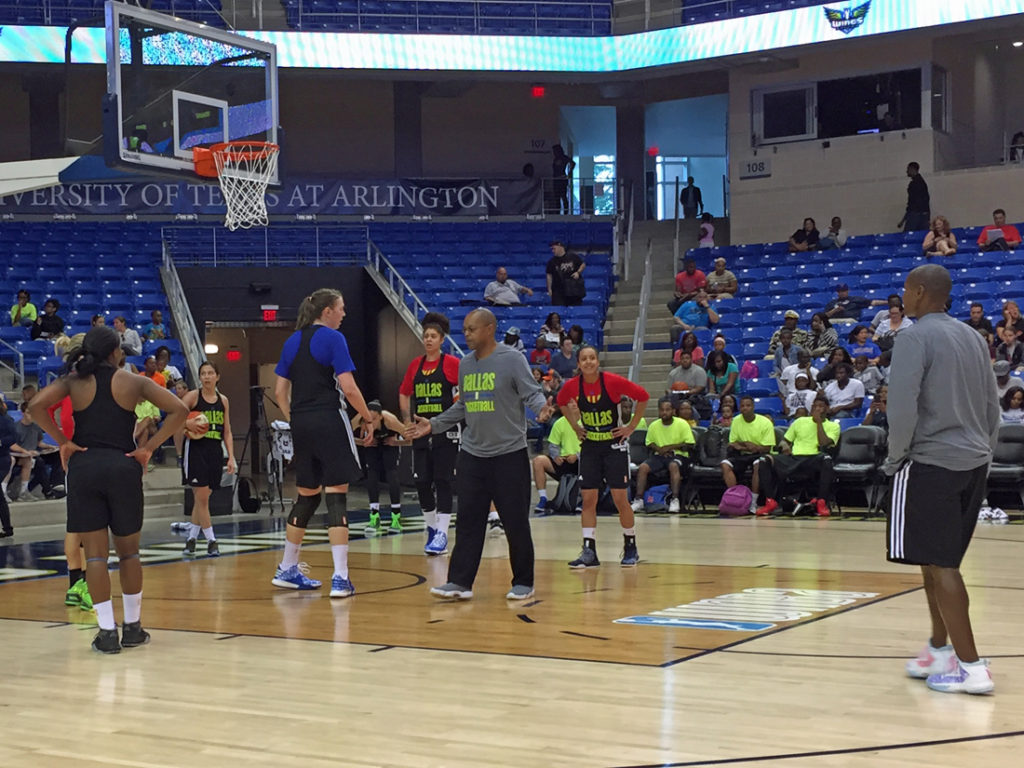
Wings_Practice_4423_1100

The WNBA’s Dallas Wings want you to know this is not your mother’s basketball game.

“My style of play is to get a lot of shots up and run,” said Wings head coach Fred Williams.

When I say “your mother’s basketball game,” I definitely mean your mother, not my mother. My mom once scored 57 points in a 1950s high school hoops game in Virginia. It was the old six-on-six version of the sport, but we can still surmise she got a lot of shots up and moved a good bit that day. So watching women’s hoopsters getting up and down the floor will be nothing new to her, but if you (or your mom) were expecting a plodding game from the area’s new women’s pro team, the Wings expect to show you differently.

“We get a lot of stereotypes as women playing in the professional ranks that our game is slower and less athletic,” said Wings forward Plenette Pierson. “Just to have a fast-paced game really changes things.”

Williams described his squad’s style of play as “up-tempo, fast break, you’ll see us do a little run-and-jump defense, a lot of traps.”

As he began training camp with Sunday’s open practice at UT-Arlington’s College Park Center, Williams mandated a number of full-court drills as he started implementing his preferred approach.

“It’s an up and down style. We want to try to get to 90 possessions each game,” guard Skylar Diggins said. “Coach Williams wants us up and down the court and to push the tempo. We want to control the tempo on both sides of the ball. That’s why you see us going up and down a lot in the first practice, getting ready for that.”

Diggins will play her third season in Williams’ system in 2016, having been part of the team when it was based in Tulsa. She missed much of last year with a knee injury, including an opening-round playoff loss. With the former All-Star back, Williams expects his core to be a strong one.

“We’ve been one of the top-scoring teams in the league the last couple of years with the same personnel,” he noted of a group that led the Western Conference in points-per-game in 2015. He also expects some off-season additions will improve his club’s ability to execute his preferred style of play.

“We’ve added some speed with (1st-round pick Aerial) Powers in there with us and I think with (2nd-round pick Ruth) Hamblin in there in the middle, it’s going to open it up for our shooters from the outside.”

One of those shooters came to the team in March via a trade with the Los Angeles Sparks.
“You’ve got to have a nice veteran player who has won championships in this league that can step in in the perimeter area and knock down some threes for you,” said Williams of new guard Erin Phillips.
The Australian Olympian, who already had a house in McKinney, feels Williams’ preferred tempo will fit her game.

“I’m a shooter, so the faster the ball moves, the quicker it gets in your hands and the quicker you can get a shot off as well. It gives you more space to play,” she said. “It’s a really fun way to play as a player.”

Williams hopes his players aren’t the only ones who find his favored pace enjoyable.

“I call it a fan-friendly atmosphere for the family. If (the players) do that (play up-tempo) and play well, these fans will come out and watch us,” the coach suggested.

If you do, you’ll see some fast-breaking ball. In truth, if you thought modern women’s basketball was a slow game, you probably should have realized long ago those stereotypes weren’t accurate. Some folks have known since the 1950s.

You can see for yourself when the Dallas Wings open their regular season home schedule May 21.


Rush Olson has spent two decades directing creative efforts for sports teams and broadcasters. He currently creates ad campaigns, television programs, and related creative projects for sports entities through his company, Rush Olson Creative & Sports.


RushOlson.com

Linkedin.com/company/rush-olson-creative-&-sports

Facebook.com/RushOlsonCreativeandSports

Thursday, April 21, 2016

Sowing Dreams

This article originally appeared in the Blotch section of the Fort Worth Weekly's website. To read it on that site : http://www.fwweekly.com/2016/04/20/sports-rush-sowing-dreams/


It’s one thing to break new ground. It’s another to continue to plow it, plant seeds in it, and nurture it year after year.

Last Thursday, a group of prominent sports figures (and a handful of entertainers) congregated in North Texas for the purpose of cultivating the future. The likes of Jerry Jones, Larry Fitzgerald, Rick Carlisle, and Toby Keith came at the behest of a Basketball Hall of Famer. The celebs’ host has always pushed boundaries.

Nancy Lieberman became the youngest basketball player to medal in an Olympics, the first to play in a men’s professional league, the first to be the head coach of a men’s professional team in the NBA Developmental League, and, just last year, only the second woman to serve as a full-time NBA assistant coach. What got all the prominent people to attend Lieberman’s annual Dream Ball gala, however, didn’t have to do with honoring her on-court achievements. It had to do with how she took her experiences, considered the people who helped her accomplish them, and looked to recreate their impact for others.

“All of us in this room are beneficiaries of people who reached down and pulled us up. I love that Nancy is doing that, not only on her own, but bringing all of us,” event host Mike Tirico of ESPN told the crowd.

Her Nancy Lieberman Charities aims to create opportunities for young people through basketball and educational initiatives, reflecting how assistance in those areas contributed to Lieberman’s own advancement.

“While your playing time is fleeting, the ability to turn almost every minute that you were on the court turn into a lifetime of recognizing a need and recognizing how to leverage your experiences, your career, into something that benefits a lot of people,” Cowboys owner Jerry Jones said in an interview a few days prior to the event, “Nancy’s arguably as good or better than anybody I’ve ever met.”

The Dream Ball raises funds for the non-profit’s programs, as the charity looks to facilitate another generation of groundbreakers. They honored Keith, Mavericks General Manager Donnie Nelson, and Cowboys Executive Vice President and Chief Brand Officer Charlotte Jones Anderson for their careers and philanthropic endeavors. Anderson summed up Lieberman’s philosophy from the podium as she accepted her award.

“You have many firsts associated with you, and I’m sure many people ask you what is it like to be the first.  Your response is ’It’s actually my obligation to make sure I’m not the last.’”
When people like Anderson and Lieberman break through in non-traditional sports environments, they succeed for more than just themselves. For one thing, they show the establishment a new way to win. Last week, we also celebrated the anniversary of Jackie Robinson and Branch Rickey showing baseball a new way to win, one that was quickly copied to the betterment of all.

The innovators also show the way to those who come after them, by example, and in the case of Lieberman and her guests, though personal investment of resources.

“It was my dream to be on the court because it was a safe environment. Nobody cared if I was a girl. Nobody cared if I was white or young or old. It was all about ‘could you play,’” Lieberman told Tirico on the stage. Her organization builds basketball courts at places like Boys and Girls Clubs so others can have the same experience and show that they, too, can play.

Eventually, as newcomers prove how irrelevant traits like skin color or gender or national origin are to the question of whether or not they can contribute to a franchise, more people like them get chances. Rick Carlisle introduced Donnie Nelson at the Dream Ball and spoke of the way the honoree’s efforts had demonstrated that non-Americans could play championship-quality basketball. Nelson’s open-minded outlook led him to hire a female coach for his D-League team, mostly because he and his bosses knew she understood hoops. The season she coached them, the Texas Legends made the D-League playoffs, the only time they have done so since moving to Frisco.

That season, Lieberman showed she could coach men effectively. At the Dream Ball, she and her attendees showed how the seeds sown by groundbreakers can blossom into opportunities well beyond their own fields, or courts, or continents.


Disclosure : Nancy Lieberman Charities once paid me for AV work I did on its behalf.


Rush Olson has spent two decades directing creative efforts for sports teams and broadcasters. He currently creates ad campaigns, television programs, and related creative projects for sports entities through his company, Rush Olson Creative & Sports.


RushOlson.com

Linkedin.com/company/rush-olson-creative-&-sports

Facebook.com/RushOlsonCreativeandSports

Wednesday, April 20, 2016

Creating a Sports Business Superstar

This post originally appeared on the Fort Worth Convention and Visitors Bureau blog. To read on that site : http://www.fortworth.com/blog/post/2016/20/Marketing-Fort-Worth-as-a-Sports-Destination/1254/


Sports fans come from all fifty states and a number of foreign countries to enjoy themselves at Texas Motor Speedway. Visitors from out of town can do business there, too, thanks to the track's numerous hospitality options. It turns out an out-of-towner can even start a sports company at the Fort Worth venue.

We discovered this fact while talking to one of the participants at the Fort Worth Convention and Visitor's Bureau's inaugural Sports Huddle event. The luncheon celebrated both the speedway's 20th anniversary and the recent announcement that the CVB had created Fort Worth Sports Marketing, a new department within the bureau.

The entrepreneur in question was NASCAR driver Kevin Harvick. It turns out that his KHI Management began its MMA business with a meeting at a TMS race.
 
Kevin Harvick
 

"The UFC side of things started right here at Texas Motor Speedway," Harvick explained to the media. "I had my first conversation with (UFC fighter) Donald (Cerrone) over a beer in the infield here at Texas. That progressed into him asking us to help him manage his day-to-day activity."

Harvick's company now works with MMA fighters (including Ultimate Fighting Championship Women's Bantamweight Champion Miesha Tate), golfers, singers, on-air talent, and even an up-and-coming motocross rider.


The CVB's new initiative aims to bring big sports names to town (like Harvick's) while also appealing to grassroots and developing sports enterprises (also like Harvick's).

"We have a lot to be proud of in Fort Worth," Bureau President and CEO Bob Jameson explained to the audience. "The CVB is launching the sports marketing department to help us continue to grow this segment and to further develop the economic impact that comes with that."


Texas Motor Speedway President Eddie Gossage has done sports business and brought in out-of-town guests to do theirs in Cowtown for, as the occasion commemorated, 20 years. He hopes his events contribute to the economic impact Jameson envisions.


"We spend $70 million a year getting tourists to town. Once they get here, they've got to decide where are they going to go? Where are they going to stay? Where are they going to go in the evenings to eat?" Gossage said."We're in Fort Worth and we want them to go to Fort Worth and spend their money."

The new sports marketing department shares Gossage's goal, and hopes to use the appeal of sport to bring more of those visitors and their money to Fort Worth. They feel the city has a lot to offer those who work in the world of athletic competition.

"This turns into a really big event (AAA Texas 500 occruing annually in April) because it's a really big market, not only for the race, but for our sponsors. There's always a lot of customers that show up to the race track," said Harvick. "It's definitely a place that everybody pays a lot of attention to and a lot of focus (is) put on it."

Eddie Gossage 

TMS often emphasizes that there are reasons to pay attention to the facility throughout the year and not just on race weekends. Fort Worth Sports Marketing aims to get sports-minded travelers to consider the town as whole a year-round destination as well. They see it as a place where firms can conduct sports business or, as Kevin Harvick and now the CVB have done, even launch one.


Rush Olson has spent two decades directing creative efforts for sports teams and broadcasters. He currently creates ad campaigns, television programs, and related creative projects for sports entities through his company, Rush Olson Creative & Sports.


RushOlson.com

Linkedin.com/company/rush-olson-creative-&-sports

Facebook.com/RushOlsonCreativeandSports


Wednesday, April 13, 2016

NASCAR is Semi-Serious Business

This article originally appeared in the Blotch section of the Fort Worth Weekly's website. To read it on that site : http://www.fwweekly.com/2016/04/12/sports-rush-nascar-is-semi-serious-business/


R1
Sports are supposed to be fun, but since the aim is to win, a competitor also has to take certain aspects of them seriously to realize his or her goals. One has to find the right balance between intensity and remembering it’s just a game.

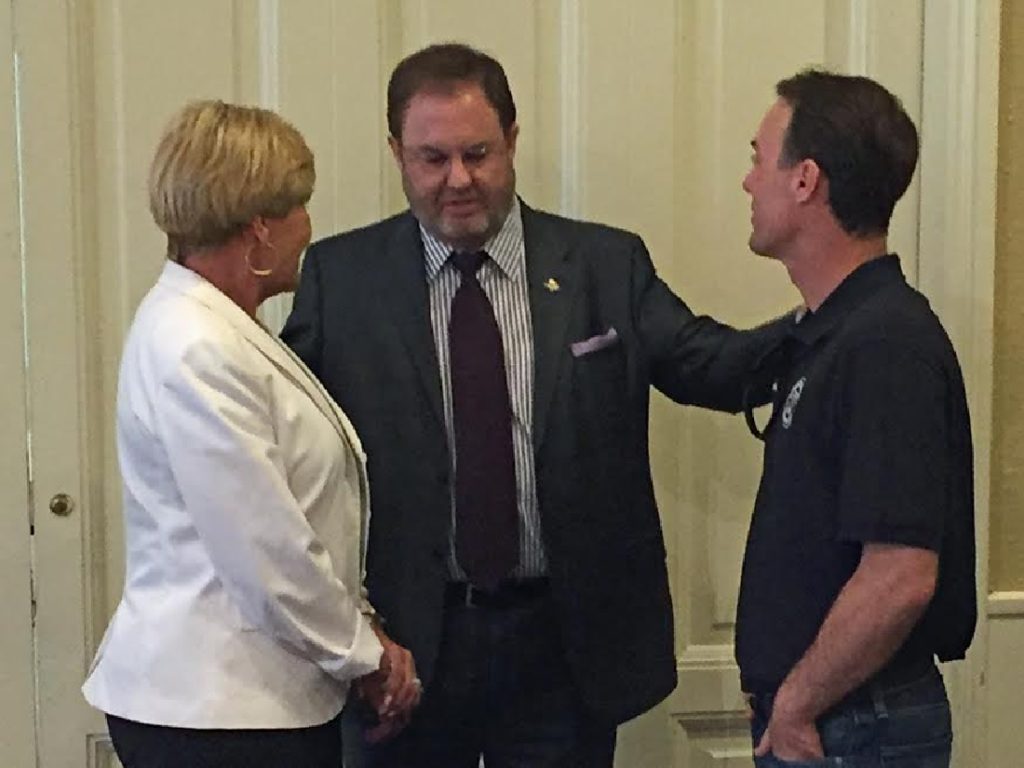
I thought about such aspects of sport while observing NASCAR personalities this week. Driver Kevin Harvick and Texas Motor Speedway President Eddie Gossage both attended the Fort Worth CVB’s Sports Huddle luncheon at the Fort Worth Club. NBC-5’s Newy Scruggs moderated a discussion with the duo, but the sportscaster largely got to save his voice for his on-air work. Harvick and Gossage had no problem carrying the discussion, and the most entertaining parts came from their back-and-forth banter.

Much of the jabber revolved around Harvick’s failure to win a top-tier race at Texas Motor Speedway. He has twice finished as high as second in the track’s Sprint Cup event and has won five Xfinity Series races and a Camping World Truck Series contest.

The exchange went like this :

Scruggs:  Eddie, if he likes you, he has some little way of messing with you a little bit. I think all of us who have been around him know that. Kevin, I know Eddie likes to hit you with the fact that, hey, Victory Lane is open for you for the Sprint Cup series. It’s been open for you for the truck . . .
Harvick: At some point (after winning a TMS Sprint Cup race), I’m going to park my car outside on pit road and I’m just going to go home. It’s so normal for me to not be there at this particular point, I figure what the hell, might as well just not even visit it. If we take the checkered flag, do we get disqualified if we don’t show up to Victory Lane? I’m going straight upstairs to champagne toast.
Gossage: You want the cowboy hat and the six shooters, don’t you? Then get your little heinie in there.

Gossage went on to explain how he revisits his running joke at least twice yearly, incorporating his track’s traditional winner’s reward of revolver fire and a Charlie 1 Horse lid.

Gossage: I always cross paths with him (Harvick) somewhere on race day and I always say to him, “Hey, you know we’ve got a Victory Lane after this one, too, and I’ve got a hat and six shooters that’ll fit you if you want it. Just come in and get hot when it’s over.”
Harvick: I don’t think he’s ever going to invite me to any more events if we ever win because he won’t have anything left to . . .
Gossage : I’ll have no material.
Harvick: He’s going to be out of material. Either that or my motor home’s going to be up on jack stands when I get there, with no wheels on it.
Gossage : Don’t tick him off. He’ll hit me, I’ve seen that stuff before, too. Let’s talk about Richmond. You and Ricky Rudd . . .
Harvick: Which time?

Both men have occasionally created controversy for themselves by reacting passionately to perceived slights. They referenced an incident from 2003 with the now-retired Ricky Rudd, but it has not been uncommon for Harvick to get crossways with his competition.

Gossage’s own flow of ideas seems to run without a restrictor plate. Scruggs’ opening remarks included a jab at Gossage’s penchant for writing letters to media members to chide them for insufficient coverage of his facility and his sport. Gossage acknowledged the correspondence, defended it, and even referenced it later on, along with other entanglements to which he’d contributed.

Both men admitted they sometimes let their emotions get the better of them, but they also didn’t mind poking fun at themselves for it. It struck me that in a general sense, that’s what we desire from our sports figures. We want them to be intense in competition, trying to win as hard as possible, but also maintaining a sense of fun and lacking pretension. Come to think of it, we like those qualities in a co-worker, too. You want someone who truly cares about his or her job but is also pleasant to share an office with.
As someone who made his living creating TV spots that often required sports figures (who were also co-workers) to perform in a goofy manner, I really learned to appreciate people who didn’t take themselves too seriously. When a Derek Holland was happy to make fun of his own mustache (in two languages) or a Mike Modano didn’t mind pretending he couldn’t get a date, it made my job a lot easier. And our marketing team would never have done those spots if we didn’t think self-deprecating humor helped fans feel more comfortable with those players. We all generally prefer to associate with people who don’t seem full of themselves.

I don’t truly know at all if either Kevin Harvick or Eddie Gossage are good guys or bad guys or in between. I have interacted with Harvick once by asking a question in a gaggle of media. I have now met Gossage once, and that was Thursday. He was friendly, thanked me for a question I asked during the media Q&A, and made a fairly standard radio host joke based on my first name. Because I hope to not take myself too seriously, I laughed at the Limbaugh quip and added some lame rejoinder.

General unpretentiousness doesn’t excuse specific incidents, so if Harvick or Gossage have been in the wrong in the past or end up there in the future, we must still hold them accountable. They improve such situations, however, with contrition and by making fun of their own shortcomings.
Harvick came up short this past weekend, finishing tenth in the Duck Commander 500. We can only hope he continues to keep his perspective about the result when someone brings it up, because TMS hosts another Sprint Cup race this fall and we can be fairly sure someone will. After all, it’s some of Eddie Gossage’s best material.


Rush Olson has spent two decades directing creative efforts for sports teams and broadcasters. He currently creates ad campaigns, television programs, and related creative projects for sports entities through his company, Rush Olson Creative & Sports.


RushOlson.com

Linkedin.com/company/rush-olson-creative-&-sports

Facebook.com/RushOlsonCreativeandSports


Friday, April 8, 2016

Playing to the Crowd

This article originally appeared in the Blotch section of the Fort Worth Weekly's website. To read it on that site : http://www.fwweekly.com/2016/04/07/playing-to-the-crowd-thoughts-on-directors-cut-by-adam-rifkin-and-penn-jillette/

R1
Director Adam Rifkin and writer/performer Penn Jillette needed their film “Director’s Cut” to be more than a movie. In fact, they needed it to be two movies on the screen, and a great deal more off it.
Media is more interactive than it has ever been. As consumers control the flow of what they watch, listen to, and read, they increasingly break the fourth wall. They can engage not only with the story they’ve chosen to watch but with the process and environment that created it. And, thanks to social media and other technology, they can participate in it at unprecedented levels.

“It was the idea is that everything is becoming so meta and everything is becoming so mashup. Wouldn’t it be really terrific to do a movie where they took all sorts of disparate media and threw it together and made a movie that was really one of passion,” Jillette noted during a question-and-answer session following Friday’s screening of the film at Plano’s Angelika Film Center.


“Everybody is becoming more and more aware of things like mashups (and) fan edits. It’s something that’s actually been popular in music for a long time, where people will sample things from other songs and create a completely new piece of music from components of other music. But I’d never seen it done with a movie before,” Rifkin said. “This movie exists entirely because of new media.”
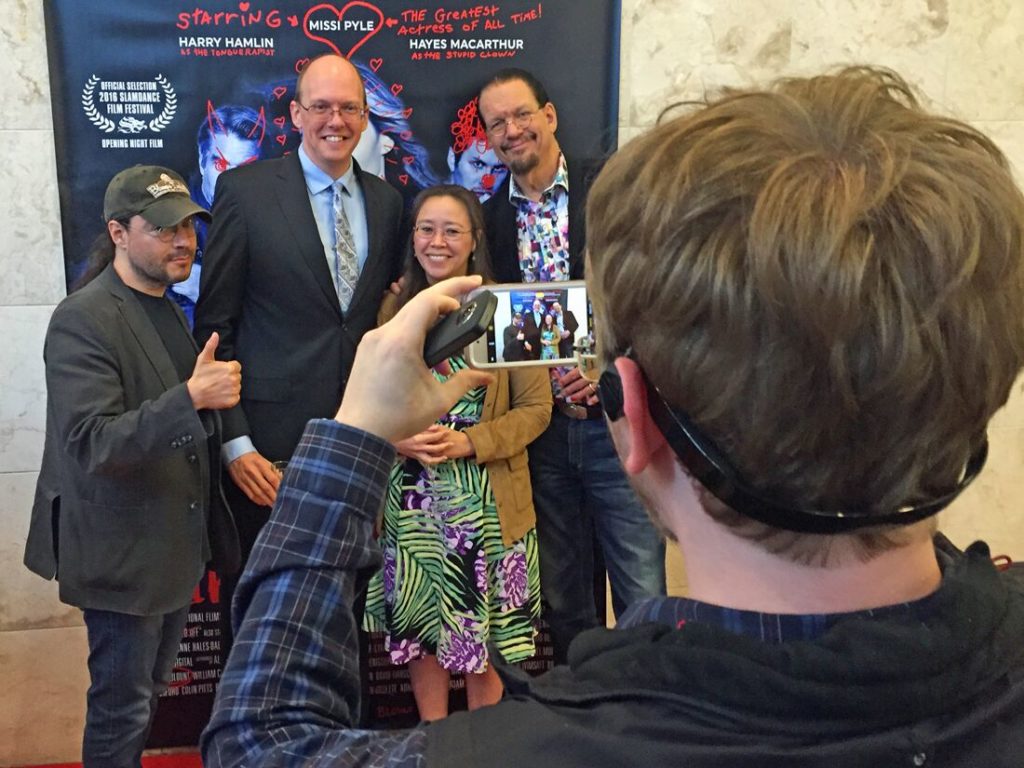
They held the screening, complete with red carpet, for the film’s “producers,” aka anyone who had contributed to the FundAnything “Make Penn Bad” campaign. Jillette and Rifkin had to fund it that way, partially because major studios didn’t bite on the film’s unique premise, but also because crowdfunding figures so heavily into their story that it almost wouldn’t have seemed right to do it another way.


“We pretty early on figured out this would be difficult movie to get funded in the traditional way. So Penn was the first one to suggest crowdfunding,” Rifkin said.

Jillette’s wife Emily administered much of the effort, which raised more than a million dollars. She attended the screening as well, and when a patron asked whether they might consider crowdfunding a future movie, the mother of two quickly interjected a decisive “no.”

The darkish comedy’s plot revolves around a character named Herbert Blount played by Penn Jillette.  The crew of a movie called “Knocked Off” allows the creepy, yet amiable, galoot (Rifkin called him a “sympathetic monster”) on the set by virtue of his sizable contributions to their crowdfunding campaign. Blount has an unhealthy obsession with Knocked Off’s female lead, Missi Pyle (playing herself in Director’s Cut), and the demented amateur filmmaker decides he will make his own version of the movie in which he will co-star with her. He steals their footage to go with what he’s shot himself on set, kidnaps Pyle, and sets about playing director.

The trick is that the entire movie you see when you watch Director’s Cut is Blount’s film, with the character’s DVD-style director’s commentary as narration throughout. Pristine images shot with a high-end Red Epic camera, ostensibly for the “Knocked Off” film, sit side-by-side with the clips Blount would have done himself, for which they used a prosumer camera, GoPros, and phone cams. To make it all work, they had to obsess over continuity.

“It’s a fake movie about a real movie being made, in which a fake crowdfunder is playing a real crowdfunder amid real crowdfunders, in a crowdfunded fake movie, but it’s a crowdfunded real movie,” Rifkin mused. “You’ve got keep track of all those different movies. Which one is Knocked Off? Which one is Herbie’s? How did Herbie get this footage? It looks simple when you see it all together, but we were tearing our hair out a lot during the process.”

Penn Jillette believes they got it right.

“There is not one frame of that movie or one line of that movie that isn’t completely justified that Herbie could have gotten ahold of the footage,” he said.

That’s not to say there aren’t a few moments to make you think about the world beyond the film. If you are a fan of Penn Jillette, the real-life performer, you may find it ironic when the avowed atheist’s character is thrown off track by Mormon missionaries or when his famously muted partner Teller delivers some deviant lines in a twisted cameo. The idea for the film came from Jillette’s creative brain after he became fascinated by directors’ commentary features.

“You trust that person to actually be in control,” Penn Jillette said. “I thought how kind of creepy and interesting it would be to give yourself over to someone in the director’s commentary that was actually crazy, who actually did not make the movie.”

He originally conceived it some ten years ago, before raising money from the masses took hold. Crowdfunding ended up not only helping him make the movie, but helping it make sense as well.
“I had his movie that I loved the script, but I put Herbie on the set by having him be a pizza delivery guy and work in craft services and it was always the weakest part of the script. It was really hard to justify,” Penn Jillette told a questioner. “Then we decided the movie had to be crowdfunded. We went through and did that rewrite and all of a sudden, the whole movie came together. So now, it’s very clear that, money aside, the movie could not have been made without crowdfunding.”


Anyone could contribute to the fundraising effort, and a diverse group attended the screening, which was held in North Texas because a funder named Randy Pitchford made the largest single payment among the 5,000-plus contributors. Attendees wore everything from David Bowie t-shirts to tuxedos. People in business suits mingled with fanboys. We saw pink hair, turquoise hair, and, of course, Penn Jillette’s notorious red fingernail. He and Rifkin have done a number of appearances related to the movie, and many of their crowdfunders have visited the set and the editing room. The newcomers’ presence became an asset for the filmmakers beyond the monetary contributions the fans made to get themselves there.

“By showing the cut so many times to so many people who came in, the cut got so much better so much quicker,” said Rifkin. “A lot of the people who came in for Boot Camp (the project’s name for crowdfunded edit session visits) had great ideas that you see in the movie. They’re incorporated into the film.”

“The experience in crowdfunding this movie for the Adam Rifkin of the movie is a nightmare. The experience of crowdfunding for the actual Adam Rifkin was just a joy,” Penn Jillette commented. “I have actually made friends from the crowdfunding, which is astonishing to me.”


At one point in the film, we see Blount has a painting of Missi Pyle hanging on the wall of his home (they reached out to their funders to crowdsource the painting). Given the film’s premise, one could wonder if a Herbert Blount copycat, with a painting of Penn Jillette on her wall, might have contributed to Director’s Cut.

“Of our almost 6,000 crowdfunders, there are a couple real-life Herbert Blounts. They’re not scary like the real Herbert Biount, but they’re a little HerbertBlountish,” said Rifkin. “We were never actually scared anything was going to happen, We just laughed. It was kind of funny. There were a couple very enthusiastic fans who have become very much a part of the experience for us.”
Having successfully funded and created their motion picture, Jillette and Rifkin premiered it at the Slamdance Film Festival in Park City, Utah, which Rifkin said had to add additional screenings to accommodate demand. They now want to make it available for more than just their fellow filmmakers.

“We’re screening it on the festival circuit, traveling the world with it,” said Rifkin. “Because it’s an unusual film, it’s a tough sell, because distributors don’t necessarily know the easiest way to sell it. So we’re trying to build buzz, build attention, get the word out there, showing it at a bunch of festivals in hopes that it will start to find its audience and a distributor will realize that and take it on. And, additionally, we’re trying to think of out-of-the-box ways to get it out as well.

Securing distribution for any film has its challenges, even one helmed by a public figure like Penn Jillette. During their Plano Q&A, the duo suggested to their fans that the filmmakers were open to ideas on how to get the movie released. That approach would seem logical – it would come as no surprise if a crowdfunded film that riffs on crowdfunding succeeded thanks to a crowdsourced distribution idea.


Rush Olson has spent two decades making filmic creative products for companies, sports teams, broadcasters. He currently creates ad campaigns, shows, and related creative projects through his company, Rush Olson Creative & Sports.

RushOlson.com
Linkedin.com/company/rush-olson-creative-&-sports
Facebook.com/RushOlsonCreativeandSports
Wednesday, April 6, 2016

Pigging Out at The Ballgame

This article originally appeared in the Blotch section of the Fort Worth Weekly's website. To read it on that site : http://www.fwweekly.com/2016/04/06/sports-rush-pig-out-at-the-ballgame/


Photo courtesy : Kelly Gavin/Texas RangersPhoto courtesy : Kelly Gavin/Texas Rangers
 
This is not your father’s ballpark brat, although you may want to bring Pops along to help you eat it.
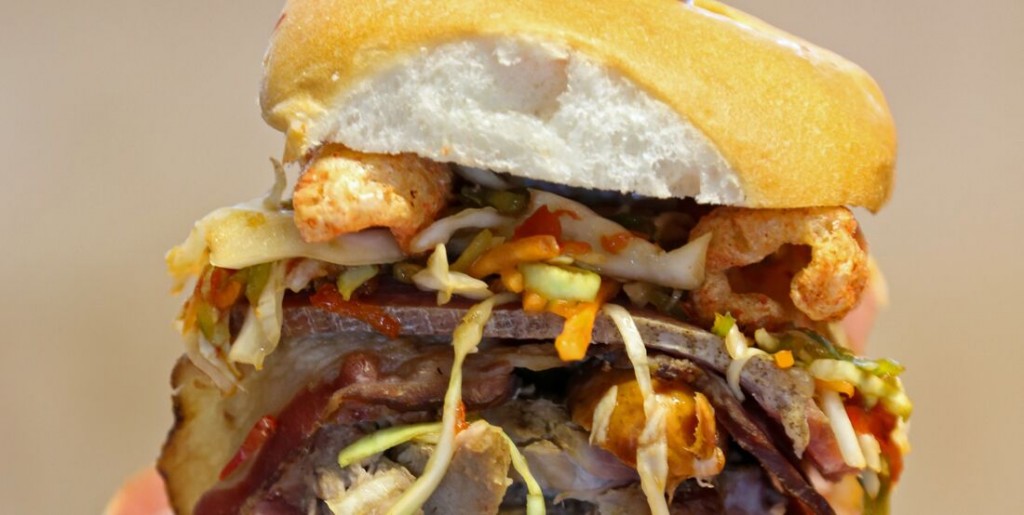
We refer to a new food item set to make its debut at Globe Life Park in Arlington this season. They call it the Wicked Pig, and the prodigious porcine sandwich continues a recent tradition of medicine ball-sized food offerings at the local baseball park. The concoction has some traditional components like sausage products between bread products, but it offers so much more.

“The last several years, it’s always been items that are horizontal,” explained Arlington Sportservice General Manager Casey Rapp. “So this year (Arlington Sportservice Executive) Chef Cris (Vazquez) got to talking about “Hey, let’s go vertical with it.”

Photo courtesy : Kelly Gavin/Texas Rangers

The tall sandwich does include a split sausage to maintain its ballpark hot dog credibility, but it also contains many other members of the pork family, including pulled pork, Danish bacon, prosciutto, thick sliced ham, and (because why not) pork rinds. They serve it near section 49 on a Hawaiian roll with barbecue sauce and cole slaw.

The Rangers and their stadium concessionaire, Sportservice, certainly know how to cater to meat junkies, and they will also introduce their Homerun Cheeseburger in the Captain Morgan Club. It includes four beef patties with American cheese, lettuce, tomato, and red onions on a brioche bun. However, they also will debut an entire menu for those who skew herbivorous. A new vegan stand near section 16 will feature plant-based versions of some standard ballpark fare.


“We’ve always had a few health-conscious and gluten-free vegan items here at the ballpark, but we’ve been told by fans that they’d like more, and so we’ve added some ballpark favorite-type vegan items, like nachos, hamburgers, and hot dogs that, of course, don’t have any meat products,” Rapp said.

As the ballpark’s top chef, Vazquez does a lot of the creative work in the kitchen. He looks for ways to put a new spin on more than just ballyard staples.

“Everybody’s doing chicken and waffles, so I thought I’m going to make a little twist,” said Vazquez. “So we’re doing chicken and donuts.”


They’ll serve the combination of donut holes and fried chicken on a 12-inch skewer drizzled with sweet & spicy buffalo honey sauce. It’s available at the Flew the Coop stand by section 50.
When one operates in a venue capable of holding nearly 50,000 diners, one expects not all of them will want to eat the same thing. Rapp and his team come up with new food items by incorporating fan suggestions and also by getting creative with items hungry spectators don’t even know they want – yet. That process starts early in the offseason.

“We start meeting once a week. There’s usually five to eight of us that sit around a table and we just throw crazy ideas at each other,” said Rapp.

Those nutty ideas (well, they could have nuts, anyway) have to be something that can be mass produced for a full ballpark, be able to be priced appropriately, and taste good. Plus, as with any recipe, Rapp’s crew also has to be able to source the ingredients and vessels in which serve them.

“You’ve got find someone who will actually make the product for you. When we did the Boomstick (named for former Ranger Nelson Cruz and still available by section 24), we had to find someone who had never done it before to make a two-foot long hot dog,” Rapp said. “You have to have something to serve it in. So with the Boomstick, we had to have somebody create a box just to carry the Boomstick. We have the same situation with the Wicked Pig. There’s a special square box that it sits in, and that way if it falls over or you want to eat it like an open-faced sandwich, you can do that.”

This year, Rapp, Vazquez, and company weren’t the only ones who got to have input into the menu. In the tradition of their Beltre Buster burger and Choomongous sandwich, they will introduce a new item named for a Rangers on-field icon. This ballplayer got to contribute more than his name.

“We always try to come up with something based on a player,” said Vazquez. “(Rangers Hall-of-Famer) Pudge (Rodriguez) likes to eat turkey. So we did a turkey panini with smoked turkey, lettuce, tomatoes, and onions, and we did a little rice stew. That’s what they do in (Rodriguez’s native) Puerto Rico. They call it a ropa vieja. It’s basically just a stew. He tried it, he loved it, so it’s going to be part of our new items.”


Fans can find the Ivan-approved “Pudge’s Plate” at the Captain Morgan Club, which is open to all fans on game days.

Rapp had his own favorite among the new selections. It packs some kick and some crunch.
“We decided we were going to break down the Flamin’ Hot Cheeto. We crunch it up to where it’s almost powder. Then we take that and put it in a gigantic pot of nacho cheese and we stir it around and we turn the nacho cheese to hot nacho cheese with the Cheetos,” he said.

They then add that mixture to the top of a hot dog and call it the “Flamin’ Hot Cheetos Dog.” You can buy one at the American Dog stands near sections 22 and 48. Before you do, however, they’ll add more Cheetos on top.

“The Flamin’ Hot Cheetos that are on top of it are not necessarily for the taste. It’s to give that hot dog the texture, the crunchiness,” Rapp said.

In all, the Rangers added 17+ new food items to their offerings in various parts of the ballpark, plus the new Best Damn Root Beer (5.5% ABV). One menu addition, however, actually made its debut late last year.

“We had featured it last year during the postseason and it was so well received, we’re doing the Cotton Candy Dog again,” said Rapp, of the frankfurter topped with cotton candy mustard.
As the Rangers begin the 2016 season, their fans will hope the team on the field can duplicate the Cotton Candy Dog’s ability to succeed in October. Meanwhile, they’ll have plenty to keep them, as well as their fathers and multiple other family members, satiated as they watch the campaign unfold.


Rush Olson has spent two decades directing creative efforts for sports teams and broadcasters. He currently creates ad campaigns, television programs, and related creative projects for sports entities through his company, Rush Olson Creative & Sports.


RushOlson.com

Linkedin.com/company/rush-olson-creative-&-sports

Facebook.com/RushOlsonCreativeandSports

Wednesday, March 30, 2016

Fort Worth Gets Into The Game

This post originally appeared on the Blotch page at the Fort Worth Weekly. To read it on that site : http://www.fwweekly.com/2016/03/29/sports-rush-fort-worth-gets-into-the-game/

R1
Last week, the Fort Worth Convention and Visitors Bureau (CVB) announced it had formed a sports marketing department. The focus will be promoting the mayor’s bid to become the first elected municipal official to win a spot on the U.S Olympic track cycling team.

OK, just kidding about the mayor, although Ms. Price does seem to highly value athletic pursuits. In truth, the initiative hopes to attract new sporting events of all kinds to Cowtown with an eye to boosting tourism revenue.

Josh Dill heads the sports marketing initiative. He has actually worked on sports matters for the CVB since 2013, but now will head his own division as Sports Marketing Director.  A study released in January by the Huddle Up Group took a comprehensive look at Fort Worth’s sports landscape and has helped guide some of the strategic directions Dill and the CVB plan to take.

Dill came to North Texas from Lubbock, where he worked in a similar capacity. He listed equestrian events, gymnastics, cheer, and motor sports as current strengths Fort Worth has in the sports world. He, like many of us, grew up loving all sports, however, and wants to bring as many different kinds of sporting events to the city as possible. We sat down with him for a Q&A session about what his department hopes to achieve.

Rush Olson: How is this different from what the CVB was doing before?
Josh Dill: We’ve slowly been devoting more resources to sports. I came in with a mission of this, of creating this department. Fort Worth was a convention town and had worked with sports. We had a few guys here who handled it on a reactive basis, but this is more of a proactive, relationship-building, figuring out what we do well and doing it, and carrying that through to the national level. I don’t want to bid of lacrosse right now because I don’t know that we have a strong lacrosse base here. So the idea is that we grow sports at the local level, build fans around it, and then we can go out and bid on these events. And then also just supporting what we already have, because we have a great sports history and a lot of great sporting activity already going on here.

Rush Olson: What do you want to accomplish?
Josh Dill: The end goal is always to create economic impact for the citizens of Fort Worth. I think the Texas Comptroller’s office has said it and it’s pretty universally true that the best way to grow your economy is by bringing people into it, having them spend money, and then leave. They come in, they’re not a strain on your resources, they’re not a strain on your infrastructure. They come in, they spend their money, and they leave. And that allows us to use that money to do more and more here locally. The end goal is that we start hosting more and more sporting events. I think eventually what I’d like to see is that we are more operational with our events, where we help operate the events and maybe, in the future, even owning our own events, so that we control that event, we put it in a time whenever Fort Worth’s calendar supports it, maybe a down time. And we start an event that’s really important to Fort Worth. We can kind of own and run that event and we don’t have to worry about bidding against other cities to host it.

Rush Olson: What resources do you have at your disposal?
Josh Dill: We’ve been slowly devoting more and more resources here internally. I think we have great resources in that we’ve been building great relationships with TCU and Parks and Community Services. Then kind of educating about what it is that we want to do. And people have embraced it at both those organizations and I think we’re starting to get a lot more support and headway in utilizing their facilities and bringing opportunities that benefit all parties.
Financially, we’re devoting more resources internally to sports. It allows me to hopefully add some additional staff members, but also promote Fort Worth in the right places as a sporting destination.
We’re really close to maybe expanding our staff. The overall goal is we want to be very methodical and do something that is very sustainable. Watching the national trends, sports commissions have popped up all over the country. A lot of them, if they’re not set up correctly, and if they bite off more than they can chew, they fail. A lot of them are independent, but the model that works is a blended sports commission, which is it’s a department of the CVB. We can share resources the CVB already has, but it’s separate marketing, different branding, I guess you would say. That plays better with the national governing bodies of sports.
We’re paying attention to sports more because it’s somewhat recession-proof. People will cut out vacations. They will cut out business trips based on the economy. Not many people will cut Johnny or Susie’s baseball, softball, lacrosse tournament. That’s the last thing they want to cut when times get tough. It’s proven to be a really recession-proof sector of our industry.

Rush Olson: What is the balance between “big-time” events and the grassroots variety?
Josh Dill: The big, flashy events help us gain some notoriety and they put us on the map. They don’t always create the most impact for Fort Worth. I think it’s really important that we support grassroots events because those are kind of the bread and butter of sports tourism. But you get notoriety by hosting some of the bigger events. It’s a balancing act. We try to look at events that we feel fit best for Fort Worth and our future goals. For instance, the NCAA Gymnastics event that we are having next month, and that we hosted last April, was one of the first things that came across whenever I got here. I looked at it as an opportunity to show the NCAA that Fort Worth is serious about sports and that we know how to host major events. It’s also, in turn, led to a few prospects, but also a few events like USA Gymnastics Junior Olympics. That was our way of saying, “We’re serious about gymnastics.” And people have responded by bringing a lot of gymnastics events here in the last three years.

Rush Olson: What is the ceiling for Fort Worth sports?
Josh Dill: A lot of cities get into this going, well, “We want to host the Olympics.” I think there’s a chance we could be a part of a regional potential to host something on that scale, but that’s not what I’m working towards per se. Honestly, a lot of our regional partnerships with the Arlington Convention and Visitors Bureau and with the Dallas Sports Commission and with our friends up in Frisco, we have a good group that gets together and discusses some major regional events, and we all benefit from them.
We’re looking strongly at bidding for more NCAA championships in the next cycle, which is this year. Over the next couple years, we want to host more national championships and we want to play a part in the regional events that we do. With Wrestlemania coming in, we don’t necessarily have an active role in that. That’s more of an Arlington and Dallas thing, and really it’s more Dallas than it is anyone else. Whenever that came up, my first thing was I went and looked at what ancillary events go on around Wrestlemania in which we can play our part. When we met with college football, the national championship committee there, that’s what we said. We saw, “The stadium’s in Arlington. Arlington is your running back. Dallas is doing this, they’re your quarterback. But we can be your left guard because we are very much a player in this and we have a lot of resources and we have the Texas feel that so many people from outside the region want.”

Rush Olson: What line do you walk in competing with, but also working with, the other cities in this area?
Josh Dill: I use the term “coopetition.” There are times when it’s us versus them. Luckily I feel like I have a strong relationship with a lot of the people in the cities that I’m competing against. I’ve always taken the approach that I want what’s best for the event. If the event works better in Arlington, then I want it to be in Arlington, because I know that there’s another event that fits for me. We all understand where we are and what we do well. I’ve sent events to Arlington and I’ve sent events to Dallas and said, “You should really look at Frisco,” but I’ve had the same thing returned, a lot of times more than I’ve sent. It’s not as contentious as one might think. That’s a good thing.

Rush Olson: What is your role in working with venues in Fort Worth?
Josh Dill: A lot of what I do is I go to trade shows and I go and meet and make relationships with national governing bodies or people that own events. I’m more of a broker. I broker deals. If I think something really fits at the speedway, then I take that opportunity to them. I try to make it advantageous for everyone.
We incentivize groups to come here, but I’m really adamant about not doing any kind of incentive that just lines someone’s pocket. We want to make sure that we are offsetting expenses to make sure that it shows that doing business in Fort Worth is good for the event owner and it’s good for the facility to get the benefit of hosting the event, whether it’s notoriety or it’s concession dollars, whatever it could be. We just try to make it as pleasant to do sports business in Fort Worth as possible.

Rush Olson: Do you have thoughts on Fort Worth having additional professional sports teams within the city limits?
Josh Dill: Professional sports is one of the things in our industry conferences we talk about a lot. They can be very helpful and they bring a lot of notoriety. I don’t think that it’s something that someone who’s tasked like we are, with creating economic impact, can really subsidize. I don’t think that it’s a good use of our funds to do that. But I do like the idea of having more professional sports teams here.

Is it something we’re going to actively pursue as part of our strategic plan? Probably not.

I can’t really get involved in subsidizing a professional sports team. I just want to have them there so I can bring them opportunities.


The Fort Worth CVB will host an event it is calling the Fort Worth Sports Huddle on April 7. This first event will honor the Texas Motor Speedway for its 20 years in Fort Worth. top-level NASCAR driver Kevin Harvick will speak. Eventually, they hope do a few such events each year to create dialogue around sports in Fort Worth. One can purchase tables or individual tickets for the April 7 event by contacting the CVB’s Elizabeth Story at ElizabethStory@FortWorth.com.


Rush Olson has spent two decades directing creative efforts for sports teams and broadcasters. He currently creates ad campaigns, television programs, and related creative projects for sports entities through his company, Rush Olson Creative & Sports.


RushOlson.com

Linkedin.com/company/rush-olson-creative-&-sports

Facebook.com/RushOlsonCreativeandSports