This article originally appeared in the Blotch section of the Fort Worth Weekly's website. To read it on that site :
http://www.fwweekly.com/2016/04/07/playing-to-the-crowd-thoughts-on-directors-cut-by-adam-rifkin-and-penn-jillette/
Director Adam Rifkin and writer/performer Penn
Jillette needed their film “Director’s Cut” to be more than a movie. In
fact, they needed it to be two movies on the screen, and a great deal
more off it.
Media is more interactive than it has ever been. As consumers control
the flow of what they watch, listen to, and read, they increasingly
break the fourth wall. They can engage not only with the story they’ve
chosen to watch but with the process and environment that created it.
And, thanks to social media and other technology, they can participate
in it at unprecedented levels.
“It was the idea is that everything is becoming so meta and
everything is becoming so mashup. Wouldn’t it be really terrific to do a
movie where they took all sorts of disparate media and threw it
together and made a movie that was really one of passion,” Jillette
noted during a question-and-answer session following Friday’s screening
of the film at Plano’s Angelika Film Center.

“Everybody is becoming more and more aware of things like mashups
(and) fan edits. It’s something that’s actually been popular in music
for a long time, where people will sample things from other songs and
create a completely new piece of music from components of other music.
But I’d never seen it done with a movie before,” Rifkin said. “This
movie exists entirely because of new media.”
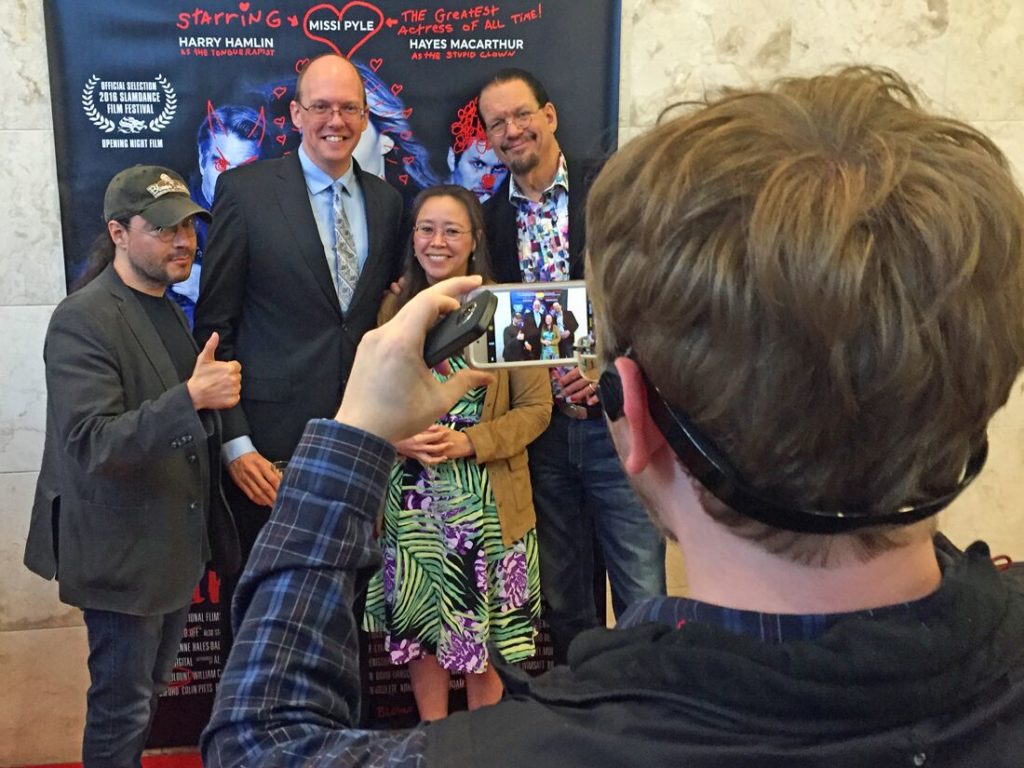
They held the screening, complete with red carpet, for the film’s
“producers,” aka anyone who had contributed to the FundAnything “Make
Penn Bad” campaign. Jillette and Rifkin had to fund it that way,
partially because major studios didn’t bite on the film’s unique
premise, but also because crowdfunding figures so heavily into their
story that it almost wouldn’t have seemed right to do it another way.

“We pretty early on figured out this would be difficult movie to get
funded in the traditional way. So Penn was the first one to suggest
crowdfunding,” Rifkin said.
Jillette’s wife Emily administered much of the effort, which raised
more than a million dollars. She attended the screening as well, and
when a patron asked whether they might consider crowdfunding a future
movie, the mother of two quickly interjected a decisive “no.”
The darkish comedy’s plot revolves around a character named Herbert
Blount played by Penn Jillette. The crew of a movie called “Knocked
Off” allows the creepy, yet amiable, galoot (Rifkin called him a
“sympathetic monster”) on the set by virtue of his sizable contributions
to their crowdfunding campaign. Blount has an unhealthy obsession with
Knocked Off’s female lead, Missi Pyle (playing herself in Director’s
Cut), and the demented amateur filmmaker decides he will make his own
version of the movie in which he will co-star with her. He steals their
footage to go with what he’s shot himself on set, kidnaps Pyle, and sets
about playing director.
The trick is that the entire movie you see when you watch Director’s
Cut is Blount’s film, with the character’s DVD-style director’s
commentary as narration throughout. Pristine images shot with a high-end
Red Epic camera, ostensibly for the “Knocked Off” film, sit
side-by-side with the clips Blount would have done himself, for which
they used a prosumer camera, GoPros, and phone cams. To make it all
work, they had to obsess over continuity.
“It’s a fake movie about a real movie being made, in which a fake
crowdfunder is playing a real crowdfunder amid real crowdfunders, in a
crowdfunded fake movie, but it’s a crowdfunded real movie,” Rifkin
mused. “You’ve got keep track of all those different movies. Which one
is Knocked Off? Which one is Herbie’s? How did Herbie get this footage?
It looks simple when you see it all together, but we were tearing our
hair out a lot during the process.”
Penn Jillette believes they got it right.
“There is not one frame of that movie or one line of that movie that
isn’t completely justified that Herbie could have gotten ahold of the
footage,” he said.
That’s not to say there aren’t a few moments to make you think about
the world beyond the film. If you are a fan of Penn Jillette, the
real-life performer, you may find it ironic when the avowed atheist’s
character is thrown off track by Mormon missionaries or when his
famously muted partner Teller delivers some deviant lines in a twisted
cameo. The idea for the film came from Jillette’s creative brain after
he became fascinated by directors’ commentary features.
“You trust that person to actually be in control,” Penn Jillette
said. “I thought how kind of creepy and interesting it would be to give
yourself over to someone in the director’s commentary that was actually
crazy, who actually did not make the movie.”
He originally conceived it some ten years ago, before raising money
from the masses took hold. Crowdfunding ended up not only helping him
make the movie, but helping it make sense as well.
“I had his movie that I loved the script, but I put Herbie on the set
by having him be a pizza delivery guy and work in craft services and it
was always the weakest part of the script. It was really hard to
justify,” Penn Jillette told a questioner. “Then we decided the movie
had to be crowdfunded. We went through and did that rewrite and all of a
sudden, the whole movie came together. So now, it’s very clear that,
money aside, the movie could not have been made without crowdfunding.”

Anyone could contribute to the fundraising effort, and a diverse
group attended the screening, which was held in North Texas because a
funder named Randy Pitchford made the largest single payment among the
5,000-plus contributors. Attendees wore everything from David Bowie
t-shirts to tuxedos. People in business suits mingled with fanboys. We
saw pink hair, turquoise hair, and, of course, Penn Jillette’s notorious
red fingernail. He and Rifkin have done a number of appearances related
to the movie, and many of their crowdfunders have visited the set and
the editing room. The newcomers’ presence became an asset for the
filmmakers beyond the monetary contributions the fans made to get
themselves there.
“By showing the cut so many times to so many people who came in, the
cut got so much better so much quicker,” said Rifkin. “A lot of the
people who came in for Boot Camp (the project’s name for crowdfunded
edit session visits) had great ideas that you see in the movie. They’re
incorporated into the film.”
“The experience in crowdfunding this movie for the Adam Rifkin of the
movie is a nightmare. The experience of crowdfunding for the actual
Adam Rifkin was just a joy,” Penn Jillette commented. “I have actually
made friends from the crowdfunding, which is astonishing to me.”

At one point in the film, we see Blount has a painting of Missi Pyle
hanging on the wall of his home (they reached out to their funders to
crowdsource the painting). Given the film’s premise, one could wonder if
a Herbert Blount copycat, with a painting of Penn Jillette on her wall,
might have contributed to Director’s Cut.
“Of our almost 6,000 crowdfunders, there are a couple real-life
Herbert Blounts. They’re not scary like the real Herbert Biount, but
they’re a little HerbertBlountish,” said Rifkin. “We were never actually
scared anything was going to happen, We just laughed. It was kind of
funny. There were a couple very enthusiastic fans who have become very
much a part of the experience for us.”
Having successfully funded and created their motion picture, Jillette
and Rifkin premiered it at the Slamdance Film Festival in Park City,
Utah, which Rifkin said had to add additional screenings to accommodate
demand. They now want to make it available for more than just their
fellow filmmakers.
“We’re screening it on the festival circuit, traveling the world with
it,” said Rifkin. “Because it’s an unusual film, it’s a tough sell,
because distributors don’t necessarily know the easiest way to sell it.
So we’re trying to build buzz, build attention, get the word out there,
showing it at a bunch of festivals in hopes that it will start to find
its audience and a distributor will realize that and take it on. And,
additionally, we’re trying to think of out-of-the-box ways to get it out
as well.
Securing distribution for any film has its challenges, even one
helmed by a public figure like Penn Jillette. During their Plano
Q&A, the duo suggested to their fans that the filmmakers were open
to ideas on how to get the movie released. That approach would seem
logical – it would come as no surprise if a crowdfunded film that riffs
on crowdfunding succeeded thanks to a crowdsourced distribution idea.
Rush Olson has spent two decades making filmic creative
products for companies, sports teams, broadcasters. He currently creates
ad campaigns, shows, and related creative projects through his company, Rush
Olson Creative & Sports.
RushOlson.com
Linkedin.com/company/rush-olson-creative-&-sports
Facebook.com/RushOlsonCreativeandSports