Showing posts with label DFW. Show all posts

Tuesday, March 28, 2017

Pushing The Ball

This post originally appeared at the Fort Worth Weekly's website. To view it there : https://www.fwweekly.com/2017/03/27/sports-rush-push-the-ball/

Basketball arrived in Tarrant County this year. I know because I had thousands of people screaming it in my ear.

A couple of weeks ago, I wrote a column about how the area had experienced an all-time high in men’s college basketball success. This past week, the local boys took it up another notch.

While the Dallas team about which I wrote, SMU, fell victim to a first-round NCAA tournament upset, Texas Wesleyan, Texas Christian, and Texas-Arlington posted some impressive results.

You might not have filled in their names in a bracket, because they weren’t playing in the NCAAs. But the single-elimination events in which they participated offer ample history and prestige.

Both the National Association of Intercollegiate Athletics (NAIA), where TWU played, national championship tourney and the National Invitational Tournament (NIT), postseason home for TCU and UTA, predate their NCAA counterpart. The NIT began its championship in 1938 after the NAIA had initiated its version for mostly smaller schools a year earlier. The NCAA started its tournament in 1939, but the NIT remained the more coveted title for some years thereafter.

Today, of course, there’s only one Big Dance. But for those schools unaccustomed to appearing there with Duke-like frequency, any late March competition feels meaningful.
The crowds felt substantial, too. UTA hosted two NIT games. A Monday win against Akron drew more than 5,000 fans and 6,000+ saw a furious comeback fall just short in a quarterfinal against Cal State Bakersfield.  Both crowds were season highs.
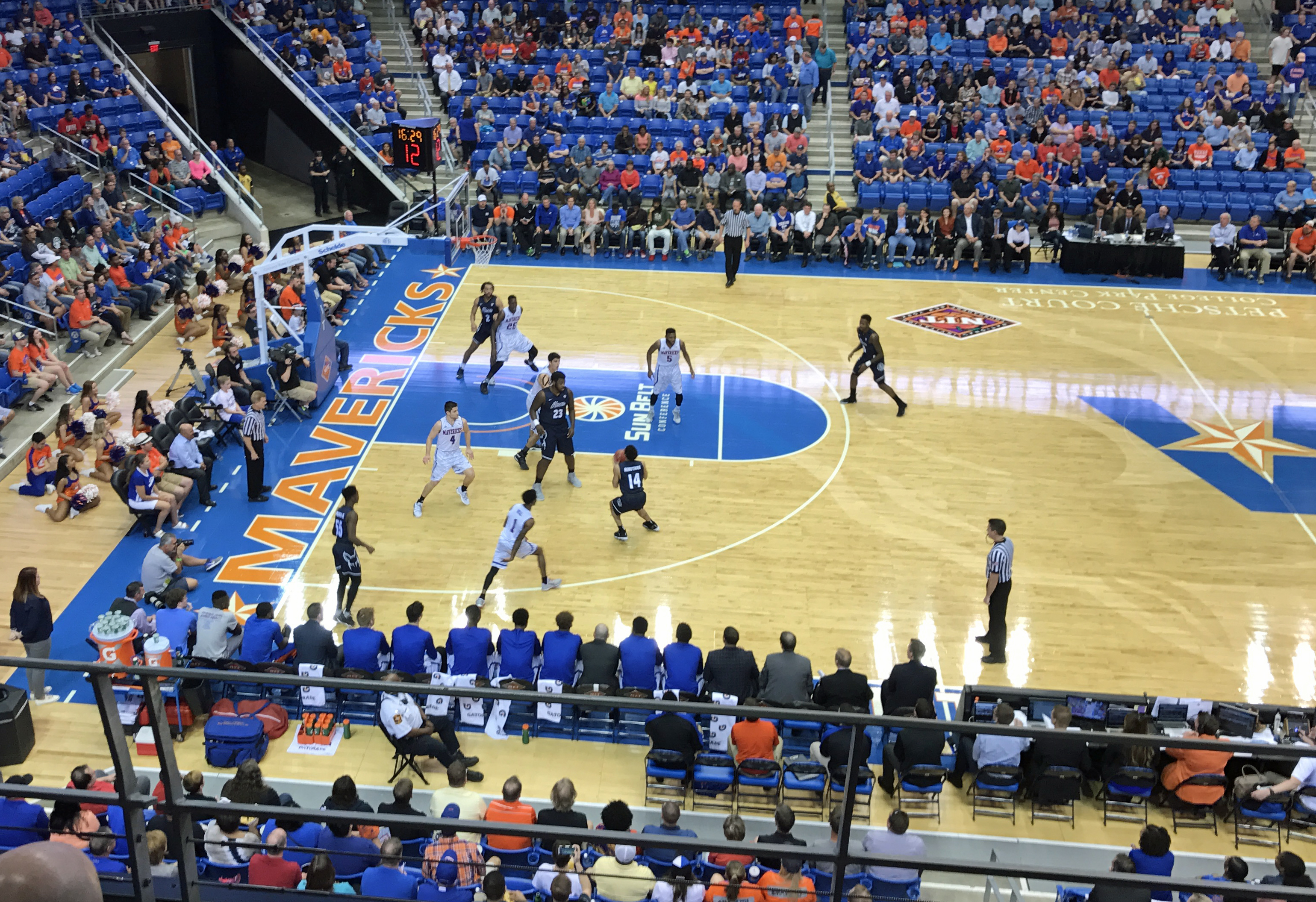
UTA Mens Basketball NIT 

TCU put nearly 6,000 fans of their own into Schollmaier Arena for their NIT quarterfinal against Richmond. Beyond just numbers, however, the atmosphere felt like a big game, one in which the winner would earn a chance to compete in the historic Madison Square Garden. The Horned Frogs played a complete game to earn themselves a trip to New York City. I stood below the student section for much of the game and can testify as to the volume and occasional maliciousness of their vocalizations. They were into it.

One observer who attended Richmond’s first round game in Tuscaloosa noted the atmosphere and intensity there paled in comparison to the ferocity of Frogland. For a school like Alabama that revolves around football national titles, an NIT berth may be no big deal. But for schools without such a pedigree, a postseason appearance offered a reason to celebrate.

Speaking of national titles and celebrating, TWU earned the ultimate honor in its classification. The Rams went to Kansas City and won the NAIA national championship. They didn’t get to play in front of home crowds, and they had to run the gauntlet of a full tournament packed into a week. It’s an impressive and significant accomplishment.
These west-side squads have pushed men’s hoops to the forefront of local consciousness. I have a proposal to help keep it there. Back in the ’70s, Wesleyan’s athletic director at the time (I know this because he is my father) proposed a local tournament among the Rams, Mavericks, Horned Frogs, and Mustangs. The bigger schools didn’t want to do it then, but maybe they should revisit the idea.

While TCU and SMU have played each other most years since 1918 (The Ponies won this past December 7), the rest of the group has matched up more sporadically. TCU hasn’t faced UTA since the Mavericks took the Frogs to overtime in both 2006 and 2007. UTA and SMU last played in 1997. TWU hasn’t taken on UTA since 2009, and hasn’t faced TCU or SMU since losing to both in 1982 (taking SMU to OT in Dallas).

One argument for such a tourney involves students. Last Tuesday, I chatted with Will Bryan, who handles media relations for Richmond’s men’s basketball team. As we watched the squads warm up, I asked him if they would stay in Fort Worth that night. He told me they would fly back because the players had school the next day. This season, our local student-athletes played mid-week games in the likes of Boise, Idaho; Morgantown, West Virginia; and Moraga, California. More local games mean fewer classes missed and more sleep before the ones the young men do attend (assuming they go to bed at a reasonable hour, as I always did in college and still do).

Another reason the teams should play each other is to keep this momentum going. The more they can do to stoke interest in the game here, the more it does to encourage participation and entice local recruits. A home-grown tournament would generate media coverage and outreach opportunities.

Texas Wesleyan, of course, is the wild card here. NCAA Division I schools wouldn’t benefit from an expected win against the Rams, but a defeat would be the equivalent of a football loss to a DII school. And as NAIA programs go, with two national titles in just over a decade, the east-siders are stout. Still, if you’re TCU, don’t you want a shot at leveling your record with your crosstown neighbors? Thanks to victories in 1937 and 1947, Texas Wesleyan currently owns the “Best of Fort Worth” title by a two-wins-to-one margin all-time.

If a tournament could help push the sport forward in this area, the DI athletic directors should consider it – especially if they can find a way to make money from it. Such a series should certainly have title sponsor appeal, especially during what could be a golden age of men’s hoops in North Texas. My eardrums can attest to it.

Rush Olson has spent two decades directing creative efforts for sports teams and broadcasters. He currently creates ad campaigns, television programs, and related creative projects for sports entities through Rush Olson Creative & Sports and FourNine Productions.

RushOlson.com
Linkedin.com/company/rush-olson-creative-&-sports
Facebook.com/RushOlsonCreativeandSports

Wednesday, June 29, 2016

Mavs Gotta Do What Exactly?

This post originally appeared at the Fort Worth Weekly's website. To view it there : http://www.fwweekly.com/2016/06/28/sports-rush-mavs-gotta-do-what-exactly/

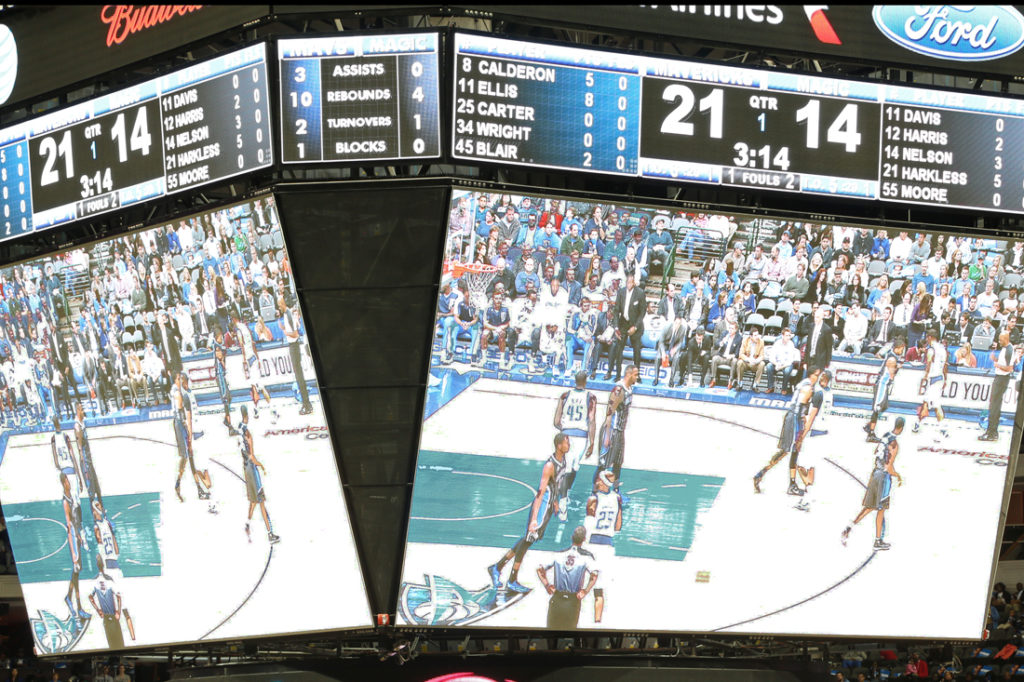
MavsAAC_1100_490A6552
The Dallas Mavericks head into the free agency season coming off a playoff season. They played a gutty series against an exceptionally talented Oklahoma City team while shorthanded. For some rosters, that might lead an optimistic Mavs fan to reason that the club is one of those “just-need-to-get-a-little-healthier-and-a-little-better-and-maybe-we-can-take-that-next-step” teams.

Unfortunately, the squad that persevered well enough to earn a postseason berth doesn’t seem to be a “young-team-on-the-verge-of-breaking-out” or a “veteran-team-that-can-make-a-title-run-by-shoring-up-a-key-position-in-free-agency.” The concern seems to be that they are a “middling-older-team-destined-for-upper-lottery-or-first-round-exit-for-eternity” sort of squad.

The franchise’s main goal, one would assume with Mark Cuban in charge, is to win another championship. Is there a path forward that leads to having a realistic chance of achieving such? Let’s look at some of the formulae that have worked for recent past champions.

1. Be-Led-By-A-Hometown-Superstar-Drafted-In-A-Premium-Position
For the past 60-some years, even extending back to the days of territorial picks, only nine teams have managed to win a title without a player they drafted among the top five overall picks, usually in the top two or three. Five of those titles went to the Kobe/Shaq/Pau Lakers. In basketball, a sport with only 10 players on the court at a given time, a transcendent Magic Johnson, Tim Duncan, or Hakeem Olajuwon can move the needle a lot. Free agency rules, including Bird rights, help teams keep a player like that around, which, in turn, attracts other good players.

The problem with this method is that you generally have to be really bad, get lucky in the draft lottery, and then hope a no-brainer superstar heads the draft that year instead of a Kwame Brown or Kent Benson. To even have a chance to make this method work, you need to have an unexpectedly injury-filled season, like the one the 1996-97 Spurs had to get Duncan, or just tear everything down, like the 2010-11 Cavaliers were forced to do to get Kyrie Irving. Both options are yucky. The Showtime Lakers landed Magic and James Worthy through free agent compensation and a trade with Cleveland, respectively, but compensation no longer exists and the Cavs’ picks aren’t worth much these days.

2. Hit-On-Lower-Draft-Picks
The good news is that seven of the nine champions who didn’t have method one at their disposals have come this century. You could almost throw the 2003-04 Pistons into that group (Darko Miličić – 2003 2nd overall – didn’t contribute a lot) and the 2010-11 Mavericks (former 2nd overall pick Jason Kidd left and came back) into the group. In fact, inspired scouting led the Mavs to effectively nab Dirk Nowitzki 9th overall (thanks to a draft-day trade with the Bucks) in 1998 and the Celtics to take title centerpiece Paul Pierce with the next pick. The Clippers had that year’s top pick, but missed badly by taking Michael Olowokandi.

Last year’s Warriors, led by Stephen Curry (7th overall in 2009), Klay Thompson (11th in 2011), and Draymond Green (35th in 2012), provide a great example of what superior drafting can do, as do the cases of Kobe Bryant (13th in 1996) and Kawhi Leonard (15th overall in 2011).
The good news is that the Mavs control almost all of their draft choices in upcoming years, after having gone without a first-round pick in seven drafts since 2004 (plus they traded Kelly Olynyk immediately after drafting him in 2013).

3. Sign-A-Lot-of-Expensive-Free-Agents
The Miami Heat used this strategy a few years ago, but they had their own top-five star in Dwyane Wade as a draw, plus South Beach is apparently a nice place to take one’s talents. The Mavs have neither of those enticements.

Free agents tend to be older and more injury-prone, they are tough to plan around (see DeAndre Jordan circa 2015), and their current team can always offer them more money. There’s also a lot of competition from places with more beaches, more titles, and more Times Squares.

4. Have-The-ABA-Fold-And-End-Up-With-Some-Of-Their-Talen
This worked well for the 1982-83 Philadelphia 76ers, who won with Julius Erving, Moses Malone, and Bobby Jones. I suppose it might be worth seeing if David Thompson still has any game.


Do none of the above sound terribly appealing? Yeah, that’s what I thought. This process is never easy, and it is complicated by the idea of trying to win another title while Dirk Nowitzki still plays here. I think I’d lean toward acquiring as many hard-throwing relief pitchers as possible on one-year contracts and trade them all before the deadline for minor leaguers. Wait, dang, wrong sport.

I truly don’t know how to advise Mavs GM Donnie Nelson here. He’s been a remarkable innovator throughout his career, from finding international players to hiring a female coach to winning a championship with a team nobody picked to do it. I guess I’d tell him to channel his inner Moneyball (sorry, more baseball) and find the-thing-nobody-else-is-doing. Is the answer spending more on scouts or scouting methodologies to try to get some Josh Howards and Rolando Blackmans in here while never again missing on the Greens and Bryants? Is it funding medical research to allow the Mavs a proprietary technology to reverse aging, allowing the Mavs to win by signing Dr. J, Kareem, and Swen Nater? Maybe Mark Cuban can pump money into Space-X to go find baller aliens like the ones in Space Jam? Good luck getting work visas for those guys in a Trump administration.

Bottom line is, if you’re a MFFL, remember that almost half the league’s teams have NEVER won an NBA title. So while you wait for the Mavs’ braintrust to figure things out, stay positive. Call it the “yeah-but-we-could-be-the-Suns” approach.


Rush Olson has spent two decades directing creative efforts for sports teams and broadcasters. He currently creates ad campaigns, television programs, and related creative projects for sports entities through Rush Olson Creative & Sports and FourNine Productions.


RushOlson.com

Linkedin.com/company/rush-olson-creative-&-sports

Facebook.com/RushOlsonCreativeandSports

Saturday, May 28, 2016

Top Spots in Ft. Worth to Watch the Rangers

This post originally appeared on the Fort Worth Convention and Visitors Bureau blog. To read on that site : http://www.fortworth.com/blog/post/2016/19/Top-Spots-to-Watch-the-Rangers/1263/


The Texas Rangers don’t play at Globe Life Park in Arlington.


Well, okay, they don’t always play at Globe Life. Half their games are road games, and Spring Training games happen mostly in Arizona. That means you’ve got to find somewhere to watch your Rangers play when they don’t do it in Tarrant County. Luckily. Fort Worth has a number of establishments you can access to get your game on.


We’d like to establish that this list is not comprehensive. Do you have a favorite place where you like to watch the local baseball team? Let us know in the comments and on social media and help us spread the word about good places to share nine innings with old or new friends.


We’ve organized this list geographically, so you can find somewhere close to you.


West 7th

On one of the fact-finding missions for this column, Landmark Bar & Kitchen won the titles (across neighborhoods) for most total TVs showing the Rangers game and most consecutive sets with the game on. More than half a dozen LGs ringing the outdoor bar all showed the Fox Sports Southwest broadcast and several more inside had it as well. Preston the bartender told us he wanted to be able to move anywhere in the place and keep up with the game, and he succeeded. Good call by him.


The West 7th area actually gives you lots of options for catching the game. The Varsity Tavern has TVs as big as Nomar Mazara’s future, and you can also look for the game on multiple screens at the likes of King Crab Tap House, Brewsters, Reservoir, the Durty Crow, The Local, BoomerJacks, and several others.


Downtown

It’s hard to pick one place in downtown. It might depend on where your hotel or office is, or perhaps what kind of food you want. Frankie’s is near the central library, but the bar that’s actually called “The Library” is at Houston and 6th, Ojos Locos bills itself as a sports cantina, with Tex-Mex offerings and TVs in several booths, so you can feel like you’ve got Steve Busby and Tom Grieve actually dining with you. Whiskey & Rye has won a few awards for best sports bar in town. You’ll find them in the Omni Hotel in southern downtown by the convention center.


A downtown sleeper pick : The Red Goose Saloon. You can sit at the bar and watch the game on a couple of screens, and the food is underrated. You can smoke here, if that appeals to you.


You could actually watch the game at the Texas Rangers Team Shop on Main Street. Not only do they have a TV inside the store, they have a couple of sets by the windows facing the street. If you don’t mind standing on the sidewalk, you can be sure the game will be priority programming.


Stockyards

Nolan Ryan is a member of the Texas Cowboy Hall of Fame, located in the Fort Worth Stockyards National Historic District. However, Cowtown’s north side has more saloons than sports bars. We recommend you sit at the bar at Filthy McNasty’s Saloon (they’re friendlier than they sound) and enjoy a beverage while watching the game on the TVs above the bar.


East Side

The No Frills Grill on Eastchase is as close as you can get to Globe Life Park in Arlington without leaving Fort Worth. And they do, in truth, have some frills - specifically TVs showing the Rangers game. You can almost see the home run fireworks from there.


Near South Side

Upper 90 on College came into being when the owners felt the Magnolia area needed a sports bar. They may be named after a soccer term, but you can still count on them having the Rangers game on one of their many TVs.


Hulen Area

You’ve got plenty of choices in restaurants near the mall. We’ve watched a Super Bowl or two at the Fox & Hound. You can play pool while you watch the ballgame there, too.


Rush Olson has spent two decades directing creative efforts for sports teams and broadcasters. He currently creates ad campaigns, television programs, and related creative projects for sports entities through his company, Rush Olson Creative & Sports.


RushOlson.com

Linkedin.com/company/rush-olson-creative-&-sports

Facebook.com/RushOlsonCreativeandSports


Wednesday, April 20, 2016

Creating a Sports Business Superstar

This post originally appeared on the Fort Worth Convention and Visitors Bureau blog. To read on that site : http://www.fortworth.com/blog/post/2016/20/Marketing-Fort-Worth-as-a-Sports-Destination/1254/


Sports fans come from all fifty states and a number of foreign countries to enjoy themselves at Texas Motor Speedway. Visitors from out of town can do business there, too, thanks to the track's numerous hospitality options. It turns out an out-of-towner can even start a sports company at the Fort Worth venue.

We discovered this fact while talking to one of the participants at the Fort Worth Convention and Visitor's Bureau's inaugural Sports Huddle event. The luncheon celebrated both the speedway's 20th anniversary and the recent announcement that the CVB had created Fort Worth Sports Marketing, a new department within the bureau.

The entrepreneur in question was NASCAR driver Kevin Harvick. It turns out that his KHI Management began its MMA business with a meeting at a TMS race.
 
Kevin Harvick
 

"The UFC side of things started right here at Texas Motor Speedway," Harvick explained to the media. "I had my first conversation with (UFC fighter) Donald (Cerrone) over a beer in the infield here at Texas. That progressed into him asking us to help him manage his day-to-day activity."

Harvick's company now works with MMA fighters (including Ultimate Fighting Championship Women's Bantamweight Champion Miesha Tate), golfers, singers, on-air talent, and even an up-and-coming motocross rider.


The CVB's new initiative aims to bring big sports names to town (like Harvick's) while also appealing to grassroots and developing sports enterprises (also like Harvick's).

"We have a lot to be proud of in Fort Worth," Bureau President and CEO Bob Jameson explained to the audience. "The CVB is launching the sports marketing department to help us continue to grow this segment and to further develop the economic impact that comes with that."


Texas Motor Speedway President Eddie Gossage has done sports business and brought in out-of-town guests to do theirs in Cowtown for, as the occasion commemorated, 20 years. He hopes his events contribute to the economic impact Jameson envisions.


"We spend $70 million a year getting tourists to town. Once they get here, they've got to decide where are they going to go? Where are they going to stay? Where are they going to go in the evenings to eat?" Gossage said."We're in Fort Worth and we want them to go to Fort Worth and spend their money."

The new sports marketing department shares Gossage's goal, and hopes to use the appeal of sport to bring more of those visitors and their money to Fort Worth. They feel the city has a lot to offer those who work in the world of athletic competition.

"This turns into a really big event (AAA Texas 500 occruing annually in April) because it's a really big market, not only for the race, but for our sponsors. There's always a lot of customers that show up to the race track," said Harvick. "It's definitely a place that everybody pays a lot of attention to and a lot of focus (is) put on it."

Eddie Gossage 

TMS often emphasizes that there are reasons to pay attention to the facility throughout the year and not just on race weekends. Fort Worth Sports Marketing aims to get sports-minded travelers to consider the town as whole a year-round destination as well. They see it as a place where firms can conduct sports business or, as Kevin Harvick and now the CVB have done, even launch one.


Rush Olson has spent two decades directing creative efforts for sports teams and broadcasters. He currently creates ad campaigns, television programs, and related creative projects for sports entities through his company, Rush Olson Creative & Sports.


RushOlson.com

Linkedin.com/company/rush-olson-creative-&-sports

Facebook.com/RushOlsonCreativeandSports


Thursday, October 15, 2015

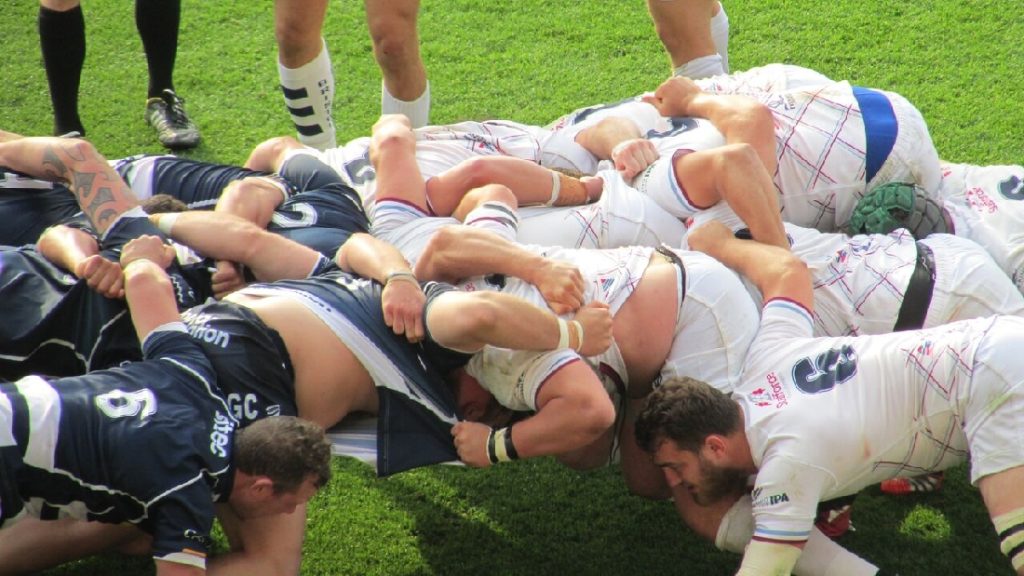
Scrummaging with the Big Boys


This post originally appeared on the Blotch page at the Fort Worth Weekly. To read it on their site : http://www.fwweekly.com/2015/10/13/the-bristol-rugby-club-scrummaging-with-the-big-boys/


B Rugby Main


What would the Allen Americans of the ECHL do if the Winter Olympics staged its hockey tournament in Texas in the middle of the team’s season?

The Americans would have to assess how to sell tickets to their games while contests in the same sport, played at its top level, occurred nearby simultaneously. Would the best strategy be to ignore the Olympics, bash them, or perhaps find a way to take advantage of them?

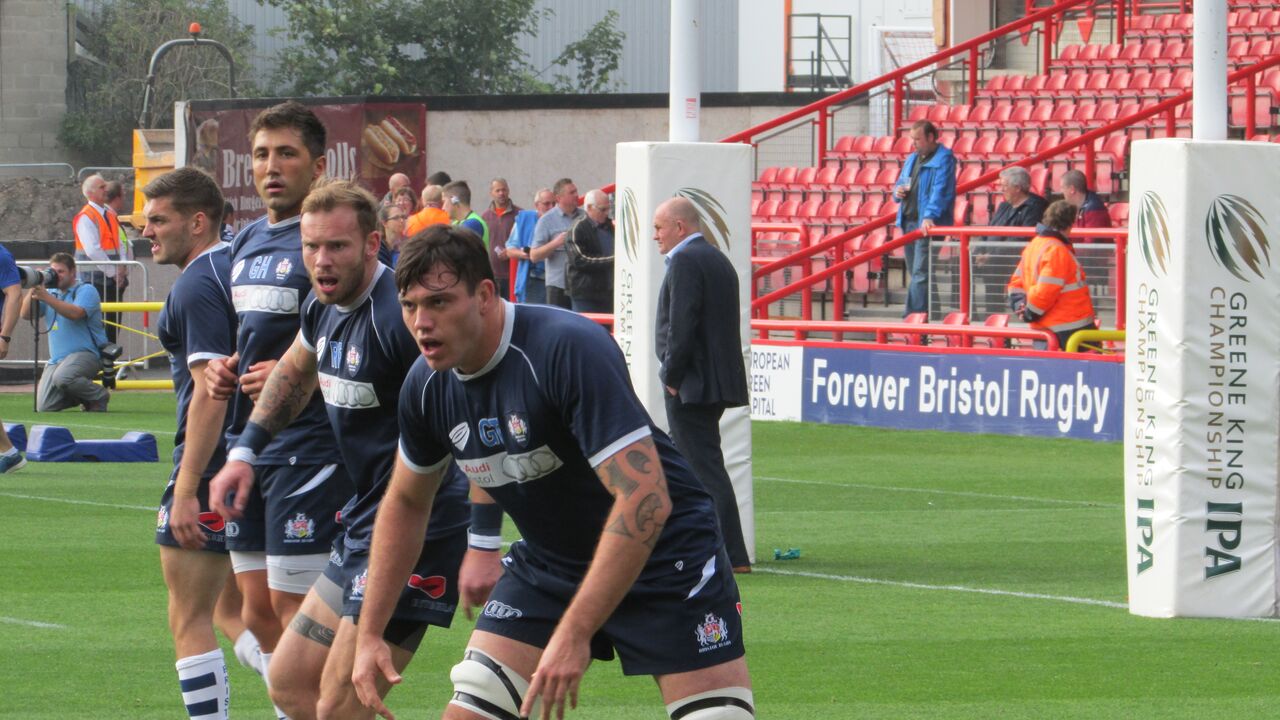
In the United Kingdom, a number of rugby union teams find themselves faced with a similar decision. As the Rugby World Cup rages around them, teams like Bristol Rugby Club must find a way to market their own products, too.

England’s top rugby union league (not to be confused with the similar but different sport called “rugby league”) is the Aviva Premiership. It suspended games until the RWC enters its knockout rounds this week, kind of like how the NHL and the Dallas Stars don’t play games during the Olympic hockey tournament. Bristol, alas, finished a point short of promotion to the first division last season, so they compete in the second-best league in England, the Greene King IPA Championship. They play a regular schedule, which has so far included three home games.

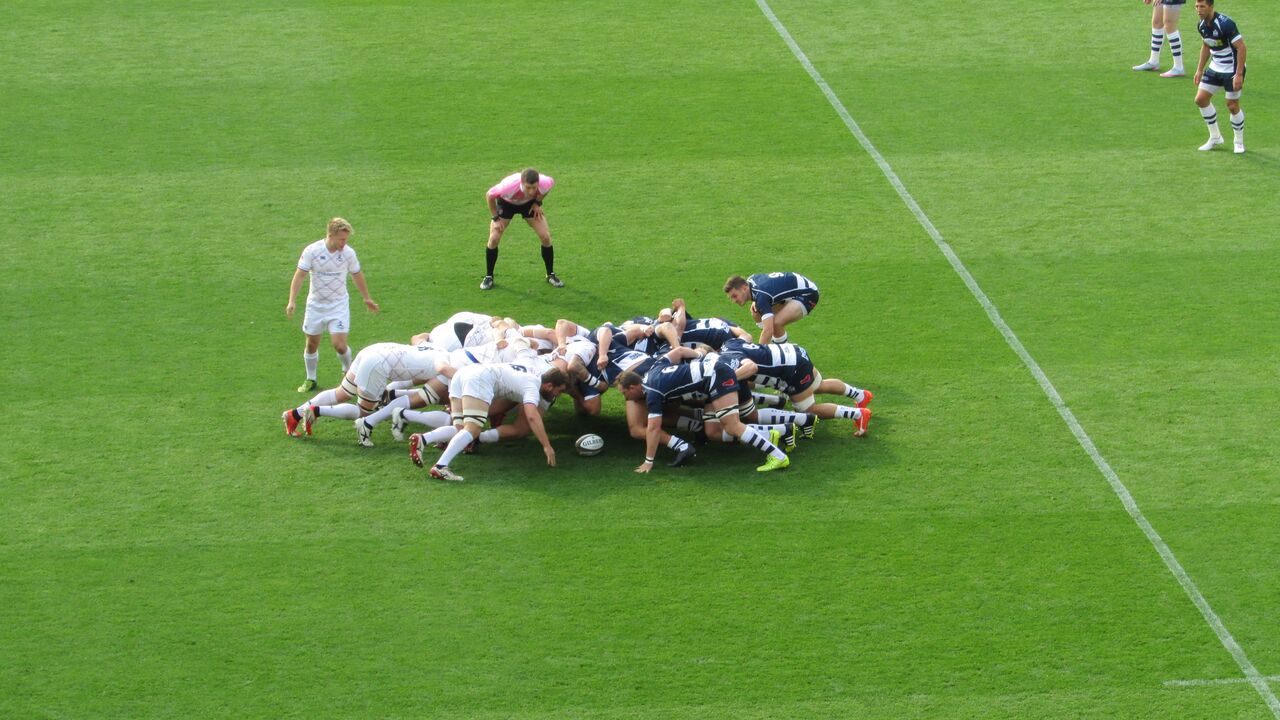
I joined 4,560 fans in attending the season’s third game, which came against Rotherham. The season-low crowd may well have had something to do with rugby burnout after England’s national team had its RWC title hopes crushed by Australia the evening before.

Bristol has additional issues brought on by the Rugby World Cup. For one, the franchise had the team from Georgia (the country, not the state whose official reptile is the gopher tortoise) training in its city, potentially drawing rugby attention away from the local side. For another, Bristol actually loses players to national sides, an obstacle an ECHL team would be highly unlikely to face. Matthew Morgan got the call from Wales, Jack Lam and Anthony Perenise played for Samoa, and Tommaso Benvenuti wore a blue Italy shirt.

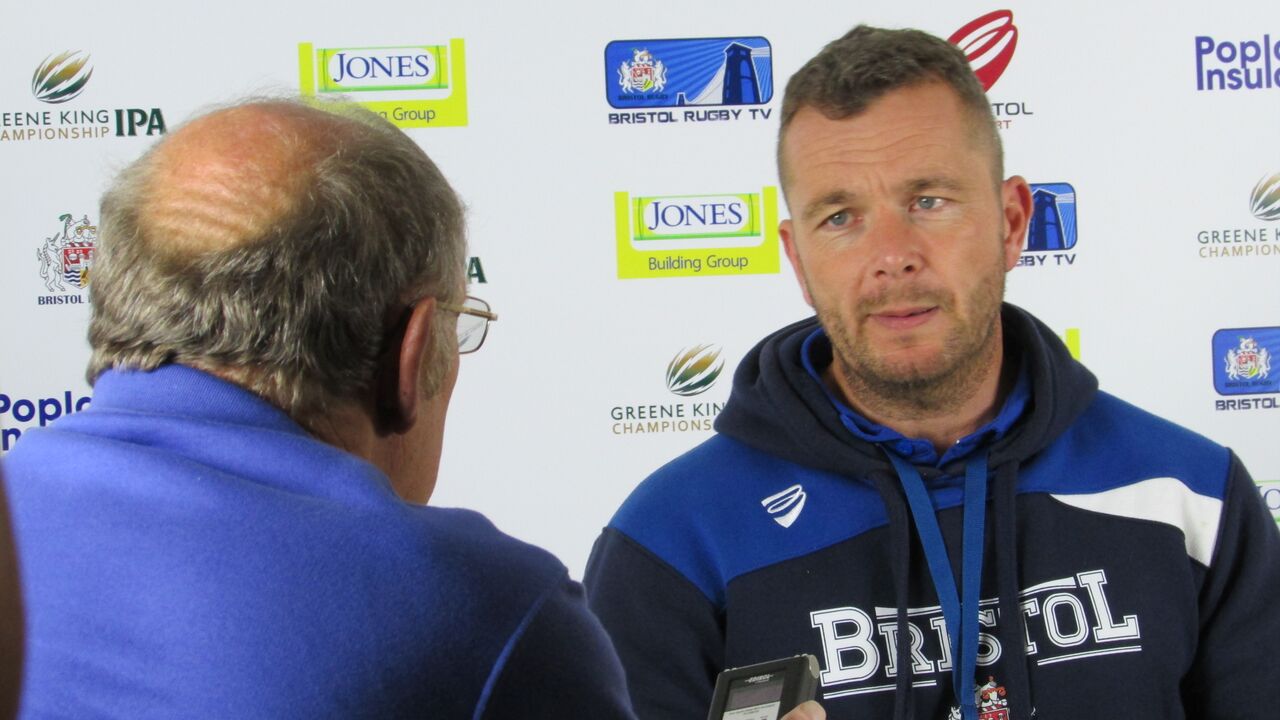
First Team Coach Sean Holley doesn’t view their departure as a negative, however.

“We have four players involved and that puts Bristol on the map. They’ll come back having participated in that environment,” he said.


In addition to the experience the quartet of internationals will gain, an added benefit will come from the playing time the club’s younger players will get in their absence.

“That’s only going to hold us in good stead when the internationals come back,” said flanker Olly Robinson, who scored two tries (similar to American football’s touchdowns) in the win over Rotherham.

Winning games, certainly, never hurts attendance no matter what else is going on. Holley may have found another RWC benefit, as well, one that may have contributed to his squad’s four-game winning streak.

“I’ve been showing examples of good practice (as seen in the RWC) to the players,” he said.
Off the field, Bristol Rugby has chosen to embrace the biggest international event in its sport and turn interest in it to the club’s advantage as much as possible.


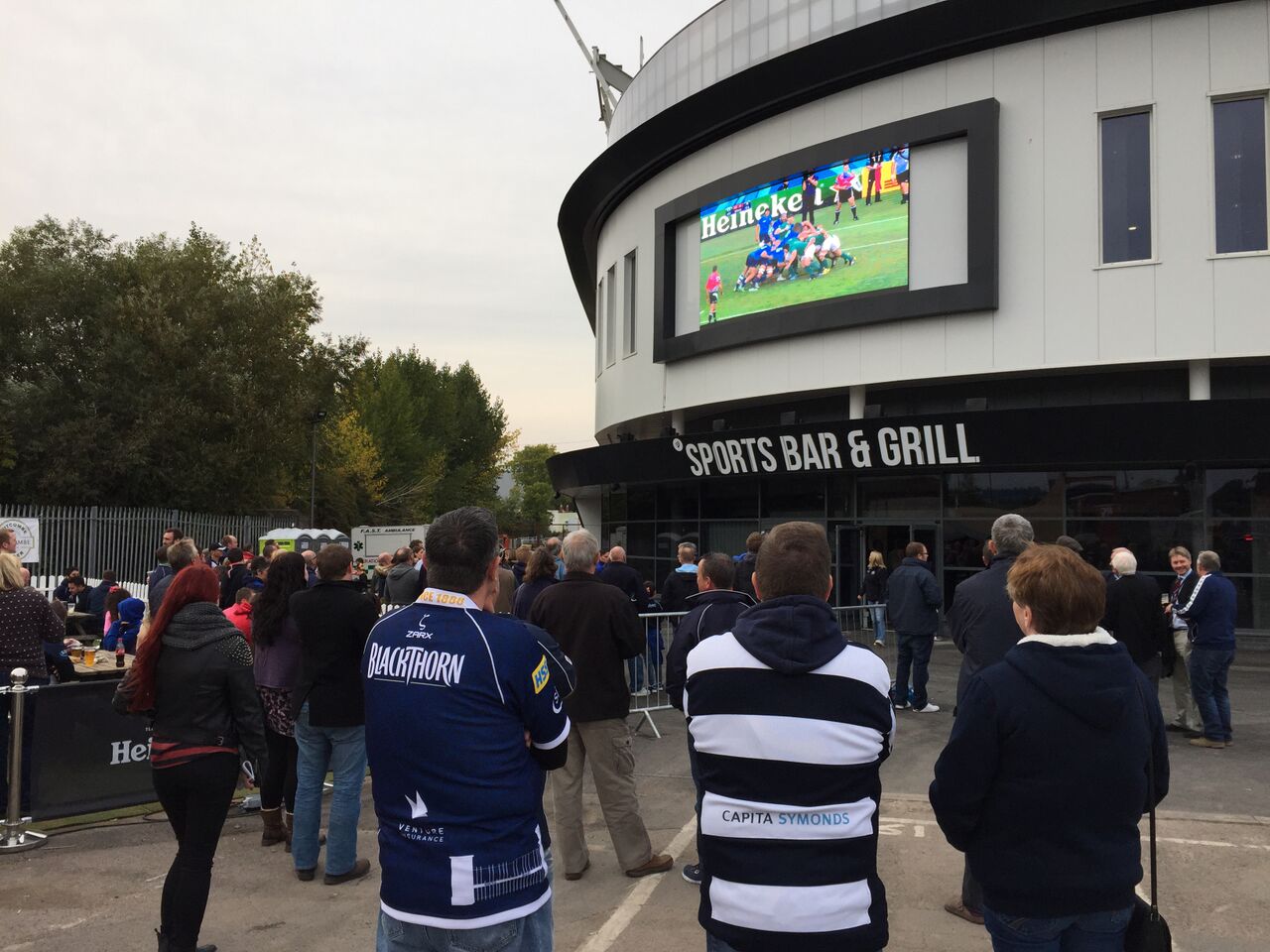
Program (aka “programme”) articles celebrate Bristol ties to the tournament. The franchise sponsors watching parties for the RWC games and encourages fans to stay after home games to watch the end of the international games as well. Fans can cluster around TVs inside the stadium, too.
To counter pressure from a nationally prominent competitor, it will often behoove a local business to emphasize grassroots initiatives. At halftime of the Rotherham game, participants in that morning’s Ashton Park schools under-13 rugby tournament paraded around the field.


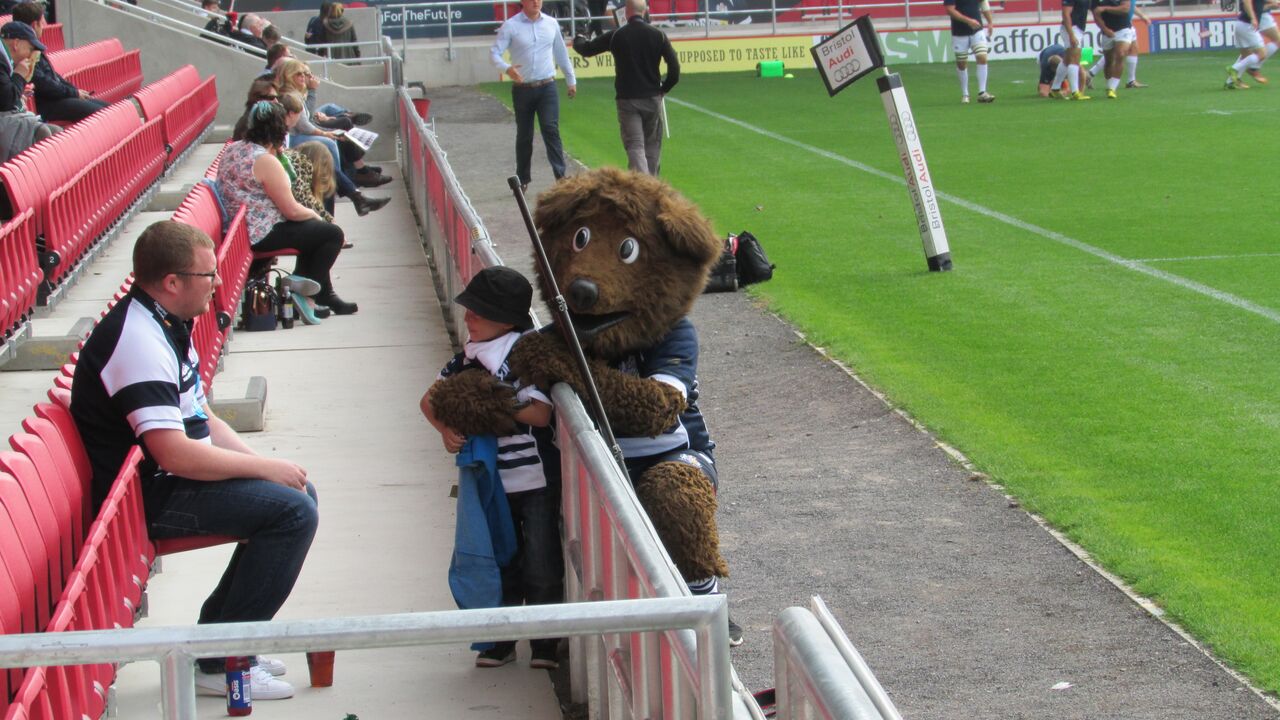
Bris has a mascot, too, to enhance the game experience of young fans, many of whom may have no idea the RWC is even going on. National mascots are never as lovable as local ones like Brizzley Bear.


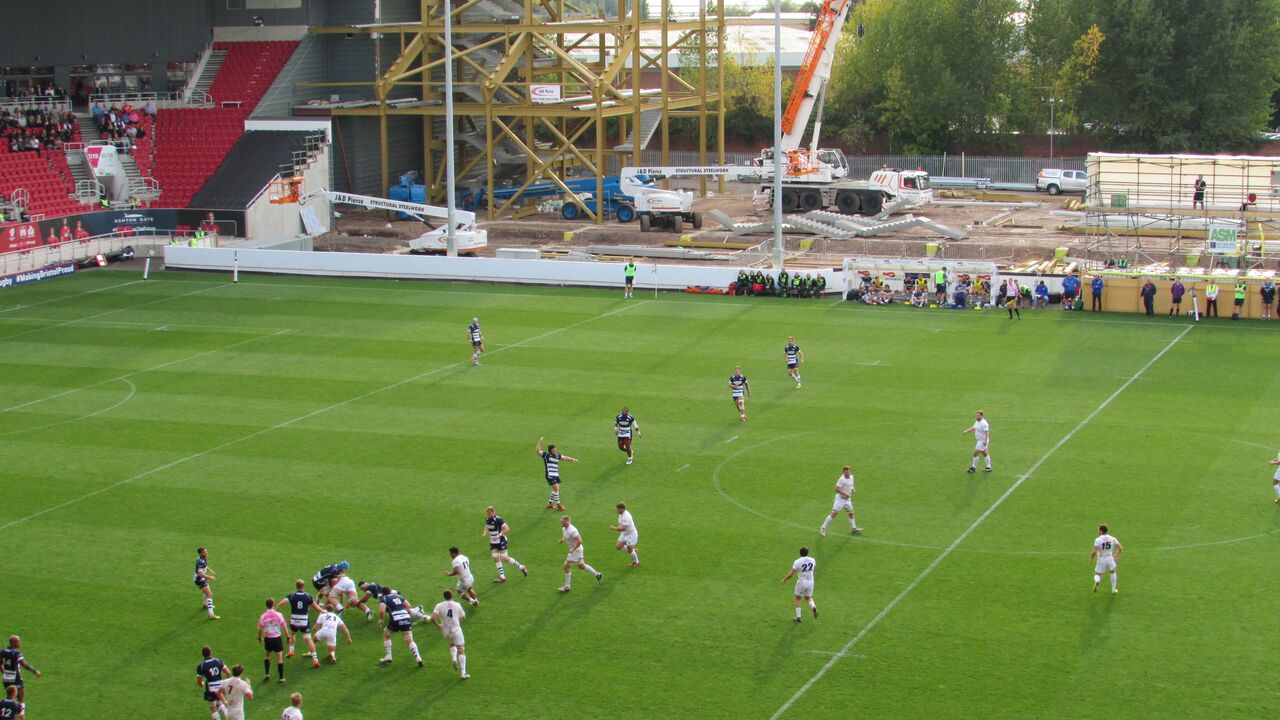
Bristol’s Ashton Gate stadium is currently in the midst of a construction phase, with the beginnings of a new west-side stand starting to take shape behind the teams’ bench areas. More than once, a kick went into touch (out of bounds in mainstream U.S. sports parlance) and into the construction site. The Bristol staff member who retrieved it did not wear a hard hat, but luckily the excavators and haulers sat idle during the match.

The project may have helped the team avoid suffering from any sponsors wanting to reserve their rugby money for RWC initiatives. Bristol Sports, which runs several teams in the area, has clearly worked hard to persuade construction contractors to get involved as club sponsors. One could count at least five companies related to the construction industry with signage in the stadium, and more had program ads and other presence.


The facility the rugby team shares with soccer’s Bristol FC will eventually have the capacity to hold some 26,000 fans. Bristol Rugby hopes to win its league’s playoff this season and ascend to the Premiership, which will greatly help with filling the new stands and suites. The team might still have to play games during the 2019 Rugby World Cup, though, as it will be held in Japan. The next year, that country will also host an Olympic Games. The Olympics seem unlikely to come to North Texas any time soon, but if they do, local teams might be well advised to confer with the folks at Bristol Rugby.


Rush Olson has spent two decades directing creative efforts for sports teams and broadcasters. He currently creates ad campaigns and related creative projects for sports entities through his company, Rush Olson Creative & Sports.

Tuesday, August 4, 2015

You Like Beer

This post originally appeared on the Blotch page at the Fort Worth Weekly. To read it on their site : http://www.fwweekly.com/2015/08/04/rangers-ballpark-beer-map/


You like beer. I feel confident making such an assertion because you’re reading a sports column. Sponsorship Today reports global beer brands spend $1.4 billion annually sponsoring sports properties. They would spend those sponsorship dollars on musical theatre or societies for creative anachronism if it made sense, but sports fans are the ones consuming a lot of suds.
As a public service, then, I’ve decided to start an occasional series of blog posts in which I will offer you guidance about where to acquire beer while attending your favorite sporting events. My kitchen cabinet populated with plastic Rangers souvenir cups prompted me to start at Globe Life Park in Arlington.
When a beer company sponsors a sports team, it also typically negotiates an agreement for favorable placement of its product within the team’s venue(s). You won’t have a difficult time guessing who scored the deal at Globe Life Park. You can’t flee an errant line drive without careening into Anheuser Busch products and signage.
Unless you’re, say, PeeWee Herman, and have a real thing for bowties, you care more about the product than the signage, so we’ll focus on the liquid refreshment. Entering through any gate but Center Field, you can walk straight ahead and encounter small stands stocked with Bud-branded goodies on ice, including ZiegenBock.

If you enter through Center Field Gate by the office building, you’ll walk smack through the Budweiser Bowtie, a concession area in which they sell food and, well, yeah, beer.
So basically you can buy a beer within seconds after you enter the ballpark. And, as noted at the top of this column, you like beer.
So now you have an aluminum bottle to enjoy while walking the concourse scouting out where you might get your next one. Before we proceed further, we want to mention some important safety tips with which you should familiarize yourself. First of all, the Budweiser Good Sport program offers rewards to designated drivers. Inquire at the guest relations office near Mazda Home Plate Gate.
Secondly, the concessionaire sells enough food products at that stadium to feed Mr. Creosote for a year. They have more than 100 concession stands, some selling comestibles the size of your labradoodle. When you can access a Choomongous, the Rangers 2-foot Korean beef sandwich named after outfielder Shin Soo Choo, you have no excuse for drinking on an empty stomach. Thirdly, you’ll find the cabstand outside Southwest Airlines Third Base Gate (or you can have an usher find it for you). Fourthly, there are, by my count, at least 189 restrooms in the stadium, if you include the suites, the clubhouses, and the office building. Your gender may disqualify you from using some of them, but you should still easily find a WC toward which to stumble if you’ve filled your bladder.
Since you probably finished that first brew while reading the last paragraph, you’ll want to assess your options for a refill. Turn left or right after entering at any gate and you’ll find a few of the aforementioned concession stands, each with taps primarily dispensing standard Bud products, like Bud Light. The Rangers must sell a lot of Bud Light. If you’re in that “Up For Whatever” kind of mood, you can satisfy your BL jones a lot of places.
How about if you crave something different? Maybe you’ve progressed past the point of choosing the cheap Arlington Stadium bleacher tickets so you could afford more paper cups of suds? Luckily, the craft beer revolution has not bypassed the Rangers’ current stadium.
Casey Rapp serves as Operations Manager for SportsService, the company that manages concession and merchandise sales for Globe Life Park in Arlington. He provided me some info on the variety of barley/hops available there.
“Section 18 has the biggest selection on draft and it’s called Major League Brewhouse,” he wrote me. “We rotate the draft, but there are local beers like Franconia, Real Ale, Deep Ellum, Revolver, Karbach, St Arnold’s, and other craft beers like Alaskan, 90 Shilling, and the list goes on and on.”
You’ll find Major League Brewhouse on the ground-level concourse near Southwest Airlines Third Base Gate, and the nearby 3rd Base Alehouse also serves a variety of drafts, bottles, and cans. If you’ve entered via Southwest Airlines First Base Gate, turn left and you’ll quickly happen upon the Beers of the World stand, near the entrance to mid-30s numbered seating sections, offering a number of beery options.
Incidentally, if you have some members of your party who prefer vino, you’ll find a wine stand across the concourse from Beers of the World. Such is Anheuser Busch’s dominance that they even sell Shock Top and Bud Light at the wine stand.
If you enter from Mazda Home Plate Gate and want something out of the ordinary, turn right and go just past the Pro Shop, across from the entrance to the good seats in the upper 20s sections. You’ll find the LandShark Lager stand. In addition to its namesake, the kiosk can sell you a draught of Montejo, Stella Artois Cidre, and the obligatory Bud Light.
Hard by Greene’s Hill (the grassy expanse in the batter’s eye named after a former Arlington politician) in centerfield resides the Beers of Texas stand, headlined by ZiegenBock. The location also offers some Shiner, Lone Star, and Lakewood brews. Rapp informs me they have such stands near sections 25, 51, 210, and 328 as well.
On the other side of the Hyundai Club from Beers of Texas, you’ll find the Centerfield Alehouse, just across from the Centerfield Market. It features, among other offerings, Stella Artois on tap. Its cooler includes cans of Modelo Especial, Heineken, Corona, 312 Urban Wheat Ale, and more.
If you visit the Lexus Club Level, there are a handful of stands and barlets that serve suds. The small bars offer a chance to enjoy some air conditioning as you order your beverage. I took special note of the left field emplacement, as it replaced my previous favorite spot in the ballpark, the ersatz Irish pub known as the Dublin Up. The new incarnation is Shock Top branded and offers its namesake’s varieties on draft as well as Bud Light.
If you choose to remain in your seats, SportService will have 75 or so beer vendors at a typical game to bring beer-filled aluminum receptacles to your very row. Rapp tells us, “You can get Bud Light, Budweiser, ZiegenBock, Michelob Ultra, Shock Top, LandShark, and the Rita family.” The Rita family means Bud Light with citrus favors. Be sure to tip the vendor something. Rita family members are heavy to carry around.
If you get up to go to one of the aforementioned necessaries, you may encounter a roaming beverage cart. Mr. Rapp tells us, “there are four on the lower level, one on the club level and three on the upper deck.  They roam each baseline, stopping to make sales on the concourse. You can get all the same things you can get from a vendor, plus wine.”
Rapp also tells me I can find Firemans #4, Rahr’s Blonde, Rahr Pride of Texas Pale Ale, and Deep Ellum Brewing Company’s Dallas Blonde in cans on portable carts.
What if you spend some of your evening in one of the onsite clubs? Of course, in the likes of the Captain Morgan Club, the Jack Daniel’s Club, and the Capital One Club, they serve beer. Casey Rapp describes it as a “wide array.” He also notes they often have Shock Top seasonal on draft, including Lemon Shandy, Banana, and Pretzel depending the time of year.
We’ve established that sports fans like yourself really like malted beverages, and a lot of folks like you attend every game. How can you feel certain the Rangers won’t run out of beer? Rapp assured me they keep a three-day supply at every game and can get same-day deliveries if needed. Whew.
Here’s one final note, for the benefit of Michael Newquist and the Fort Worth Weekly sales staff:  if you’re a beer brand, consider sponsoring this column. The people who read it like your product.


Rush Olson has spent two decades directing creative efforts for sports teams and broadcasters. He currently creates ad campaigns and related creative projects for sports entities through his company, Rush Olson Creative & Sports.


RushOlson.com

Linkedin.com/company/rush-olson-creative-&-sports

Facebook.com/RushOlsonCreativeandSports
Tuesday, July 28, 2015

How The WNBA Can Succeed in North Texas

This post originally appeared on the Blotch page at the Fort Worth Weekly. To read it on their site : http://www.fwweekly.com/2015/07/28/sports-how-the-wnba-can-succeed-in-north-texas/

It’s got the makings of a great story. Oklahoma girl, originally from Detroit, leaves the hinterlands of Northwest OK and heads to the big city in Texas to make her fortune.
We recently learned of such a story in the offing, although it involves not one girl, but rather several women (really tall ones at that). The ladies in question play basketball for the Tulsa Shock of the Women’s National Basketball Association and the team’s owner announced last week he wants to move the franchise to North Texas. They expect to play home games at UT-Arlington’s College Park Center.
To that, I say super. It means more high-quality basketball in the area, with visits from the best women’s players in the world. It also pleases me because I have two nieces who like hoops and could benefit from the chance to observe, and become invested in, a team of that caliber.
So I hope the team does well, but they should know success won’t come easily. Local arenas are strewn with remnants of pro teams that have come and gone. I still own Fort Worth Fire jerseys and a Fort Worth Cavalry golf shirt. Maybe your attic houses a Fort Worth Cats cap (old or modern) or a Dallas Chaparrals program your dad bought. To help the A-Town Shock (or whatever decide to call themselves) avoid the fate of, say, the Dallas-Fort Worth Spurs, I put together a committee to make some recommendations.
Leiberman
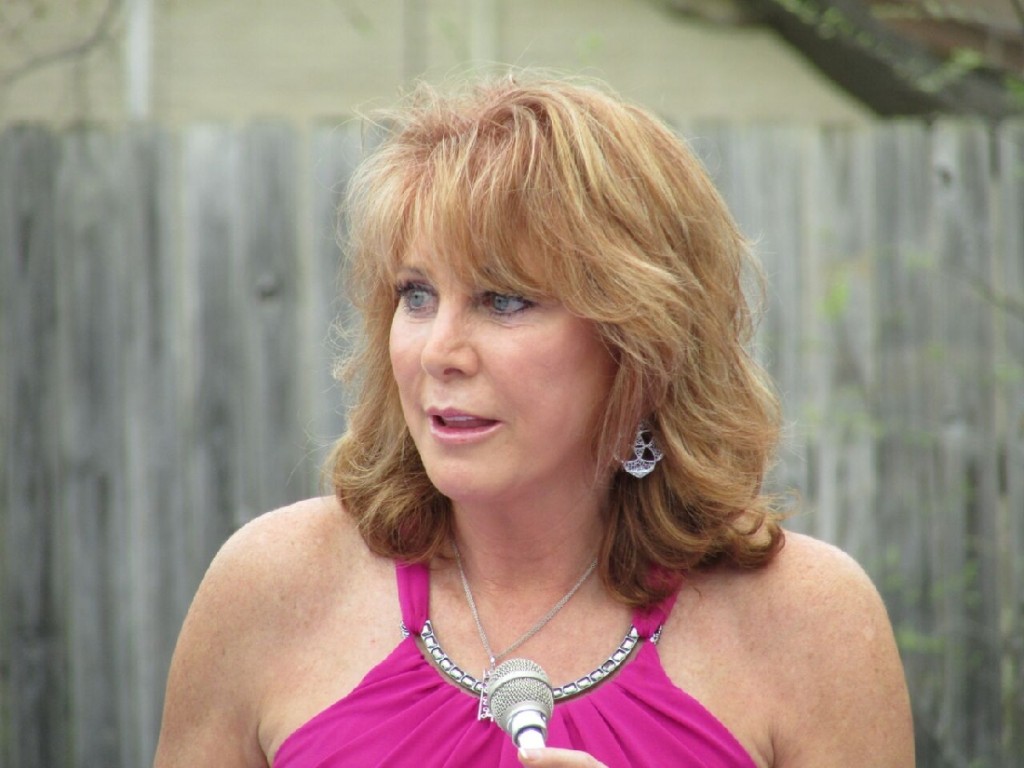
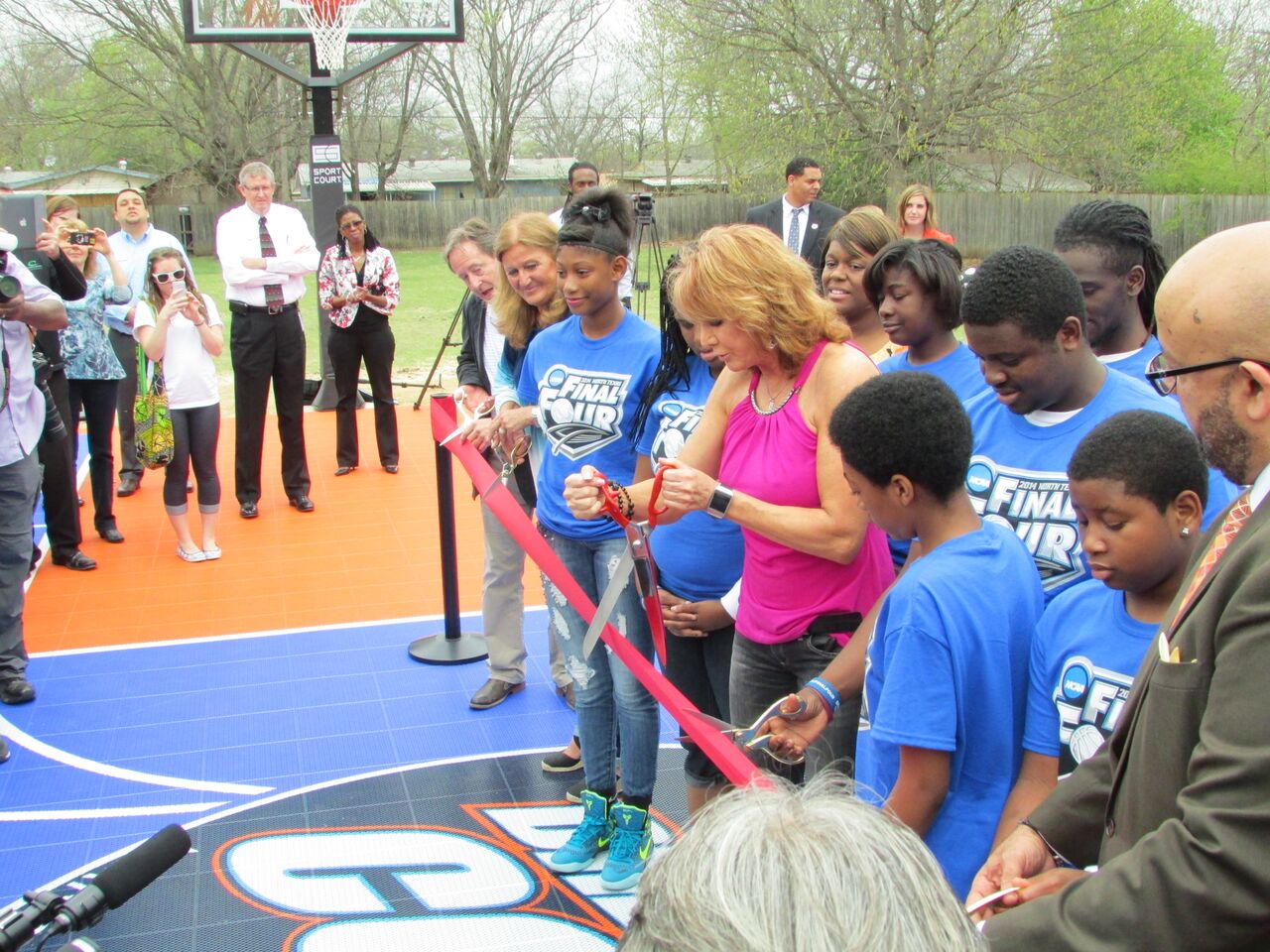
It’s a committee of two. I got a spot because I write this column and because I did broadcasting work for a lot of the defunct teams and marketing work for some of the ones still in existence. The better half of the committee (in so many ways) is Nancy Lieberman. She made the cut because she’s in the dang Basketball Hall of Fame, she played pro ball here, and she knows a heck of a lot about the WNBA and hoops in general. I also picked her (blatant plug alert) because she runs a really great foundation that helps a lot of kids. I’ve done some videos for it and helped at some NLF events.
Lieberman pointed out “You get one chance to do it right,” which means the team has to hit the ground running and have a good plan.
Let’s start with the challenges. This seems like an attractive market because of its large population and affinity for sports. The NFL, NHL, NBA, MLB, and MLS certainly liked the looks of it and their teams have shown staying power here. The newest of the Big Five pro franchises, the one I wish they still called the Dallas Burn, has lasted in the area since 1996.
In 1992, the new Central Hockey League began with, among others, the Fort Worth Fire, Dallas Freeze, and Tulsa Oilers. The Oilers won the league’s first championship and still reported drawing 5,479 fans a game last year despite never having won another title. The Fire and Freeze exist only in my closet, I think. I might still have a Fire puckhead somewhere.
The point is that the North Texas market is a lot different from Tulsa and so are the teams that stick here long term. The Shock moved to Tulsa from Detroit, so they could have some institutional memory about the challenges of sharing a large media market with teams from the country’s dominant sports leagues. In fact, Lieberman coached them their first three seasons in Motown. She had a strong opinion about the most important thing they could do to start carving a local niche.
“Grassroots, grassroots, gassroots!,” she said emphatically. Trust me, you could hear the exclamation point in her voice.
She suggested the team be everywhere from “camps to birthday parties.” She cited a model used by the NBA D-League team with which she is affiliated.
“Every team in the WNBA should borrow from the Texas Legends,” she said, noting also their kid-oriented approach to game presentation
My top point of emphasis relates closely to Lieberman’s: “Group tickets, group tickets, group tickets!” I didn’t actually say that out loud, but if I did, you would hear the exclamation point.
They can’t monetize their grassroots strategy without building in reasons to come to a game. Not only does a solid groups strategy allow a team to sell a bunch of tickets at once, but it can do so before the season starts. Preseason sales offer some revenue certainty that isn’t subject to the vicissitudes of a won/loss record.
Speaking of “Ws,” that “W” in WNBA matters. It’s a point of differentiation for the team brand. Lieberman pointed out one has to “get with the parents who are going to send their kids to you.” Parents who see value in inspiring their girls to pursue sports and fitness would seem a vital community outreach target.
Geography matters when it comes to the grassroots outreach. A WNBA team will have the advantage of being the most high-profile women’s pro team in the area, so they can draw some fans from throughout North Texas. Because the area is so enormous, however, driving distances will discourage fans in East Dallas and the northern suburbs from coming to games in Arlington. The Shock, then, need a solid strategy for establishing a base of fans near where they play. I’d start a lot of the grassroots activity by identifying pockets of likely ticket buyers in Arlington, Grand Prairie, and eastern Fort Worth.
They must keep regional tensions in mind as well. The Cowboys can play in Tarrant County and get away with having “Dallas” for a first name. Another team that tried that would risk alienating potential fans in Fort Worth and its environs.
The size of this media market can seem daunting as well. Going beyond the grassroots in Tulsa by, say, buying TV ads or airtime to broadcast games, incurs costs appropriate to the 61st largest media market. In North Texas, top-five market costs mean major sticker, um, shock. One has to pay to reach millions of viewers/listeners who live too far away to drive to many games. Big-market media costs make a more targeted PR strategy really important (and grassroots outreach, too).
The franchise will still want earned media attention, certainly, and an NBA-affiliated entity offers advantages there that are unavailable to, say, the Grand Prairie Airhogs. But one has to keep in mind that the media will expect major-market service. The D-League’s Fort Worth Flyers, for instance, didn’t put an emphasis on PR support. They lasted two seasons (with lack of media savvy helping compound lots of other issues).
One tricky part, then, of operating in this market is that one has to act major league without having the budget of a team that generates substantial TV revenue and draws 18,000 fans a night. Lieberman believes that doesn’t have to be an insurmountable problem.
“Even if you don’t have the budget, what you have to do (to be major-league) is work hard,” she said. The Shock do have to go the extra mile as a little fish in a big pond, and have to show creativity as well. For instance, they may not be able to afford to shell out the scads of money the Mavs spend to produce scoreboard features, but digital technology has made it possible to create really good ones much less expensively than ever before. Quality concepts can make up for lack of cash outlay.
Part of the hard work element comes in the form of digital strategy (creativity is pretty important here, too). A strong social media plan, one that goes hand-in-hand with the grassroots fan engagement plans, is a must, especially with a spread-out fan base and high traditional-media costs. Constant updates and new features require a significant time commitment.
So, to summarize, here’s what our committee thinks the team needs to do to succeed:
1.      Get involved in the grassroots (with an exclamation point).
2.      Sell group tickets like crazy.
3.      Understand the market and overcome its challenges with creativity and hard work.
One thing I didn’t add to the above list: Win.
Winning a lot of games never hurts, but finishing first is actually not as important at driving fans as it is for the Mavs or Rangers. The Shock won three titles in Detroit and moved. The Houston Comets won four and folded. Establishing a loyal fanbase matters more than even championships.
Lieberman won a title in this area in the WABA and also led a team to the WBL finals. Her Dallas Diamonds drew sustainable crowds but the rest of those leagues did not. Since the current well-established NBA-backed women’s league seems unlikely to fold like those earlier circuits, the Shock would seem to have a chance at success.
For the record, Lieberman thinks they will. “(Owner) Bill Cameron is a wonderful person,” she said. She believes he will put a plan in place to turn the move to Arlington into a success story. Heeding the recommendations she made in this piece would probably be a great place for Mr. Cameron to start.


Rush Olson has spent two decades directing creative efforts for sports teams and broadcasters. He currently creates ad campaigns and related creative projects for sports entities through his company, Rush Olson Creative & Sports.
RushOlson.comLinkedin.com/company/rush-olson-creative-&-sports

Facebook.com/RushOlsonCreativeandSports