Showing posts with label Dallas Stars. Show all posts

Monday, March 9, 2020

Ensuring Hockey Is For Everyone

This post originally appeared in the Blotch section of the Fort Worth Weekly's website. To consume it there: https://www.fwweekly.com/2020/02/21/sports-rush-making-hockey-a-sport-for-everyone/
In 1993, the Dallas Stars brought their sport to a whole new group of people when they moved to Texas from Minnesota. Much of the native population had little affinity for the game when the club arrived. Early marketing efforts emphasized similarities to American football.
The Stars gradually expanded their reach. They became the first Sun Belt team to win a Stanley Cup. Their initiatives to establish youth hockey programs have resulted in thousands of children playing the sport and even delivered locally-trained players to the National Hockey League. Sports fans previously unfamiliar with ice hockey developed affinity for the likes of Mike Modano, Jamie Benn, Tyler Seguin, and Marty Turco. The Stars gave North Texans a comfort level with their game.

Before, during, and after Wednesday night’s game against another southern team, the Arizona Coyotes, the franchise looked toward making even more people comfortable in the sport. They held a Hockey is For Everyone night at their game against the St. Louis Blues in partnership with the You Can Play organization. You Can Play aims to, as they phrase it, “develop locker room cultures that replace ‘casual homophobia’ – the unintentional use of anti-gay slurs – with acceptance and respect for an athlete’s contribution to the team.” The organization works with a number of sports, but has roots in ice hockey thanks to former NHL GM Brian Burke and his son, current NHL Senior Director of Player Safety Patrick Burke. Their son/brother Brendan came out in an ESPN interview and advocated for a more inclusive hockey culture. After Brendan’s 2010 death, You Can Play was created to continue his legacy and move the issue forward.
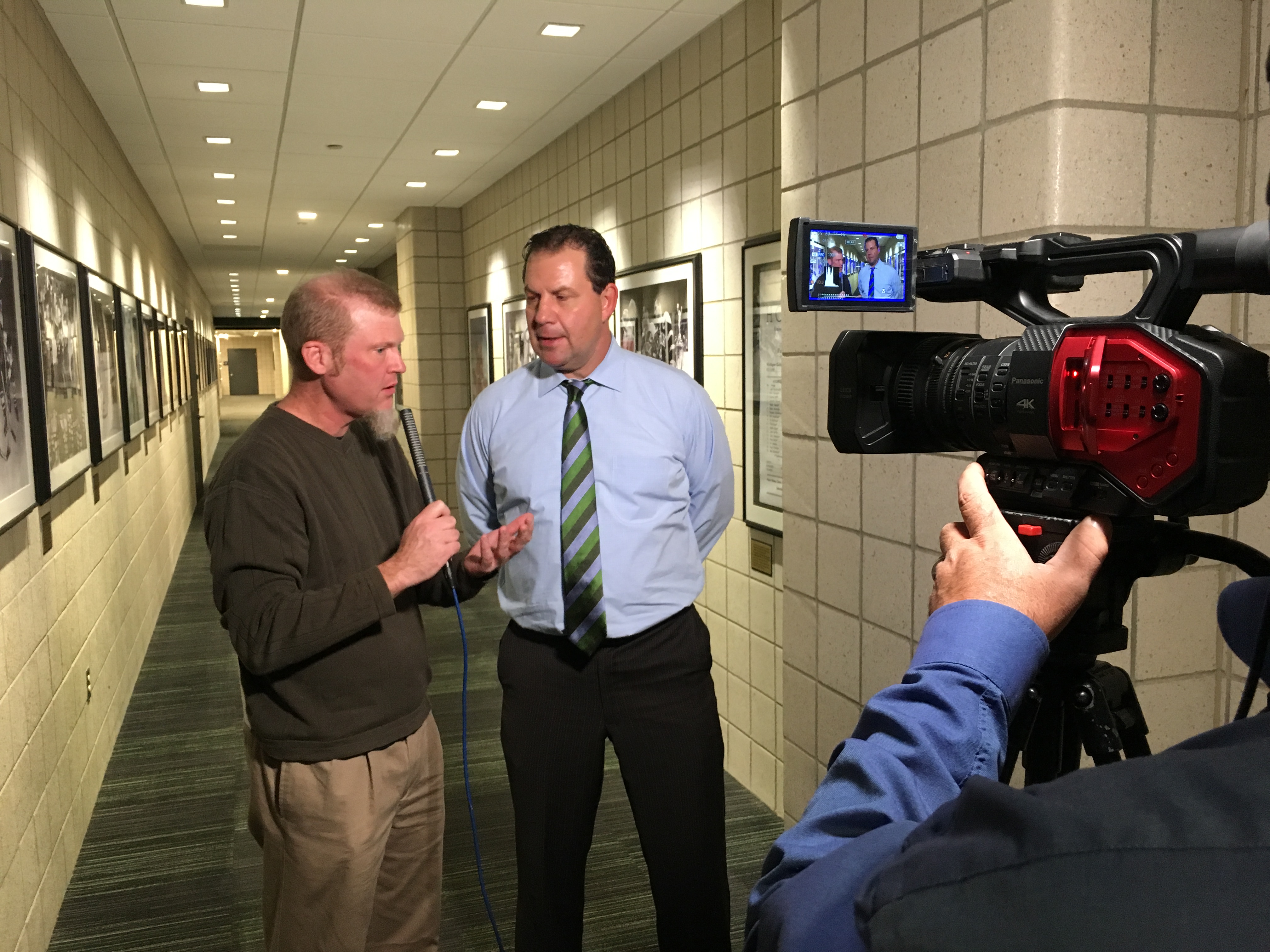
The league has embraced the cause and almost all of its teams have participated in some form as well. The Stars held a pregame happy hour at Dibs on Victor. Their foundation’s staff, including Turco, the Dallas Stars Foundation’s president, attended and they also set up a silent auction. The video interviews in this post were conducted there and they offer some real insight into what the issue is all about. 

And there does seem to be plenty of misunderstanding of this initiative. Check out the comments on the Stars’ Instagram post about selling pride-taped sticks as a fundraiser. Many commenters take a strongly supportive tone. Others condemn the post.

Some objections consisted of juvenile jokes. Others were Biblically-based. Several called it out as a political play and wanted the team to stick to hockey. My conversations from Wednesday’s event lead me to think these hostile commentators miss the point. This whole thing IS about “sticking to hockey.”

You Can Play doesn’t have a PAC. They aren’t trying to get laws passed giving LGBTQ hockey players special privileges or restricting straight people’s freedom of speech. Their function is one of education. They want to help straight teammates and fans understand that certain jokes and terms can be detrimental to a teammate’s psyche. A stray comment can create a hostile atmosphere without the speaker even realizing it.
That’s especially true for young players. Coming out is hard enough without having to wonder if doing so will put you at odds with your teammates. Billy Scullion, one of this post’s interview subjects, spent years overcoming the repercussions of the challenges he experienced hiding his sexual orientation amidst what the perceived as hostile junior hockey dressing rooms. Scullion appeared with defenseman John Klingberg in a video that Stars created that discusses the initiative, and a number of other NHL players have expressed support for the principles behind Hockey Is For Everyone. You Can Play wants athletes to view teammates and opponents strictly on the basis of their performance. Their mantra is “if you can play, you can play,” meaning that if players have the requisite skill to compete on a team, they should be able to do so regardless of factors like race, creed, or sexual orientation. 

Scullion and You Can Play co-founder Brian Kitts explained how an environment where all players are comfortable helps them perform better and leads to a greater chance of realizing the shared goal of all teammates, gay or straight: to win the game. As I discussed with Fort Worth dentist Bill Ralstin in his interview, that can apply to business, too. An inclusive environment also improves employee productivity.
Any Stars fan or player wants the team to win. If an inclusive environment leads to a better quality of play, that seems like a good enough reason to get on board with it, even if one can’t summon up empathy for the particular people involved. What we’ve seen in the past, however, with issues of, for instance, race in sport, is that excellence in competition leads to greater overall acceptance eventually. The late Fort Worth baseball icon Bobby Bragan often talked of his objection to Jackie Robinson’s presence when the African American trailblazer first joined Bragan’s Brooklyn Dodger team. But soon enough, the Alabama-reared Bragan came to realize Robinson’s worth as a player and a person and it changed his whole outlook. You Can Play hopes to see that scenario duplicated, but without the initial hostility.

Hockey’s an uncomfortable sport. Bodychecks ram you into the boards from every angle as you glide along on tiny metal edges. You try to use a stick to convince a little blob of rubber to do what you want it to. And have you ever smelled a hockey dressing room? But the Stars and the NHL want to ensure discomfort in their sport remains confined to icing sore muscles or regretting you didn’t get a better shot on net in the second period, and not whether one can be oneself in front of one’s teammates.


Rush Olson has spent more than two decades directing creative efforts for sports teams and broadcasters. He currently creates ad campaigns, television programs, and related creative projects for sports entities through Rush Olson Creative & Sports, Mint Farm Films, and FourNine Productions.

RushOlson.comMintFarmFilms.comLinkedin.com/company/rush-olson-creative-&-sportsFacebook.com/RushOlsonCreativeandSports 


Monday, April 2, 2018

Are the Playoffs Far, Far Away?

This post originally appeared in the Blotch section of the Fort Worth Weekly's website. To consume it there : https://www.fwweekly.com/2018/03/28/stars-fading-or-twinkling/

Before Friday night’s game, the Dallas Stars honored former player Jamie Langenbrunner as part of their celebration of the 25th anniversary of the team’s move from Minnesota to downtown Dallas. The right-winger joined the organization that same year, when the Stars selected him in the second round of the 1993 NHL Entry Draft. While the 18-year-old Langenbrunner honed his skills with his junior hockey team in Peterborough, Ontario, the big club surprised many by making the playoffs in 1994 after having missed them the previous year in Minnesota.
This year’s group had hoped to repeat its predecessors’ performance of two and a half decades ago by returning to the postseason after missing it in 2016-17. That desired outcome is in grave doubt as the regular season enters its final two weeks. One man who has watched each of this season’s tilts from the Stars’ broadcast booth also played in every game for that first Dallas team: Craig Ludwig.
This past offseason, Ludwig saw the Stars make moves they hoped would position them for success. They added a high-scoring forward in Alexander Radulov, a frontline defenseman in Marc Methot, a big face-off specialist and second-line scorer in Martin Hanzal, and a man Ludwig suggested has “arguably been one of the top five to 10 goaltenders in the league” over the past few years, Ben Bishop. (He did lead the league in goals-against average two years ago.) Those players would supplement a talented core that includes former scoring champion Jamie Benn, speedy and gifted center Tyler Séguin, four-time All-Star center Jason Spezza, and one of the league’s most skilled defensemen, John Klingberg. Though the team has had a pair of five-game winning streaks and stretches where they looked like they could beat anyone, the season has not played out as hoped.
“Earlier in the season, this team was better positioned,” Ludwig said. “Injuries is kind of what happened.”
Methot and Hanzal have participated in only 30 and 38 games, respectively, out of the 75-plus the Stars have played so far. Spezza has missed time recently, and, most devastatingly, Bishop has played only 10 minutes since March 16. Bishop hurt his left knee early in the month, missed five games, and aggravated the injury during his return to the lineup. The rise in doctor visits corresponded with a drop in the team’s position in the standings.
NHL teams compete in two conferences, with eight teams from each earning a chance to play for the Stanley Cup awarded to the league’s champion. The Stars had occupied one of the final two Western Conference playoff spots for much of the season, but when they pulled only two points in the standings from a recent six-game road trip, it dropped them into 10th. They’re in a five-way fight with Anaheim, Colorado, Los Angeles, and St. Louis for a spot in the postseason tournament. A team receives two points for a win, one if they lose in overtime or the penalty shot shootout that results from a scoreless OT. A regulation loss yields no points. The Stars earned only four points in road games in March, all via losses in extra time. Home losses this past weekend to Boston and Vancouver have put them on the brink of an early summer vacation.
Even if the Stars rally to grab the eighth seed in the West, they would face a first-round matchup with the conference’s top seed, most likely last year’s Cup finalist, the Nashville Predators. Though it’s not unheard of for a low seed to fight its way through two months of playoff hockey, it’s highly unlikely, especially with a depleted roster.
“I’m not going to sit here and say that we’re a team that’s in a position right now to go to the finals,” Ludwig said. “It just wouldn’t be realistic to say.”
If they won’t make noise in the playoffs this year, the question arises: When will they? Ludwig despises terms like “rebuild” or “retool.” He thinks the Stars aren’t that far away from contending, though, and a man Ludwig knows well is one of the reasons. After last year’s disappointing finish, Dallas made changes off the ice in addition to adding players. They brought back a man who had coached Ludwig, Langenbrunner, and other Stars icons through the most successful years in franchise history. They hired Ken Hitchcock. 
The Edmonton native started with the franchise in 1993, too. The general manager at the time, Bob Gainey, hired him to helm the club’s top minor league affiliate, which played in that era in Kalamazoo as a member of the since-folded International Hockey League. Langenbrunner played 11 games there for Hitchcock in 1994-95 before moving on to the NHL. The coach got his own promotion when he took over the Stars’ head coaching duties in 1996. His tenure lasted until 2001 and included the team’s only Stanley Cup win, in 1999. The coach’s return had little to do with 25th anniversary nostalgia and a lot to do with the club’s desire for him to implement his hard-charging yet defensively responsible style of play.
“Ken Hitchcock didn’t come here at 66 years old and 800 and how many ever wins he has [819 as of press time] to be in a rebuilding team,” Ludwig said. “You know he’s here to win.”
Furthermore, Ludwig believes the team’s players have bought into the system Hitchcock used to help earn Ludwig a second Stanley Cup ring. (The defenseman also won one with Montreal in 1986.) He cited young center Radek Faksa as a young player who has improved enough that Hitchcock can match him defensively against the opposition’s best forwards. He credits Rick Wilson, who coached the defensemen for the Cup-winning team and now does so again, for helping the offensively creative Klingberg become more reliable defensively. Perhaps most importantly, Hitchcock has helped the man with the talent to excel at all phases of the game start to do so.
“Tyler Séguin has been fantastic all season long,” Ludwig said. “Hitchcock asked him to be a more rounded player, and he bought right into that, and he’s getting rewarded on the offensive side. He’s been the go-to guy from face-offs, the penalty kill, power play, five on five.”
Ludwig has seen the team give the all-out effort Hitchcock demands. They just haven’t had sufficient depth of talent, especially after the injuries.
“You can’t lean on three guys up front all the time – Benn, Séguin, Radulov – and that’s what we’ve done,” said Ludwig of a team in which those three players plus Klingberg have each exceeded 60 points (goals plus assists) on the year while no other player has approached 40. Of the newly acquired Radulov, Ludwig noted, “I don’t know how this guy can play all 82 games the way that he plays, because he empties his tank every single shift – not just every game, every single shift. He gives you everything.”
As the Stars move into the offseason, they’ll need to determine how to find supplemental talent. During Hitchcock’s first tour in Dallas, they added front-line players like Joe Nieuwendyk, Ed Belfour, and Brett Hull, as well as depth contributors with leadership skills like Guy Carbonneau, Mike Keane, and Brian Skrudland. Facing a salary cap their 1990s predecessors didn’t have to deal with, current GM Jim Nill’s braintrust will have to determine this offseason whether they can sign, draft, or trade for the types of players who will help the Stars quickly take the next steps.
In building the Stars’ championship club, Ludwig recalled, Gainey formulated a veteran team accustomed to playoff tension. If the Stars did eke out a playoff berth this season, that experience could prove invaluable to young players like Faksa, Klingberg, and Stephen Johns, as ’90s playoff runs no doubt did for the likes of Langenbrunner, Richard Matvichuk, and Jere Lehtinen.  Perhaps they’ll decide to acquire postseason-hardened veterans to expedite their journey to contending, in part due to Hitchcock’s age. (He turns 67 in the middle of next season.) The defenseman-turned-broadcaster sees signs the Stars might have the core to make it happen.
“The majority of Stanley Cup contenders, you’re going to have three guys: one guy that’s up for the Vezina [Trophy] for the best goaltender in the league, one guy that’s up for the Norris for the best defenseman in the league, and one guy who’s up for the Selke,” officially for best defensive forward but often awarded to a top all-around center. A healthy Bishop, Klingberg, and Seguin could give the Stars those components. Can Nill, Hitchcock, and company fill in the roster around them? We’ll know they did so successfully if we see those acquisitions dropping ceremonial first pucks 25 years from now.

Rush Olson has spent more than two decades directing creative efforts for sports teams and broadcasters. He currently creates ad campaigns, television programs, and related creative projects for sports entities through Rush Olson Creative & Sports, Mint Farm Films, and FourNine Productions.

Sunday, January 28, 2018

Hockey's New Home in Hockeytown

This post originally appeared in the Blotch section of the Fort Worth Weekly's website. To consume it there : https://www.fwweekly.com/2018/01/25/sports-rush-jewel-of-hockeytown/


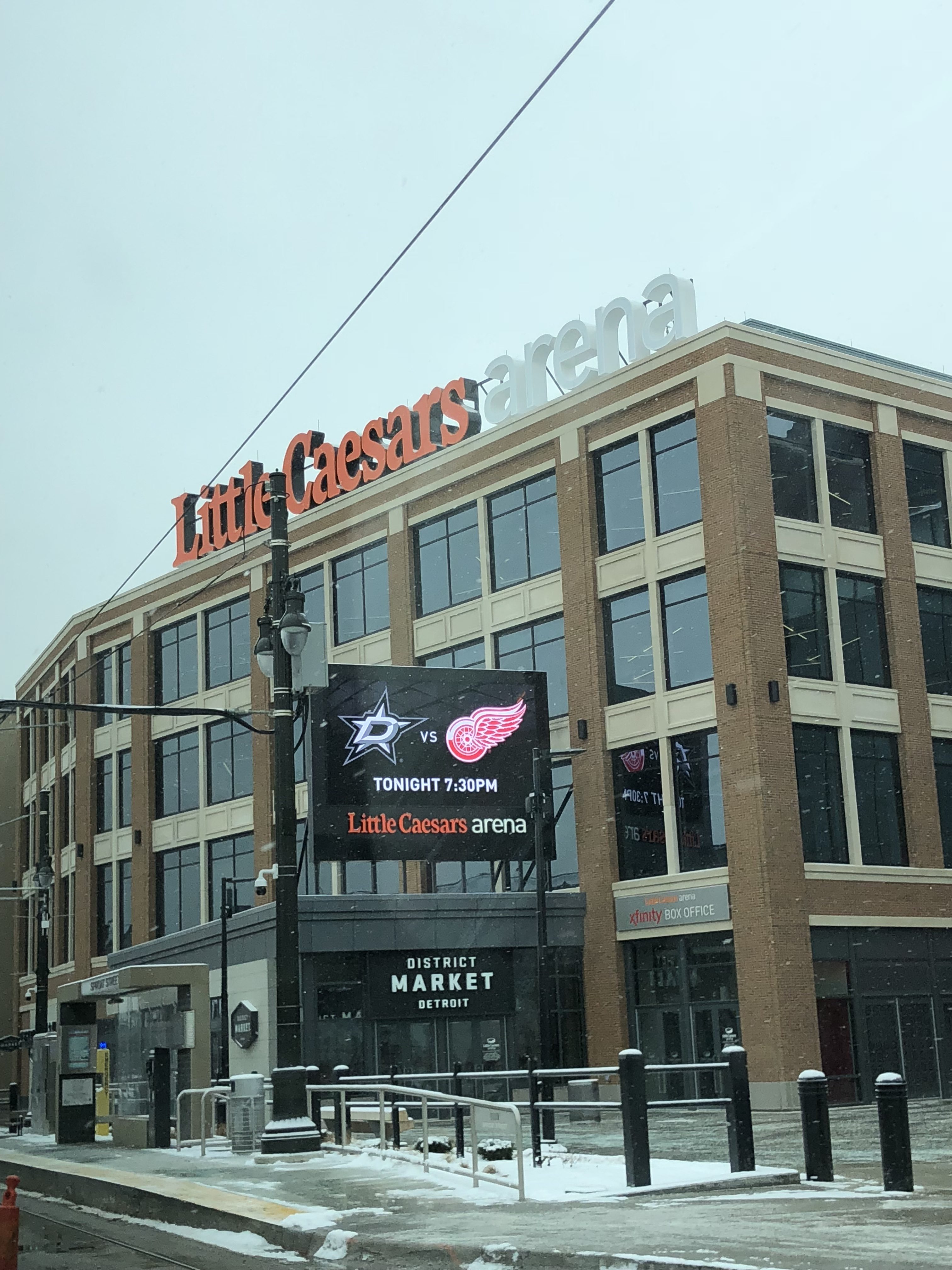
Last week the Dallas Stars made their first visit to Detroit’s new hockey facility, Little Caesars Arena. I went on the trip and you’re probably wondering, “What did you see? And did you freeze your gungagalunga off?” Here are some observations, and my gungagalunga is fine, thank you very much.
Stars at Red Wings Signage
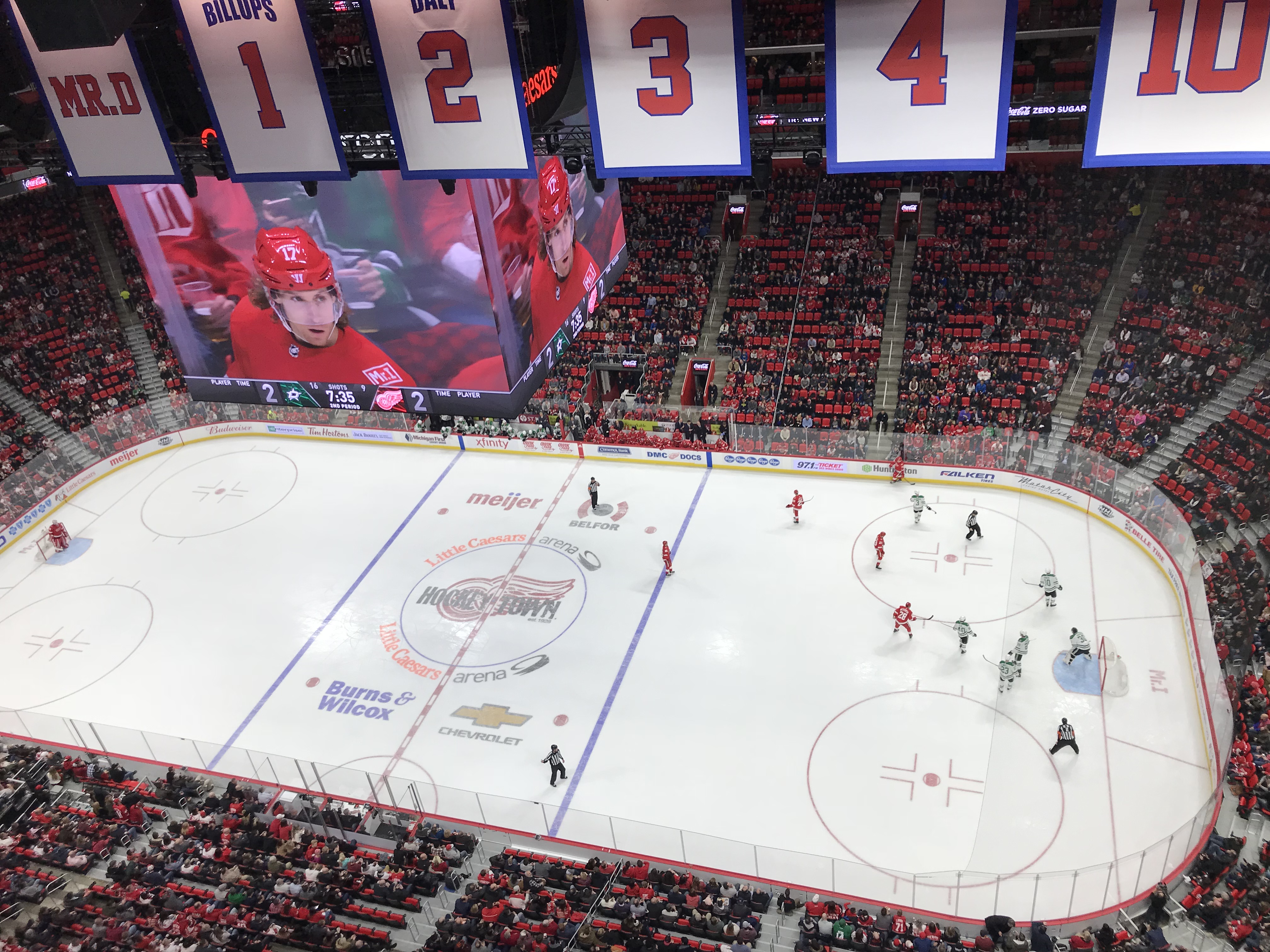
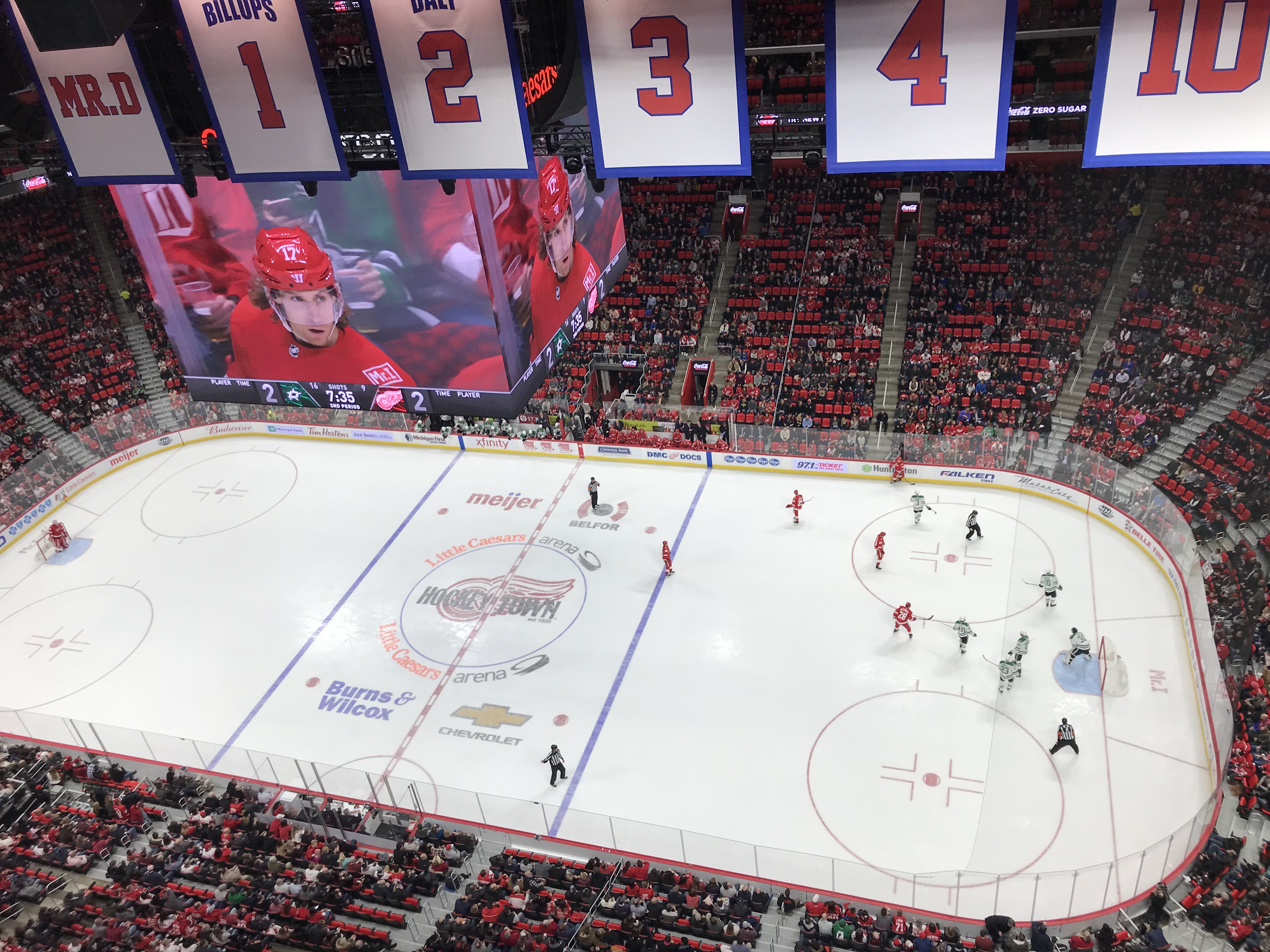
When they spend millions on a new hockey stadium in a place that styles itself “Hockeytown,” you can bet it’ll be pretty full-throttle, and the place has a lot of features and a lot of style. Besides a superb sound system and wide concourses, it features top-level “gondola” seating that provides a look from right over the ice, albeit from a mountainous elevation (it still works).

Stars at Red Wings
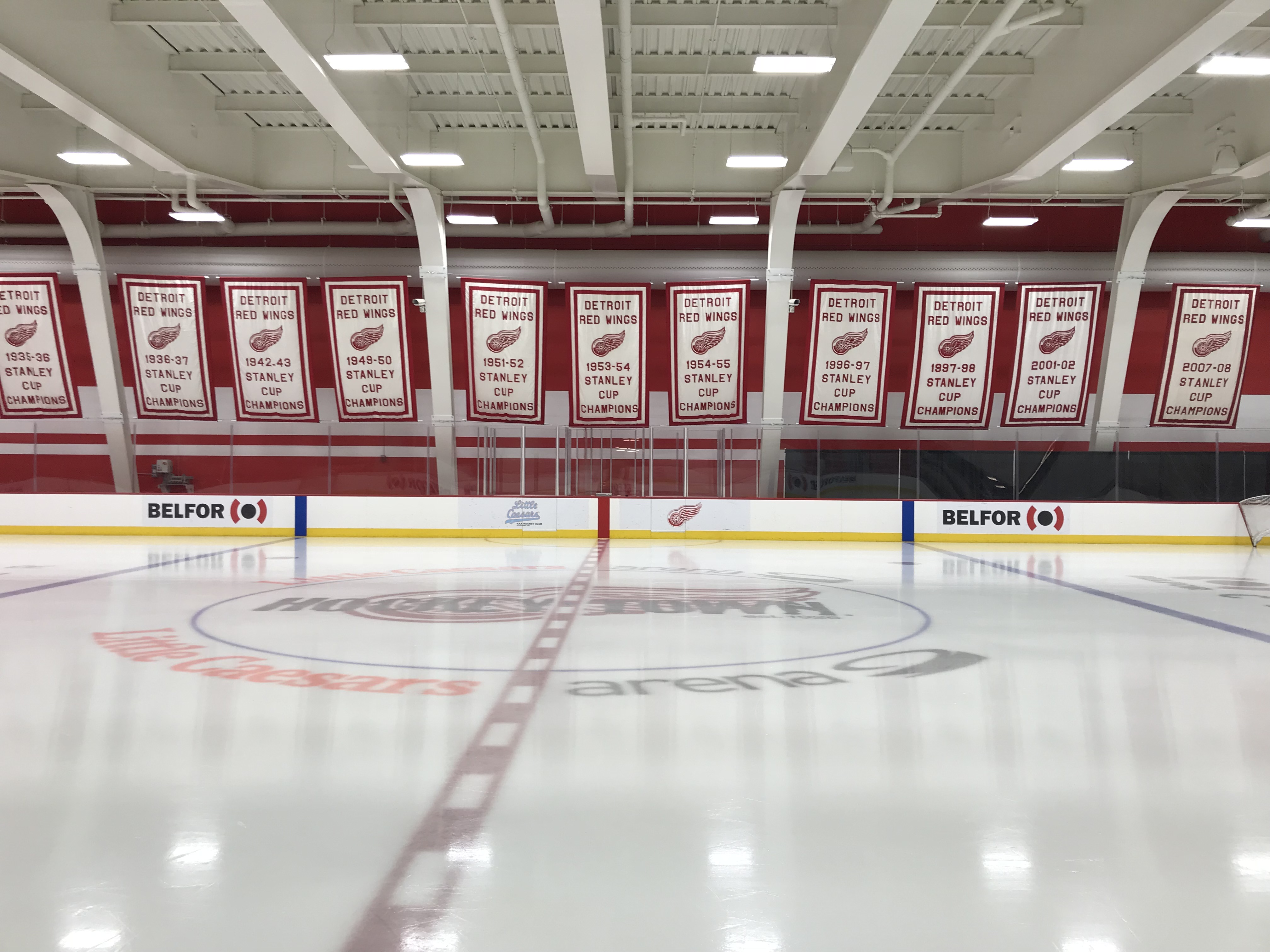
Inside, banners commemorating the Original Six franchise’s retired numbers and Stanley Cup wins hang from the ceiling girders. They created these banners specially for the new space, with the ones that hung in the team’s previous home, Joe Louis Arena, now adorning the team’s downstairs practice rink.
Red Wings Original Banners
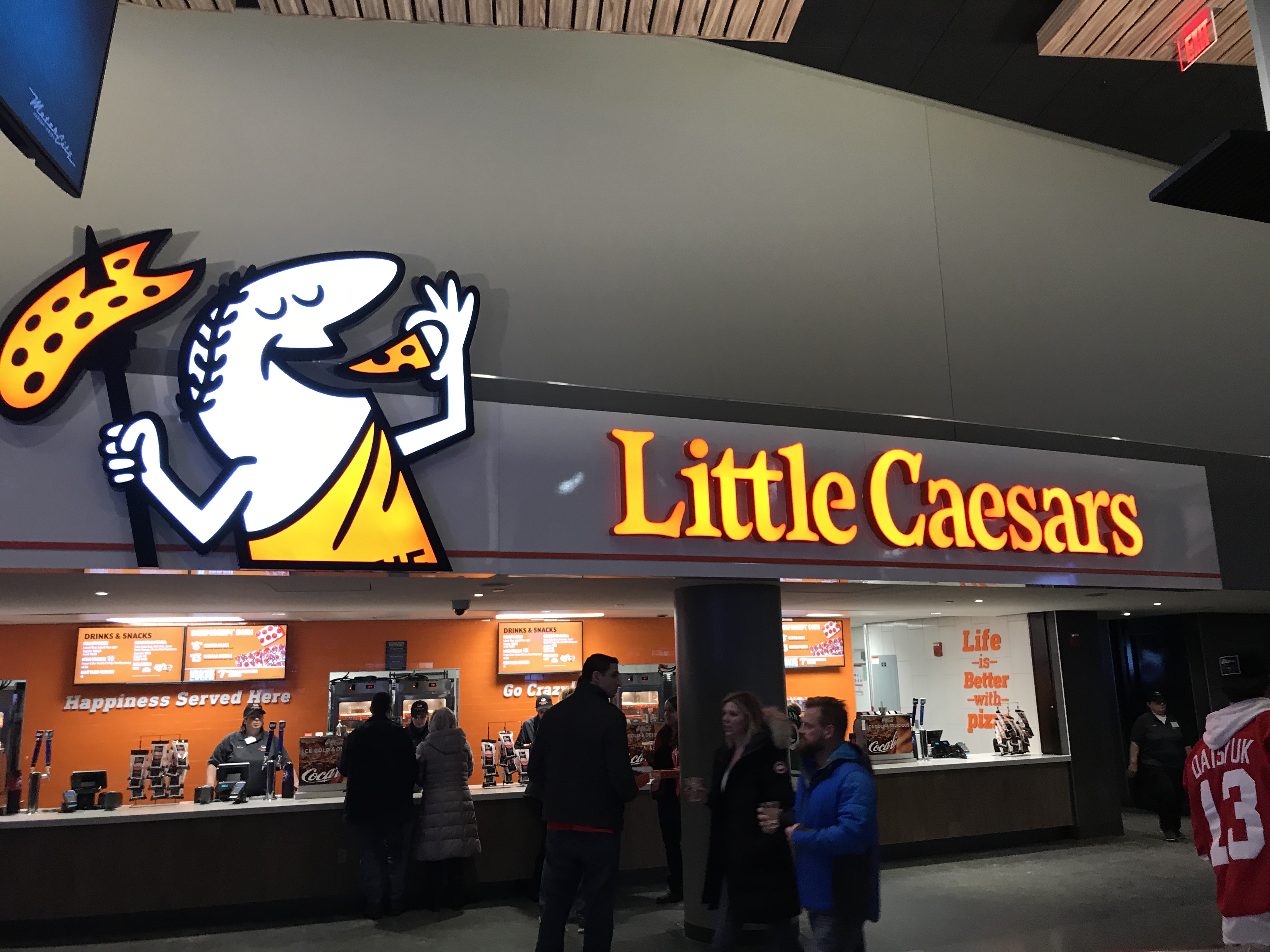
The facility also serves as home to various youth hockey programs, with youngsters traipsing through the downstairs hallways even on game day. Those teams have long been sponsored by the arena’s namesake pizza company, founded by the late Red Wings and Tigers owner Mike Ilitch and his wife, Marian. They don’t skimp on their naming rights sponsor’s branding in the place, either, and, yes, you can get a hot-and-ready pie in various locations.
Little Caesars
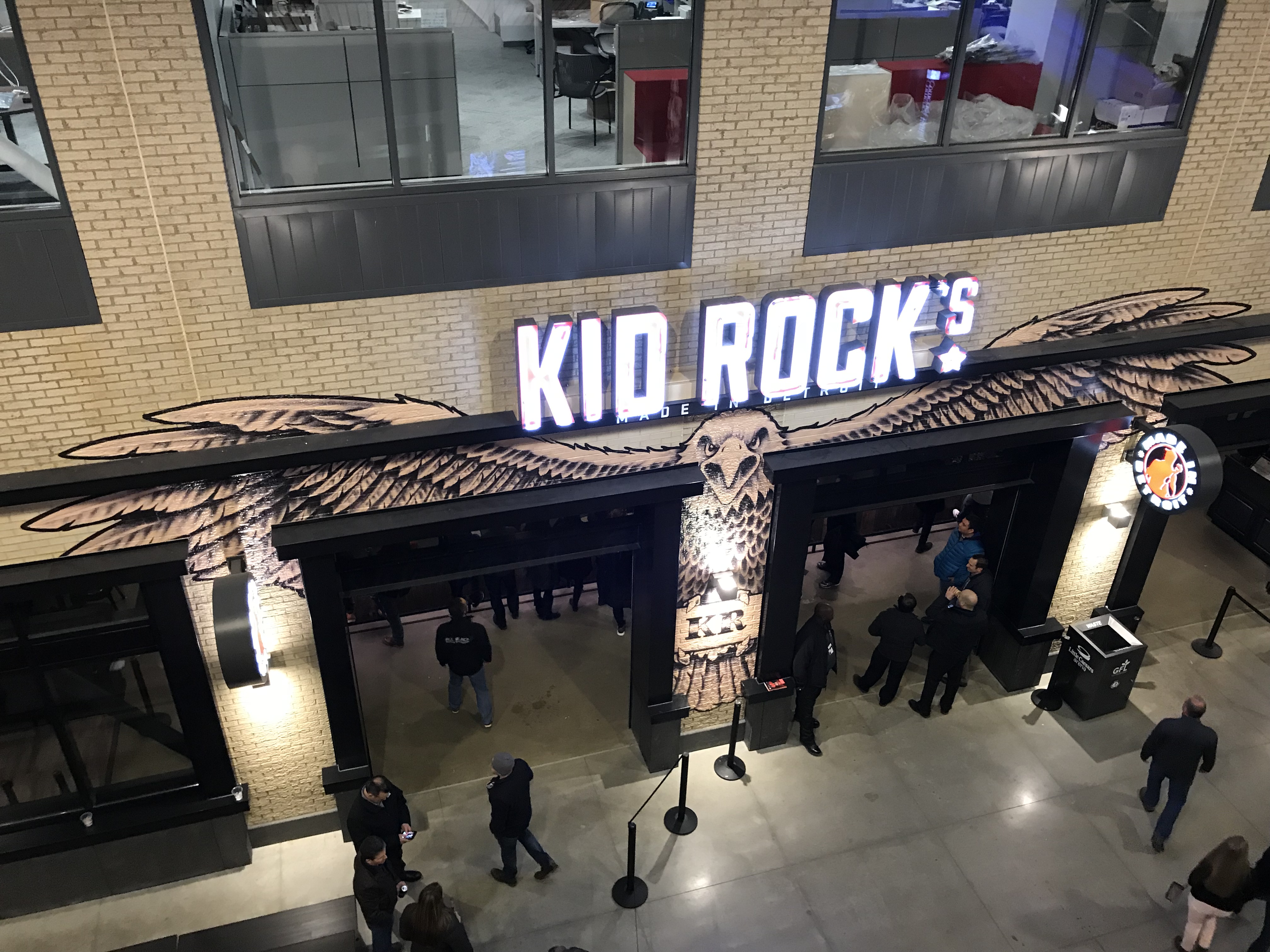
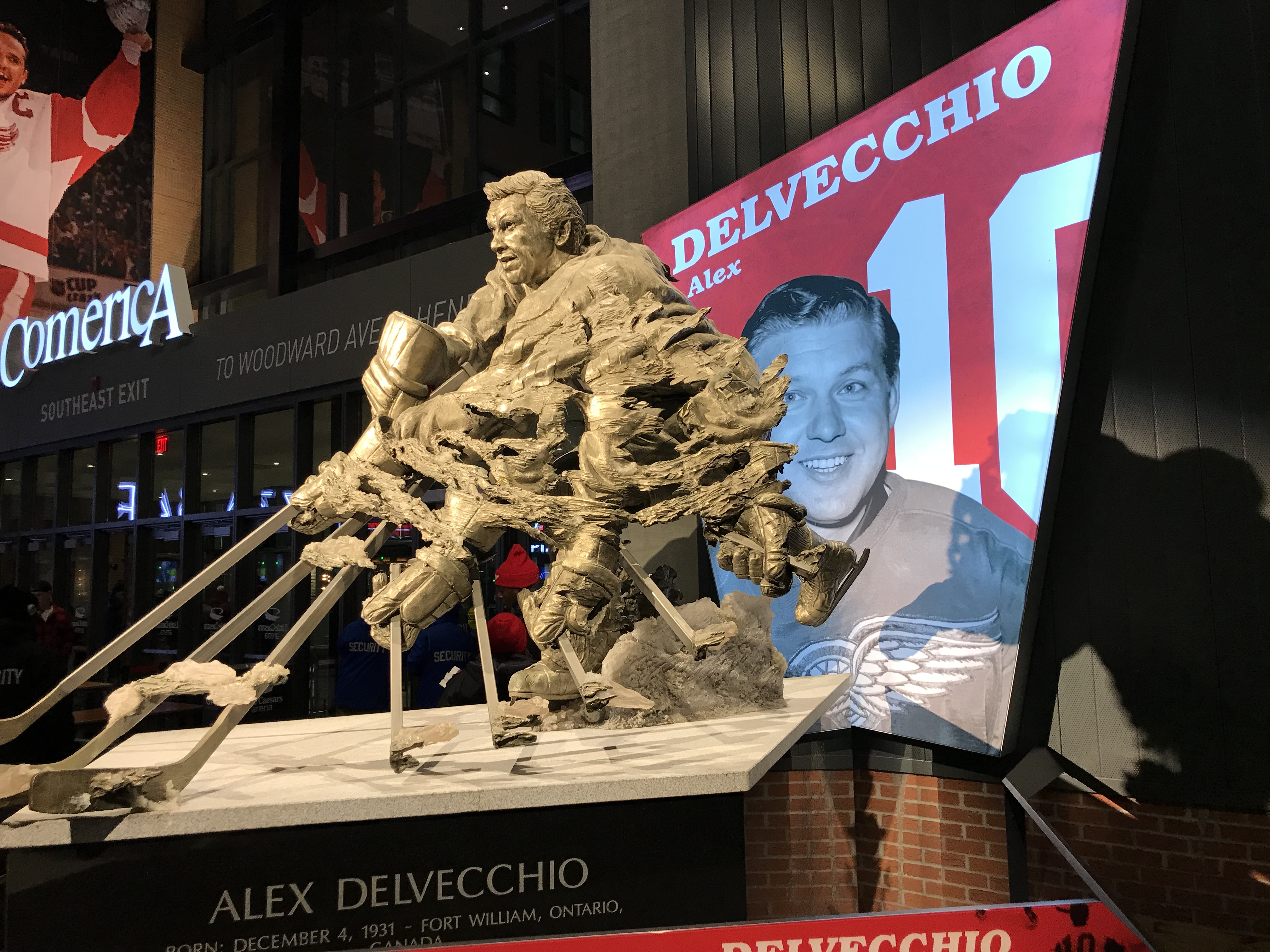
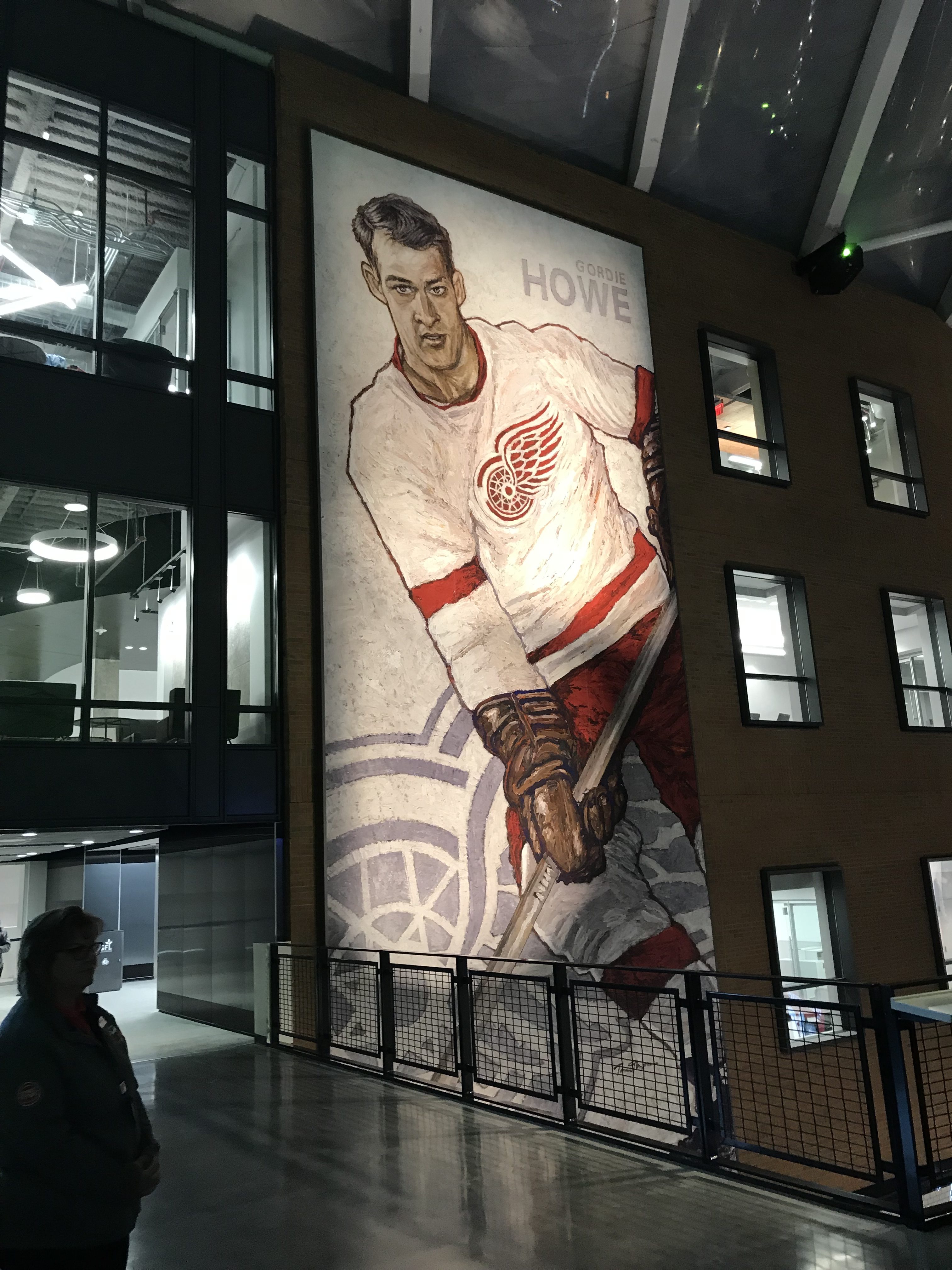
There’s also a Kid Rock-themed restaurant. Huge images and statuary of Wings legends like Gordie Howe decorate the concourses.
Alex Delvecchio Statue
Gordie Howe artworkKid Rock Restaurant
Two things we didn’t see as much of: octopi and the Pistons.
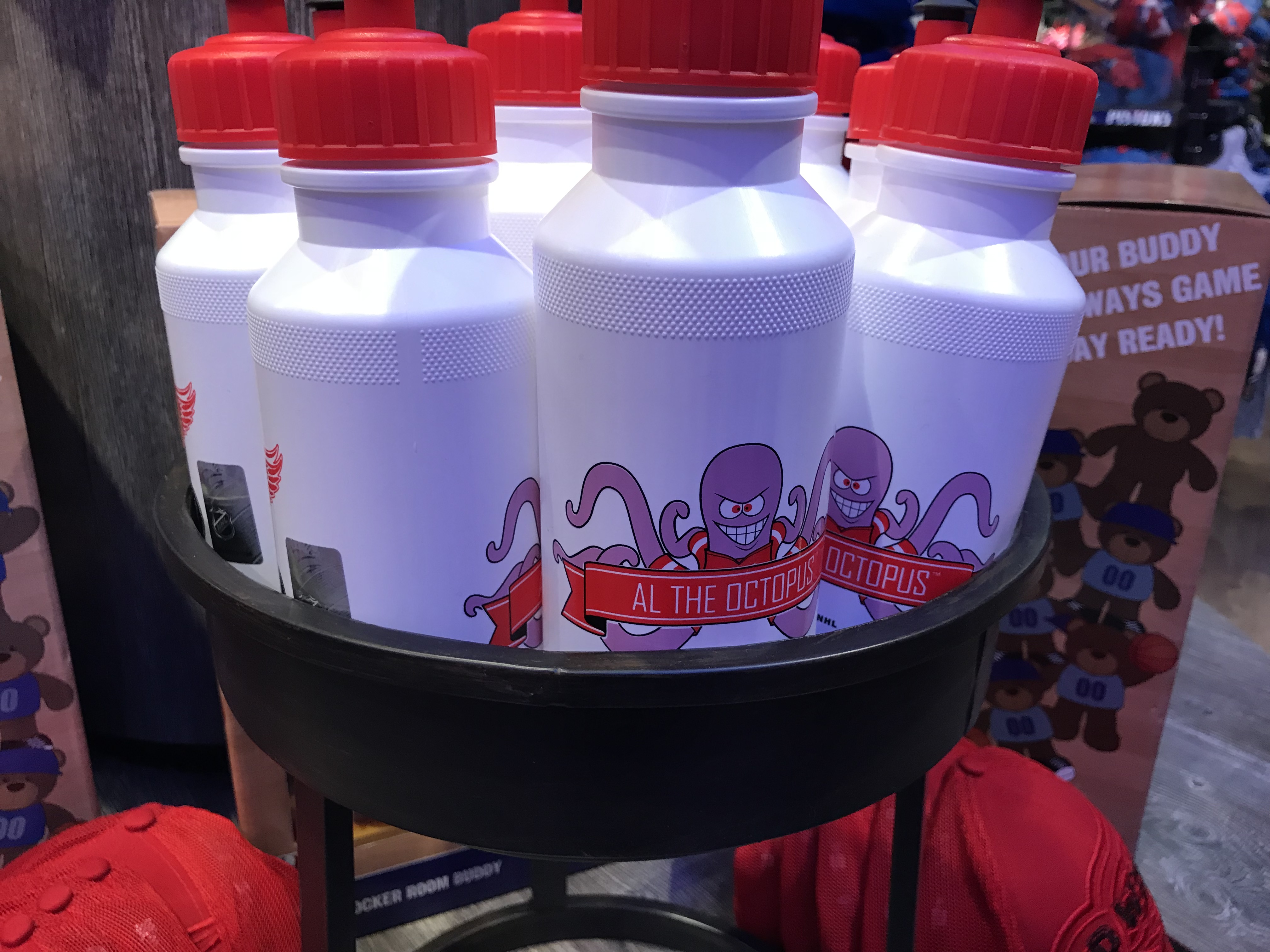
Wings fans have long prided themselves on sneaking in mollusks to fling onto the ice during the playoffs. While it’s a storied hockey tradition, my guess is the team doesn’t want to do anything encourage it. They do, however, have a few kids octopus items in the gift shop.
Octopus Water Bottle
The Pistons announced their move to the new arena well after the hockey team had spearheaded its development. While it was admittedly a Wings game night, the deficit in permanent branding between the basketball and ice hockey sides of the equation was noticeable.
The Wings announced attendance at 19,515, a sellout, but pockets of empty seats dotted the arena. Playing a Tuesday in frigid weather can’t have helped fill seats. I wondered if when the Texas Rangers can add air conditioning in their new ballpark, the hot trip from the parking lot might still depress attendance. My guess is people would favor a 100-degree drive and walk over the same ordeal in freezing cold precipitation, but we won’t know for sure until the 2020s.
Detroit Building
It will also take a while to know how the development schemes around the stadia in Arlington and the Motor City will work out. In year one, there wasn’t much around the arena. Perhaps that will change if the city of Detroit recovers from its recent financial turmoil.
Little Caesars Arena: Stars at Red Wings
Bottom line is that if you’re a hockey fan, an ornate arena operated by an Original Six team is well worth visiting. And if you’re a Stars fan, you’ll hope to do it on a night like last Tuesday: Dallas overcame an early deficit to earn a 4-2 road win.


Rush Olson has spent more than two decades directing creative efforts for sports teams and broadcasters. He currently creates ad campaigns, television programs, and related creative projects for sports entities through Rush Olson Creative & Sports, Mint Farm Films, and FourNine Productions.

RushOlson.com
Linkedin.com/company/rush-olson-creative-&-sports
Facebook.com/RushOlsonCreativeandSports


Wednesday, December 27, 2017

A Hockey Home for the Holidays


This post originally appeared in the Blotch section of the Fort Worth Weekly's website. To consume it there : https://www.fwweekly.com/2017/12/27/sports-rush-dallas-stars-home-for-the-holidays/

 For Dallas Stars fans, December 31st is a night to party.


OK, yes, that’s true for the entire rest of the world, too. But adding ice hockey into the mix of sparklers and champagne has become a tradition in North Texas sports.

Since moving to Dallas, the Stars have played games on New Year’s Eve 19 times, all but one of them at home. They’ve won a dozen of those, so this bit of holiday scheduling has more often than not made for a happy new year.

Marty Turco was the winning goaltender in four of these matchups (and drew another). In this video interview, he explains why he liked the annual affair and reminds us of a couple of the more memorable contests.


Rush Olson has spent more than two decades directing creative efforts for sports teams and broadcasters. He currently creates ad campaigns, television programs, and related creative projects for sports entities through Rush Olson Creative & Sports, Mint Farm Films, and FourNine Productions.

RushOlson.com
Linkedin.com/company/rush-olson-creative-&-sports
Facebook.com/RushOlsonCreativeandSports
Tuesday, October 17, 2017

Stars in College Hockey Country

This post originally appeared in the Blotch section of the Fort Worth Weekly's website. To consume it there : https://www.fwweekly.com/2017/10/17/sports-rush-stars-in-college-hockey-country/


Brad Berry played in the Dallas Stars organization for a number of years, including a couple of seasons in Minnesota, several with the top farm club in Kalamazoo, and the team’s inaugural season in Dallas. The former defenseman has since returned to his alma mater, the University of North Dakota, as the head coach. He won a national championship two years ago in his first season as the man in charge and has his group off to a 3-0-1 start this season.


We interviewed Berry, who bore some stitches above his right eye thanks to a wayward practice puck, after his team had just finished sweeping a pair of games from the St. Lawrence Saints. Before the Saturday game, the program honored the 1986-87 team that won a national title. A number of the players from that squad had returned to campus to enjoy a reunion, including a pair who also won a Stanley Cup with the Stars: Ed Belfour and Tony Hrkac. That North Dakota team, in fact, became known as “The Hrkac Circus,” as they set scoring records and became the first college hockey team to record 40 wins in a season. 
Rush Olson interviews Brad Berry
photo by Tom Fireoved
Coach Berry commented on what it meant to have that team return to the ice, both for him and his players. I also asked him about the hockey experience at the Ralph Englestad Arena. It was my first time to visit the facility and it is a remarkable place to watch a game. Impressive physical features include marble floors and padded seats, and they have a row of suites and a couple of clubs with a view of the action. The crowd is into it, with chants and gestures and a band. In the interview, Berry compared it to a college football atmosphere and I agree with him. At the second intermission, the band even plays as they march around the concourse. A hockey fan might want to put a North Dakota game on his or her bucket list.


Rush Olson has spent two decades directing creative efforts for sports teams and broadcasters. He currently creates ad campaigns, television programs, and related creative projects for sports entities through Rush Olson Creative & Sports, Mint Farm Films, and FourNine Productions.


Thursday, October 5, 2017

A Voice Lives On

This post originally appeared in the Blotch section of the Fort Worth Weekly's website. To consume it there : https://www.fwweekly.com/2017/10/03/sports-rush-a-voice-lives-on/

I only met the man in person once.

The meetup came at the Dallas Stars’ media day in September, 2015. The team had just hired Dave Strader as its play-by-play announcer and he had come over to Frisco’s Dr Pepper Arena to observe the goings-on. I chatted with him and his new broadcast partner, Daryl Reaugh. The whole conversation might have lasted a minute. I remember Dave being nice and then I went on to whatever other production duties had presented themselves.

I re-connected with Dave earlier this year. The Stars announcer was scheduled to join his radio counterparts from the Mavericks, Rangers, and Cowboys to swap stories and raise money for charities. I had taken on some producing duties for this event, called Talk of the Town, and needed to work with him on the show. What made it tricky was that we didn’t know if he would be there.

Since I had last seen Dave Strader, the Hockey Hall of Fame had honored his broadcasting excellence by naming him the 2017 recipient of the Foster Hewitt Memorial Award. Dave had also contracted cholangiocarcinoma, a punishing cancer of the bile duct.

We had shot funny (I hope) promotional videos with Eric Nadel, Brad Sham, and Chuck Cooperstein to promote the event. Dave didn’t get to participate in those because he was undergoing treatment. But he retweeted and promoted and did everything he could to support his fellow broadcasters, the event, and the charity he had chosen to benefit from it, the Dallas Stars Foundation.

We had discussed trying to have him participate live via an electronic connection if we could work out the technical details, but I honestly wasn’t sure what to expect and what kind of strength he would have. Then, shortly before the event, we found out good news: Dave would be well enough to fly in and attend the event.

We needed to add his elements to the program. I had collected play-by-play excerpts for all the other announcers and now I got to ask Dave what he wanted. He asked for a Red Wings call, his last as a team broadcaster for that Original Six team. A connection helped me get that from Detroit. He also sent us a voicemail recording sportscasting icon Marv Albert had left him after the Foster Hewitt announcement.

Then, abruptly, Dave’s treatment schedule changed. He wouldn’t be able to make it to Dallas for Talk of the Town. But he felt he would be strong enough to join via Skype if we could make the technical details work (which, luckily, we could). And that evening, we dialed him up and found out he indeed was very much robust enough to connect and contribute.

I had Dave make his entrance in the middle of the program because I wasn’t sure of his stamina. I wish I had dropped him from the beginning, because he gave a fantastic performance. He told great stories, interacted with his fellows, and gave the audience one of the best memories of any charity event I’ve ever worked. I’ll never forget how moved the table of Dallas Stars employees seemed when he appeared on the video screen. When he signed off, they and the rest of the crowd gave him a well-deserved standing ovation.
Talk of the Town might have been the last time he got to use his voice in a live broadcast-style setup to entertain sports fans. It seemed to truly energize him and I think that makes all of us who took part in it feel pretty good.

I had one other regret from the evening. When we were talking about calls to find, Dave had written this: “I would love to have the call of Jamie Benn’s OT goal from Feb 18…my first game game back after my cancer diagnosis. I would also like the clip of Razor’s comment as the players skated over to salute me at the end of the game.”

In hindsight, I desperately wish I had made the extra effort to include that call, which due to exigent circumstances that week, was more of a challenge that it normally would have been. I remember thinking that I would for sure use it for next year’s event, when he would hopefully make a triumphant in-person appearance.

That won’t happen now. Dave Strader died Sunday.

I only met Dave the one time, and communicated with him via email, phone, and Skype a bit. Yet somehow his passing resonated deeply. It didn’t require much exposure to the man to see his passion for people and a deep-seated fervor for life.

Many Stars fans (and those of the other teams for whom he called games) never had the pleasure of meeting Dave even once, but I bet they could tell the same things I could, thanks to the zeal with which Dave broadcast hockey games (and the other sports he did as well).

Many in the hockey business called Dave Strader “The Voice.” Luckily, his voice will live on in the work he did and the calls you’ll be able to listen to online and in hockey shows for years to come. And in the memories of those who knew him, even just a little bit.


Rush Olson has spent two decades directing creative efforts for sports teams and broadcasters. He currently creates ad campaigns, television programs, and related creative projects for sports entities through Rush Olson Creative & Sports, Mint Farm Films, and FourNine Productions.

RushOlson.com
Linkedin.com/company/rush-olson-creative-&-sports
Facebook.com/RushOlsonCreativeandSports
Wednesday, August 9, 2017

Ed Belfour on Hockey and His New Business Venture

This post originally appeared in the Blotch section of the Fort Worth Weekly's website. To consume it there : https://www.fwweekly.com/2017/08/09/sports-rush-ed-belfour-in-good-spirits/

Ed Belfour’s goaltending propelled the Dallas Stars to the franchise’s only Stanley Cup win. He formed a unique bond with that team’s coach, Ken Hitchcock. Now the club has rehired Hitchcock in hopes of returning to an elite level. In this video interview, Belfour offers his feelings about his former coach coming back and why Hitchcock might be even better this time around. The Eagle also talks about a team he has assembled and the work they have been doing to create a North Texas distillery to be called Belfour Spirits.

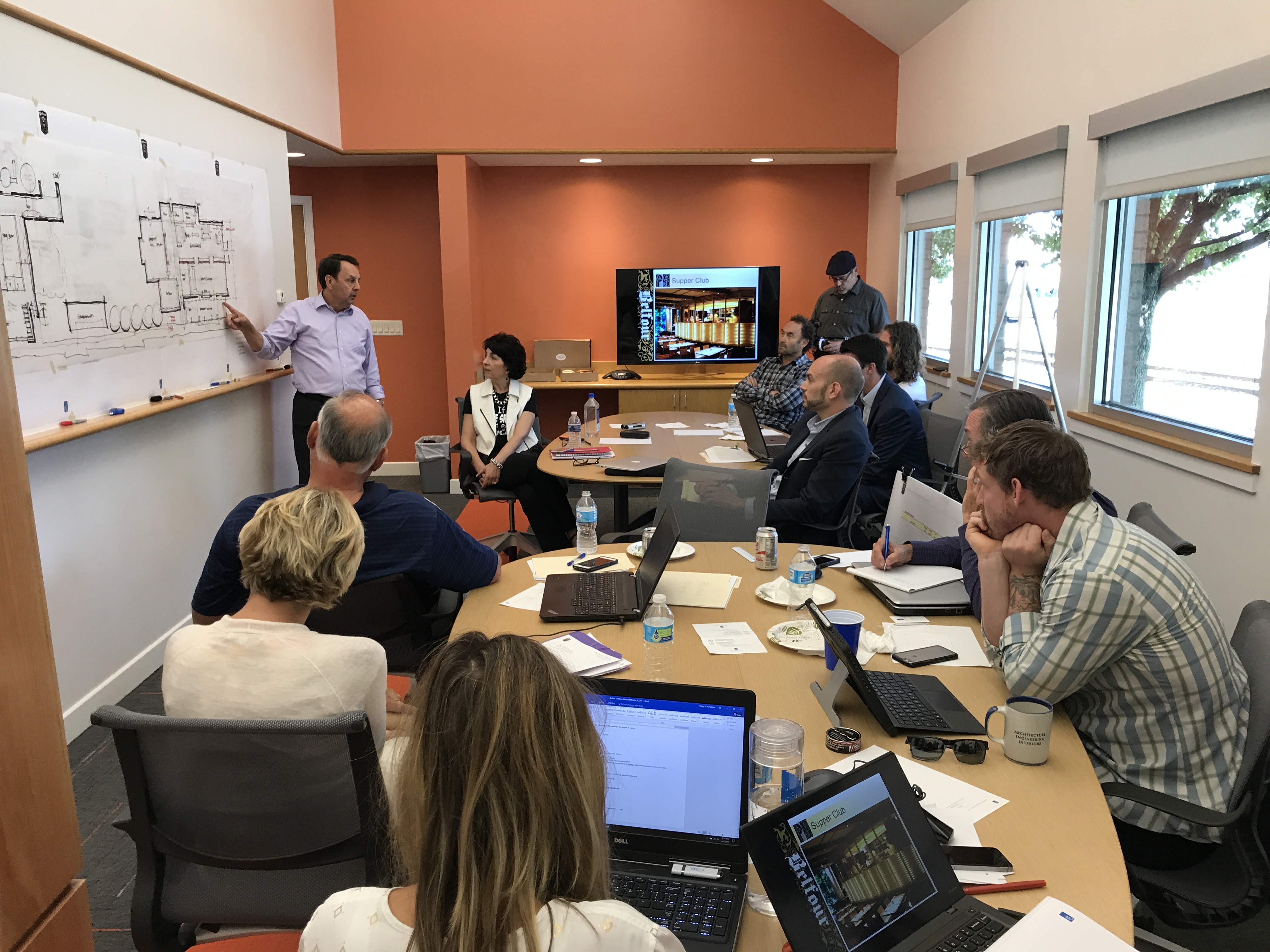
Videographer Dave French and I did this interview in Louisville, Kentucky where we were recording images of the exchange and refinement of ideas related to the development of the distillery. I observed elements analogous to the Belfours’ sporting backgrounds (Ed’s son Dayn, also a former goaltender, is his partner in the venture, as is his daughter Reaghan) . Firstly, they truly tried to assemble a team and let them play their positions. The Belfours didn’t pretend to know everything (although they have certainly done their homework on the industry), but they did try to have a good representation of the diverse factors that go into creating a distillery from scratch. Those included building design and construction, event space planning, branding and marketing, production workflow, and finance.

BelfourSpiritsMeeting_8138 I also thought about how Ed Belfour approached the game of hockey. He had a reputation for paying close attention to details, wanting to keep on top of everything from the sharpness of his skates to new techniques other goaltenders had adopted around the league. He approached the distillery business the same way. Everyone we talked to at the meetings agreed that he was keen to make sure nothing fell through the cracks. Architect Wayne Estopinal, who describes himself as a “detail freak,” viewed Ed’s approach as a positive.

“I think that’s helped a lot,” he told me. “If we had a guy who just threw out a big idea and left it to everybody else to implement it, for them it’s kind of a hollow feeling. You want somebody engaged and he certainly is.”

They came out of their meetings knowing what they wanted and how much it might cost, and next steps will include figuring out financing it and what to do first. It’s probably similar to building a hockey team, come to think of it. Stars fans will no doubt hope both Belfour and his former boss will experience success with their new, yet in many ways familiar, teams.

Rush Olson has spent two decades directing creative efforts for sports teams and broadcasters. He currently creates ad campaigns, television programs, and related creative projects for sports entities through Rush Olson Creative & Sports, Mint Farm Films, and FourNine Productions.

RushOlson.com
Linkedin.com/company/rush-olson-creative-&-sports
Facebook.com/RushOlsonCreativeandSports
Thursday, April 27, 2017

Turco Behind the Mask (or Masque)

This post originally appeared at the Fort Worth Weekly's website. To view it there :  https://www.fwweekly.com/2017/04/27/behind-the-mask-or-masque/


After retiring from playing hockey, former Dallas Stars goaltender Marty Turco has maintained the affinity for nonprofit work he had as a player. Turco serves as president of C5 Youth Foundation of Texas, an organization that works with at-risk youth to shepherd them from eighth grade through high school graduation. Their track record includes nearly all of their graduates advancing to college.

Part of Turco’s job includes fundraising, and he has an event coming up May 11th that draws inspiration from his hockey equipment. The Behind The Masque Gala, presented by Aimbridge Hospitality, is a masquerade ball. In this video interview, Turco explains a few details about the event and delves into his own experience of wearing custom-made masks when he played. He also talks about why he feels C5 Texas to be such a worthwhile organization.

To learn more about C5 or to support them by purchasing Behind the Masque tickets, visit c5texas.org.


Rush Olson has spent two decades directing creative efforts for sports teams and broadcasters. He currently creates ad campaigns, television programs, and related creative projects for sports entities through Rush Olson Creative & Sports and FourNine Productions.

RushOlson.com
Linkedin.com/company/rush-olson-creative-&-sports
Facebook.com/RushOlsonCreativeandSports
Thursday, November 24, 2016

Jamie Benn Gets Charitable

This post originally appeared at the Fort Worth Weekly's website. To view it there : https://www.fwweekly.com/2016/11/22/sports-rush-jamie-benn-assists/

During the season, professional athletes have lots of demands on their time. So for the captain of one of the local sports teams to attend an event that wasn’t even an official team function in the middle of a homestand indicates that he must have a deep-seated interest in it. Last Wednesday, Stars forward Jamie Benn appeared at the Lagardère Sports presents the Heart of Dallas Fast Pitch Event. He received the group’s Community Excellence Award, and also collected monies set to go to a charity he cares about.

Find out what that cause is and more about the event in my video interview with Jamie Benn.


A little more insight into the character of the guy who wears the C – he wore a suit, you’ll notice. He could have donned anything he wanted and gotten away with it, but he followed the dress code. He was extremely gracious the whole evening, took photos with all the sponsors and committee members, and earnestly answered host Julie Dobbs’ questions on stage. You can look for excerpts from their chat on this coming week’s Stars Insider show on Fox Sports Southwest.

The Fast Pitch event, held this year at LIFE in Deep Ellum, has its roots in the group that puts on the Zaxby’s Heart of Dallas Bowl, held each December in the Cotton Bowl. It awards game-related charitable funds through this annual Shark Tank-style event. Charities tell some amazing stories about the good work they do. More than one tale was moving enough to bring tears from some of the attendees and the judges’ decisions on who should get which sums was not an easy one.
All six charity finalists received awards of at least four figures :
  • Bryan’s House
  • Café Momentum
  • Mercy Street
  • New Friends New Life
  • The First Tee of Greater Dallas
  • The Warren Center


Rush Olson has spent two decades directing creative efforts for sports teams and broadcasters. He currently creates ad campaigns, television programs, and related creative projects for sports entities through Rush Olson Creative & Sports and FourNine Productions.


RushOlson.com
Linkedin.com/company/rush-olson-creative-&-sports
Facebook.com/RushOlsonCreativeandSports
Tuesday, December 8, 2015

Delectable Hockey Made From Scratch

This post originally appeared on the Blotch page at the Fort Worth Weekly. To read it on that site : http://www.fwweekly.com/2015/12/08/delectable-hockey-made-from-scratch/


Dallas Stars fans have had a lot of reasons to take pride in their team this season. They’ve played exciting hockey, hovering at or near the league lead in goals scored all year. Supporters have no doubt loved the team’s moxie, demonstrated most recently by taking six points from four road games (including three in the Pacific time zone) in six days. And they’ve certainly enjoyed seeing the Stars compile the National Hockey League’s best record while featuring a number of guys who’ve never played for another NHL team.

The Stars drafted their leading goal scorer in the fifth round in 2007. They took their top-scoring defenseman in the same round three years later. Jamie Benn and John Klingberg join nine other men on the current roster whom the Stars either drafted or signed after the player went undrafted.

That Dallas would see success from homegrown players comes as no surprise to Stars fans who have expected a wave of young players to move the franchise forward for a few years now. The team’s top minor league affiliate, the AHL’s Texas Stars, have been to the Calder Cup finals twice this decade, winning the title in 2014. The ECHL’s Idaho Steelheads have not missed the playoffs as a Stars affiliate and won their league’s Kelly Cup in 2007.

This Stars team may end up being really good. Really, really good, even. The Stars have had a number of strong teams since coming to Dallas, but one can make the case that this is the most homegrown good team they’ve iced.

By way of comparison, I looked at the six Stars teams that have made the conference finals since homegrown Hall-of-Famer Mike Modano joined the team in 1989. The era had the draft remaining as an established commodity, Eastern European players becoming easier to import, and free agency in place. The rules for building a team changed over that period, but not so appreciably as to make comparisons irrelevant, as they would have been during the Original Six or WHA periods.


To calculate, I looked at the top 22 skaters as measured by playoff games played, plus the top three goalies in the organization. I figured that playoff participation let you truly know who the core players were, and that criterion also takes into account the trade deadline deals that impact a team’s finish. I made exceptions to add crucial performers who missed significant parts of the playoff runs, including the likes of 1998 Joe Nieuwendyk, 2000 Brian Skrudland, and 2008 Philippe Boucher. For this year’s team, I looked at the current roster plus the top three goaltenders.

R1We can start with the late 90s Stars teams. From 1998-2000, Dallas went to three straight conference finals, skated the Stanley Cup in 1999, and lost in the finals in 2000. General Manager Bob Gainey built those groups with savvy trades, money from Tom Hicks, and between seven and nine homegrown players a year. The free agents in that pre-salary-cap time included Brett Hull, Ed Belfour, and Pat Verbeek, and we should probably also note that a large contract kept Nieuwendyk from testing free agency. In addition to those high-dollar signings, trades matched the talent of Sergei Zubov and Daryl Sydor with the grit of Cup-winners from Gainey’s old Montreal organization, like Skrudland, Craig Ludwig, Mike Keane, and Guy Carbonneau. Those players combined with organizational products in their primes, like Modano, Jere Lehtinen, and Derian Hatcher, to produce the greatest era in franchise history.


The first team to make it to the finals in the Modano era came when he was 20 and the franchise had not left Minnesota. GM Bobby Clarke gave first-year coach Gainey 10 homegrown players with which to work, 12 trade acquisitions, a pair of veteran free agents, plus Stew Gavin on a waiver draft claim (the waiver draft got eliminated in the 2005 labor agreement). Dallas fans might recognize Stars draftees on that team like Neal Broten, Modano, Mike Craig, and Shawn Chambers (a supplemental draft selection who left the organization but returned as a free agent to win the ’99 Cup). That group, which also included former first-rounder Brian Bellows, lost to Pittsburgh in the Stanley Cup Finals.

2007-08 provides this year’s version the best competition for the title of “Most Homegrown Good Stars Team.”  They had 14 guys who had never played for another NHL franchise. The four free agents included defensive stalwarts Philippe Boucher and Stephane Robidas. The seven trade acquisitions were headlined by trade deadline pickup Brad Richards and the stalwart Zubov. They posted 97 points and lost the conference finals in six games to Detroit.
There’s a case to be made that the ’07-’08 Stars were more indigenous than this ’15-16 batch, since they had the 14 draftees (all but three from the top two rounds). Heck, a third of their general managers that season were kind of homegrown (Brett Hull played here before sharing GM duties with Les Jackson after Hicks let Doug Armstrong go). But a development pipeline shows its depth not only by the players who come through it to play a key role for your team, but also by how effectively you can use it to acquire other talent.  Here current GM Jim Nill and his predecessor, the former Star Nieuwendyk, have made a real impact on this year’s success.

The Stars traded a total of 13 players (plus three draft picks) to acquire top-six forwards Tyler Seguin, Patrick Sharp, Jason Spezza; solid defensemen Jason Demers and Alex Goligoski; and co-number one goalie Kari Lehtonen. Of the 13 traded players, all but one had never been the property of another NHL team. The lone exception, Seguin trade inclusion Joe Morrow, came to the Stars in a deal for former top pick Brenden Morrow.
Those other Stars teams had some success dealing players who came through the organization. Jackson (who had a hand in shaping all these teams in some front office position or another) and Hull’s package for Richards included draftees Jussi Jokinen and Mike Smith. Dave Gagner’s 40 goals and strong playoff run in 1991 made the deal for Jari Gronstrand and Paul Boutilier look pretty good. And even in hindsight, no Stars fan would undo Gainey’s swap of Jarome Iginla for Conn Smythe Trophy-winner Nieuwendyk. But the 2015-16 Stars have benefitted from using young talent to acquire top-caliber performers more frequently than any of their predecessors.

Speaking of youth, only one of the 11 homegrown Stars this season is older than 26 (Benn’s brother Jordie, 28) and there’s more talent waiting in Cedar Park. This team could be good for a while.

Nill no doubt understands how the draft-and-develop approach can win. The Red Wings team that beat the ’07-08 Stars group went on to win the most recent Motor City Stanley Cup. Eight of their top ten playoff scorers were guys the longtime Detroit Assistant GM helped draft. Stars fans hope a playoff leaders list that includes names like Benn, Klingberg, and Nichushkin brings the same hardware to North Texas.


Rush Olson has spent two decades directing creative efforts for sports teams and broadcasters. He currently creates ad campaigns and related creative projects for sports entities through his company, Rush Olson Creative & Sports.


RushOlson.com

Linkedin.com/company/rush-olson-creative-&-sports

Facebook.com/RushOlsonCreativeandSports

Wednesday, September 23, 2015

Stars For A Day

This post originally appeared on the Blotch page at the Fort Worth Weekly. To read it on their site : http://www.fwweekly.com/2015/09/23/stars-for-a-day/
When you attend a Dallas Stars game, you might say “Wow, that video they play before the game looks awesome!” You might laugh a lot during a TV timeout when ersatz game show host Daryl Reaugh awards a player 25,000 points for preferring steak over sushi. You could even declare, “Wow, Jamie Benn’s really cute without his helmet.”
After making those observations about what you’ve just seen on the big center-hung video screen, you might then wonder “How do they do all this stuff?” The answer: Media Day.
Thursday, the Stars took their whole team to Cedar Park, Texas to begin training camp. They have to marshal massive amounts of gear and personnel to make the move happen. Earlier in the day, an undertaking nearly as large preceded it. That’s the one that yields you your player features.
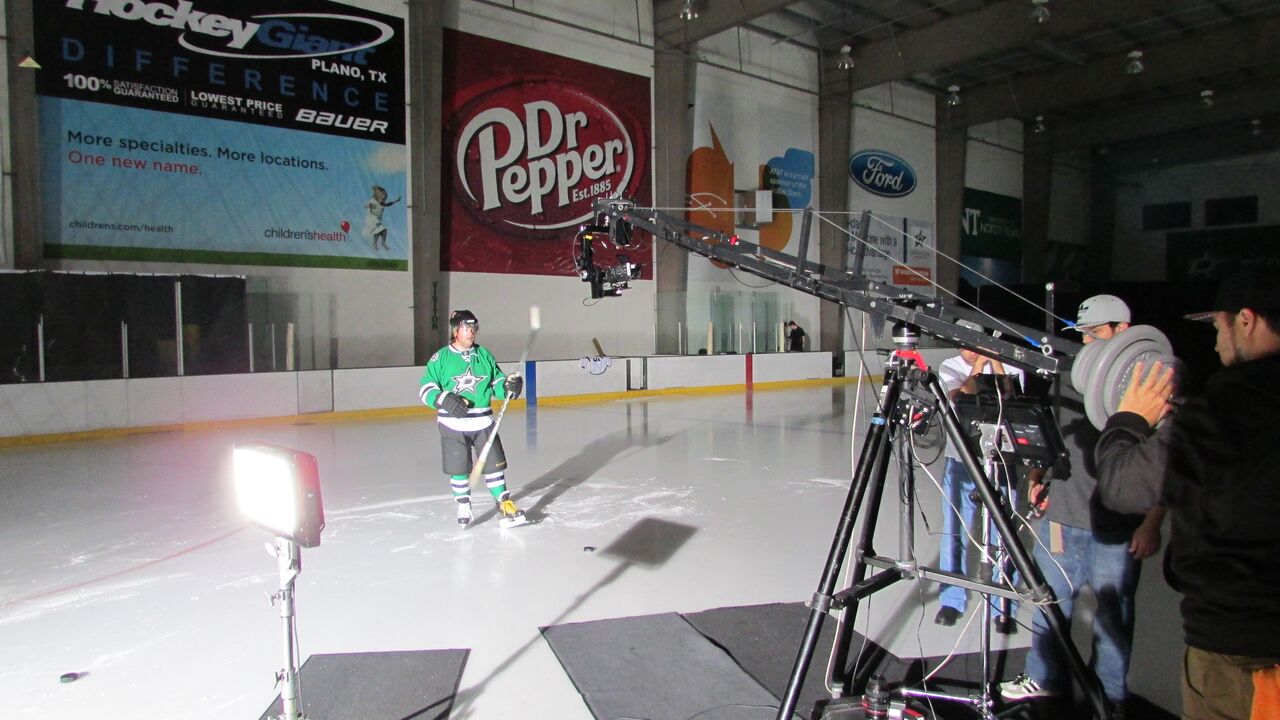
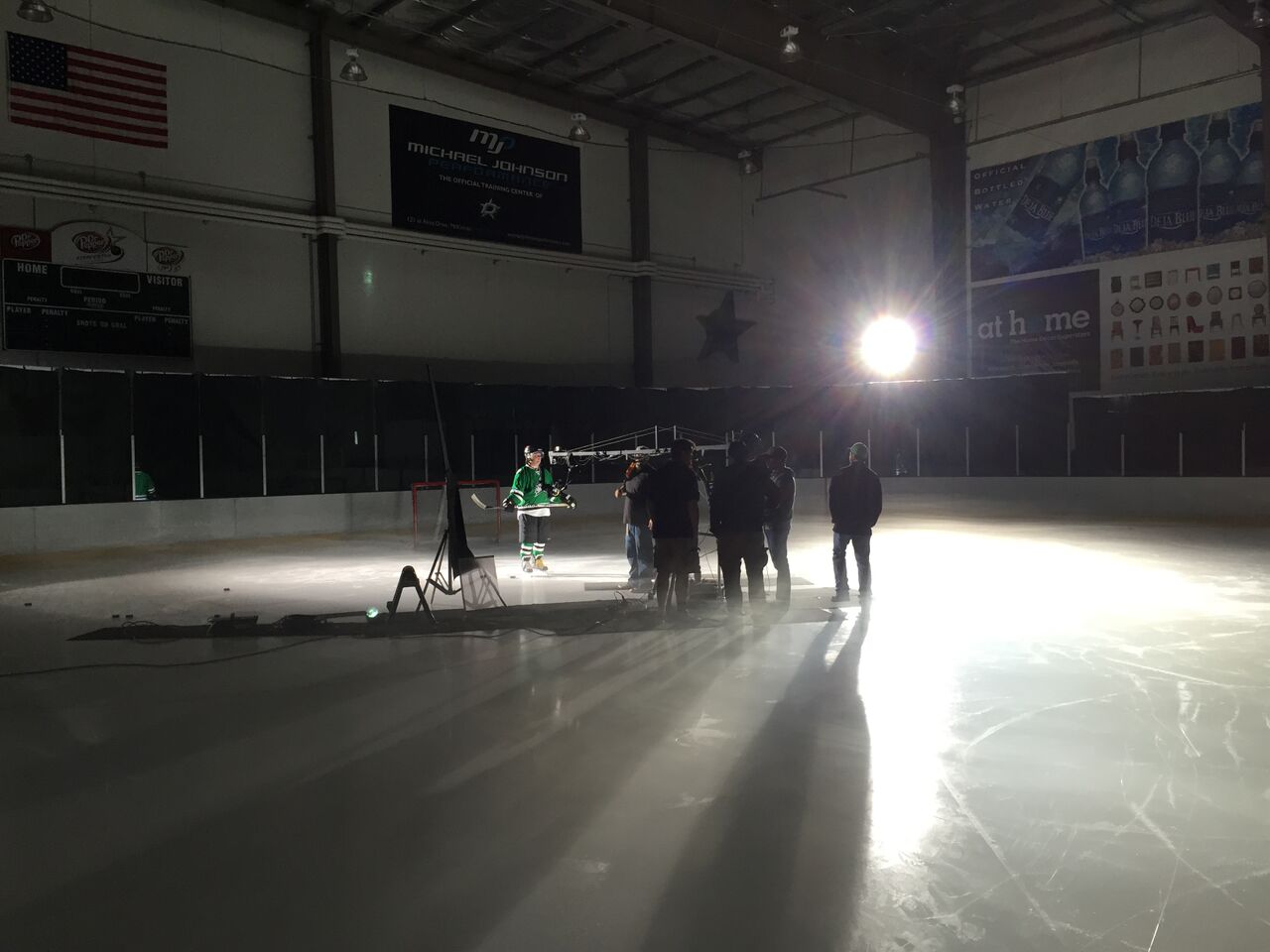
You don’t actually see a lot of media at Media Day. It’s mostly for the Stars’ in-house productions. They set up a dozen or so video and photo stations scattered throughout a darkened Frisco Dr Pepper StarCenter. Top players like Jason Spezza and Jamie Benn visit every spot, while young players likely to spend the season in Cedar Park or junior hockey don’t have to make the entire circuit.
Stars Vice President of Production and Entertainment Jason Walsh and his department bear the responsibility for putting on the event. They want to try to shoot almost every element they’ll need for the entire season. Why do they go to the trouble?
“The players’ time is valuable,” explained Walsh. “During the season, the guys play so many games and attend so many practices and team events that their time with families is at a premium. We respect this and want to get in, capture the needed content, and get out of their way.”
On Media Day, Walsh’s group will have been at the facility since 5:00 am after a full day of setup the day before and weeks of planning.
Walsh said, “This is a project that requires every video resource we have in house and significant help from outside the organization. It takes a month or so to visualize all the needed elements from every department in the organization. Marketing, corporate partnerships and our foundation all play a major role in how we go about preparing for this day.”
At 8:30 am or so, the players started hitting the ice to shoot video elements the Stars can use in-arena, online, and in their television broadcasts. This year, the team added a high-speed camera that shoots at 240 frames per second. The slow motion video it produced looks stunningly dramatic.
After some on-ice photos, the players removed their skates and pads and returned for the next several stations. The various emplacements were numbered and the front office issued each player a card listing which ones he needed to visit. Going in numerical order was not required so long as each player made it to every station they’d assigned him.
They had to get photos made for NHL official head shots. All pro sports leagues shoot such items preseason, so as a player you can always expect that whatever hairdo you had at the beginning of the campaign will follow you throughout visiting arenas for the rest of the season.
Players also posed for photos in team branded shirts, caps, and other wearables for use by the folks who sell Stars merchandise.
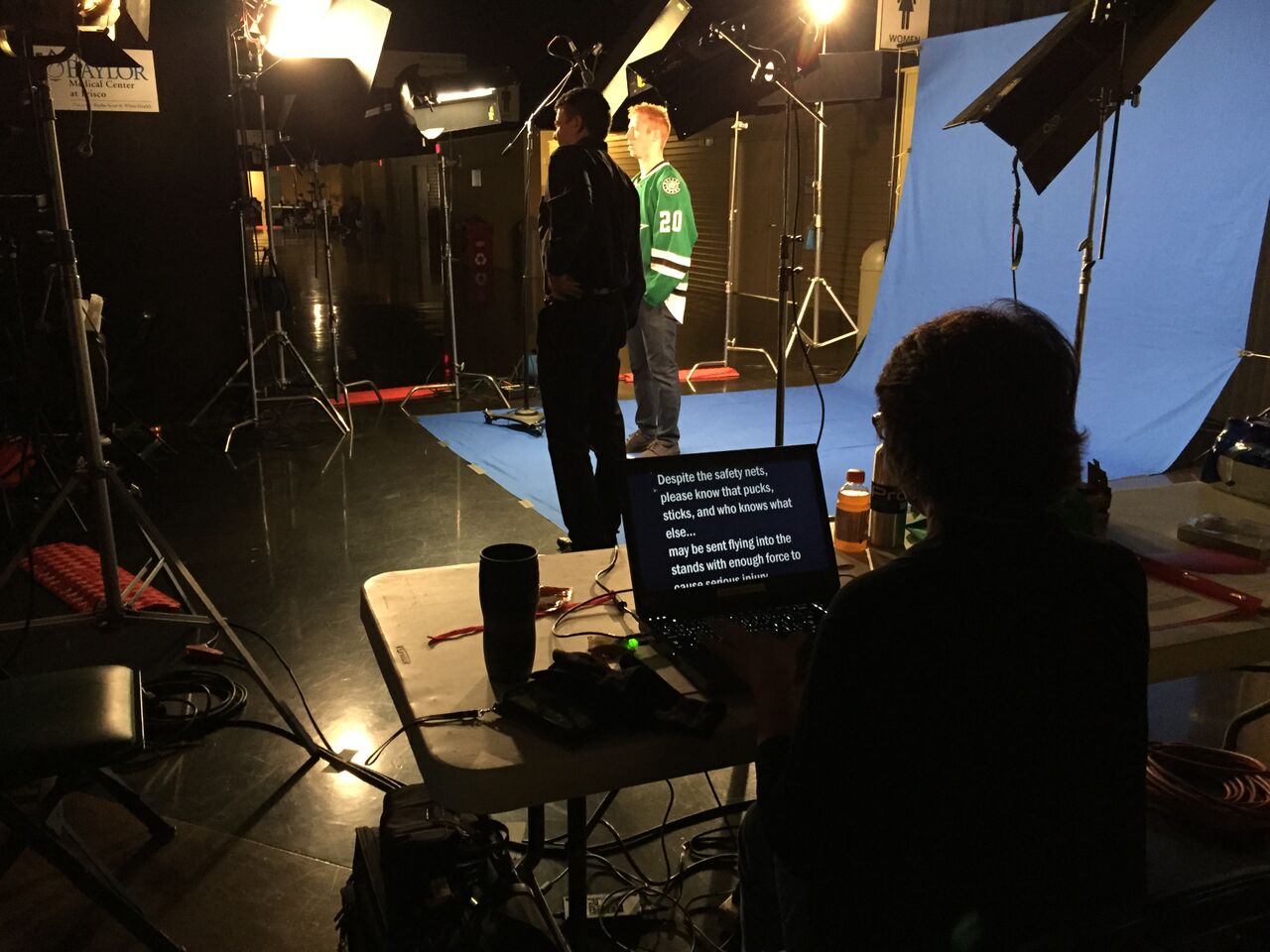
Three stations on the Dr Pepper Arena’s concourse level involved players saying lines in front of a blue screen. The Stars have to use blue screens rather than the green ones typically used by weathercasters. That’s because they wear green jerseys and the technology that removes the green to replace it with a background would also take out the jersey.
They said lines for marketing and in-game use. Spoiler: if you’re at a game this year and the Stars score in the second period, you’re going home with a coupon for a free taco. You may also laugh when the player on the video board says “I like tacos.”
Another funny moment will come when players hold up a fake mustache while saying lines. This one isn’t for a sponsor promotion, though. Pro athletes often look to do more than just entertain. They can can use their visibility to inform and motivate fans regarding charitable causes. The Stars Foundation station creates that sort of content.
Also upstairs, they did interviews for Stars features and Fox Sports Southwest promos and features.
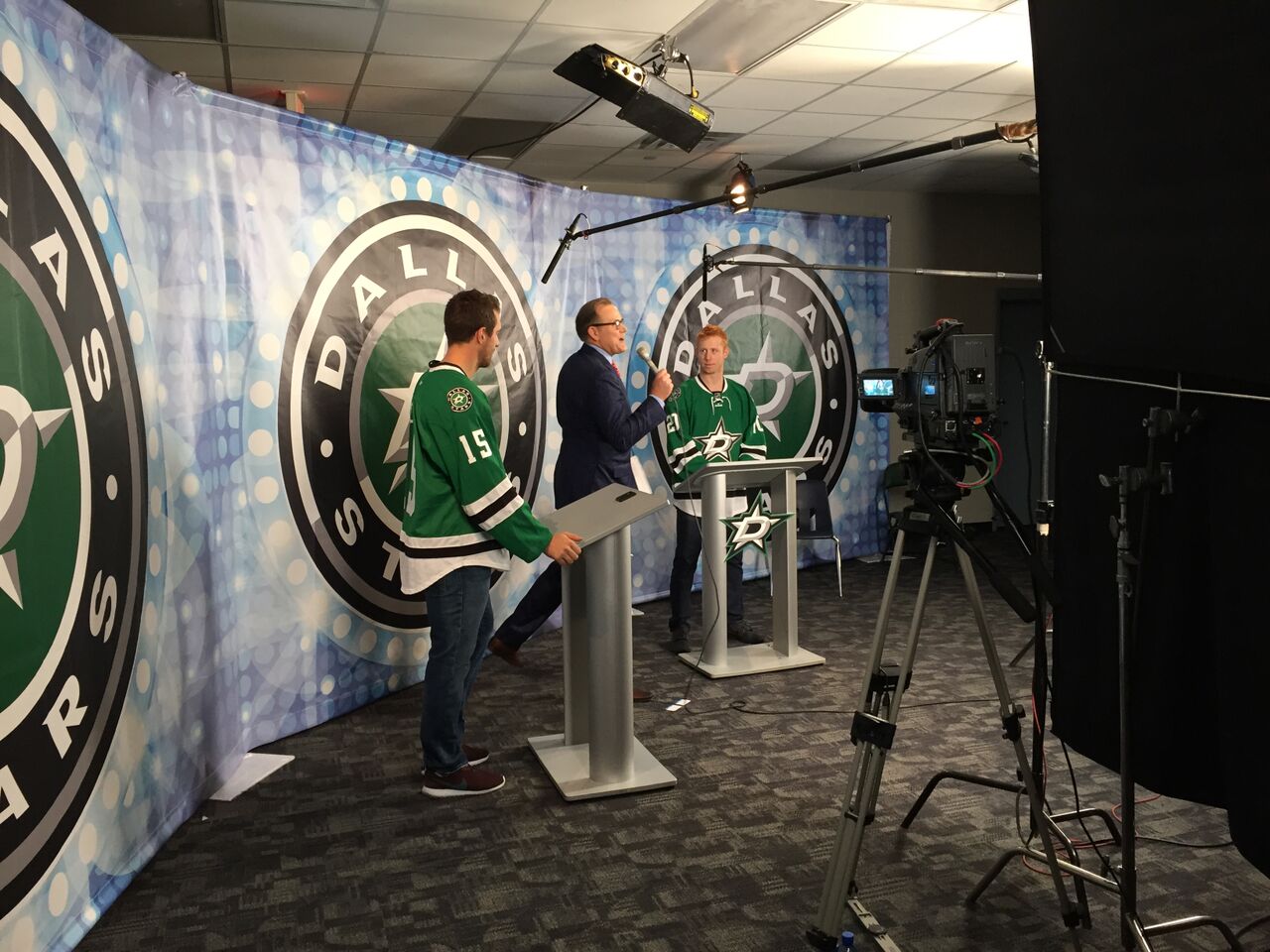
In a room downstairs, a sparkly 30-foot wide banner stood behind two podiums. Players entered this room by twos so they could play a game called “Head to Head.” Stars TV/Radio analyst Daryl Reaugh played the part of a game show host, asking questions and allowing players to answer as seriously or flippantly as they desired. Sometimes they got it. Sometimes they didn’t and it was still amusing. Reaugh suggested that the best line of the day might have been when defenseman John Klingberg declared “I don’t understand this at all.”
“The whole idea is to give fans a chance to see the players in a different setting, without their gear, and hopefully exhibiting a bit of their personality,” Reaugh explained. “The more smiles we can put on fans’ (and players’) faces, the better.”
Razor has mastered the subtle details that traditionally marked the game show genre. He wore a loud tie. He entered the set as if Don Pardo had just introduced him. He improvised awarding ridiculous sums of points for answers he saw as having shot and scored.
“One of the best answers came from (goaltender Antti) Niemi,” Reaugh said. The question was: ‘Would you rather spend summers in Texas or winters in Finland?’ He was up against fellow Finn Kari Lehtonen and he showed quick wit to go along with his lightning reflexes. His answer: ‘Summers in Finland, winters in Texas.’ Bam!”
Reaugh even engaged in fake silent happy talk after the game show concluded. That’s the part where the audio operator has turned the microphones down on the set but you see the host banter with the contestants as the credits roll. Razor mimicked the effect by mouthing words to the players after he closed each segment. If the players caught on, it was funny. If they didn’t, it was funny.
Sports teams have long produced lots of content (like game programs, scorecards, and publications like Dallas Cowboys Weekly), but technology like HD video boards and websites has driven teams to put resources into producing content of all kinds like never before. They do it all to entertain and engage Stars fans like yourself. And now when you see some of that content on the American Airlines Center video boards, you’ll be able to say “I know where that comes from – Media Day.”
Disclosure: For the last couple of years, the Stars have paid me to help organize the crews and gear for their Media Day setup.

Rush Olson has spent two decades directing creative efforts for sports teams and broadcasters. He currently creates ad campaigns and related creative projects for sports entities through his company, Rush Olson Creative & Sports.


RushOlson.com

Linkedin.com/company/rush-olson-creative-&-sports

Facebook.com/RushOlsonCreativeandSports