Showing posts with label college sports. Show all posts

Sunday, August 30, 2020

Agility Matters in TV and Football

 The agility of high-level American football players has always amazed me. 300-pound men change direction instantaneously as they pursue their missions of either protecting or demolishing a ballcarrier.


We saw a lot of agility among the guys in pads as we produced a television program about the College Gridiron Showcase this year. The event, in fact, revolves around former college football players trying to show pro scouts how nimble, strong, ferocious, and/or intelligent they are. They’re high-level performers – young men who excelled as amateurs hoping to show they’re truly elite. So our crew got to see some good football.

We also discovered we needed to be agile ourselves, and not just because videographer Suzanne Wilemon isn’t afraid to push the limits of how close one should get to a pileup involving guys up to a foot-and-a-half taller than her.

We first had to find a way to get the show shot. We didn’t have the financing or distribution in place by the time the event rolled around, and at the time we believed the football calendar to be an immovable object. The CGS had to happen in January in Fort Worth and we had to shoot it. So we called in some favors and pulled a few double shifts. We emerged with a lot of interviews, football footage, and a whole lot of great narratives involving young people trying to realize their dreams.

Our goal had been to create a series in which we would take deep dives into players’ stories using CGS as a common core element. We would conduct additional interviews, go to their hometowns, and generally let the audience engage with their whole life situations.

Then we had to pivot. As we worked on financing and distribution, the production world abruptly came to halt. NFL and CFL calendars normally propelled by pro days and live drafts came to an unprecedented halt.

The pandemic meant we wouldn’t be doing any more interviews or shoots.

So we took a look at what we had. And it turns out we had a lot. One thing we always liked about CGS from a production standpoint was that we could shoot efficiently, with a lot of players in one place. And we had some great stories we could still tell, including:


·     A one-time top recruit confronting the off-field issues that caused him to enroll at four colleges and put his pro football dreams in serious jeopardy.

·     A record-setting running back from a small school, homeless as a kid, who hopes to realize a lifelong dream on the NFL’s big stage.

·     An offensive lineman whose mental health issues forced him to leave the Big Ten school he loved and finish college at a lower-level school in Texas.

·     An offensive lineman who grew up in poverty and became one of the few players to announce he was gay while still competing.

Napoleon Maxwell interviewed by Mint Farm Films

·     A small-school running back who persevered through two torn ACLs.


So we decided to make a show from it. It wouldn’t be a series, but instead a one-hour capsule summary that revolved around the CGS chapter in these player’s lives. Mixed in with the football angles, we worked in how they prepared for life off the field. That part included powerful testimony from rape survivor and activist Brenda Tracy that made these 20-somethings really consider matters of character.

By the end, we thought we had something people would want to watch. Executives at a couple of networks agreed with us, but those deals fell apart when others in the organization didn’t share their vision. That led us to choose to distribute the show via broadcast syndication.

The broadcast syndication process involves placing a program individually on local stations throughout the country who agree to carry it. There are a number of groups who own many such stations and a couple of those, Nexstar and Scripps, agreed to offer it to their local decision-makers.

I was on a Zoom call with one of my business partners in late July and I checked my email when I got done. I’m not sure I had ever before received an email from Grand Junction, Colorado, but the one I read that day was from that city’s CBS affiliate. KREX wanted the show. We had our first broadcast outlet. No matter how many emails I get in the future from Grand Junction, that will always be the best one.

A number of other stations followed and we have gradually built up our coverage to a significant portion of the country. I think one of the things our team is most excited about is that the road wasn’t smooth, but we eventually found our way to where we wanted to be. One has to be agile.

---------------------------------------------------------------------------------------------------------------

We also try to provide a package to our partner stations to allow them to be agile. We supply promotional spots of multiple lengths (you don’t know useful that is until you’ve found yourself hunched over a computer terminal trying to fill in the holes on the log of a typical broadcast day), social media content (including versions without voiceover so they can let their own sportscasters voice them for added localization), and materials to facilitate earned media. We want to give them the tools to drive viewers to their stations.

Thanks a bunch to our sponsors – we could not have pulled this off without them:

·     44 Management

·     KT Tape

·     One on One Kicking

·     Reveal Suits

·     Service King Collision

·     Space Center Houston

·     Visit Fort Worth

Tuesday, October 17, 2017

Stars in College Hockey Country

This post originally appeared in the Blotch section of the Fort Worth Weekly's website. To consume it there : https://www.fwweekly.com/2017/10/17/sports-rush-stars-in-college-hockey-country/


Brad Berry played in the Dallas Stars organization for a number of years, including a couple of seasons in Minnesota, several with the top farm club in Kalamazoo, and the team’s inaugural season in Dallas. The former defenseman has since returned to his alma mater, the University of North Dakota, as the head coach. He won a national championship two years ago in his first season as the man in charge and has his group off to a 3-0-1 start this season.


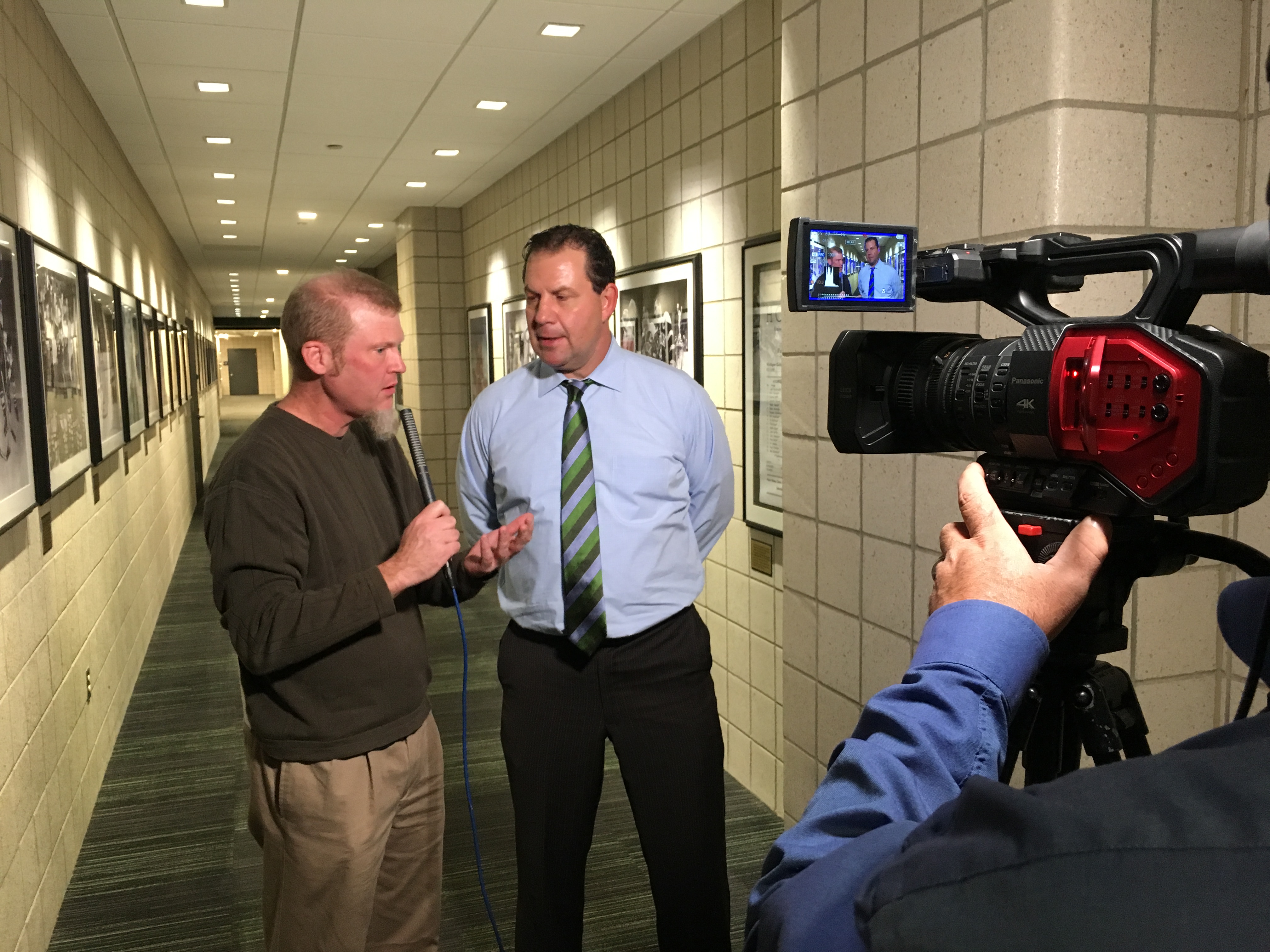
We interviewed Berry, who bore some stitches above his right eye thanks to a wayward practice puck, after his team had just finished sweeping a pair of games from the St. Lawrence Saints. Before the Saturday game, the program honored the 1986-87 team that won a national title. A number of the players from that squad had returned to campus to enjoy a reunion, including a pair who also won a Stanley Cup with the Stars: Ed Belfour and Tony Hrkac. That North Dakota team, in fact, became known as “The Hrkac Circus,” as they set scoring records and became the first college hockey team to record 40 wins in a season. 
Rush Olson interviews Brad Berry
photo by Tom Fireoved
Coach Berry commented on what it meant to have that team return to the ice, both for him and his players. I also asked him about the hockey experience at the Ralph Englestad Arena. It was my first time to visit the facility and it is a remarkable place to watch a game. Impressive physical features include marble floors and padded seats, and they have a row of suites and a couple of clubs with a view of the action. The crowd is into it, with chants and gestures and a band. In the interview, Berry compared it to a college football atmosphere and I agree with him. At the second intermission, the band even plays as they march around the concourse. A hockey fan might want to put a North Dakota game on his or her bucket list.


Rush Olson has spent two decades directing creative efforts for sports teams and broadcasters. He currently creates ad campaigns, television programs, and related creative projects for sports entities through Rush Olson Creative & Sports, Mint Farm Films, and FourNine Productions.


Friday, April 7, 2017

Big Doings in Big D

This post originally appeared at the Fort Worth Weekly's website. To view it there : https://www.fwweekly.com/2017/04/05/a-big-deal-in-big-d/


A big deal in sports happened here over the weekend. We know this because we saw people roaming local streets wearing multiple color schemes not native to the area’s teams. We saw a clear indicator when prominent athletes from other sports, in this case Russell Wilson and Dak Prescott, attended. And we can guess at its national import because ESPN brought 25 cameras to cover it.


The event that sold out the American Airlines Center Friday and Sunday was the NCAA Women’s Final Four. Basketball teams representing Stanford, South Carolina, Mississippi State, and the University of Connecticut competed in the Division I national tournament semifinals.
Could UConn win a fifth straight title and continue a 111-game winning streak? Would the Samuelson sisters (the Cardinal’s Karlie and the Huskies’ Katie Lou) become the first siblings to oppose each other in a national title game? South Carolina prevented the latter with a win in Friday’s opening semi, and MSU stymied both, courtesy of a Morgan William overtime buzzer-beater in the nightcap.

Those results created intriguing new plotlines, including which of two Southeastern Conference schools would become the first from its conference besides Tennessee to win a title. (Current member Texas A&M was still in the Big 12 when it won in 2011.)

Pat Lowry adjusted on the fly to the changing circumstances. She served as one of two coordinating producers for ESPN’s Women’s Final Four broadcasts and had to plan how her crew would convey the weekend’s ebbs and flows. While there is no home team, she still believes the event can have an impact on its host region.

“I think you get exposed to the highest level of women’s basketball,” she said. “If you like basketball, when you see this, it’s going to open a new door for you, because you’re going to see that women’s basketball is a little different than men but equally as entertaining and competitive.”

Getting sports fans to view women’s basketball happenings as significant is an ongoing process. While the men have had a Final Four since 1939, the NCAA didn’t officially sanction women’s basketball or any other sports for female students until 1981, when about 9,500 fans watched Louisiana Tech win the first women’s NCAA title in Norfolk, Va. Since then, those involved in promoting the game have made progress in turning it into a big deal, one that can sell out NBA arenas. That the local venue should host the spectacle is appropriate and overdue, according to basketball pioneer Nancy Lieberman.

“This city deserves the Final Four,” said Lieberman, who played for the Dallas Diamonds of early women’s pro leagues in the 1980s and believes North Texas has been ahead of the curve in embracing women’s hoops. “You should be rewarded for your foresight and rewarded for giving women something before it was the chic thing to do.”

Area fans supported those Diamonds teams, though their leagues folded when other cities failed to muster the same level of patronage. The women’s pro game reappeared in North Texas last year, with the WNBA’s Dallas Wings playing in Arlington’s College Park Center. At a reception Thursday evening, NCAA Vice President of Women’s Basketball Championships, Anucha Browne, said the competition she supervises is likely to return as well.

“If we have an opportunity to bring the Women’s Final Four back to Dallas, we’re coming back, because we love what this community means to women’s basketball,” she said in front of a crowd that included Wings head coach Fred Williams and point guard Tiffani Bias. “When we decided that we would select Dallas, it was because of the history.”

The history of this particular tournament will read that South Carolina won its first-ever NCAA title in the sport of women’s basketball. For those like Browne, who believe “women in sport changes life” when it inspires young girls, the event’s legacy may be whether the area continues to support the women’s game in the manner to which it has become accustomed: like it’s a big deal.

For more of my filings from the 2017 Women’s Final Four, including video interviews with Holly Rowe of ESPN and Aerial Powers of the Dallas Wings, visit Blotch at Fwweekly.com.


Rush Olson has spent two decades directing creative efforts for sports teams and broadcasters. He currently creates ad campaigns, television programs, and related creative projects for sports entities through Rush Olson Creative & Sports and FourNine Productions.


RushOlson.com
Linkedin.com/company/rush-olson-creative-&-sports
Facebook.com/RushOlsonCreativeandSports

Wednesday, April 5, 2017

Good Games

This post originally appeared at the Fort Worth Weekly's website. To view it there : https://www.fwweekly.com/2017/04/05/sports-rush-good-games-this-weekend/

One of the good things about sports is losing.

UConn women’s basketball coach Geno Auriemma lost this weekend. He might have forgotten how it felt, as it hadn’t happened in the Huskies’ previous 111 games.

“I understand losing, believe it or not. We haven’t lost in a while, but I understand it. I know how to appreciate when other people win.”

Grace in defeat is commendable. The coach also praised his opponent, suggesting Mississippi State “deserved to win. They beat us.”

Auriemma’s team was supposed to have lost already this season. The core of four straight title teams graduated and he built this squad around young players.

“I’m proud of what they’ve been able to do, how much they changed from last October, you know. When we started October 15th to where we are today, as I said, these kids were way older than they were supposed to be. They should have shown their age early on in the season.”

Helping young people mature as people and learn life lessons, including how to deal with setbacks, is part of what amateur athletics should be about.

“This is an education process,” said Mississippi State coach Vic Schaefer after his team, in turn, lost to South Carolina in the final. “I try to hold people accountable.”

photo by Dave French

South Carolina didn’t win everything this weekend. The school’s men’s team lost to Gonzaga in their semifinal. Afterward, head coach Frank Martin said his players “impacted our community in an unbelievable way, which is worth so much more than the score of a game. It’s what it’s all about. These kids are great role models. There’s a lot of young kids that want to be the next Sindarius Thornwell, Justin McKie, and I don’t get to coach them anymore, but they’re part of my life forever.”
The tough coach teared up as he spoke, clearly emotionally invested in the students he’d supervised. A shared sports experience can build powerful bonds that become lifelong relationships.

Also this weekend, I spoke with a friend who is a team doctor for one of the Women’s Final Four teams, and she told me about a student-athlete she had treated. The player at one time had wanted to be a surgeon, but had for various reasons abandoned that career path. My friend didn’t juts repair her physical injury. She counseled the young woman and inspired her to revisit the goal, and the student is back on track for medical school. My friend enjoys fixing damaged knees and shoulders, but her level of job satisfaction peaks when she feels she has helped a young person advance in life.

As I spent much of my weekend absorbed in the Women’s Final Four in Dallas, and monitoring the men’s version on TV, I was reminded that the college athletic experience is about more than determining the best team on the court, rink, or field.  It was a lesson I originally learned many years ago from my father, who spent his life as a professor, coach, administrator, and mentor to college students. While he’s one of the most competitive people I know, and aches to win at any contest, he always emphasized that the university athletic experience is, first and foremost, about positively affecting the student-athlete. It was a really good thing to see that college sports remains capable of achieving that goal. 

Rush Olson has spent two decades directing creative efforts for sports teams and broadcasters. He currently creates ad campaigns, television programs, and related creative projects for sports entities through Rush Olson Creative & Sports and FourNine Productions.

RushOlson.com
Linkedin.com/company/rush-olson-creative-&-sports
Facebook.com/RushOlsonCreativeandSports

Thursday, March 30, 2017

Power of the FInal Four

This post originally appeared at the Fort Worth Weekly's website. To view it there :


I’ve decided I like Aerial Powers. It has nothing to do with her making the WNBA All-Rookie Team for the Dallas Wings last year, though she is certainly an entertaining player to watch play.

No, I like Ms. Powers because when we discussed my name, she compared it to the movie “Rush Hour.” I admitted to owning the film on VHS and she graciously claimed that fact did NOT make me old. With respect for her at an all-time high, this apparently well-preserved reporter proceeded with the interview you can watch in this post.


Powers, along with Wings teammate Tiffany Bias, head coach Fred Williams, assistant coach Taj McWilliams-Franklin, and members of the club’s front office, had come to Arcadia Park in Dallas to witness the dedication of a Dream CourtTM. The event was timed to coincide with the presence of the Women’s Final Four in Dallas this weekend, and the NCAA had worked with Nancy Lieberman Charities and the WorldVentures Foundation to place the court in the Oak Cliff neighborhood.

After the VIPs had done a ribbon-cutting and dedicated the new basketball court, I talked with her about the Final Four, the ceremony, and the upcoming Wings season. We did not discuss movies of (relatively) recent vintage.


Rush Olson has spent two decades directing creative efforts for sports teams and broadcasters. He currently creates ad campaigns, television programs, and related creative projects for sports entities through Rush Olson Creative & Sports and FourNine Productions.

RushOlson.com
Linkedin.com/company/rush-olson-creative-&-sports
Facebook.com/RushOlsonCreativeandSports

Tuesday, March 28, 2017

Pushing The Ball

This post originally appeared at the Fort Worth Weekly's website. To view it there : https://www.fwweekly.com/2017/03/27/sports-rush-push-the-ball/

Basketball arrived in Tarrant County this year. I know because I had thousands of people screaming it in my ear.

A couple of weeks ago, I wrote a column about how the area had experienced an all-time high in men’s college basketball success. This past week, the local boys took it up another notch.

While the Dallas team about which I wrote, SMU, fell victim to a first-round NCAA tournament upset, Texas Wesleyan, Texas Christian, and Texas-Arlington posted some impressive results.

You might not have filled in their names in a bracket, because they weren’t playing in the NCAAs. But the single-elimination events in which they participated offer ample history and prestige.

Both the National Association of Intercollegiate Athletics (NAIA), where TWU played, national championship tourney and the National Invitational Tournament (NIT), postseason home for TCU and UTA, predate their NCAA counterpart. The NIT began its championship in 1938 after the NAIA had initiated its version for mostly smaller schools a year earlier. The NCAA started its tournament in 1939, but the NIT remained the more coveted title for some years thereafter.

Today, of course, there’s only one Big Dance. But for those schools unaccustomed to appearing there with Duke-like frequency, any late March competition feels meaningful.
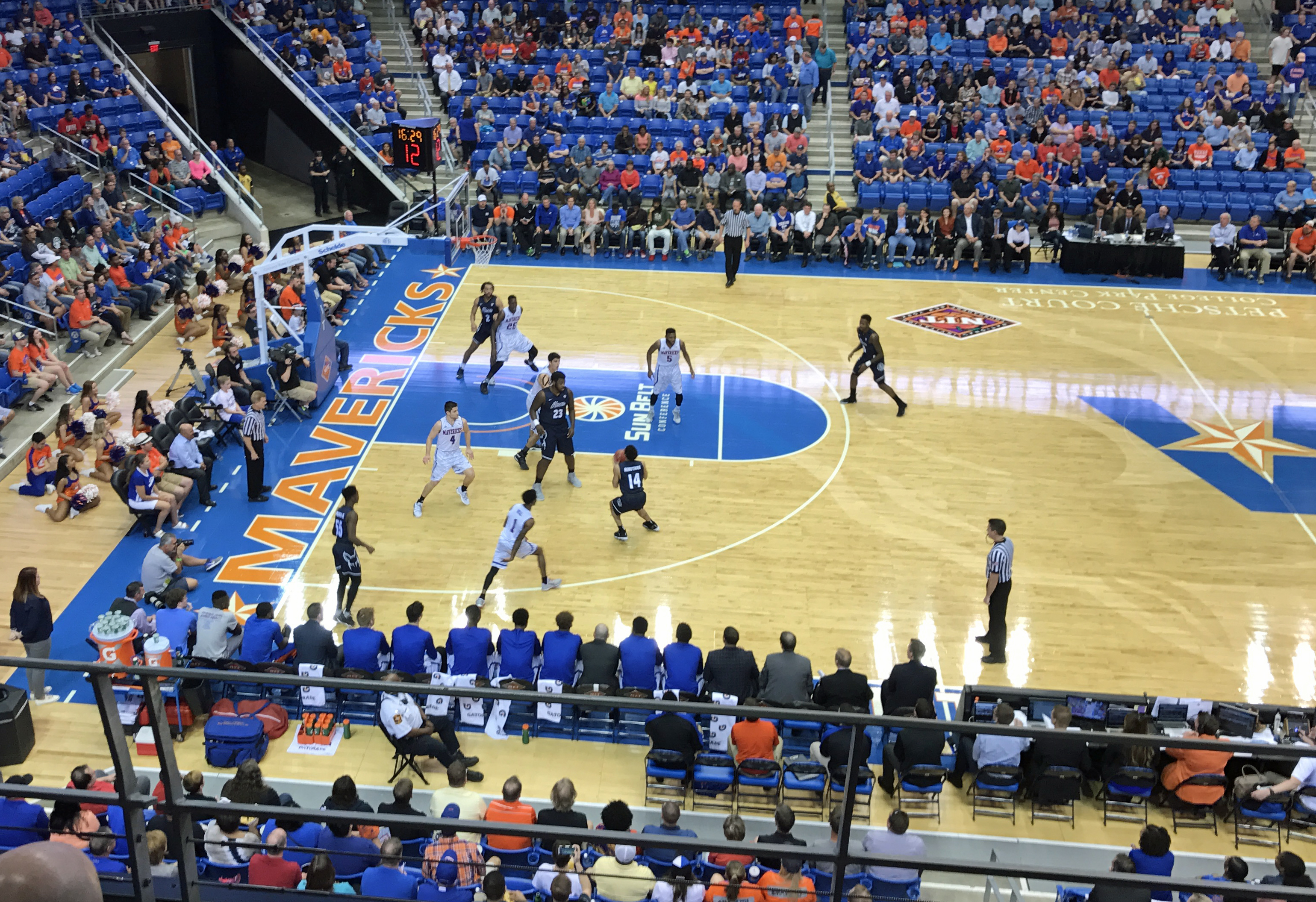
The crowds felt substantial, too. UTA hosted two NIT games. A Monday win against Akron drew more than 5,000 fans and 6,000+ saw a furious comeback fall just short in a quarterfinal against Cal State Bakersfield.  Both crowds were season highs.

UTA Mens Basketball NIT 

TCU put nearly 6,000 fans of their own into Schollmaier Arena for their NIT quarterfinal against Richmond. Beyond just numbers, however, the atmosphere felt like a big game, one in which the winner would earn a chance to compete in the historic Madison Square Garden. The Horned Frogs played a complete game to earn themselves a trip to New York City. I stood below the student section for much of the game and can testify as to the volume and occasional maliciousness of their vocalizations. They were into it.

One observer who attended Richmond’s first round game in Tuscaloosa noted the atmosphere and intensity there paled in comparison to the ferocity of Frogland. For a school like Alabama that revolves around football national titles, an NIT berth may be no big deal. But for schools without such a pedigree, a postseason appearance offered a reason to celebrate.

Speaking of national titles and celebrating, TWU earned the ultimate honor in its classification. The Rams went to Kansas City and won the NAIA national championship. They didn’t get to play in front of home crowds, and they had to run the gauntlet of a full tournament packed into a week. It’s an impressive and significant accomplishment.
These west-side squads have pushed men’s hoops to the forefront of local consciousness. I have a proposal to help keep it there. Back in the ’70s, Wesleyan’s athletic director at the time (I know this because he is my father) proposed a local tournament among the Rams, Mavericks, Horned Frogs, and Mustangs. The bigger schools didn’t want to do it then, but maybe they should revisit the idea.

While TCU and SMU have played each other most years since 1918 (The Ponies won this past December 7), the rest of the group has matched up more sporadically. TCU hasn’t faced UTA since the Mavericks took the Frogs to overtime in both 2006 and 2007. UTA and SMU last played in 1997. TWU hasn’t taken on UTA since 2009, and hasn’t faced TCU or SMU since losing to both in 1982 (taking SMU to OT in Dallas).

One argument for such a tourney involves students. Last Tuesday, I chatted with Will Bryan, who handles media relations for Richmond’s men’s basketball team. As we watched the squads warm up, I asked him if they would stay in Fort Worth that night. He told me they would fly back because the players had school the next day. This season, our local student-athletes played mid-week games in the likes of Boise, Idaho; Morgantown, West Virginia; and Moraga, California. More local games mean fewer classes missed and more sleep before the ones the young men do attend (assuming they go to bed at a reasonable hour, as I always did in college and still do).

Another reason the teams should play each other is to keep this momentum going. The more they can do to stoke interest in the game here, the more it does to encourage participation and entice local recruits. A home-grown tournament would generate media coverage and outreach opportunities.

Texas Wesleyan, of course, is the wild card here. NCAA Division I schools wouldn’t benefit from an expected win against the Rams, but a defeat would be the equivalent of a football loss to a DII school. And as NAIA programs go, with two national titles in just over a decade, the east-siders are stout. Still, if you’re TCU, don’t you want a shot at leveling your record with your crosstown neighbors? Thanks to victories in 1937 and 1947, Texas Wesleyan currently owns the “Best of Fort Worth” title by a two-wins-to-one margin all-time.

If a tournament could help push the sport forward in this area, the DI athletic directors should consider it – especially if they can find a way to make money from it. Such a series should certainly have title sponsor appeal, especially during what could be a golden age of men’s hoops in North Texas. My eardrums can attest to it.

Rush Olson has spent two decades directing creative efforts for sports teams and broadcasters. He currently creates ad campaigns, television programs, and related creative projects for sports entities through Rush Olson Creative & Sports and FourNine Productions.

RushOlson.com
Linkedin.com/company/rush-olson-creative-&-sports
Facebook.com/RushOlsonCreativeandSports

Tuesday, March 14, 2017

Fort Worth-Dallas - A Hotbed of Hoops?

This post originally appeared at the Fort Worth Weekly's website. To view it there : https://www.fwweekly.com/2017/03/13/sports-rush-a-hoops-hotbed/

Wow. All of a sudden, basketball is a big deal.

OK, it’s one of the world’s most popular sports, but this area has not necessarily been a college basketball nexus. Until now.

An upset of top-ranked Kansas in the Big 12 tournament, which Texas Christian pulled off Thursday should make one sit up and take notice. Have you checked out Texas-Arlington? How about Southern Methodist? There have been a lot of balls ripping nets this year. If you haven’t been paying attention, the local men’s college basketball teams have been making some noise all season. Historically so, in fact.

TCU lost to eventual champion Iowa State in the Big 12 semis. UTA won the Sun Belt regular season before falling in the tournament semi-finals. SMU won the American Athletic Conference regular season and tournament. Among the area’s Division I teams, only Denton’s University of North Texas had a subpar year, finishing 8-22.

The Frogs, Mustangs, and Mavericks will all take part in the postseason. SMU earned a number six seed in the NCAA Tournament, playing Providence or the University of Southern California on Friday afternoon in Tulsa on truTV. TCU will host Fresno State in the National Invitation Tournament at 8pm Central Wednesday. At that same time, the UTA Mavs have an NIT first-round matchup against Brigham Young in Provo, with the game televised on ESPN2.


Each team has had good seasons in the past, but one can make the case that the area has never before had so much success in the sport all at once. The NCAA and the NIT are the top two postseason tournaments in men’s college basketball, and the North Texas region has participated sporadically. In the 1950s, when UTA was still a two-year institution called Arlington State College, SMU and TCU both had some good teams, but never made it into the postseason at the same time (though there were fewer berths available in those days). The two Southwest Conference schools again posted some winning records in the 1980s, Texas Christian under coach Jim Killingsworth and Southern Methodist under the since-disgraced Dave Bliss. UTA played a game in the 1981 NIT under Bob “Snake” LeGrand. However, 1986 and 1988 were the only previous years in which as many as two local teams made the two big tourneys. In 1986, TCU was defeated by Florida in the second round of the NIT while SMU lost to BYU in the first round of the same competition. In 1988, SMU made the second round of the NCAAs before falling to Duke and UNT also lost to an ACC team, North Carolina, in the first round of the big tournament.

In 2012, UTA dropped a first-round game to Washington in the NIT while TCU made it to the second round of the third-tier College Basketball Invitational (a tournament won, incidentally, by current TCU head coach Jamie Dixon’s University of Pittsburgh team).
Never before, though, have we had three teams qualifying for end-of-season tournaments at once.

In addition to their postseason berths, all three teams have recorded wins over big-time opponents. TCU and UTA went a combined 3-0 against the University of Texas, though admittedly in a down year for the Longhorns. TCU beat Iowa State during the regular season. UTA defeated four NCAA tournament teams. SMU won 30 games, with no losses to teams not in the NCAA or NIT draws. Add to that the fact that Texas Wesleyan made the 32-team NAIA field (they play Cumberland Thursday) and it’s not hard to make the case that there has never been a better men’s college basketball season in North Texas.
So pay attention this week, and hopefully beyond, to the glut of area teams playing in the postseason tournaments. It doesn’t happen very often. Or ever.

On the other hand, the four NCAA teams expect to lose a total of only sixteen players off these rosters. And none of their leading scorers are seniors. So maybe we can expect the same next year. For basketball fans, that probably sounds like a pretty good deal.


Rush Olson has spent two decades directing creative efforts for sports teams and broadcasters. He currently creates ad campaigns, television programs, and related creative projects for sports entities through Rush Olson Creative & Sports and FourNine Productions.

RushOlson.com
Linkedin.com/company/rush-olson-creative-&-sports
Facebook.com/RushOlsonCreativeandSports

Thursday, March 9, 2017

More March Madness Than You Realize

This post originally appeared at the Fort Worth Weekly's website. To view it there : https://www.fwweekly.com/2017/03/06/sports-rush-madness-in-the-third-degree/

There is so much more madness in March than we even realize.

If you think you have to wait for the CBS Selection Sunday Show this coming weekend to start picking a bracket, or for the women’s hoops equivalent on ESPN the following day, you should investigate further. The NCAA basketball playoffs started Friday, and they played a regional in Dallas- Fort Worth.

No, the governing body didn’t add even more play-in games to the Big Dance. It’s just that the NCAA runs more than one dance card. They have multiple divisions, and we had the opportunity to see the Division III women’s tournament get underway locally.
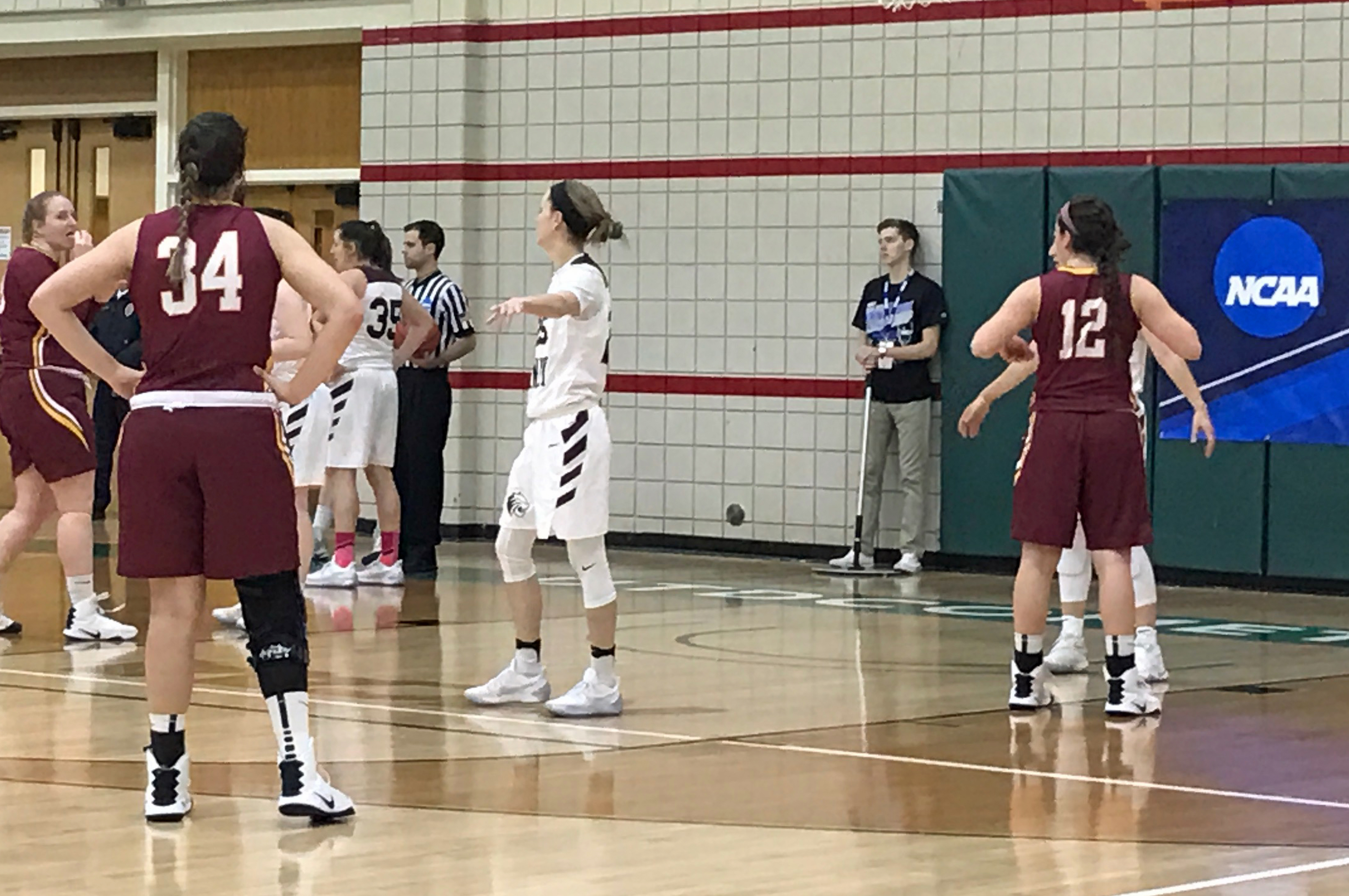
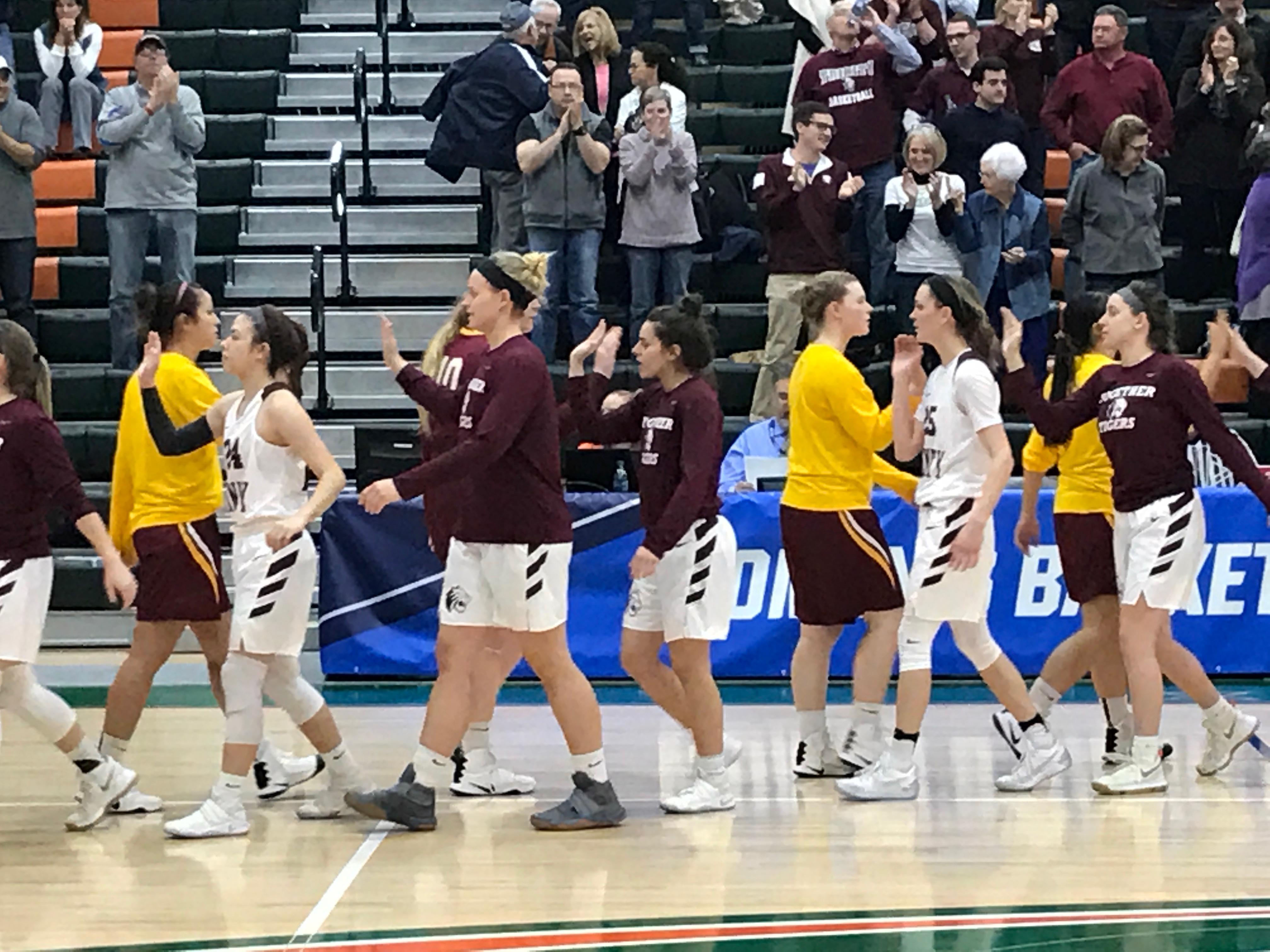
I found myself at a second-round game Saturday between my alma mater, Trinity University, and Claremont-Mudd-Scripps. They played in a regional held at the University of Texas at Dallas. CMS had defeated the hosts the previous night after the Tigers had beaten Hendrix College in the evening’s first game.

TU_On_Defense_1618 

The DIII draws (women’s and men’s) include 64 teams each and not one of them features a player on an athletic scholarship. At this level, students pay their own way or find other forms of financial aid. While they don’t have hype or pedigrees, they otherwise share a great deal with their counterparts who will fill your office pool next week.

These teams won their respective conferences and they know how to compete. Before the tip, I noticed Trinity’s Mollie Hughes sporting a black left eye and CMS’s Quinn Glosniak wearing a large bandage on her right eyebrow. Hughes had gotten hers going for a rebound in an earlier game and said she had gotten called for a foul on the play, apparently having somehow hacked an opponent with her cheekbone. Glosniak’s cut had required stitches, with the team’s athletic trainer preferring to leave the covering in place rather than reapply the stitches when the player inevitably took another blow there. Based on that evidence, one might have expected a physical game, and we got one.

“One of our goals was to get the ball inside this game,” said CMS senior Aly Young, whose team-high 17 points came mostly via a variety of post moves. There was plenty of up-tempo play, too, with Trinity running a full-court press from the get-go. The combination made for an intense contest.

Indeed, the atmosphere felt like you would expect a playoff game should. Claremont-Mudd-Scripps represents an amalgam of three schools whose campuses adjoin each other in Southern California. The Athenas brought a couple of dozen fans, and they made themselves heard. San Antonio-based Trinity filled a good portion of the home side (they also wore the white jerseys and got to have their points recorded as “Comets” on the UTD scoreboard). The Tigers’ head coach, Cameron Hill, even spotted some players from other teams in their conference having come to support their rivals.

If the stakes weren’t enough, the game itself effectively caffeinated the gym. Trinity got out to a strong start, but the Athenas pulled to within three at halftime. The second half went to-and-fro until the Tigers forced some turnovers late to pull away. The 77-66 win put Trinity into the Division III round of 16.

Hill said afterward of his now 28-1 team, “The key to this whole thing is there’s just not a lot of panic in this group. There’s no doubt in their mind that they can figure out a way to stay competitive and give themselves a chance to win.“

Trinity_PC_7545 

Staying calm in tension-filled situations; self-confidence; problem solving – all abilities that carry over well to the business world these students will shortly enter. What should matter the most in college athletics is the student-athletes and how the experience pays off for them in future endeavors. Any competitive sport experience should provide those benefits, but raised stakes accentuate the pressure and the payoff.

“They sacrifice a ton of stuff, especially Division III student-athletes, so the fact that they get this experience is the best part, besides the team,.” said Claremont-Mudd-Scripps head coach Kristen Dowling. “The team is the best part, but the experience in the national tournament is absolutely a reward for their hard work all year.”

The Athenas’ six seniors made their fourth NCAA tournament appearances this year.
“They’re the best memories I have. There’s nothing like going to a postseason tournament. The excitement, I mean, it’s so incredible to be able to play,” said Young. “There’s nothing that brings us together more than making it this far.”

Turning shared memories into longtime friendships is another benefit of a university experience. The longer your team lasts, the more of those you get to make. Last season, the Athenas were the ones who denied the Tigers that opportunity, defeating them in a first-round matchup in Tyler. This year, it was Trinity who got to prolong the adventure.
“It’s just a really, really nice feeling to know that we get to have practice on Monday,” said Hill.

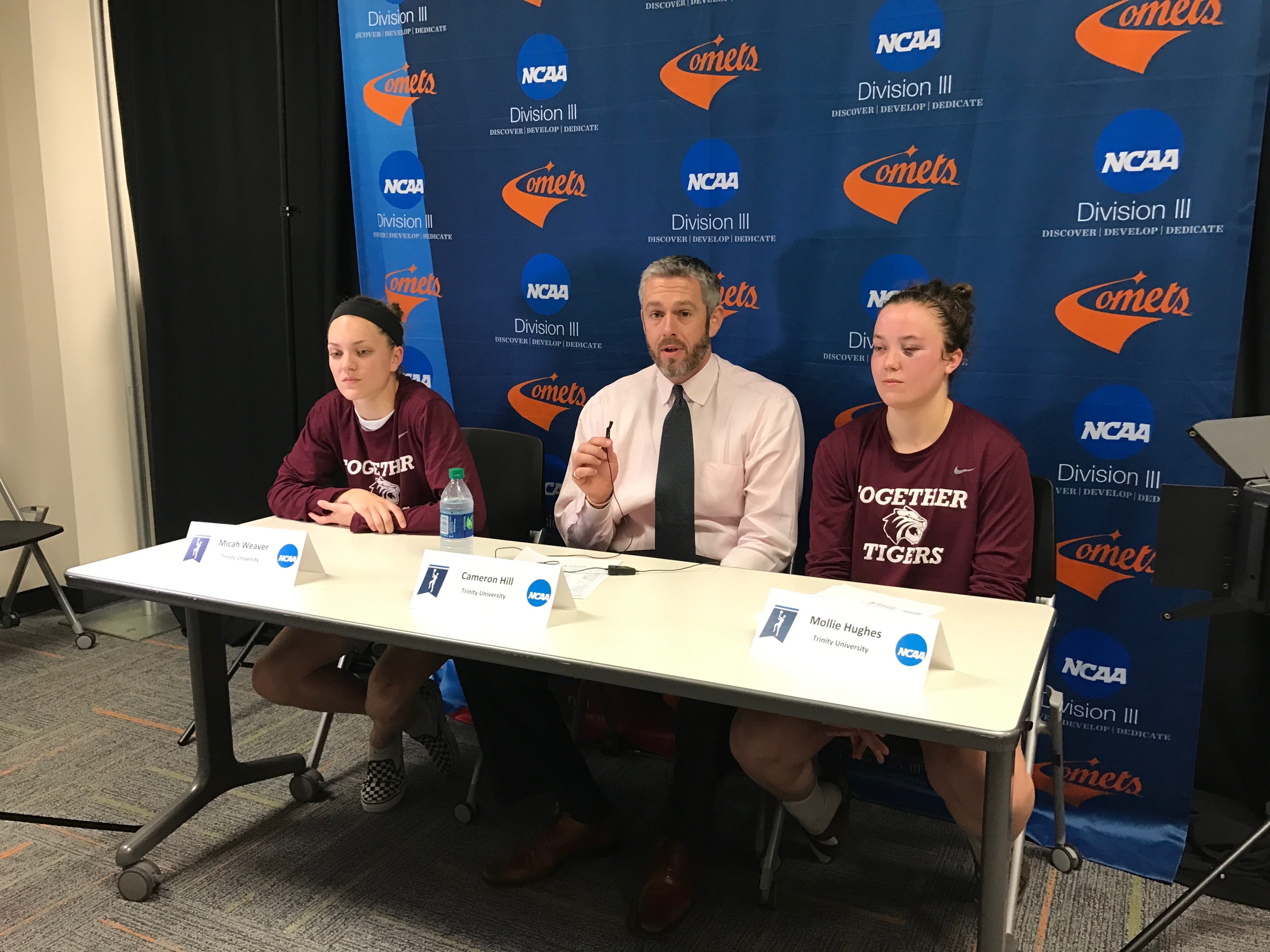
“Our chemistry is like no other team I’ve ever been on, said TU junior Micah Weaver, who contributed 17 points in the second-round win after scoring 31 in the first round against Hendrix. “I’m just excited to have another week with them.”

TU_CMS_Postgame_9125 

The Tigers will attempt to extend their season another weekend when they play Whitman Friday in Saint Paul, Minnesota. Expect the same intensity, passion, and ultimate payoff as those other games you may watch on the big networks. So whom do you have in your bracket? I’ve got Trinity.

Rush Olson has spent two decades directing creative efforts for sports teams and broadcasters. He currently creates ad campaigns, television programs, and related creative projects for sports entities through Rush Olson Creative & Sports and FourNine Productions.

RushOlson.com
Linkedin.com/company/rush-olson-creative-&-sports
Facebook.com/RushOlsonCreativeandSports

Tuesday, February 7, 2017

Is It Good TCU Didn't Go Big?

This post originally appeared at the Fort Worth Weekly's website. To view it there : https://www.fwweekly.com/2017/02/07/sports-rush-maybe-its-good-tcu-didnt-go-big/


Fort Worth teems with good people. I was born and raised in Cowtown and can’t imagine a more warm-hearted bunch of folks.

Persons of quality character – like the ones in Funkytown – can often resist the temptation to compromise their morals for the sake of worldly gain. It’s best if they don’t have to, though. A little over 20 years ago, circumstances kept a group of locals from having to make some choices that certain neighbors of ours haven’t handled well.

You’ve perhaps followed recent developments in Baylor football. Over the last year, an apparent pattern of widespread misconduct in the supervision of the football program has led to personnel changes and lawsuits. The most recent allegations, if true, illuminate a culture in which conscience seemed to have had no place in the discussion. They also indicate that such attitudes were held by top school administrators, coaches, boosters, and even local law enforcement personnel. The ethically indifferent approach seems to have facilitated sexual assaults and other offensive crimes.

Make no mistake, we’re talking about serious charges. This is not buying a bus ticket for a player to go see his family for the holidays. This isn’t even letting him drive a free Lexus. This is actual criminal activity.

Some people’s jobs depended on football success. The boosters may have done it for the chance to feel reflected glory from a school they used to attend. They all allegedly decided those rewards outweighed any potential long-term repercussions or personal sense of shame.

The Waco university has experienced scandal before. In 2003, a former Baylor basketball player killed a teammate. A corrupt coach tried to use the murder to help him cover up NCAA violations. In 2012, both the men’s and women’s basketball programs received sanctions from the governing body.

The Baylor Bears compete in the Big 12 conference, one of the country’s top five Division 1 athletic conferences. Since its formation, the league’s schools have won national titles in 17 different sports (including two by Baylor in women’s hoops). Competing for such stakes intensifies the pressure to win. It also boosts the potential reward for boosters’ egos and staffers’ career paths.

So how does all of this concern TCU and nice Fort Worth people? Well, Baylor got into the Big 12 in large part because TCU did not. That happened back in 1996 and at the time caused a great deal of local upset. TCU trudged off to the Western Athletic Conference, then Conference USA and the Mountain West before recently winding up in the conference that had shut them out before.

Over those years, TCU kept a lower profile than its neighbor 90 minutes to the south. That had to be frustrating for Frog fans, but not competing against the UTs, A&Ms, and Techs in high-stakes matchups also kept it out of emotionally-charged rivalries with those huge taxpayer-financed institutions. Horned Frogs didn’t have to hear from Longhorns or Aggies about getting trounced year after year in the marquee sports like Bears supporters did.
I think that was a good thing for TCU. If they had been the lone private school to get into the Big 12, they would have had to endure the heightened expectations of trying to compete as the smallest member of the conference against subsidized rivals – as Baylor did. Less pressure means less incentive to find a way to work around the rules, be they ones of athletic associations or common decency. The Frogs have gradually built up some remarkable football achievements in the Franchione/Patterson era with a sparse record of disciplinary hiccups.

As noted earlier, Fort Worth is full of good people. The Horned Frogs might well have avoided a moral crisis no matter what conference they occupied the last 20-odd years. We do, however, have to keep in mind what happened to bring about the demise of the league they had joined in 1923.

The Southwest Conference collapsed in part because of the prestige its members lost due to widespread NCAA violations. TCU had its own 1980s transgressions, thanks to boosters paying student-athletes behind coach Jim Wacker’s back. But it’s another Christian school that might provide the best cautionary note. Southern Methodist’s delinquent culture didn’t result in criminal charges, but they did implicate the governor of Texas (Bill Clements) and the sanctions they received forced the cancellation of two full football seasons – the death penalty.  Incidentally, the Mustangs’ men’s basketball coach for much of that era was found to have committed multiple violations at the school in his sport in the 1980s. Dave Bliss repeated that modus operandi when he coached Baylor in the early 2000s, culminating with his appalling approach to a homicide.

TCU doesn’t have to repeat past errors, whether their own or someone else’s. Hopefully for the Frogs, those years away from competing with their bigger in-state rivals have helped the university establish a healthy atmosphere for its athletic programs. Now that they are once again facing top-level foes in the Big 12, they will need it.

Rush Olson has spent two decades directing creative efforts for sports teams and broadcasters. He currently creates ad campaigns, television programs, and related creative projects for sports entities through Rush Olson Creative & Sports and FourNine Productions.

RushOlson.com
Linkedin.com/company/rush-olson-creative-&-sports
Facebook.com/RushOlsonCreativeandSports