Showing posts with label SMU. Show all posts

Tuesday, March 28, 2017

Pushing The Ball

This post originally appeared at the Fort Worth Weekly's website. To view it there : https://www.fwweekly.com/2017/03/27/sports-rush-push-the-ball/

Basketball arrived in Tarrant County this year. I know because I had thousands of people screaming it in my ear.

A couple of weeks ago, I wrote a column about how the area had experienced an all-time high in men’s college basketball success. This past week, the local boys took it up another notch.

While the Dallas team about which I wrote, SMU, fell victim to a first-round NCAA tournament upset, Texas Wesleyan, Texas Christian, and Texas-Arlington posted some impressive results.

You might not have filled in their names in a bracket, because they weren’t playing in the NCAAs. But the single-elimination events in which they participated offer ample history and prestige.

Both the National Association of Intercollegiate Athletics (NAIA), where TWU played, national championship tourney and the National Invitational Tournament (NIT), postseason home for TCU and UTA, predate their NCAA counterpart. The NIT began its championship in 1938 after the NAIA had initiated its version for mostly smaller schools a year earlier. The NCAA started its tournament in 1939, but the NIT remained the more coveted title for some years thereafter.

Today, of course, there’s only one Big Dance. But for those schools unaccustomed to appearing there with Duke-like frequency, any late March competition feels meaningful.
The crowds felt substantial, too. UTA hosted two NIT games. A Monday win against Akron drew more than 5,000 fans and 6,000+ saw a furious comeback fall just short in a quarterfinal against Cal State Bakersfield.  Both crowds were season highs.
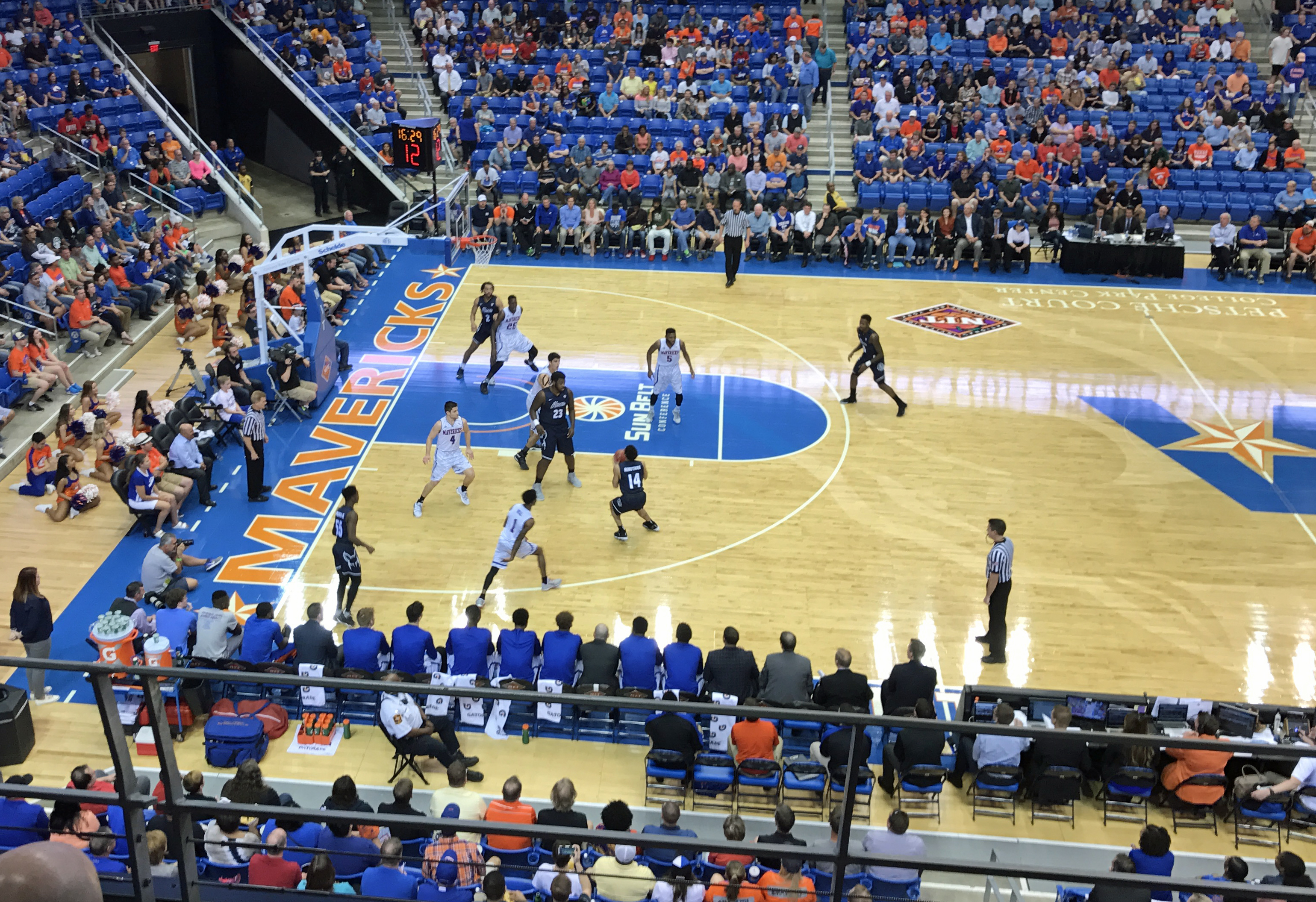
UTA Mens Basketball NIT 

TCU put nearly 6,000 fans of their own into Schollmaier Arena for their NIT quarterfinal against Richmond. Beyond just numbers, however, the atmosphere felt like a big game, one in which the winner would earn a chance to compete in the historic Madison Square Garden. The Horned Frogs played a complete game to earn themselves a trip to New York City. I stood below the student section for much of the game and can testify as to the volume and occasional maliciousness of their vocalizations. They were into it.

One observer who attended Richmond’s first round game in Tuscaloosa noted the atmosphere and intensity there paled in comparison to the ferocity of Frogland. For a school like Alabama that revolves around football national titles, an NIT berth may be no big deal. But for schools without such a pedigree, a postseason appearance offered a reason to celebrate.

Speaking of national titles and celebrating, TWU earned the ultimate honor in its classification. The Rams went to Kansas City and won the NAIA national championship. They didn’t get to play in front of home crowds, and they had to run the gauntlet of a full tournament packed into a week. It’s an impressive and significant accomplishment.
These west-side squads have pushed men’s hoops to the forefront of local consciousness. I have a proposal to help keep it there. Back in the ’70s, Wesleyan’s athletic director at the time (I know this because he is my father) proposed a local tournament among the Rams, Mavericks, Horned Frogs, and Mustangs. The bigger schools didn’t want to do it then, but maybe they should revisit the idea.

While TCU and SMU have played each other most years since 1918 (The Ponies won this past December 7), the rest of the group has matched up more sporadically. TCU hasn’t faced UTA since the Mavericks took the Frogs to overtime in both 2006 and 2007. UTA and SMU last played in 1997. TWU hasn’t taken on UTA since 2009, and hasn’t faced TCU or SMU since losing to both in 1982 (taking SMU to OT in Dallas).

One argument for such a tourney involves students. Last Tuesday, I chatted with Will Bryan, who handles media relations for Richmond’s men’s basketball team. As we watched the squads warm up, I asked him if they would stay in Fort Worth that night. He told me they would fly back because the players had school the next day. This season, our local student-athletes played mid-week games in the likes of Boise, Idaho; Morgantown, West Virginia; and Moraga, California. More local games mean fewer classes missed and more sleep before the ones the young men do attend (assuming they go to bed at a reasonable hour, as I always did in college and still do).

Another reason the teams should play each other is to keep this momentum going. The more they can do to stoke interest in the game here, the more it does to encourage participation and entice local recruits. A home-grown tournament would generate media coverage and outreach opportunities.

Texas Wesleyan, of course, is the wild card here. NCAA Division I schools wouldn’t benefit from an expected win against the Rams, but a defeat would be the equivalent of a football loss to a DII school. And as NAIA programs go, with two national titles in just over a decade, the east-siders are stout. Still, if you’re TCU, don’t you want a shot at leveling your record with your crosstown neighbors? Thanks to victories in 1937 and 1947, Texas Wesleyan currently owns the “Best of Fort Worth” title by a two-wins-to-one margin all-time.

If a tournament could help push the sport forward in this area, the DI athletic directors should consider it – especially if they can find a way to make money from it. Such a series should certainly have title sponsor appeal, especially during what could be a golden age of men’s hoops in North Texas. My eardrums can attest to it.

Rush Olson has spent two decades directing creative efforts for sports teams and broadcasters. He currently creates ad campaigns, television programs, and related creative projects for sports entities through Rush Olson Creative & Sports and FourNine Productions.

RushOlson.com
Linkedin.com/company/rush-olson-creative-&-sports
Facebook.com/RushOlsonCreativeandSports

Tuesday, March 14, 2017

Fort Worth-Dallas - A Hotbed of Hoops?

This post originally appeared at the Fort Worth Weekly's website. To view it there : https://www.fwweekly.com/2017/03/13/sports-rush-a-hoops-hotbed/

Wow. All of a sudden, basketball is a big deal.

OK, it’s one of the world’s most popular sports, but this area has not necessarily been a college basketball nexus. Until now.

An upset of top-ranked Kansas in the Big 12 tournament, which Texas Christian pulled off Thursday should make one sit up and take notice. Have you checked out Texas-Arlington? How about Southern Methodist? There have been a lot of balls ripping nets this year. If you haven’t been paying attention, the local men’s college basketball teams have been making some noise all season. Historically so, in fact.

TCU lost to eventual champion Iowa State in the Big 12 semis. UTA won the Sun Belt regular season before falling in the tournament semi-finals. SMU won the American Athletic Conference regular season and tournament. Among the area’s Division I teams, only Denton’s University of North Texas had a subpar year, finishing 8-22.

The Frogs, Mustangs, and Mavericks will all take part in the postseason. SMU earned a number six seed in the NCAA Tournament, playing Providence or the University of Southern California on Friday afternoon in Tulsa on truTV. TCU will host Fresno State in the National Invitation Tournament at 8pm Central Wednesday. At that same time, the UTA Mavs have an NIT first-round matchup against Brigham Young in Provo, with the game televised on ESPN2.


Each team has had good seasons in the past, but one can make the case that the area has never before had so much success in the sport all at once. The NCAA and the NIT are the top two postseason tournaments in men’s college basketball, and the North Texas region has participated sporadically. In the 1950s, when UTA was still a two-year institution called Arlington State College, SMU and TCU both had some good teams, but never made it into the postseason at the same time (though there were fewer berths available in those days). The two Southwest Conference schools again posted some winning records in the 1980s, Texas Christian under coach Jim Killingsworth and Southern Methodist under the since-disgraced Dave Bliss. UTA played a game in the 1981 NIT under Bob “Snake” LeGrand. However, 1986 and 1988 were the only previous years in which as many as two local teams made the two big tourneys. In 1986, TCU was defeated by Florida in the second round of the NIT while SMU lost to BYU in the first round of the same competition. In 1988, SMU made the second round of the NCAAs before falling to Duke and UNT also lost to an ACC team, North Carolina, in the first round of the big tournament.

In 2012, UTA dropped a first-round game to Washington in the NIT while TCU made it to the second round of the third-tier College Basketball Invitational (a tournament won, incidentally, by current TCU head coach Jamie Dixon’s University of Pittsburgh team).
Never before, though, have we had three teams qualifying for end-of-season tournaments at once.

In addition to their postseason berths, all three teams have recorded wins over big-time opponents. TCU and UTA went a combined 3-0 against the University of Texas, though admittedly in a down year for the Longhorns. TCU beat Iowa State during the regular season. UTA defeated four NCAA tournament teams. SMU won 30 games, with no losses to teams not in the NCAA or NIT draws. Add to that the fact that Texas Wesleyan made the 32-team NAIA field (they play Cumberland Thursday) and it’s not hard to make the case that there has never been a better men’s college basketball season in North Texas.
So pay attention this week, and hopefully beyond, to the glut of area teams playing in the postseason tournaments. It doesn’t happen very often. Or ever.

On the other hand, the four NCAA teams expect to lose a total of only sixteen players off these rosters. And none of their leading scorers are seniors. So maybe we can expect the same next year. For basketball fans, that probably sounds like a pretty good deal.


Rush Olson has spent two decades directing creative efforts for sports teams and broadcasters. He currently creates ad campaigns, television programs, and related creative projects for sports entities through Rush Olson Creative & Sports and FourNine Productions.

RushOlson.com
Linkedin.com/company/rush-olson-creative-&-sports
Facebook.com/RushOlsonCreativeandSports

Wednesday, September 21, 2016

41-Love : Dirk Nowitzki's Tennis Event

This post originally appeared at the Fort Worth Weekly's website. To view it there : http://www.fwweekly.com/2016/09/21/sports-rush-41-love/

Charity sporting events seem to usually possess an interesting mix of competitive energies and laid-back attitudes. One always wants to win, and to play well, but the outcome usually falls lower on the priority list than maintaining a chill vibe.

Sunday’s Dirk Nowitzki Pro Celebrity Tennis Classic offered donors a chance to play doubles alongside pedigreed names from the worlds of sport and entertainment. The mix felt just about right. The players played hard, everyone laughed a lot, and the group left the SMU Tennis Center as friends.

Nowitzki already counted many in the draw as buddies, but he hadn’t met quite all of them in person before the event. His Mavericks teammates Harrison Barnes and J.J. Barea played (and Dwight Powell, Rick Carlisle, Donnie Nelson, and Michael Finley made non-playing appearances). Actors Ben Stiller and Boris Kodjoe (the former a newcomer to the game and the latter a former college player) represented the entertainment sphere. The tennis world filled several slots, including the top-ranked American man, John Isner, current tour players Benjamin Becker and Mitchell Krueger, and the last American to win a singles title in a Grand Slam tournament, Andy Roddick.

Stiller noted at the pre-match press conference that the “pro celebrity” event seemed heavily weighted toward world-class athletes and away from guys like him who had been in lots movies but only took up the game at age 45. A handicap system aimed to address the potential imbalances, and the team with a lower handicap could take a point or two for themselves any time before match point in the 10-point tie-breakers that made up the round-robin pools. Implementing that strategy usually consisted of taking away a pro’s service point, because who wants to return an Isner or Roddick serve if you don’t have to?

By the way, if I played against Isner in an event like this, I would ask him to rip a serve at me full speed. I would want to know what it felt like to try to return it (or maybe even just see it).
Nowitzki jokingly called obviously “in” shots “out,” but perhaps the best competitive, yet fun, element came via the non-serious trash talk that cropped up every so often. Barea began it in the pre-event media session when declared that he likes to come to his German teammate’s home in the offseason and “whoop his butt” on the tennis court. In the championship match, Kodjoe and Roddick engaged in some spirited banter. Roddick told his partner not to take it easy on Kodjoe because he was ugly (I’ve been informed by certain female experts in such things that the [married] thespian is anything but unattractive). Kodjoe remarked that Roddick’s partner, Tonya McKinney, might have difficulty seeing around the former ATP star’s allegedly sizable posterior when he crouched as she served. And when Kodjoe and his partner, Alberto Lombardi, took their handicap point, Roddick incited the crowd to boo because they would now be receiving “less tennis” for the price of their donation.

Roddick’s team came out on top anyway and he will no doubt display the plate he received next to his 2003 U.S. Open trophy. The event wasn’t about winning, of course. It was about the charitable purpose (raising money for the foundation Dirk and his wife Jessica administer) and about having a really unique and fun experience. Even for the pro tennis players, it wasn’t a typical hit-and-giggle, as they got to mingle with NBA stars and other famous faces.

The biggest giggler was Dirk Nowitzki, who no doubt took great joy in the combination of tennis playing, fundraising, and fellowship. The Mavericks forward seemed perpetually jolly through the previous evening’s pre-party and all the way through the day Sunday when he stopped through the workroom to thank the event staff. Roddick commented that “We’re all huge admirers of Dirk and what he has done for Dallas and what he continues to do for Dallas.” Indeed the big German-now-Texan deserved his weekend full of smiles.

Video
Mitchell Krueger interview – Fort Worth native Mitchell Krueger is a pro tennis player looking to great into the upper echelon of the sport. He got to participate in the Dirk Nowitzki Pro Celebrity Tennis Classic and talks about his experience there and his goals for the rest of 2016. 


Dirk Nowitzki Pro Celebrity Tennis Classic highlights – My company put this together for the event with the help of Ludisian Legion Entertainment.  


The Event Pre-party – This is the only video of the event pre-party, held at Dallas’ Joule Hotel. The elegant affair featured a performance by Ben Harper and appearances by Nowitzki and some of his Mavs colleagues, as well as Ben Stiller. 


Rush Olson has spent two decades directing creative efforts for sports teams and broadcasters. He currently creates ad campaigns, television programs, and related creative projects for sports entities through Rush Olson Creative & Sports and FourNine Productions.

RushOlson.com
Linkedin.com/company/rush-olson-creative-&-sports
Facebook.com/RushOlsonCreativeandSports

Sunday, August 14, 2016

North Texans In The Games

This post originally appeared on the Fort Worth Convention and Visitors Bureau blog. To read on that site : https://www.fortworth.com/blog/post/north-texas-goes-for-gold/

Texas is larger, geographically speaking, than over 150 of the countries participating in this summer’s Olympic Games. For that matter, the population of North Central Texas, at 7 million-plus, exceeds that of more than 100 Olympic nations. So, as you might expect, the region has produced its share of Olympic athletes. We offer a representative sampling, both current and historical, to give you some perspective on what the area has contributed to the world’s premier multi-sport athletic competition.

Natives

Starting life here isn’t a bad route to the Olympics. Here are a few competitors born in the metroplex.
-Lanny Bassham went to the University of Texas-Arlington and was born in Comanche, Texas. He took a silver medal in shooting in the 1972 Munich Games and won gold in Montreal in 1976.
-Michael Carter of Dallas and SMU won silver in 1984 in the shot put and went on to a successful NFL career.
-Michelle Carter won four state shot put titles at Red Oak High School and is competing in her second Games in Rio, She’s also the daughter of the other Carter on our list.
-Claire Donahue was born in Dallas and the butterfly swimmer earned gold for her role in the 4x100m medley relay in London in 2012.
-Jackie Galloway was born in Wylie and attends SMU. She has dual citizenship and was a 2012 alternate on Mexico’s taekwondo team. Galloway is competing for Team USA in Brazil.
-Ricky Grace was born in Dallas, but played basketball as a naturalized Australian in 2000.
-His father Calvin played for the Cowboys when Grant Hill was born in Dallas in 1972. Grant’s sport was basketball and he won gold in it with the USA in 1996.
-Fort Worth North Side’s Darrow Hooper garnered a silver medal in shot put in the 1952 Helsinki Games.
-Michael Johnson runs a high-performance training center in McKinney. The Dallas-born sprinter ran his way to four gold medals over three Olympics.
-Madison Kocian of Dallas is a big Rangers fan and part of the powerhouse U.S. gymnastics team in Rio that took home the Gold medal. 
-Colleyville’s Stephen Lambdin is making his Olympic taekwondo debut at the 2016 Games.
-There’s a Grand Prairie park named after Arlington native Jennifer McFalls, who won softball gold in 2000.
-Area native Katie Meili went to Nolan High School in Fort Worth. She just won a swimming bronze in the 100-meter breaststroke in Rio.
-Equestrian athlete Clark Montgomery hails from Mineral Wells and honored the area’s tradition of horsemanship as he competed in eventing in Brazil.
-Courtney Okolo of Carrollton will sprint for Team USA in this year’s track and field competition. -Sergio Reyes boxed his way from Fort Worth to the 1992 Games in Barcelona.
-Louise Ritter from Red Oak and Texas Women's University competed in three Olympiads. The high jumper won a gold medal in 1988.
-Fort Worth Paschal’s Jack Robinson won gold in the second-ever Olympic basketball tournament in 1948.
-Pole vaulter Guinn Smith of McKinney took gold in the 1948 Games in London.
-Stacy Sykora from Burleson H.S. played volleyball for the U.S. in three Olympic Games.
-Chrishuna Williams will run the 800 meters in Rio. She was born in Dallas and attended DeSoto High.
-Deron Williams played basketball at The Colony High School before winning gold in the sport with Team USA in Beijing in 2008.
-Gymnast Rowland Wolfe was born in Dallas and went to Woodrow Wilson High School. He was a gold medalist in men’s tumbling in Los Angeles in 1932.
-Lance Armstrong of Plano brought home a bronze medal in the time trial in his third Olympics in 2000, though he later returned it amid the doping issues that derailed his cycling career.

Naturalized North Texans/Collegians

Plenty of folks have come to North Texas to train or attend school (or both). The local universities tend to be well-represented, with TCU and SMU having been especially prolific producers of Olympians.

-Tamika Catchings of Duncanville High will shoot for her fourth basketball gold in Rio.
-Tervel Dlagnev will compete in the Rio Olympics’ freestyle wrestling competition in the 125kg weight class after having finished tied for fifth in 2012. Born in Bulgaria, he attended Arlington High School and competes internationally for Team USA.
-U.S. Army veteran Vincent Hancock lives in Fort Worth and won two consecutive skeet shooting gold medals before failing to medal in Rio de Janeiro.
-Texas Wesleyan graduate Mark Hazinski competed for the United States in men’s table tennis doubles in 2004.
-Jerry Heidenreich was an SMU swimmer who won four medals, including two golds, in Munich in 1972.
-Nastia Liukin was born in Russia, but was competing out of Plano as she trained to win a gold, three silvers, and a bronze for Team USA in 2008.
-Steve Lundquist from SMU was 1984 double gold medalist in swimming for the United States.
-Earle Meadows was born in Mississippi, but he won the Fort Worth city pole vaulting championship four years in a row after he relocated. He took gold in the discipline in 1936 in Berlin.
-Longtime Greenhill School swim coach Jim Montgomery won three golds and four medals overall in the pool in 1976 in Montreal. He currently runs the Jim Montgomery Swim School in Dallas.
-Martina Moravcová from SMU earned two silver medals over five Olympics for Czechoslovakia and Slovakia. She still lives in Dallas.
-Gymnast Carly Patterson graduated from Texas Women’s University and lives in Allen. She won gold in the individual all-around in 2004 in Athens.
-Jasna Rather is the Texas Wesleyan table tennis co-ed team coach. She’s competed in four Olympics, two with Yugoslavia and two with Team USA. She won a bronze in 1988 in doubles for Yugoslavia.
-Doug Russell was born in New York City, raised in Midland, and swam collegiately at UTA. He won two gold medals swimming the butterfly stroke in 1968 in Mexico City.
-Sarah Scherer attended Texas Christian University. She’s competing in air rifle for Team USA in Rio after making her second straight Olympic team.
-TCU’s Raymond Stewart won a silver medal on Jamaica’s 4x100m relay team in 1984. He competed in four Olympics, though he was later implicated in an HGH doping scandal.
-Multiple gold medal winner Dana Vollmer was born in New York, but raised in Granbury. The swimmer has already made it back to the medal stand in Brazil.
 

The Pros

A number of athletes have played for area pro teams and competed in the Olympics, too.
Dallas Cowboys
Yes, we know American football isn’t an Olympic sport. But some Cowboys have represented their home nations in other sports. In addition to these summertime athletes, former running back Herschel Walker competed in the bobsled during the 1992 Winter Olympics in Albertville.

Bob Hayes is not only a Cowboys Ring of Honor member, he won two golds sprinting in Tokyo in 1964. He remains the only athlete to have won a Super Bowl ring and an Olympic gold medal.
Lawrence Okoye is in camp trying to earn a Cowboys roster spot this year. In 2012, he made the Great Britain Olympic squad and finished 12th in the discus in London.
Australian Colin Ridgeway punted briefly for the Cowboys in 1965 after having competed as a high jumper in the 1956 Melbourne Games.
 

Dallas Mavericks
The global ties of General Manager Donnie Nelson (a former Olympic assistant coach for Lithuania and China) have ensured an international roster in Dallas. Current or former Mavs have hooped for the national teams of Australia, Brazil Canada, China, France, Germany, Great Britan, Nigeria, Serbia & Montenegro, Spain, the USA, and Yugoslavia. Stars like Dirk Nowitzki, Shawn Marion, Jason Kidd, Steve Nash, and Adrian Dantley made it. So did lesser-known (in this country, at least) names like Uwe Blab, Wang Zhizhi, João Vianna, Tom LaGarde, and Pops Mensah-Bonsu. Al-Farouq Ajiede Aminu (2012) and Josh Akognon (2016) were the Nigerian representatives. Off-season signees Harrison Barnes, Andrew Bogut, and Nicolas Brussino will play in Rio for Team USA, Australia, and Argentina, respectively, before joining the Mavericks for training camp.
 

Dallas Wings
Erin Phillips plays hoops for the Dallas Wings and is competing for her native Australia in Rio. Her teammates Odyssey Sims (Irving MacArthur) and Aerial Powers were on the select squad that played practice games against Team USA.
 

Texas Rangers
Baseball will return to the Olympics in 2020 in Tokyo and perhaps Yu Darvish will have a chance to make his second Games appearance at home for his native Japan. Former Ranger Koji Uehara also pitched for the Japanese team and three former Rangers (Rob Ducey, Aaron Myette, and Matt Stairs) have played for Team Canada. Rikkert Faneyte represented the Netherlands twice. Several prominent Rangers have performed for Team USA, including the likes of Will Clark, R.A. Dickey, Tom Goodwin, Rick Helling, Phil Nevin, and Bobby Witt.


Rush Olson has spent two decades directing creative efforts for sports teams and broadcasters. He currently creates ad campaigns, television programs, and related creative projects for sports entities through his company, Rush Olson Creative & Sports.


RushOlson.com

Linkedin.com/company/rush-olson-creative-&-sports

Facebook.com/RushOlsonCreativeandSports