Showing posts with label cryotherapy. Show all posts

Monday, March 13, 2017

Creative Suffering In TX


In Burleson, Texas, elite cyclists and triathletes can now train in a festival atmosphere.


Of course, it’s endurance training, so it’s a festival of hard work, perspiration, and, yes, suffering. In fact, they call it the Sufferfest.


The athletes assemble in the studio room at C3 Cryo Club. Most bring their own bicycles, which they attach to trainers, though there are also spin bikes available for those who need them. Then high-energy music kicks in, a video with a title like “The Wretched” or “Sufferfest Fight Club” begins to play, and they begin to pedal.


"Sufferfest videos make you faster," says class supervisor William Pruett. 

Pruett runs CorioVelo, a multi-sport coaching and consulting company. He had personally used training videos from a concern calling themselves The Sufferfest, who produces videos for cyclists to watch whilst training. The pieces brandish a cheeky attitude about torturing oneself for one’s fitness, while also incorporating actual footage from some of cycling’s biggest races, like the Tour de France.


“It gives you the feeling like you're riding in a pack, like in a group ride, so it's a little bit different than just being in a room by yourself,” said recent participant Leslie Haas.


“I had always wanted to do (a) Sufferfest (class), because Sufferfest is designed so well for cyclists,” said Pruett.


“William Pruett knows how to get the most out of his athletes to help them achieve their goals,” said David McQuillen, Chief Suffering Officer at The Sufferfest, via email. “So we’re thrilled that CorioVelo has become a Sufferlandrian Embassy and is using our videos to help guide those athletes to victory.”


Pruett is beginning with classes four days a week. Weekday sessions will last a half hour. He’ll offer longer Sunday rides designed to appeal to athletes in training for upcoming races, though one of the setup’s appeals is its ability to cater to multiple types of athletes at the same time.


“You have different levels of experience,” said Haas, “But they get the same workout because it's (based) on perceived exertion.”


On a trail, an inexperienced rider would get left behind no matter how hard he or she pushed. In the studio, each person can perform – and suffer – equally. The shared experience creates an element of camaraderie and motivation that might be missed when riding at home by oneself.


“Leslie gave me a high-five in the middle,” said rider Eva Diana Iguaran.


“You're all in it together,” noted Haas. “When everyone else is in the room doing it, it’s like, ‘all right, we can all do this.’”


"You shouldn't be talking. You should be climbing," joked Pruett at one point in their class.


The videos’ editing and graphic elements are based on workouts designed by coach Neal Henderson of APEX Coaching and the BMC Racing Team’s sports science staff. Each film features changes in cadence and effort level designed to mimic the ups and downs one would encounter in a race. Having pictures helps.


“Looking at the screen is like riding on the road,” said Pruett. “You keep your head up."


As the moderator, Pruett watches a rundown sheet that lists upcoming climbs and sprints and keeps his charges aware of how long certain elements will last. He also keeps an eye on the exercisers’ gear settings and other technical elements to help them get the most from their ride. He says being able to use one’s own machine without having to brave weather or traffic is an advantage in training.


“You can bring your bike specifically fit for you, and you can do these harder workouts to increase your fitness, but on your bike. So that's the beauty of this.”


The cyclists will also be watching beautiful scenery from around the world, and indeed, the Sufferfest is an international company. Though based in Singapore, they have created their own ersatz nation, dubbed Sufferlandria. Cycling studios who license their videos for classes are known as “Embassies,” and only they are allowed to exhibit the works publicly


Pruett’s is the only such outpost in North Texas, having achieved the embassy designation. It gives him the privilege of bestowing naturalization on those intrepid trailblazers whom The Sufferfest has just directed to move their “legs like a (suffering) hummingbird” or been told it’s “time to separate the Sufferlandrians from the weak.” At the end of the session, Pruett distributes high-fives and congratulations.


“You’re all official Sufferlandrians!” he said.


One can purchase passes for Sufferfest classes at https://squareup.com/store/coriovelo-enterprises-llc. For more information on CorioVelo, visit http://www.coriovelo.com/.


Rush Olson has spent two decades directing creative efforts for sports teams and broadcasters. He currently creates ad campaigns, television programs, and related creative projects for sports entities through Rush Olson Creative & Sports and FourNine Productions.

RushOlson.com
Linkedin.com/company/rush-olson-creative-&-sports
Facebook.com/RushOlsonCreativeandSports

Wednesday, May 11, 2016

The Coolest Thing in Athletics

This article originally appeared in the Blotch section of the Fort Worth Weekly's website. To read it on that site :http://www.fwweekly.com/2016/05/10/sports-rush-the-coolest-thing-in-athletics/


Rush_Cryo_2160_1100

I just tried the hottest trend in sports recovery.

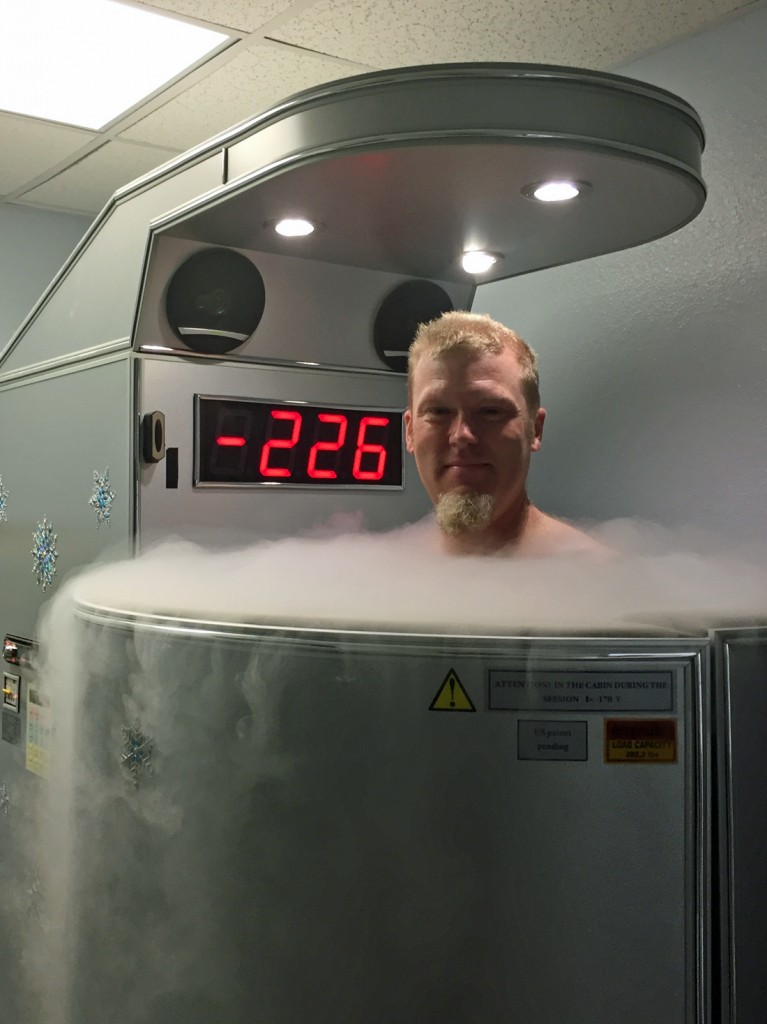
Or at least as hot as you can get at 240 degrees below zero.

When you play sports your whole life, you inevitably run (or stumble) into situations where you have to “put some ice on it.” We’ve all filled plastic bags from the freezer to place on sprained ankles and sore shoulders. The method I sampled is an ice bag on steroids (ok, bad choice of recovery metaphor there).

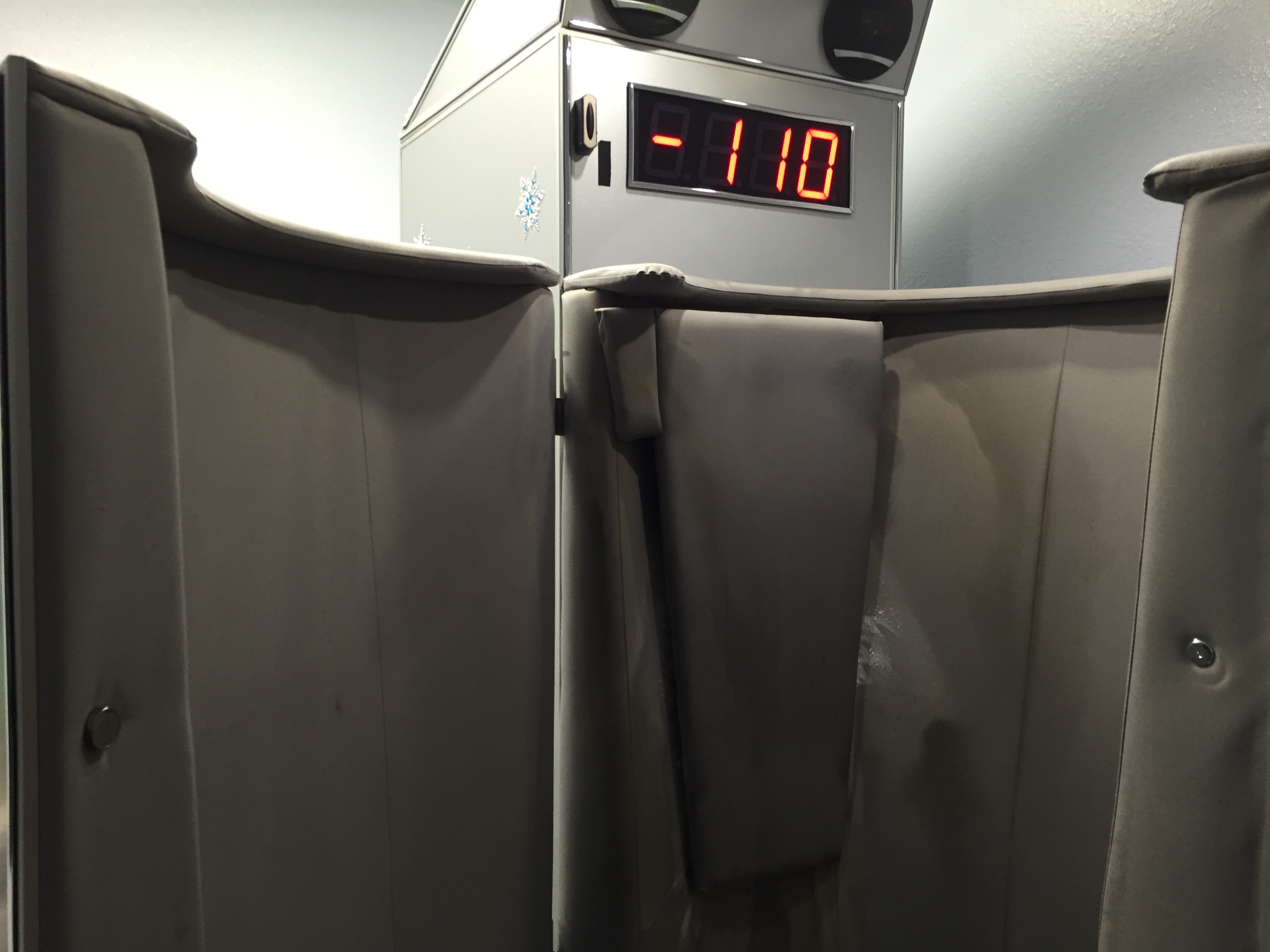
Wearing only gloves, socks, and a pair of plaid boxer shorts (your underwear selection may vary), one steps into a shoulder-high cylinder which floods with chilled nitrogen gas. Then the chamber gets cold. Really cold. Snow Miser cold.

I had my session at C3 Cryo Club in Burleson. Owner Lisa Flynn monitored the machine as it rapidly lowered the numbers on the attached thermometer.

“The cryotherapy starts to work on your body when the temperature reaches minus 166 in the chamber. The temperature will drop to minus 240, minus 250, sometimes minus 260 for about 30 seconds while you’re in the chamber,” Flynn explained.

I had played softball the night before and run more than usual (fallen over more, too). I hoped the cryotherapy would alleviate some of the inevitable muscle soreness. Flynn became aware of cryotherapy thanks to an injury of the diamond.

“My son was a freshman in high school, 14 years old. He rolled his ankle running to first base. The trainer told us we needed to take him to have an x-ray. It swelled up pretty bad. He had a high ankle sprain. The orthopedic told us he’d be out of playing three to five weeks. So he came to the trainer and he went and did cryotherapy every other for two weeks, so he did six treatments. After that sixth treatment, he was back on the field running, sliding, playing like he’d never gotten hurt before.”


Athletes at all levels have started using the procedure, most prominently in place of ice baths. After her son’s experience, Flynn, a nurse by profession, began to investigate the procedure before eventually opening her own shop.

“We discovered that cryotherapy was actually developed in the 70s in Japan and it was originally developed for rheumatoid arthritis patients. However, it had gotten popular here in the United States in 2011, actually in Texas in 2011, when the Dallas Mavericks used it for their winning season.”
Flynn’s cryo users consist of more than just players seeking a championship.

“A lot of people will come in with joint pain, inflammation, just in general throughout their body. They may be or may not be diagnosed with rheumatoid arthritis, fibromyalgia, (or) lupus,” she explained, “It has helped symptoms with those clients so they can have a better quality of life. It doesn’t necessarily cure it, but it does help with the inflammation they experience in their bodies.”

The science behind the treatment involves fooling your body into rushing blood to a core it believes is in mortal danger. Research is ongoing. How did it make me feel? I felt cold. Duh.

I grew up in Texas. I don’t like cold. I’d rather it be 100 every day than ever drop below 60. Luckily, the operator (Lisa Flynn in my case) talks to the subject the whole time to take one’s mind off one’s goosebumps. She also doesn’t leave the groceries in the freezer too long.

“We control the time that you’re in there. You cannot stay in there any longer than three minutes,” Flynn said. “Some people, two minutes, that’s it, every time they get in. The average time is two and a half minutes.”

It was hard for me to evaluate whether I felt better afterward than I would have otherwise after just a single cryo session. But the endurance athlete who recommended it uses it regularly and plenty of other sportspersons do as well. I may have a better idea after the next time I play softball and don’t use it. In the meantime, you can guess what I’ll be thinking about every time the air conditioner comes on.


Rush Olson has spent two decades directing creative efforts for sports teams and broadcasters. He currently creates ad campaigns, television programs, and related creative projects for sports entities through Rush Olson Creative & Sports and FourNine Productions.


RushOlson.com

Linkedin.com/company/rush-olson-creative-&-sports

Facebook.com/RushOlsonCreativeandSports