This post originally appeared in the Stuff section of the Fort Worth Weekly's website. To consume it there : https://www.fwweekly.com/2017/08/02/trading-games/ A baseball trading deadline revolves around seeing the future. A team
acquiring proven talent attempts to peer three months hence and
occasionally as much as 15 months. A franchise adding prospects needs to
see further, sometimes as much as four years or more. Ironically,
a word we use when talking about a baseball club’s ability to try to
predict its near future is “window.” A winning club’s collection of
talent is said to have a period of time when it’s a viable title
contender before those players age and leave due to free agency,
retirement, or cost-benefit analysis.
Heading into this season,
the Texas Rangers returned the core of consecutive division
title-winning teams led by the 2015 American League Manager of the Year.
They added fan favorite and power threat Mike Napoli, plus TCU product
Andrew Cashner. They had reason to expect continued progress from young
players like Rougned Odor, Nomar Mazara, and Joey Gallo.
Their
window of opportunity seemed open. The 2017 Rangers have shown promising
bursts, including May’s 10-game win streak and another five-gamer in
June against first-place teams Washington and Houston. Overall, however,
they have won fewer games than they have lost. Young players have not
taken necessary steps forward, though the 23-year-old Gallo’s OPS north
of .830 shows progress. Veterans have mostly underperformed. Cole Hamels
missed time with an oblique strain. The relief pitching has
inexplicably beached itself, as bullpens sometimes do.
This
season’s window of contention, then, has likely rattled closed for the
Rangers, and their trade deadline activity reflected it.
July 31 represents a
key date in the baseball calendar, because it is the last date teams can trade
players without sending them through waivers. From now through the end of the
season, a team wishing to trade a player must put him through revocable
waivers, a process that allows any team to claim him. At that point, the player’s
current club must either pull him off waivers and keep him, trade him to the
claiming team, or let the claimant take the player and his salary. Each player
can only go through the process once a season, so it can stymie a lot of August
trades. Teams therefore generally decide by July 31 whether their windows to
win include the current campaign. This July, the Rangers traded three established
players for younger ones unlikely to help them win games this season.
Catcher Jonathan Lucroy went to the Rockies for a player to be named
later; relief pitcher Jeremy Jeffress moved to Milwaukee for minor
league right-hander Tayler Scott; and starting pitcher Yu Darvish headed
west to the Los Angeles Dodgers for prospects Willie Calhoun, A.J.
Alexy, and Brendon Davis.
The returns for Lucroy and Jeffress will
not have a substantial impact on any Rangers window. With the former
posting a career-low batting average and the latter’s ERA at a
career-high 5.31 at the time of the trade, the Rangers had to sell low.
Baseball-reference.com rated both at below replacement level in 2017,
implying that any average player would have performed better. One could
argue that moving them might have made sense no matter where you found
yourself in the standings, especially given that Colorado now has to pay
a portion of Lucroy’s $5-plus million salary.
Darvish, however,
likely offers substantial present value to any team. Baseball Reference
estimated his WAR at 2.8, higher than any other Ranger. He has struck
out more than a batter per inning and offers a bewildering selection of
pitches. Banister declared that losing his team’s only All-Star
selection doesn’t mean his group won’t have a chance to contend. He
should say that, because his job entails motivating the men he manages,
and players view the possibility of October baseball as an important
enticement. Also, Banister could be right. We don’t know because we
haven’t played the games yet. Other contenders could suffer slumps or
injuries, and his roster could improve its performance. Darvish’s
departure makes it unlikely, however, that the Rangers’ window of
contention will extend into 2017. The Rangers fan must ask that if
2017 is not the team’s window, when is? The team’s current run dates to
2010, with Texas playing beyond the standard 162 regular season games
every year since then other than an injury-crushed 2014. Its success
rested on a strong minor league system fortified by prescient trades,
draft choices, and international signings. The club supplemented its
internal promotions with free agent signings and by using its farm depth
to trade for the likes of Hamels, Cliff Lee, and Mike Adams.
If
General Manager Jon Daniels polishes the glass on his crystal ball and
spies a chance to contend next season, it means he sees enough tools
either currently on the roster, ready to be promoted from the minor
leagues, or likely to be acquired in the offseason. Perhaps internal
evaluations indicate they can expect improved performance from current
guys. They might also look at signing free agents. Darvish will become
available again, if they want to make a run at him. Last year, the
Yankees effectively rented Aroldis Chapman to the Cubs before re-signing
him in the offseason. The Cubbies did the same the year before in
bringing Jason Hammel back from Oakland after dealing him there
mid-season.
Darvish makes $11 million this year and can expect to
command more than double that next year, barring injury. Texas has
$61.5 million in combined commitments to three thirtysomething players
next year (Hamels, Adrián Beltré, and Shin-soo Choo) and the 29-year-old
Elvis Andrus. Could they afford to re-up with Darvish and, since they
would need to improve on what they had this season even with the big
right-hander, also add another big-ticket free agent like Wade Davis or
J.D. Martinez?
In a sport without a hard salary cap, the Rangers’
revenues have an impact on payroll acquisitions. The way ticket sales
cycles go, the club will likely have less money to work with for next
year’s budget. A non-playoff season means less money coming in during
the all-important winter season and group ticket sales period. We can
also expect limited sponsor revenue-producing additions to the current
ballpark (à la the Hyundai Club or left field video board of recent
years) with a new stadium on the horizon.
In terms of internal
help, it’s not out of the question that Calhoun or Ronald Guzman could
emerge from AAA to impact the big club next year. Perhaps Nick Martinez
will surface as a reliable starter. The Rangers’ farm system is not what
it once was, though, weakened in part by the trades for Ryan Dempster,
Matt Garza, and others, made to extend the current competitive window.
This year’s trade deadline deals won’t hurt, but they won’t move the
needle there, either.
If the Rangers’ next window isn’t 2018, when
is it? To get back to winning its division consistently, and earning
its best chance at succeeding in the crapshoot that is the postseason,
Texas must overcome its A.L. West foes. Most of the teams have remained
bunched in the middle of the standings this year. Various services rank
the minor league systems of the Rangers, Angels, and Mariners in the
lower third of baseball. The A’s get placed a bit higher, and their own
deadline trade of Sonny Gray improved their system further, but unless
they get a new facility and improve their ability to boost payroll,
Oakland isn’t a long-term threat.
The young and talented Astros
present problems, however. In addition to running away with the division
in 2017, they possess one of the major leagues’ top development
pipelines. How can the Rangers match up with them in 2019 and beyond? In
2008 and 2009, Daniels and his staff, along with then-president Nolan
Ryan, brilliantly identified who in their current organization could
help them win and which players they’d need to acquire. They thought
they might surprise in 2009 (and they almost did), and they knew
they would in 2010. That’s their challenge now — to figure out when
they’ll be good again and who needs to still be here when it happens.
It’s not an easy process, because everyone wants to win now, but the
organization needs, above all, to be realistic about it.
Daniels’
office, like many on the fourth floor of Globe Life Park in Arlington’s
center field building, has a window overlooking the diamond. Every so
often, workers walk the ballpark balconies cleaning the glass. Rangers
fans hope they do a good job, because for JD and his staff, it’s all
about clear vision and windows. Rush Olson has spent two decades directing creative efforts for sports teams and broadcasters. He currently creates ad campaigns, television programs, and related creative projects for sports entities through Rush Olson Creative & Sports, Mint Farm Films, and FourNine Productions.
As baseball’s non-waiver trading deadline approaches, we find
ourselves asking important questions. Are we buyers? Are we sellers? Are
we standpatters?
Teams really try not to be standpatters, and not just because it’s
actually not a word. You either want to get better for this year so you
can win the World Series now or improve for subsequent years so you can
win the World Series then.
Should the Rangers be sellers this year, unloading veterans in return
for young players who need seasoning but have high upsides? Or should
they buy talent at the price of their own farm system depth? I’m a
flip-flopper, because while the hometown team is not currently in
playoff position, part of me thinks they could sneak into a wild card
slot, and once in the postseason teams can get hot. Darvish and Hamels
could pitch lights out and Beltre could rake and that
new-bullpen-piece-we-acquired-because-we-decided-we-were-buyers could
dominate.
Or
the team might give up prospects for proven talent and tank anyway.
Both scenarios have happened to clubs before. So if I can’t predict the
future, I decided I would look at the past. Perhaps you’ll remember
some of these in-season exchanges.
On May 30, 1972, that first Texas team traded Norm McRae to the
Tigers for Dalton Jones. McRae never threw another pitch in the big
leagues and Jones hit .159 for the Rangers that year in what would turn
out to be the final 166 plate appearances of his Major League career.
Jones was the older player, so we can characterize the Rangers as
buyers. However, they were 16-23 when they made the deal and would lose
100 games, so they should have been sellers. In fact, Rangers manager
Ted Williams knew Jones from his time with the Red Sox and I’ll surmise that had something to do with the club’s first-ever “deadline deal.”
In those days, the non-waiver deadline was earlier, June 15, and only
two teams per league made the postseason. When the deadline moved to
July 30 in 1986 and the playoffs expanded in 1994 and 2012, mid-season
trade activity increased. The stakes have also risen as prospects have
become an increasingly valued commodity. Deals get made after the
deadline, too, although they are more difficult because other teams can
block the trade by claiming a player off waivers (with the risk that
they may have to take on his salary if his current club decides to
unload it).
The guys in Arlington have made some solid deals as buyers. On July
9, 2010, they sent Matt Lawson, Blake Beavan, Josh Lueke, and Justin
Smoak to the Mariners for Cliff Lee and Mark Lowe. Do they reach their
first World Series without Lee? Probably not, so it’s hard to say any
deal had a bigger impact than that one. None of the other players in the
deal really did a lot until Smoak’s breakout season this year for
Toronto.
On July 31, 2015, Jorge Alfaro, Alec Asher, Jerad Eickhoff, Matt
Harrison, Jake Thompson and Nick Williams went to the Philadelphia
Phillies for Jake Diekman and Cole Hamels. Hamels and Diekman have been
key contributors to two playoff teams, so no matter how good the young
players they gave up become, it’ll be hard to count this as something
other than a win.
Perhaps the best deal as a buyer actually worked out more like a
seller’s deal for Texas. On July 28, 2006 Julian Cordero, Francisco
Cordero, Kevin Mench and Laynce Nix went to the Brewers in exchange for
veteran Carlos Lee and stalled prospect Nelson Cruz. Coco became
Milwaukee’s closer and Lee hit ok for the Rangers in an ultimately
fruitless ’06 playoff pursuit. But the deal’s “insurance,” Cruz, became
perhaps the most impactful postseason player in Rangers history.
As sellers, one deal that’s still paying dividends is the July 31,
2007 one in which Ron Mahay and Mark Teixeira went to the Atlanta
Braves. Texas received Beau Jones, Neftali Feliz, Matt Harrison, Jarrod
Saltalamacchia, and their current starting shortstop, Elvis Andrus. They
also picked up David Murphy from the Red Sox that day and he now
contributes as a broadcaster after posting some good years on the field
for winning Rangers teams. photo credit: Brian Gagnon/Texas Rangers
The July 19, 1985 trade of an aging Buddy Bell to the Reds for a
player to be named later and Duane Walker turned out well for the
Rangers when future closer Jeff Russell became the PTBNL four days
hence.
They don’t all work out as well. Robb Nen might been Russell’s heir
as closer had he not gone to the Marlins with Kurt Miller for Cris
Carpenter (not to be confused with future Rangers nemesis Chris
Carpenter) on July 17, 1993. Nen saved more than 300 games for the
Marlins and Giants.
One deal that drives one crazy is the 2011 Chris Davis/Tommy Hunter
for Koji Uehara trade with the Baltimore Orioles. Davis became a star,
which would have been fine if the Rangers had gotten what they needed
from the trade. While Texas did go to the World Series that year, Uehara
inexplicably had the highest ERA of his career pitching three months
for the Rangers and didn’t make the World Series roster. Two years later
he became ALCS MVP for the Red Sox and allowed no runs in five World
Series appearances. Rangers fans may recall a need for a shutdown
reliever in a certain Game 6.
Fans might feel a similar frustration about the August 19, 1983 trade
that sent Rick Honeycutt to the Dodgers for Dave Stewart and Ricky
Wright. Stewart’s talent never emerged with Texas, but he became a star
for the Athletics teams the Rangers chased in the late 1980s.
Another tough one came in 2001 as Ruben Mateo went to the Cincinnati
Reds for young pitcher Rob Bell. Bell never realized his high upside,
but the teenager the Reds convinced Texas to add to the deal became All-Star infielder/DH Edwin Encarnación.
On June 29, 1989, the Rangers traded Tack Wilson and Scott May to the
Milwaukee Brewers for Todd Simmons and LaVel Freeman. None of those
players ever played in the bigs for their new team. And had that been it
for 1989, the year would not have been included in this roundup.
Unfortunately, however, there was another trade that summer. Exactly a
month later, Texas picked up a veteran bat they thought might propel
them to their first postseason berth, plus a serviceable utility
infielder. Harold Baines and Fred Manrique did not get the Rangers
across the threshold. However, Wilson Alvarez, Scott Fletcher and Sammy
Sosa went to the Chicago White Sox in the swap, making this likely the
most notorious trade in Rangers history.
As sellers on July 11, 2003, Texas executed a superb exchange in
sending Ugueth Urbina to the Florida Marlins for Adrian Gonzalez, Will
Smith, and Ryan Snare. And it would have been a perfect example of the
vet winning a ring and the young player developing into a potential Hall
of Famer for his new team, except that Gonzalez had his superb career
with the Padres, Red Sox, and Dodgers after later deals.
More than one player, including Saltalamacchia, has been both
acquired and traded at separate deadlines. Ryan Dempster went to the
Marlins on August 8, 1996 for veteran right-hander John Burkett, which
helped Texas to its first division title. On July 31, 2012, Texas
brought Dempster back at the cost of Christian Villanueva and Kyle
Hendricks. Dempster posted a 5.09 ERA in 12 starts with Texas, but
Hendricks helped push his new team, the Cubs, to a World Series win last
fall.
The guy who went with Dempster to Florida came back to the Rangers on
August 12, 1997 as the Rangers were sellers. Ed Vosberg went to the
Marlins, who were on the way to their first championship. Rick Helling
returned to the club that had drafted him and led the starting staff of
two Rangers postseason teams.
In 1998, the club picked up another one of those twice-dealt guys,
Esteban Loaiza, along with Todd Stottlemyre and Royce Clayton in
deadline deals. Those players helped push Texas to a second A.L. West
title.
Who’s the best player ever acquired by Texas in an in-season deal?
You could make the case for Cruz, Hamels, Lee, or for Michael Young, who
came to Texas with Darwin Cubillan on July 19, 2000 for Loaiza. The
Rangers also picked up future Hall of Fame curveballer Bert Blyleven in a
1976 deal. But this is, in fact, a trick question. The best player
Texas ever acquired was . . . Ivan “Pudge” Rodriguez. By the time of his
August 19, 2009 re-acquisition from the Astros, he was no longer the
perennial Gold Glover and offensive force of his first swing through
Arlington. But he’s Pudge and I expect to get no argument from Rangers
fans about this selection.
So now you have an overview of past Rangers deadline deals. If I left
out your favorite Ruben Sierra or Ed Kirkpatrick trade, I apologize.
Perhaps in a few years they’ll be included when I write about how we
just reacquired Justin Smoak or Nick Williams.
Rush Olson has spent two decades directing creative efforts for
sports teams and broadcasters. He currently creates ad campaigns,
television programs, and related creative projects for sports entities
through Rush Olson Creative & Sports and FourNine Productions.
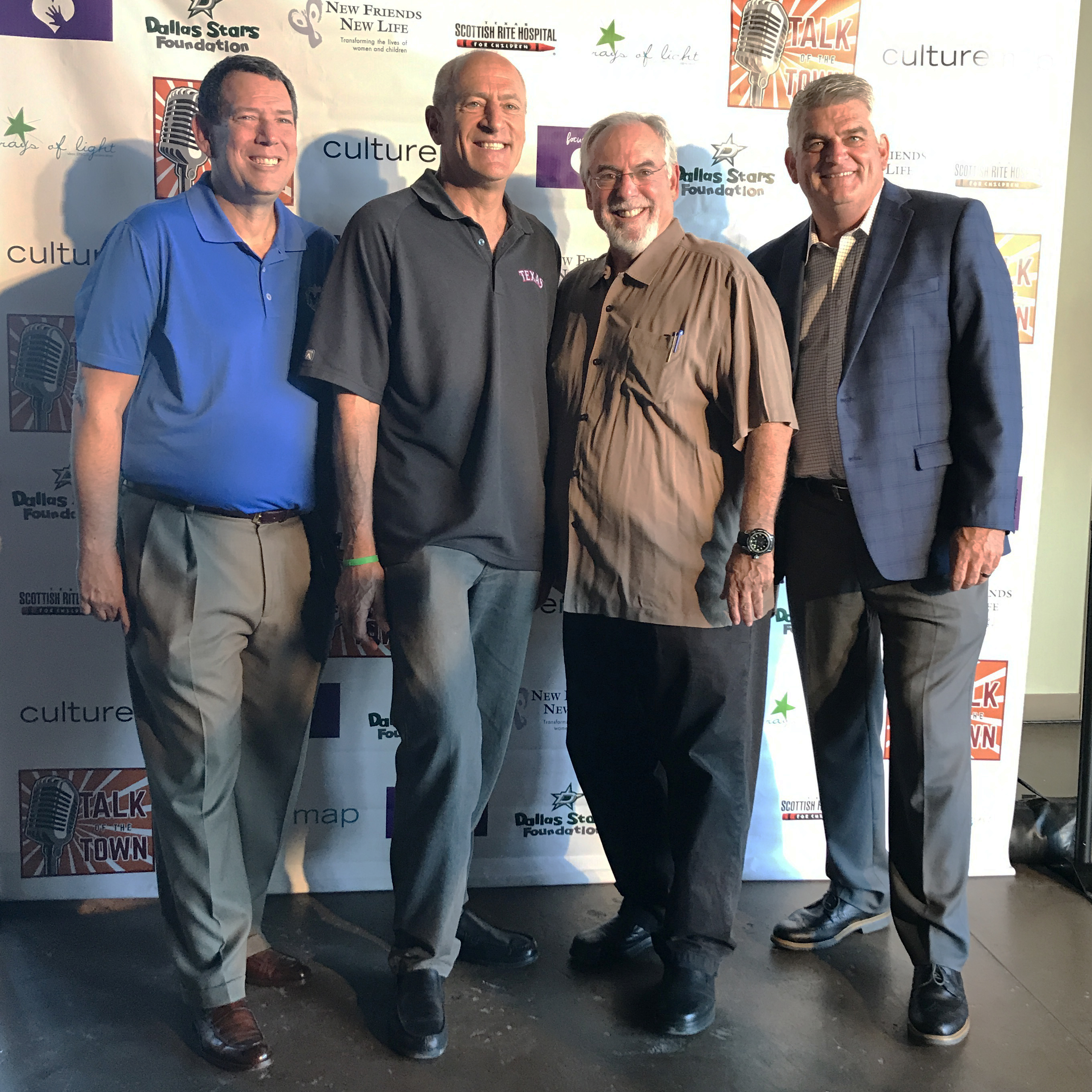
Thursday night, someone asked a group of noted play-by-play
men about the most difficult venues in which to call a game. New York
City native Chuck Cooperstein of the Mavericks, the subject of this
post’s video interview, reluctantly cited his beloved Madison Square
Garden’s subpar sightlines. The Rangers’ Eric Nadel noted that he loved
Chicago’s venerable Wrigley Field in general, but not its lilliputian
broadcast booth. (He observed that early broadcasters “apparently were
very small people.”) Brad Sham from the Cowboys placed Washington, D.C.
first. He also named them second, third, and on up through number 32.
Sham explained that the visiting radio booth is low and in the corner
and he has to call certain distant plays using the monitors in the
instant replay booth next door. photo by Carrie AdamsAt the Talk of the Town event, radio announcers for North Texas’s top
four pro sports teams assembled to swap inside stories about their
profession. The audience could submit queries on note cards and the
venues question was one of the first moderator John Rhadigan read. Dave
Strader wasn’t on stage at that point and we didn’t find out his answer
to it. The Stars’ announcer had planned to attend, but a recent
complication in his cancer treatment prevented him from being physically
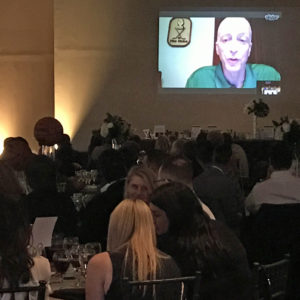
onsite. It didn’t stop him from participating, however. A few minutes
after the broadcast booth discussion, Rhadigan introduced a classic call
of a Steve Yzerman playoff overtime goal, one Strader had made as the
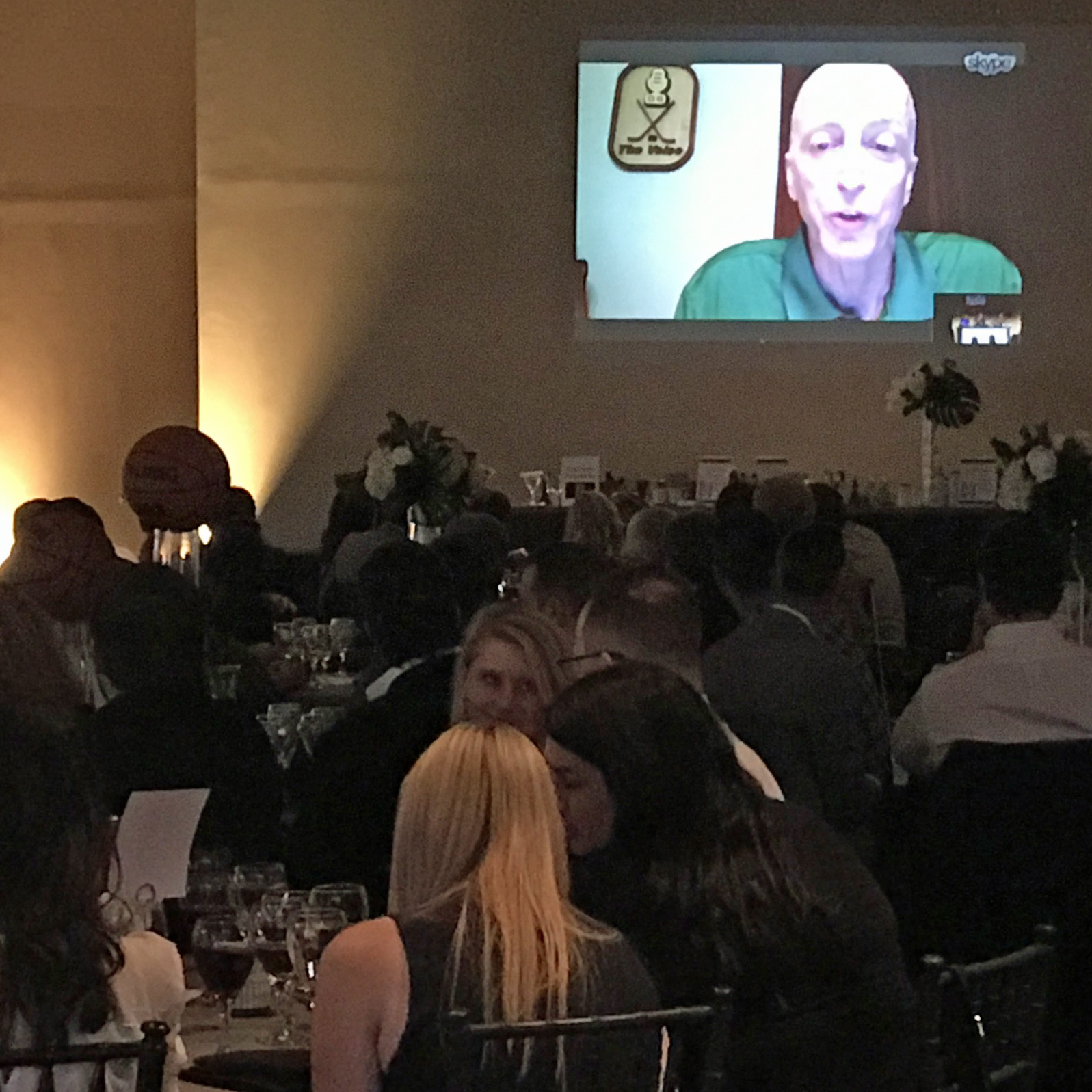
voice of the Detroit Red Wings. As it ended, the skinny but energetic
hockey broadcaster appeared on the video screen via Skype and described
how they had just watched his final call as a Red Wings team
broadcaster. photo by Carrie AdamsStrader then stuck around virtually, contributing his viewpoint to
every question and clearly enjoying the night. After the event, he
tweeted “Thank you for having me! It meant a lot.” I’m sure the
experience raised his spirits, and it lifted the room up a lot, too.
Perhaps my most enduring memory of a fully enjoyable evening will be of
the occupants of the Dallas Stars’ table, including former Stars forward
Vern Fiddler, watching their colleague on the screen and clearly being
moved by the sight.
In
addition to serving as a pick-me-up for Strader and his Stars
colleagues, the event also benefited five charities dedicated to serving
less-fortunate children. Earlier in the evening, after Sham had
described the challenges of having no depth perception when calling a
Cowboys-Redskins game, he had added a caveat.
“The one thing you won’t hear us do is complain about it. Because one
of the things I think we all understand,” explained the longtime
announcer, “Is there’s a line of people three times around the stadium
who would do it for free.”
Sham and the rest clearly appreciate what they have. In a night filled with great stories, that message was truly a lasting one.
Rush Olson has spent two decades directing creative efforts for
sports teams and broadcasters. He currently creates ad campaigns,
television programs, and related creative projects for sports entities
through Rush Olson Creative & Sports and FourNine Productions.
Why did Tom Grieve say my name on the TV Friday? OK, my first name is also a common noun, but he wasn’t referring to a
pitcher rushing his delivery or a runner in a rush to beat a throw
while going from first to third. He meant me. Grieve and his broadcast partner, C.J. Nitkowski had noticed the
Rangers’ home jerseys have script across the front reading “Texas.” The
more common practice in baseball is to have a team’s geographical home
printed on the road jerseys, while the home versions boast the name of
the team’s mascot. The Rangers, however, use “Texas” on both. The
announcers wondered why. So
I sent Grieve a text that read “My memory of why Texas is on the front
of the home jersey is that it was part of an effort to brand the club
with the qualities of the state a few years ago. We ended up doing a
whole ad campaign around My Texas My Rangers. I think the jersey
branding was related to that.” The longtime Rangers analyst then read the message on the air. Later
in the game, Rangers Executive Vice President of Communications John
Blake confirmed my memory was correct (which caused them to say my name
again, pleasing my parents who were watching the telecast in Fort
Worth). While it’s always cool having an esteemed personality like Tom
Grieve say nice things about you, one of the bonuses of the situation
was it got me thinking about the ad campaign and how it came about. it started intuitively, but was ultimately backed up by data. Nolan
Ryan had taken over as team president in February of 2008 and the
ownership group in which he participated took over the team in August of
2010. The new head of business-side operations, Chuck Greenberg, wanted
to direct fans to identify the Rangers as their team, so we quickly
shot and edited some new spots
consisting of highlights mixed with fans telling the camera some
variant of “these are my Rangers.” Though that advertising effort was an
unscientific one, in the offseason, Greenberg directed resources toward
something the Rangers had done only sporadically during my years there:
audience research. I found the process truly valuable. As a creative director, one likes
to know to whom one is speaking (through the medium of television or
radio or the internet). It helps you craft better material, because once
you know what you’re trying to accomplish, you can find innovative ways
of achieving it. As consultant Corky Hall of Stellus Consulting put it,
“Give me the freedom of a tightly defined strategy.” Hall’s firm had taken existing data and spearheaded new research
initiatives so we could find out what our fans thought of us. We also
wanted to know what they liked and what we could do to position
ourselves to better reflect their preferences. One of the things we
discovered (not that it was a surprise) was that people liked Texas
symbols and values like loyalty, toughness, and friendliness they felt
reflected those of Texas and Texans. The Rangers had long sported a Texas flag patch on their jersey
sleeves and the Lone Star State had found its way into plenty of
branding elements over the years. The year before (2009), in fact, was
when the club had made the move to have all its jerseys read “Texas.”
Identifying with the state made sense instinctively, but now we had data
to back it up. Out of those brainstorming sessions came a tag line that
combined elements of the previous year’s end of season spots with the
new research, one that encouraged people to take pride in their team the
same way they did in their state: My Texas, My Rangers. The next step was to figure out how to embody the concept in actual
creative executions that would both encourage ballpark attendance and
create the brand perceptions we wanted. The solution we adopted involved
portraying what was then known as Rangers Ballpark in Arlington as a
place where Texas values were ever-present. For television commercials,
what I thought might be funny (and therefore memorable) was if the
images symbolic of those values actually existed at the park. Some
manifestations included:
Grazing Longhorns grazed
in the outfield, ostensibly to save on mower fuel. This spot starred
Mitch Moreland and Head Groundskeeper Dennis Klein and no, those were
not real cows in the outfield. We digitally manipulated some stock
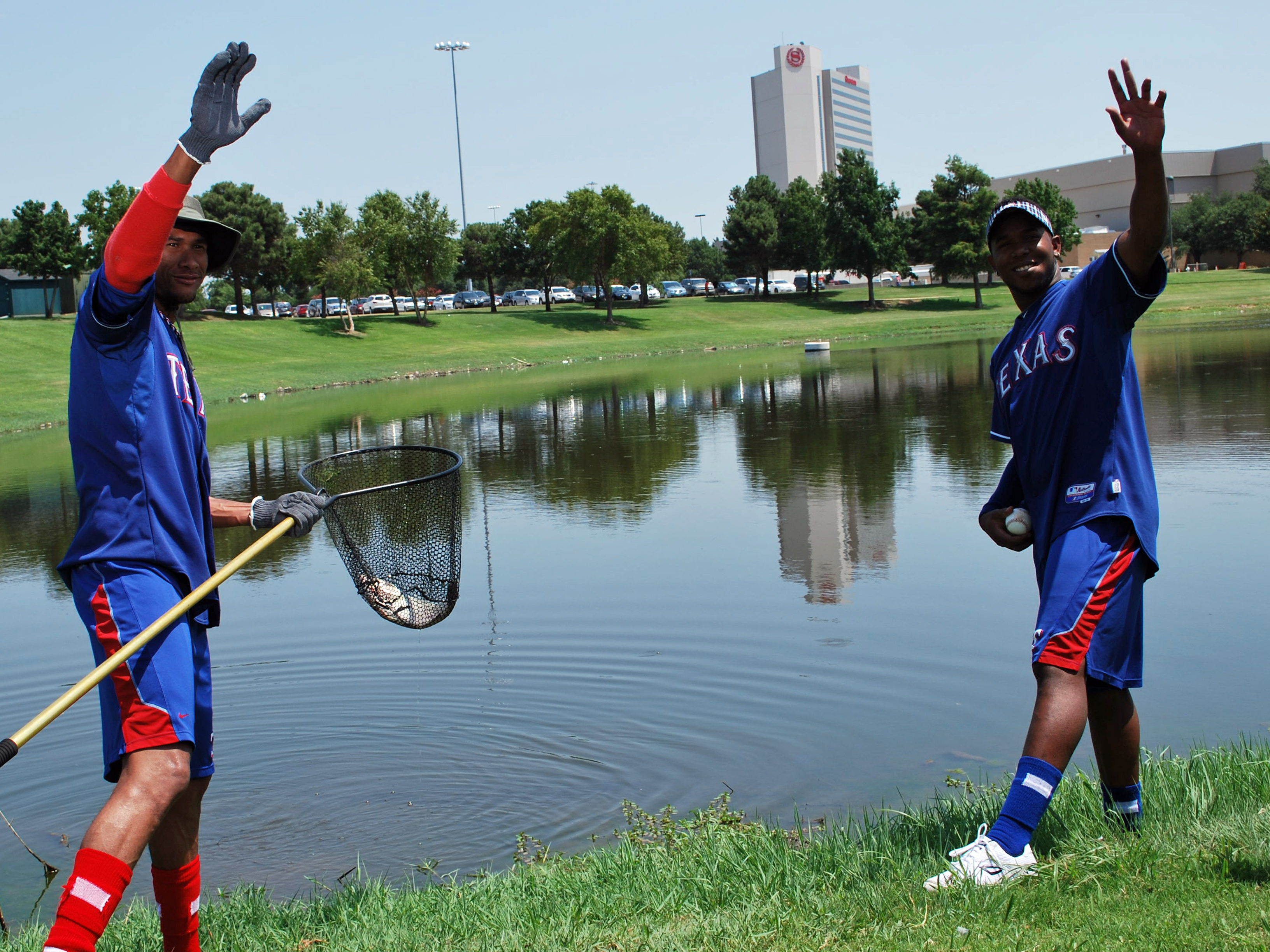
footage. photo credit: Brian Gagnon/Texas RangersBass Fishing Texans love their bass fishing, so Alexi Ogando and Neftali Feliz demonstrated
an innovative way of doing it, as observed by Pitching Coach Mike
Maddox and Bullpen Coach Andy Hawkins. For props, we used old batting
practice balls and some whole fish carcasses I bought at an Arlington
Asian market. Yes, our marketing budget went to buy dead fish. I did
check, by the way, to make sure the fish I purchased could actually be
found in Texas lakes. I didn’t want a detail-minded angler hating on our
spot because we used the wrong bass. Pecans A pecan
tree grew in the upper deck, with Nelson Cruz and Thad Bosley in charge
of cracking the nuts of the official state tree. I wandered the Central
Arlington neighborhood in which I lived at the time picking up sticks
and pecan fragments dropped from the local trees. For Bosley and Cruz’s
part, shot in spring training in Surprise, Arizona, I had to trek to
Tempe to find unshelled pecans. Horns Horses are pretty Texan, and the Rangers happen to have one working
for them. During the Rangers’ first World Series run, the “claw and
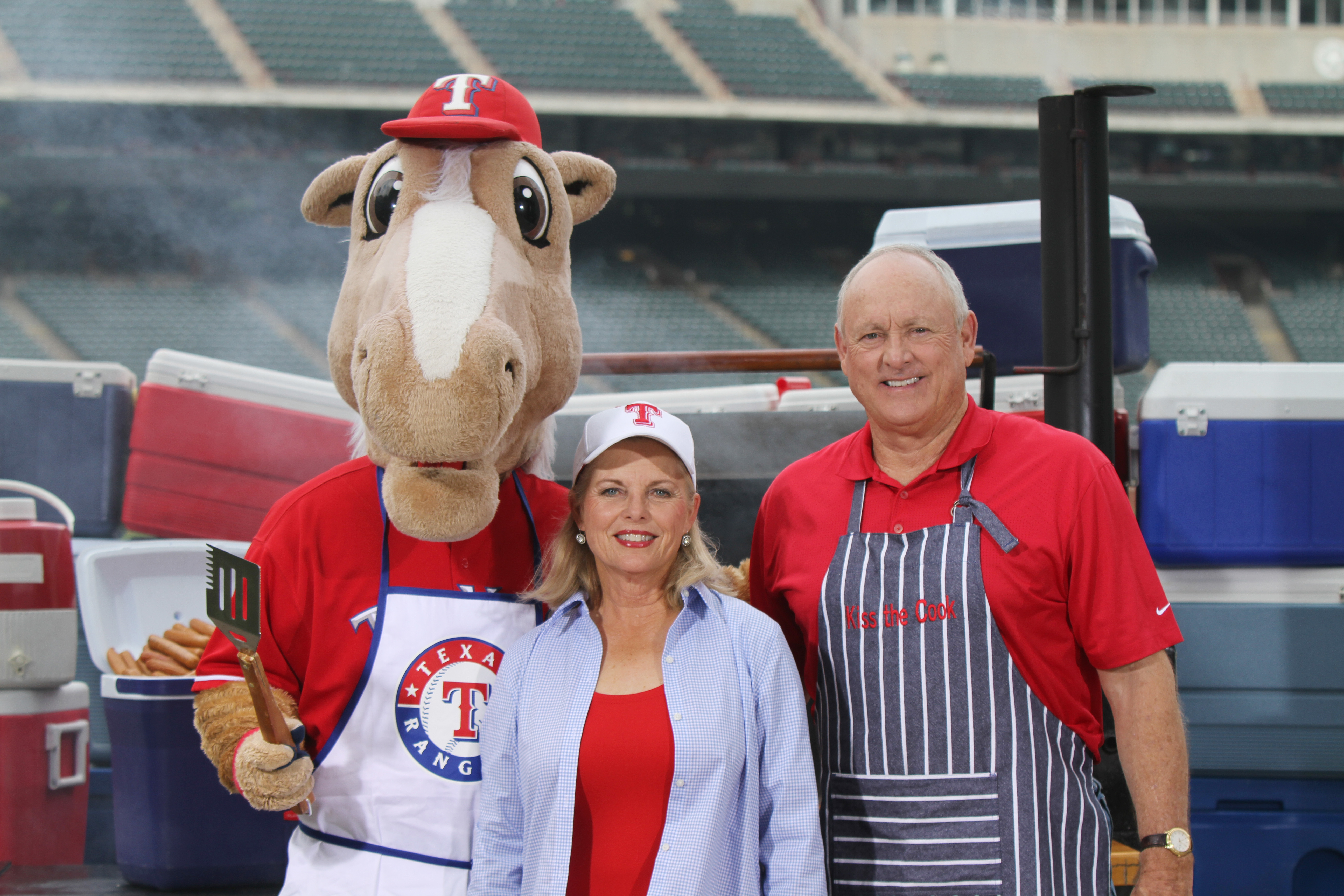
antler” craze consumed the local fandom. After this spot starring Rangers Captain began running, the mascot reported kids coming up to him doing the antlers sign. Lots of Dogs Grilling out with friends and family is a Texas tradition, but
apparently some Texans can take it too far. This was one of the most fun
shoots I ever did, and not just because Nolan and Ruth Ryan are great
people (two of their granddaughters appeared in the commercial,
too). Ballpark chef Cris Vazquez hauled out a humungous quantity of hot
dogs and an enormous grill that morning and started cooking. We grabbed
every cooler in the ballpark to ostensibly be full of hot dogs and the
crew brought some ice chests from home, too. If you don’t watch the Spanish-language version,
too, you do yourself a disservice. We knew Nolan would be reluctant to
speak a phrase in Spanish, so we recruited his former teammate Jose
Guzman to help. The scheme was that Jose was going to say the Spanish
line, but we plotted all along to try to get Nolan to say it. So we cut a
take where Jose said the line, then I asked Nolan if we could try one
more thing. Nolan guardedly agreed, and Jose, with help from team
videographer Hugo Carbajal, coached him in what is, as far as I know,
the Hall of Famer’s only appearance ever speaking in Spanish on camera. photo credit: Alan H. Rose/Texas Rangers
This spot got a lot of discussion on the Ticket radio station, too,
thanks to a shot Carbajal added in the edit of a well-inked lady eating a
hot dog. Nolan’s image as the quintessential Texan helped the My Texas, My
Rangers campaign a lot. We referenced him in the copy (it was ostensibly
his idea to put in the pecan tree and, in another spot I didn’t mention
above because it’s unfortunately not available to view online, an oil
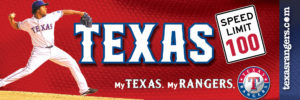
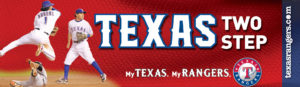
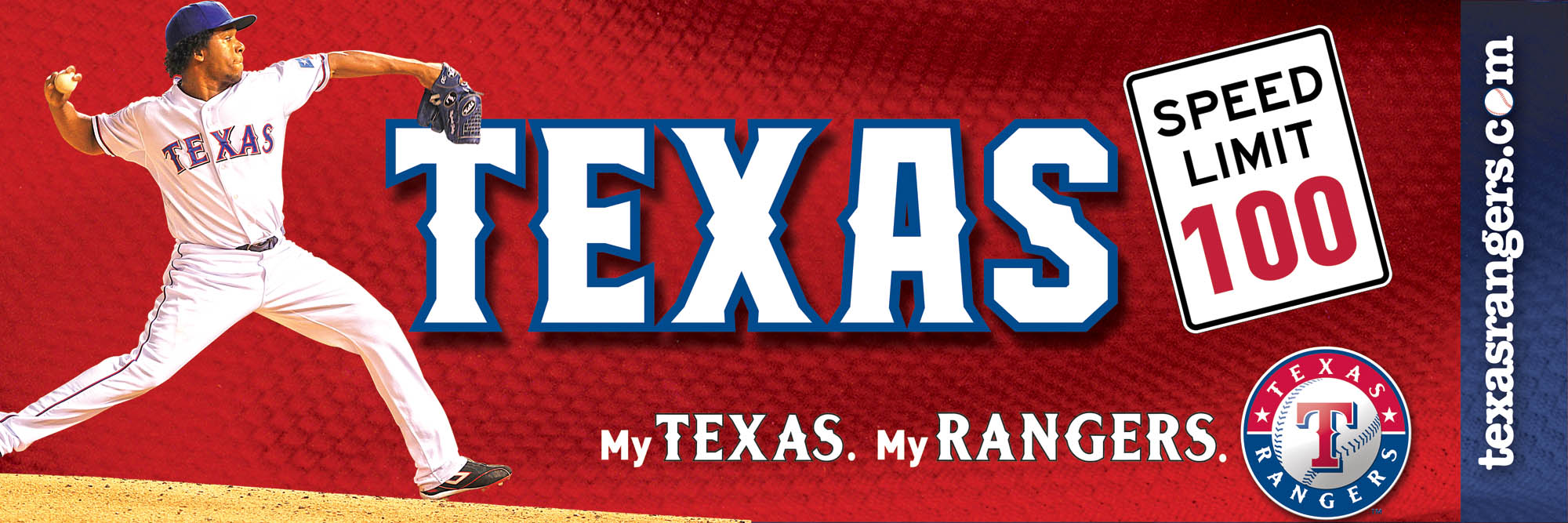
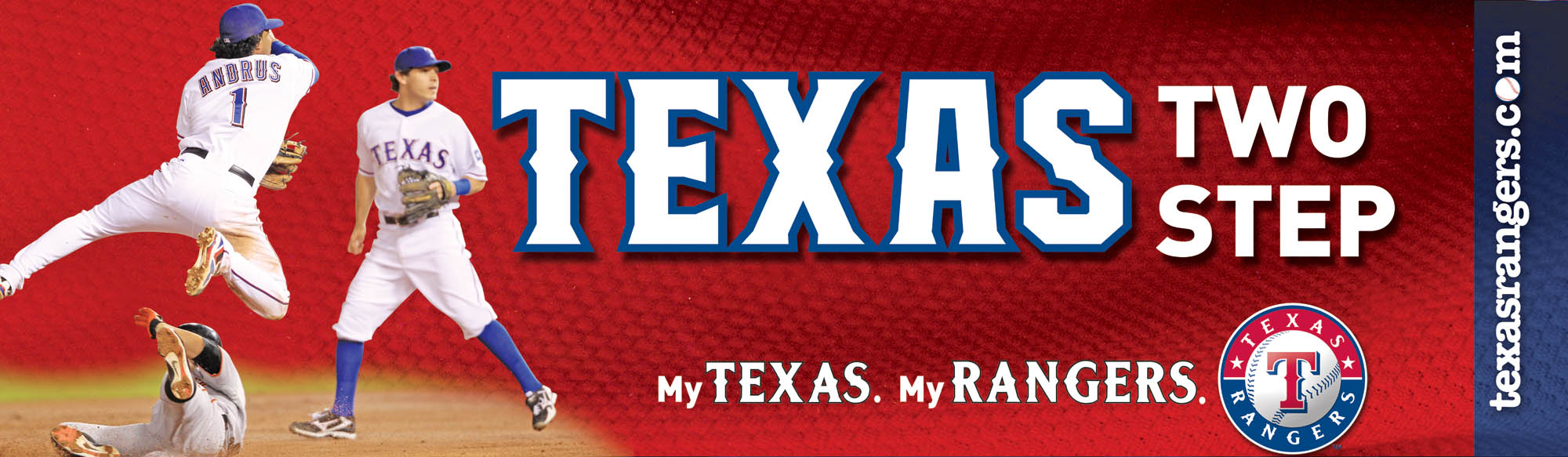
well along the right field wall). We created other media besides television. Billboards offered
baseball variations on state themes, like its country-and-western
dancing and miles of open road. design by: Rainer Uhlir/Texas Rangersdesign by: Rainer Uhlir/Texas Rangers
We had radio, too. Can Texans sometimes exaggerate? We decided Texas
Tall Tales was a worthwhile theme, so Eric Nadel voiced a series of
spots positing Texas ties to certain team-related items. For instance,
did you know the word Tejas means “he who hits with the strength of a
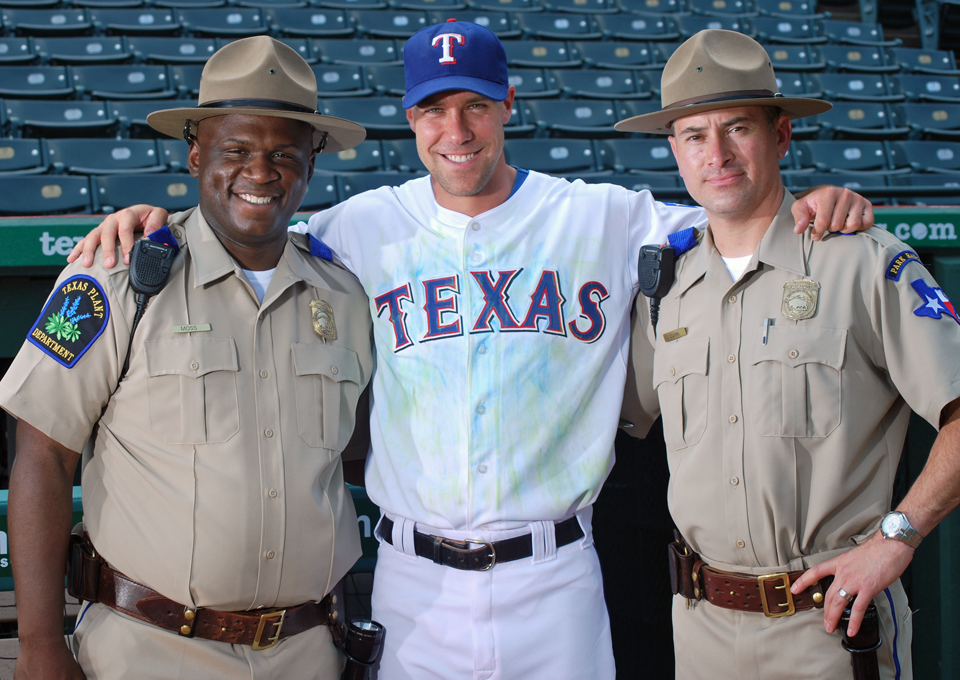
bear?” Or that the dye in the Rangers’ blue uniforms is made from
organic bluebonnets? Or that Nolan Ryan gives the Rangers employee of
the year a heifer from his personal herd? Of course, those are all made
up, but Eric would go on to emphasize that it was not a Texas Tall Tale
that the Rangers did, in fact, embody many of the good qualities of the
Lone Star State. You can check out some samples of the radio campaign here. We also didn’t want to turn off non-Texans, so we did some radio and
TV themed as “Welcome to Texas,” that suggested you didn’t have to be
from the state of Texas to cheer for the team named “Texas.” And when
the pennant race heated up, we did some new spots that hit on Texas pride in retaining the American League title (which that 2011 team did). When one thinks of the Texas Rangers, one inescapably thinks of the
state – heck, it’s the team’s first name. In the latter part of the
first decade of the 2000s, the team made that connection a little more
explicit. Tom Grieve noticed.
Basketball Hall of Famer Nancy Lieberman has been putting on kids camps in North Texas since the early 1980s. With the summer in full swing, some families may still be in need of activities for the kiddos. You might also be wanting to figure out how to evaluate the camps you did this year. She and I discussed these topics in this video interview, and also an idea Lieberman stole from DeMarcus Cousins (not physically - he's a big dude- virtually). You can find details on the camps she runs (one in July, one in August) at nancyliebermancharities.org.
Side note : As you’re checking out the cool framed memorabilia in the background (we shot chez Lieberman and she has some remarkable stuff there), you might notice a little movement, too. Don’t be alarmed, it’s just Magic and Thunder, her dogs. Later in the interview you can even hear them a bit as well when they decided they’d like to wrestle beneath where we were sitting.
Rush Olson has spent two decades directing creative efforts for
sports teams and broadcasters. He currently creates ad campaigns,
television programs, and related creative projects for sports entities
through Rush Olson Creative & Sports and FourNine Productions.
I had a couple of things I wanted to talk to Theresa Plaisance of the Dallas Wings about in this video interview.
Firstly,
we needed to cover the team’s current four-game winning streak. It’s
evened their record at 8-8, putting them squarely into a crowded playoff
mix with a little more than half the season remaining. The fourth-year
frontcourt player scored in double figures in three of the four games,
and posted a career-high nine rebounds in Sunday’s win over Connecticut.
Plaisance has gotten more playing time as a result of an injury to
Courtney Paris and the Louisiana State product has taken advantage of
it.
Secondly, I wanted to follow up on a conversation she and I
had had after a recent game - a discussion, which interestingly enough,
involved WNBA President Lisa Borders and Wings Chief Marketing Officer
Nicole Smith. We talked about suntans or lack of same, and it turns out
that Plaisance’s mom had certain rules regarding her daughter’s
application of sunscreen. Since I was with the Wings outdoors during
Monday’s team visit to the Dallas Zoo, I thought it appropriate to ask
her to relay the story, and you’ll hear it in this video.
Side
note #1: The funniest remark of the zoo visit was offered by assistant
coach Bridget Pettis. As we approached the giraffe enclosure, she
proclaimed “We finally found someone who can guard Brittney Griner,”
referencing the imposing former Baylor post who puts up big numbers for
the Phoenix Mercury.
Side note #2: The WNBA team that plays in
Connecticut is named the "Sun." Plaisance recorded three blocked shots
against them on, appropriately enough, Sunday. So in a sense, Plaisance
blocked the sun twice in two days. And her mother’s a basketball coach,
so DoBee Plaisance can probably claim some of the credit for both victories.
Rush Olson has spent two decades directing creative efforts for
sports teams and broadcasters. He currently creates ad campaigns,
television programs, and related creative projects for sports entities
through Rush Olson Creative & Sports and FourNine Productions.
Two Fort Worth neighbors have their roots in the same place: The Old West.
I’m
talking about the Amon Carter Museum and the rodeo that resides across
the street from it. The museum began with its namesake’s collection of
works depicting the American frontier by Frederic Remington and Charles
M. Russell. These artists attempted to show the robust lifestyle of
those who made their homes in that legendary expanse.
Though the
Carter has expanded its collection of American art well beyond the
cowboy genre, western heritage still forms an important part of its
identity. The facility dedicates an entire section to the works of
Remington and Russell.
As I wrote
in the Stuff section of the Weekly this week, the museum also owns a
number of works with a sports theme. One intriguing example comes via a
letter Russell wrote to a man he calls “Friend Guy.” The artist would
often illustrate his correspondence and visitors can view several of the
originals preserved in drawers. On January 28, 1916, he wrote to Guy
Weadick about “bronk riders” and “bull dogers (aka steer wrestlers)” He
notes that Weadick’s audience members “have all seen wild west shows but
yours is no show it’s a contest where horses and riders are strangers.”
The event Weadick founded would eventually become one of the world’s
premier rodeos: The Calgary Stampede. Russell had knowledge of its first
incarnations in Calgary and Winnipeg.
photo courtesy Amon Carter Museum
The
following year, Fort Worth would make one of its major contributions to
the sport by staging the first indoor rodeo. The Fort Worth Stock Show
Rodeo pioneered other innovations as well, including side-release
bucking chutes, and lays claim to having hosted the first modern bull
riding event in 1920.
Competitions in which cowboys tested their
riding and roping skills had sprung up in the latter part of the 19th
century, around the time when Russell and Remington were creating the
images of the West for which they became known. Some of the creations
portrayed cowboys working at the tasks that eventually would be
incorporated into the sport of rodeo.
The most prominent such work is a sculpture by Remington called The Broncho Buster.
The Carter owns three versions of it, with the largest placed
prominently in a first-floor gallery. It shows a cowboy in the act of
conditioning a recalcitrant mount to accept the idea of having a rider
on its back.
That endeavor translates pretty straightforwardly
into the bronc riding competitions one might see in the Will Rogers
Memorial Center arena. Other events, like bull riding, were created
especially for the rodeo arena. Each year, the Stock Show supplements
its regular PRCA shows with a Best of the West Ranch Rodeo featuring
events designed to reflect the daily duties of a working ranchhand. The
Stock Show, and indeed Cowtown in general, is never shy about
celebrating western heritage.
When we visit the rodeo or the art
museum, we do so in part to observe and enjoy talent – the artist’s
beautiful brushstrokes or the surpassing athletic abilities of human and
animal competitors. We also expand our knowledge of the culture that
permeates each. In Fort Worth, we are fortunate to have more than one
way to appreciate, and learn about, the vigor, toughness, and character
of those who call themselves cowboys and cowgirls. And the two venues
are right across the street from each other.


![Charles M. Russell (1864-1926); Friend Guy [Guy Weadick], January 28, 1916; 1916; Ink, watercolor, and graphite on paper; Amon Carter Museum, Fort Worth, Texas; 1961.308.1](https://www.fwweekly.com/wp-content/uploads/2017/06/RussellLetter-1961-308-1_pr-191x300.jpg)
![Charles M. Russell (1864-1926); Friend Guy [Guy Weadick], January 28, 1916; 1916; Ink, watercolor, and graphite on paper; Amon Carter Museum, Fort Worth, Texas; 1961.308.1](https://www.fwweekly.com/wp-content/uploads/2017/06/RussellLetter-1961-308-1_pr.jpg)
