Why did Tom Grieve say my name on the TV Friday? OK, my first name is also a common noun, but he wasn’t referring to a
pitcher rushing his delivery or a runner in a rush to beat a throw
while going from first to third. He meant me. Grieve and his broadcast partner, C.J. Nitkowski had noticed the
Rangers’ home jerseys have script across the front reading “Texas.” The
more common practice in baseball is to have a team’s geographical home
printed on the road jerseys, while the home versions boast the name of
the team’s mascot. The Rangers, however, use “Texas” on both. The
announcers wondered why. So
I sent Grieve a text that read “My memory of why Texas is on the front
of the home jersey is that it was part of an effort to brand the club
with the qualities of the state a few years ago. We ended up doing a
whole ad campaign around My Texas My Rangers. I think the jersey
branding was related to that.” The longtime Rangers analyst then read the message on the air. Later
in the game, Rangers Executive Vice President of Communications John
Blake confirmed my memory was correct (which caused them to say my name
again, pleasing my parents who were watching the telecast in Fort
Worth). While it’s always cool having an esteemed personality like Tom
Grieve say nice things about you, one of the bonuses of the situation
was it got me thinking about the ad campaign and how it came about. it started intuitively, but was ultimately backed up by data. Nolan
Ryan had taken over as team president in February of 2008 and the
ownership group in which he participated took over the team in August of
2010. The new head of business-side operations, Chuck Greenberg, wanted
to direct fans to identify the Rangers as their team, so we quickly
shot and edited some new spots
consisting of highlights mixed with fans telling the camera some
variant of “these are my Rangers.” Though that advertising effort was an
unscientific one, in the offseason, Greenberg directed resources toward
something the Rangers had done only sporadically during my years there:
audience research. I found the process truly valuable. As a creative director, one likes
to know to whom one is speaking (through the medium of television or
radio or the internet). It helps you craft better material, because once
you know what you’re trying to accomplish, you can find innovative ways
of achieving it. As consultant Corky Hall of Stellus Consulting put it,
“Give me the freedom of a tightly defined strategy.” Hall’s firm had taken existing data and spearheaded new research
initiatives so we could find out what our fans thought of us. We also
wanted to know what they liked and what we could do to position
ourselves to better reflect their preferences. One of the things we
discovered (not that it was a surprise) was that people liked Texas
symbols and values like loyalty, toughness, and friendliness they felt
reflected those of Texas and Texans. The Rangers had long sported a Texas flag patch on their jersey
sleeves and the Lone Star State had found its way into plenty of
branding elements over the years. The year before (2009), in fact, was
when the club had made the move to have all its jerseys read “Texas.”
Identifying with the state made sense instinctively, but now we had data
to back it up. Out of those brainstorming sessions came a tag line that
combined elements of the previous year’s end of season spots with the
new research, one that encouraged people to take pride in their team the
same way they did in their state: My Texas, My Rangers. The next step was to figure out how to embody the concept in actual
creative executions that would both encourage ballpark attendance and
create the brand perceptions we wanted. The solution we adopted involved
portraying what was then known as Rangers Ballpark in Arlington as a
place where Texas values were ever-present. For television commercials,
what I thought might be funny (and therefore memorable) was if the
images symbolic of those values actually existed at the park. Some
manifestations included:
Grazing Longhorns grazed
in the outfield, ostensibly to save on mower fuel. This spot starred
Mitch Moreland and Head Groundskeeper Dennis Klein and no, those were
not real cows in the outfield. We digitally manipulated some stock
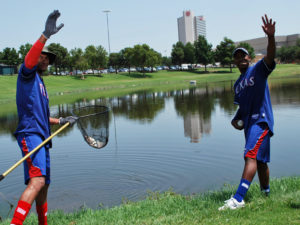
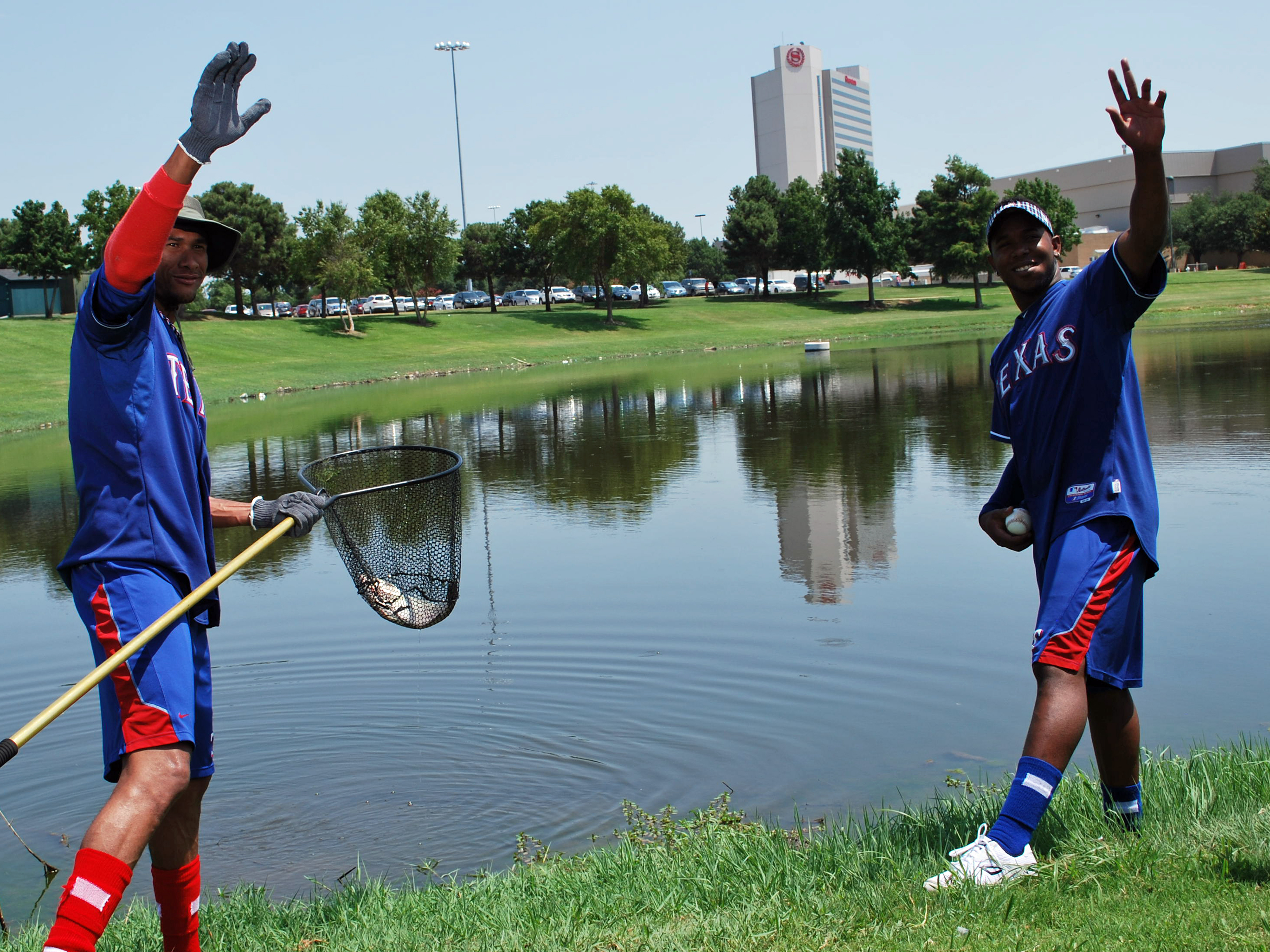
footage. photo credit: Brian Gagnon/Texas RangersBass Fishing Texans love their bass fishing, so Alexi Ogando and Neftali Feliz demonstrated
an innovative way of doing it, as observed by Pitching Coach Mike
Maddox and Bullpen Coach Andy Hawkins. For props, we used old batting
practice balls and some whole fish carcasses I bought at an Arlington
Asian market. Yes, our marketing budget went to buy dead fish. I did
check, by the way, to make sure the fish I purchased could actually be
found in Texas lakes. I didn’t want a detail-minded angler hating on our
spot because we used the wrong bass. Pecans A pecan
tree grew in the upper deck, with Nelson Cruz and Thad Bosley in charge
of cracking the nuts of the official state tree. I wandered the Central
Arlington neighborhood in which I lived at the time picking up sticks
and pecan fragments dropped from the local trees. For Bosley and Cruz’s
part, shot in spring training in Surprise, Arizona, I had to trek to
Tempe to find unshelled pecans. Horns Horses are pretty Texan, and the Rangers happen to have one working
for them. During the Rangers’ first World Series run, the “claw and
antler” craze consumed the local fandom. After this spot starring Rangers Captain began running, the mascot reported kids coming up to him doing the antlers sign. Lots of Dogs Grilling out with friends and family is a Texas tradition, but
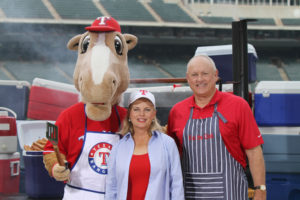
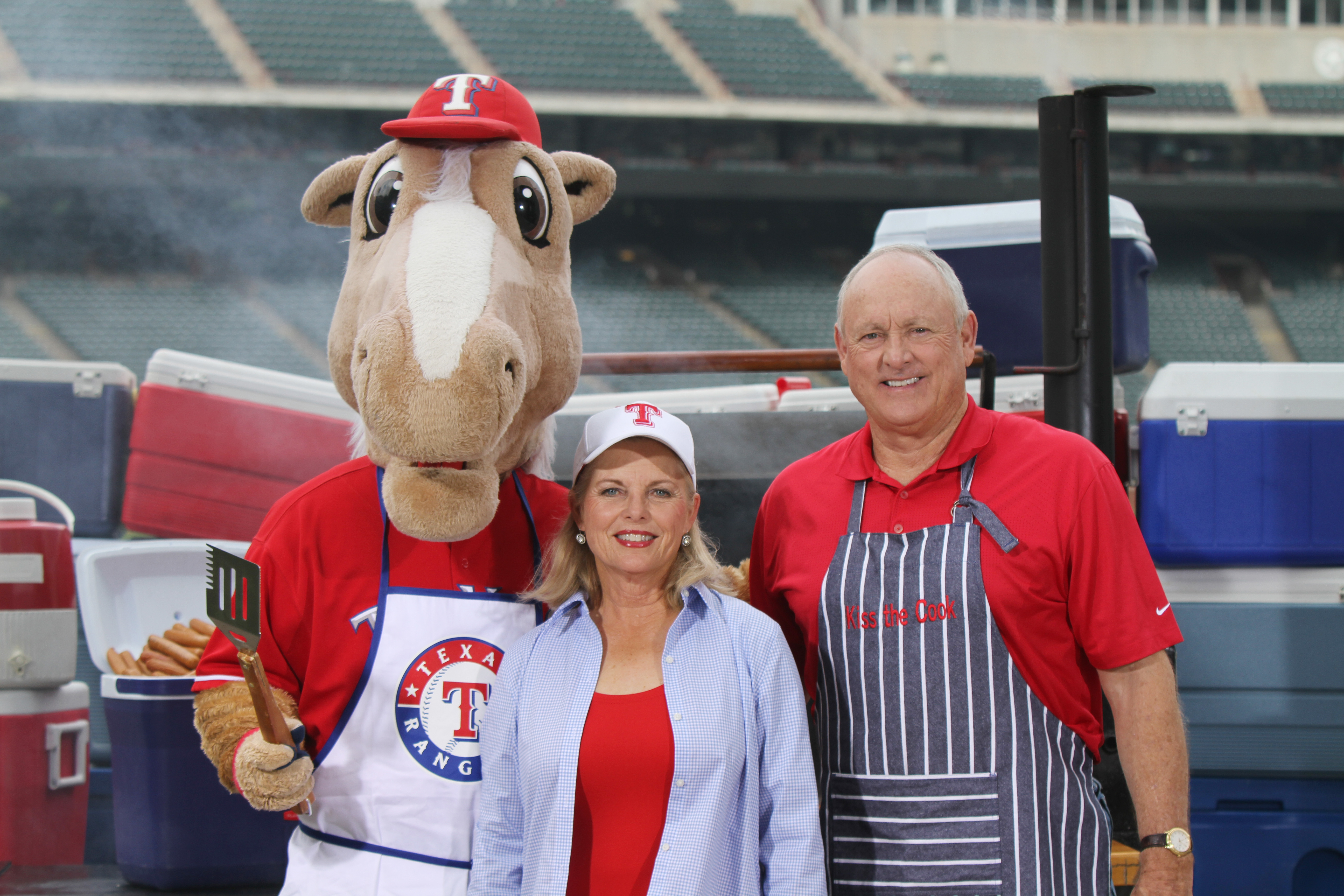
apparently some Texans can take it too far. This was one of the most fun
shoots I ever did, and not just because Nolan and Ruth Ryan are great
people (two of their granddaughters appeared in the commercial,
too). Ballpark chef Cris Vazquez hauled out a humungous quantity of hot
dogs and an enormous grill that morning and started cooking. We grabbed
every cooler in the ballpark to ostensibly be full of hot dogs and the
crew brought some ice chests from home, too. If you don’t watch the Spanish-language version,
too, you do yourself a disservice. We knew Nolan would be reluctant to
speak a phrase in Spanish, so we recruited his former teammate Jose
Guzman to help. The scheme was that Jose was going to say the Spanish
line, but we plotted all along to try to get Nolan to say it. So we cut a
take where Jose said the line, then I asked Nolan if we could try one
more thing. Nolan guardedly agreed, and Jose, with help from team
videographer Hugo Carbajal, coached him in what is, as far as I know,
the Hall of Famer’s only appearance ever speaking in Spanish on camera. photo credit: Alan H. Rose/Texas Rangers
This spot got a lot of discussion on the Ticket radio station, too,
thanks to a shot Carbajal added in the edit of a well-inked lady eating a
hot dog. Nolan’s image as the quintessential Texan helped the My Texas, My
Rangers campaign a lot. We referenced him in the copy (it was ostensibly
his idea to put in the pecan tree and, in another spot I didn’t mention
above because it’s unfortunately not available to view online, an oil
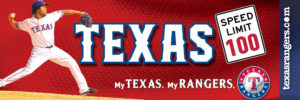
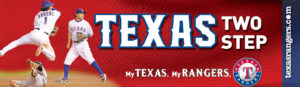
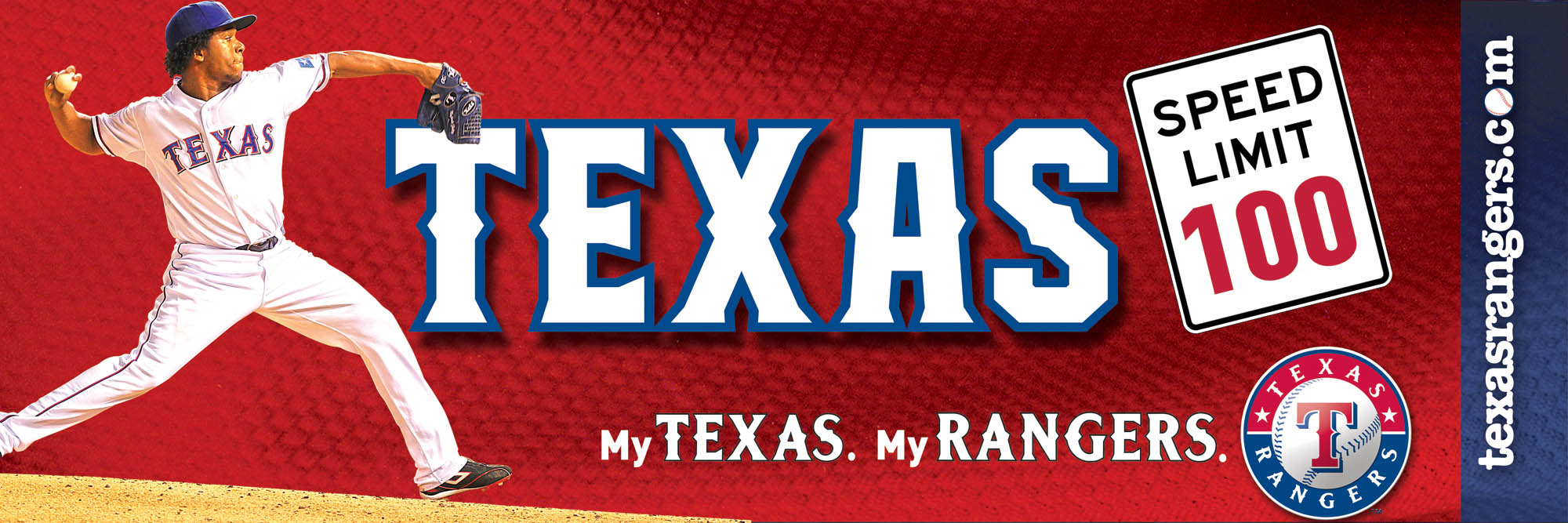
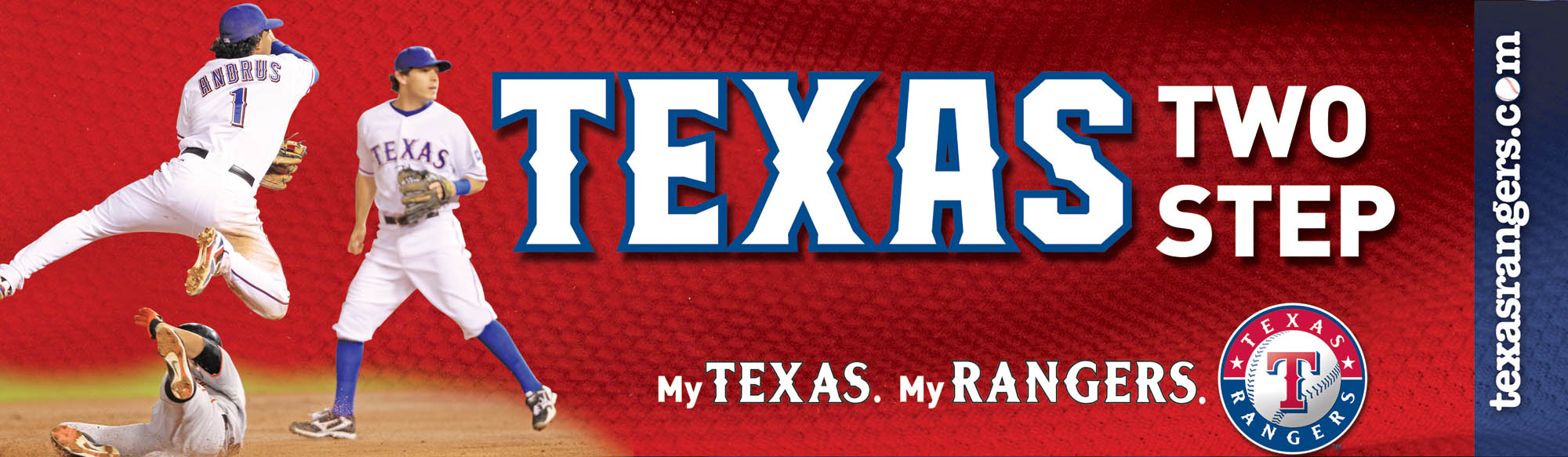
well along the right field wall). We created other media besides television. Billboards offered
baseball variations on state themes, like its country-and-western
dancing and miles of open road. design by: Rainer Uhlir/Texas Rangersdesign by: Rainer Uhlir/Texas Rangers
We had radio, too. Can Texans sometimes exaggerate? We decided Texas
Tall Tales was a worthwhile theme, so Eric Nadel voiced a series of
spots positing Texas ties to certain team-related items. For instance,
did you know the word Tejas means “he who hits with the strength of a
bear?” Or that the dye in the Rangers’ blue uniforms is made from
organic bluebonnets? Or that Nolan Ryan gives the Rangers employee of
the year a heifer from his personal herd? Of course, those are all made
up, but Eric would go on to emphasize that it was not a Texas Tall Tale
that the Rangers did, in fact, embody many of the good qualities of the
Lone Star State. You can check out some samples of the radio campaign here. We also didn’t want to turn off non-Texans, so we did some radio and
TV themed as “Welcome to Texas,” that suggested you didn’t have to be
from the state of Texas to cheer for the team named “Texas.” And when
the pennant race heated up, we did some new spots that hit on Texas pride in retaining the American League title (which that 2011 team did). When one thinks of the Texas Rangers, one inescapably thinks of the
state – heck, it’s the team’s first name. In the latter part of the
first decade of the 2000s, the team made that connection a little more
explicit. Tom Grieve noticed.
The man would exude sex appeal if he didn’t weigh 300+ squishy pounds and prance around in no shirt.
He’s a professional athlete who goes by the name “Super Porky,” and he’s really good at his job.
A recent trip to Texas’ southern neighbor provided a couple of sports experiences I felt compelled to share. Sports are an important part of every nation’s culture, so when I travel, I like to explore ballgames along with food, museums, and serpentine passport control queues. This time, my native hosts assured me that watching the performance of the large man in the tight pants and his cohorts represented a thoroughly Mexican experience. Super Porky, aka Brazo de Plata, is an icon in the world of Lucha Libre professional wrestling.
I won’t pretend to understand all the nuances, so I’ll just offer a few entertaining details and the recommendation that if you find yourself in the México D.F., consider a trip to Viernes Espectaculares at the Arena México. It is pure entertainment.
What it’s not, technically speaking, is sport. Like U.S. pro wrestling, it’s a pre-planned performance under a sporting veneer. However, that doesn’t mean you won’t see a lot of athletic ability on display. Some of these men and women show amazing acrobatic talent, diving and flipping through and out of the ring with impressive precision and serious hops. Even Super Porky could balance himself on one of the ropes using only his belly (something I can’t seem to unsee).
The show’s producers at CMLL appear to understand the concept of brand consistency. If you’re going to do something, do it all the way, every time, and don’t stray from your core message. That message is “over-the-top” and they do it well enough to have generated consistent crowds for decades. I’d peg a lot of the fans as hardcore attendees, judging by the number wearing masks and branded shirts. They participated noisily when goaded by performers. We sat near some aficionados with horns and drums who reveled in receiving acknowledgment from wrestlers whose names they periodically chanted.
Multiple video screens and lights pump up the energy level within the nearly 60-year old arena. Full-volume music choices included ZZ Top’s LaGrange and plenty of selections I didn’t recognize. Stands outside the arena sell souvenirs. I got my 8-year old niece a pink mask.
Inside, you can buy soup or nachos from an in-seat vendor. That’s not a misprint where I meant to type “super nachos.” The lady’s tray contained instant soup plus chips/cheese that looked just like the ones you’d have bought at the old Arlington Stadium. You might also fancy tortas, bagged chips, churros, or 32-ounce Victoria beers.
In the ring, the half-dozen bouts consisted of five 3-person tag team matches and a single one-on-one affair. Six women competed in the night’s first fight, which set the tone for the evening (and tag team contests everywhere) with a plethora of blows struck from the ropes and by contestants inside the ring who weren’t supposed to be there, according to what might pass for rules.
Selectively observant referees play a big part in the evening’s proceedings. In the second bout, a point deducted for kicking turned a one-sided contest into a disputed draw. The disagreement took the form of continued fighting after the decision.
Wrestler Disturbio earned disqualification after “accidentally” hitting the referee while crushing his opponent. The official raised the victor’s hand as the latter lay incapacitated on the canvas.
Super Porky, who had a brief WWE stint stateside a few years ago, entered doing stripper poses. He ended his team’s bout when he pinned an adversary by sitting on the poor guy. Earlier, he had rubbed that rearmost part of his anatomy in the face of a competitor who had no doubt drawn the short straw backstage.
The last couple bouts included more great characters. Bárbaro Cavernario was a shaggy caveman who would have looked at home in a Geico commercial. Marco Corleone provided eye candy for the ladies with occasional ab flexes in his tight red trunks. He absorbed every blow directed at him without flinching until, of course, he didn’t and got thrown from the ring. A red-bodysuited wrestler kicked his teammate after a disagreement over who would fight.
The last bout also included an unmasking, which is apparently considered a great dishonor for the de-masked wrestler. At one point an Australian (maybe) in a mask had interrupted a previous bout and stomped on a sombrero. He was challenged to a “mask vs. hair” bout, but declined the challenge. In such a bout, the loser would have either been unmasked or had his head shaved, depending on how he normally presented himself. Hopefully we’ll get to see that drama next time.
One test the show fails is that of political correctness, which I justified overlooking by ascribing it to cultural differences. Two little people in costume accompanied wrestlers to the ring. One of the little persons ended up getting dragged into the ring and flung around a bit in retaliation for unknown offenses. An effeminate man with a pink ribbon in his hair reveled in getting spanked (literally) by his opponent. He came on to one of the other wrestlers, forcing the latter to apologize to the jealous female teammate who was apparently his significant other. And, of course, the male wrestlers entered the arena surrounded by scantily clad females.
If you’d like to learn more about the bout I saw, CMLL posts results and photos on its official website. If you find yourself in México City and want to get tickets to see wrestling at the Arena México or a few other venues, Ticketmaster can hook you up. The dollar is strong right now against the peso, so it might be a great time for you to pick your favorite Técnico (hero) or Rudo (villain) and mask up.
Rush Olson has spent two decades directing creative efforts for sports teams and broadcasters. He currently creates ad campaigns and related creative projects for sports entities through his company, Rush Olson Creative & Sports.
We can
tell that people like lists because we see them all over LinkedIn, the
blogosphere, late-night television, and every marketing website ever created.
When I was a kid, I had a roll of “Book of Sports Lists” toilet paper. I owned
the book, too, incidentally.
Reason #2) Organization
A list
must stay at least somewhat organized, by its very nature. Paragraphs can
ramble. Sentences can run on. With a list, the author had to at least consider
in what order he or she would make his or her points.
Reason #3) Reason #4
Even if reason
#3 is terrible (as this one is), It’s only one point of several. You can easily
move on to the next one.
Reason #4) Minimum knowledge
If a
person writes an article, you can’t be sure they know a darn thing until you’ve
read a bit of it. A 12-item list, though, implies the creator certainly knows a
minimum of a dozen things about the topic (in this case, lists).
Reason #5) The Count
We
Americans all watched Sesame Street. The show's mathematically inclined vampire
taught us to love counting things. Admit it, you can hear Count Von Count’s
Transylvanian accent in your head whenever you read a list, saying “Five! Five
Reasons to Include Yik Yak in Your Content Marketing Mix!Hahahahaha!”
Reason #6) The Cute Photo
Reason
number 6 includes a picture of an adorable child wearing a shirt advertising
one of my projects.Generally speaking,
at least one entry per list has some image, animated gif, or infographic
embedded in it. Look! Pretty colors!
This young film enthusiast has I Am Douglass on her list of must-see movies
Reason #7) It’s Finite
When you
read an article, it can drag. You find yourself scrolling down to see if you
have a chance of making it to the end of the prose before your children are
grown. Even with a stupid list like this one, you at least know it will come to
an end once it has reached its appointed number. Listmakers seem to have a
really good track record for honesty. If they say their list will have ten
reasons, you can feel pretty darn certain it won’t have eleven, or twenty-six,
or a hundred-forty-seven. When it’s over, it’s over. As this list thankfully
is.
Rush Olson has spent two decades
directing creative efforts for sports teams and broadcasters. He currently
creates ad campaigns and related creative projects for sports entities through
his company, Rush Olson Creative & Sports.
In some
shocking news from Melbourne this morning, authorities disclosed that Andy
Murray was under investigation for tampering with the tennis balls used in his
Australian Open semi-final. Seeking to negate Thomas Berdych’s power, Murray
apparently surreptitiously replaced the regular lively Wilson-supplied balls
with dead practice balls. (1)
The
report comes on the heels of a similar scandal in another major sport. In an
effort to slow down the high-scoring Golden State Warriors, Spurs coach Gregg
Popovich supposedly snuck in partially deflated basketballs for the teams’ most
recent meeting in San Antonio. As Popovich rested some of his tricenarian
stars, the coach reportedly felt balls capable of bouncing only to the
Warriors’ kneecaps would help his D-Leaguers compete. The ploy did not succeed
to the degree Popovich may have hoped, as Golden State prevailed 23-21 in
overtime. (2)
After the
Detroit Red Wings' use of a germanium-powered syringe to hollow out pucks, the
Yankees de-cored baseball incident, and the North Korean badminton team's
lighter-than-air shuttlecock fiasco, the sports world has now lost complete
trust in the integrity of its spheroids, cylinders, and those rocks with the
handle on top.
So why
did I just make up all of the preceding malarkey? Because it occurred to me
just how difficult it is to futz with the balls in any professional sport
besides American Football. In pretty much every other pro sport, some neutral
official selects and monitors the game balls to a greater degree than football.
Baseball umpires even rub them with mud. Home field may confer many advantages,
but the ball won’t be one of them.
In pro
football, however, the team selects the balls, breaks them in during the week,
and supplies them for their team’s offense to use during the game.
Theoretically, this practice should improve offensive performance, since
players should perform better using a ball with which they have a comfort
level. The officials do check the balls, but the New England Patriots have allegedly
found a way to circumvent the inspection.(3)
So how to
deal with the problem (if, in fact, the Patriots are guilty, which is not
certain(4))? Several solutions present themselves :
·Make the Pats forfeit their next
game if they are guilty. Unfortunately, a bunch of people planned parties
around said game and Katy Perry probably moved tour dates to be there, so you
may have to do something else.
·You could punish the offending
team and its personnel by taking away a first-round draft pick and fining them
$750,000. That’s a pretty stiff penalty that would almost certainly serve as a
deterrent to cheating, as it did the last time the NFL imposed it, on the 2007
New Engl . . . oh, never mind.
·Another deterrent : let the
opposition choose the footballs the Patriots use next season. At least a
chocolate football would taste good.(5)
·Use only Nerf footballs.
·Have the league supply all the
balls and the quarterbacks and receivers will tough it out. The only drawback :
paying for an extra bag of checked luggage when the officials fly the balls to
the game. Non-profits like the NFL can find it tough to pull extra petty cash
for such an unbudgeted item.
·Get rid of the rule altogether.
Play with the ball however you want it. If a team thinks it can gain a
competitive advantage by pounding it flat as a frisbee, do it. If your
receivers can’t catch anyway, freeze it solid and avoid interceptions.
Of
course, other sports do have plenty of cheaters. It’s just tough for them to do
it through the ball itself (with Baseball Hall-of-Famer Gaylord Perry a notable
exception). The best solution to all of those problems comes through
sportsmanship. Teach children cheating is wrong and they won’t grow up to
believe it’s okay to win through violating the rules.
The
latter solution faces exceedingly long odds against succeeding, and that proposition
is what’s truly deflating.
Rush Olson has spent two decades
directing creative efforts for sports teams and broadcasters. He currently
creates ad campaigns and related creative projects for sports entities through
his company, Rush Olson Creative & Sports.
RushOlson.com
Linkedin.com/company/rush-olson-creative-&-sports
Facebook.com/RushOlsonCreativeandSports
Footnotes
(1) Made-up story – no footnote
(2) IBID.
(3) Jeff Pini, “A Lot of Hot Air?
Here Are The Facts About Deflategate,” boston.com. http://www.boston.com/sports/football/patriots/2015/01/31/lot-hot-air-here-are-the-facts-about-deflategate/Ae6bx4CTvqk5rj3kgSvDCK/story.html(Accessed February 1, 2015)
(4) Ian Rapoport “More details on the
investigation of Patriots' deflated footballs,” NFL.com. http://www.nfl.com/news/story/0ap3000000466783/article/more-details-on-the-investigation-of-patriots-deflated-footballs
(accessed February 1, 2015)
(5) “Chocolate Football,” Phillips Chocolates.
http://www.phillipschocolate.com/prodinfo.asp?number=CHFB
(Accessed February 1, 2015)