Showing posts with label elite. Show all posts

Wednesday, August 10, 2016

Of Tex and Texas

This post originally appeared at the Fort Worth Weekly's website. To view it there : http://www.fwweekly.com/2016/08/10/sports-rush-of-tex-and-texas/


The Yankees announced last week that the last reason a Rangers fan might reasonably have to cheer for them to win a ballgame will go away at the end of the season.

Or at least that’s the way it is for me. I supposed, technically, a Texan might need to pull for the Yankees to defeat a wild card rival this September. And if that uncomfortable circumstance does occur, I’ll hope the Bombers do win and all the runs score due to Mark Teixeira’s first career four-home run game.


Tex declared last week he would end a 14-year Major League career at season’s end. He has been gone from the Rangers since the mid-2007 trade that many fans likely consider his most lasting legacy with the club. Indeed, the deal Atlanta made for the talented infielder placed contributors Elvis Andrus, Matt Harrison, and Neftali Feliz on two Texas World Series teams.  Feliz’s 2010 ALCS strikeout of another newly retired Ranger-turned-Yankee, Alex Rodriguez, arguably ranks as the best moment in franchise history. An injury-hampered Teixeira went hitless in four games that series. But his contributions to Texas go beyond the indirect ones he made to the franchise’s only World Series berths. He did a lot more.

Doug Melvin drafted the Georgia Tech junior with 2001’s fifth overall pick. Teixeira got to the big leagues by 2003. In 2004, he combined with Michael Young, Hank Blalock, and Alfonso Soriano in a formidable young infield. That club gave Texas fans plenty of thrills as they unexpectedly stayed in the race all year before falling just short of the postseason. We remember Michael Young having switched positions to accommodate Soriano’s arrival, but do you recall Teixeira moving to first base the previous year because of Blalock’s presence at third? Teixeira would go on to earn five Gold Gloves at his new position. Tex led the team in OPS in ’04 (a robust .929) and became only the second Ranger (at the time) to hit for the cycle.

In 2005, he led the league in total bases and drove in two runs in his first All-Star Game. He also took home both the Gold Glove and Silver Slugger Awards. The batsman continued to put up big numbers for the Rangers until, in July of 2007, the club traded the then-Scott Boras client. He probably left a couple years shy of consideration for the Rangers Hall of Fame, but you saw him play a lot of superb baseball at The Ballpark in Arlington / Ameriquest Field in Arlington / Rangers Ballpark in Arlington (he lasted through three different stadium names).


He had a legacy beyond the field, as well. In a duet with pitcher Rosman Garcia, Tex sang the first rookie song at the inaugural Park Place Dealerships Triple Play game show night. His singing set the tone (in a nearly-on-pitch sort of way) for all those who followed. When Rafael Palmeiro departed after 2003, he embraced the event as its player spokesperson and helped build it into what has become a substantial fundraiser for the worthwhile programs of the Texas Rangers Baseball Foundation. He did a lot with the team’s foundation, and he and his wife Leigh started their own, as well.

Teixeira was intelligent and had a head for business, but he also had a sense of humor and didn’t mind cutting up on camera. One year, he even came up with the idea for a TV spot and didn’t mind putting on fake tattoos to execute it. Making the commercials was my job and I certainly enjoyed working with him on set.

When you’re fan of a team, you develop an affection for its players, and you often retain it even after they stop wearing the home colors. When you’re employed by a club, and work with players, as was the case for me during Tex’s Ranger years, it magnifies the experience. So when a guy you like goes to another club, it’s hard to stop hoping he does well – even if his eventual destination is the team you’ve been conditioned to find most distasteful. That’s happened to me a lot, with guys like Mike Napoli, Carl Everett, Ian Kinsler, David Murphy, and, for sure, Mark Teixeira. There’s a lot to like about him, and hopefully his life’s next chapter produces as many good things as his Rangers years did.


Rush Olson has spent two decades directing creative efforts for sports teams and broadcasters. He currently creates ad campaigns, television programs, and related creative projects for sports entities through Rush Olson Creative & Sports and FourNine Productions.


RushOlson.com

Linkedin.com/company/rush-olson-creative-&-sports

Facebook.com/RushOlsonCreativeandSports


Thursday, October 29, 2015

It Takes An Ironox

This post originally appeared on the Blotch page at the Fort Worth Weekly. To read it on their site : http://www.fwweekly.com/2015/10/27/it-takes-an-ironox/

Pruett main 
Can one consider a person who describes himself as “just your middle of the pack in every sport” an “elite athlete?” 
 
How about if he’s 49 years old and stocky enough to earn a nickname like “Ironox?”
How about if he completes a feat that even the pro athletes in his sport don’t try, one that most of us can’t even fathom attempting?

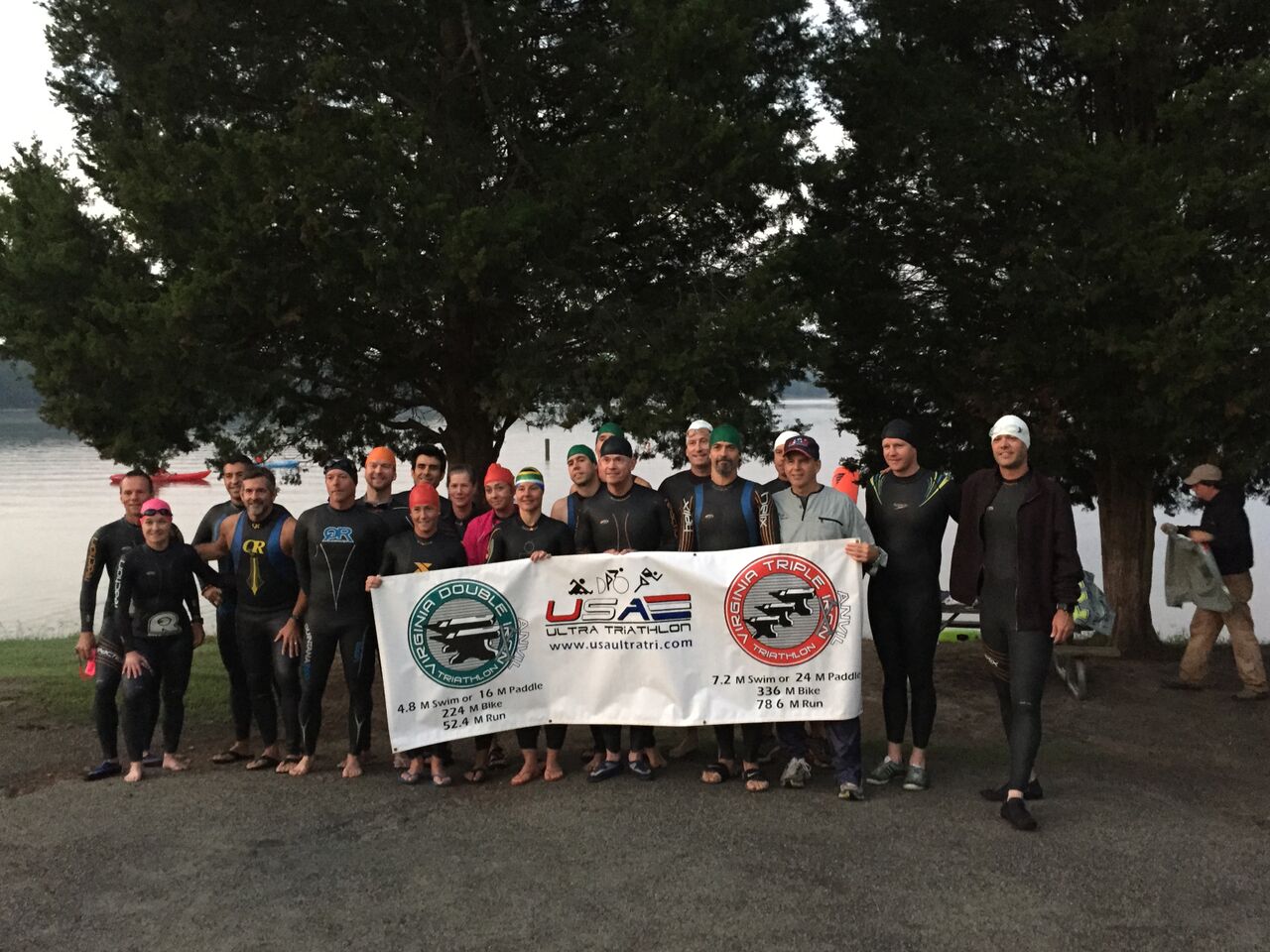
“I always cycled, but I was never a star athlete,” declared Burleson’s William Pruett. Earlier this month, though, he accomplished an athletic task only a handful of people in the world will even attempt. Pruett finished a triple iron distance triathlon.


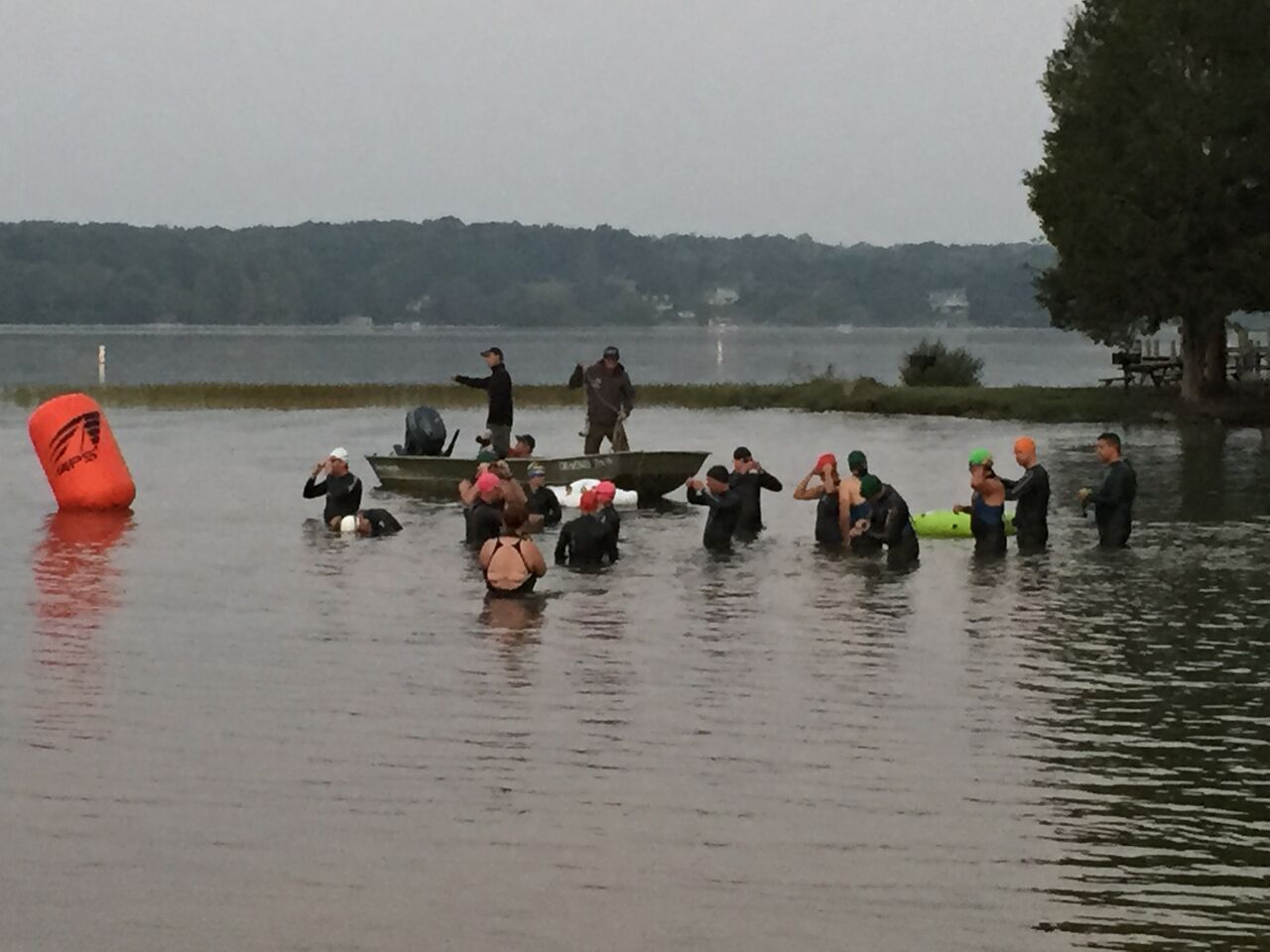
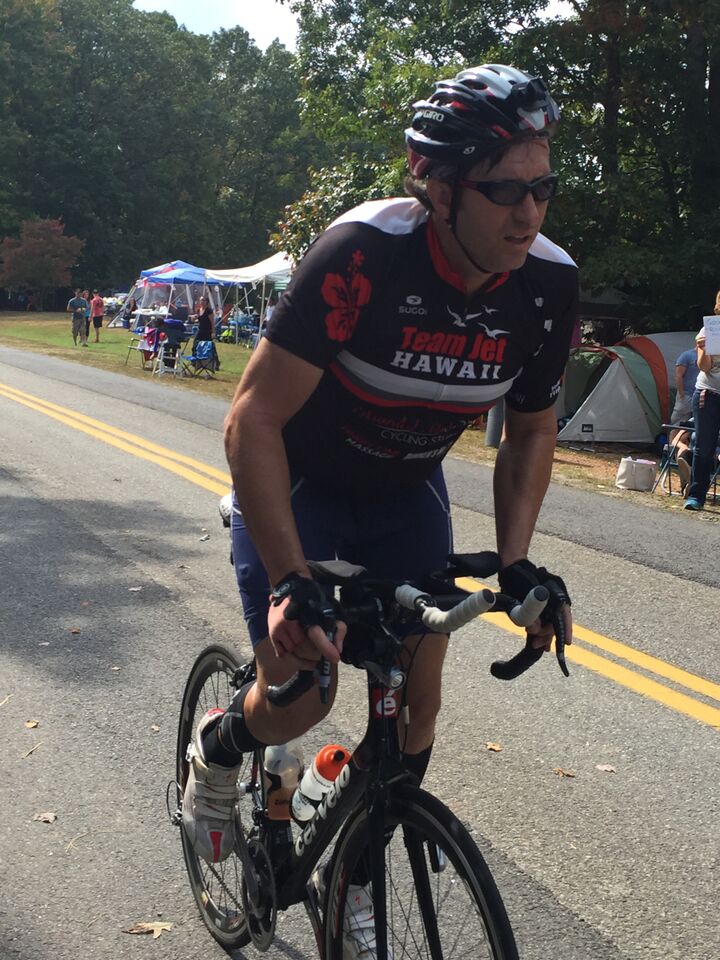
Pruett first swam 7.2 miles in a chilly lake, then rode his bicycle for 336 miles (roughly the distance from Burleson to Odessa, Texas).


“You can’t ride too fast because you know you’re going to have to run three marathons,” he says matter-of-factly.

The finishing run covers 78.6 miles. For his or her time to officially count, a competitor has to complete all three events in 60 hours or less. Pruett finished in 59:51:52.

Ironox’s successful result came in his second attempt at the triple. In 2014, at the same course in Lake Anna State Park near Spotsylvania, Virginia, he sustained a severe ankle sprain at mile six of the run. He pressed on for 25 more miles before succumbing to the injury.

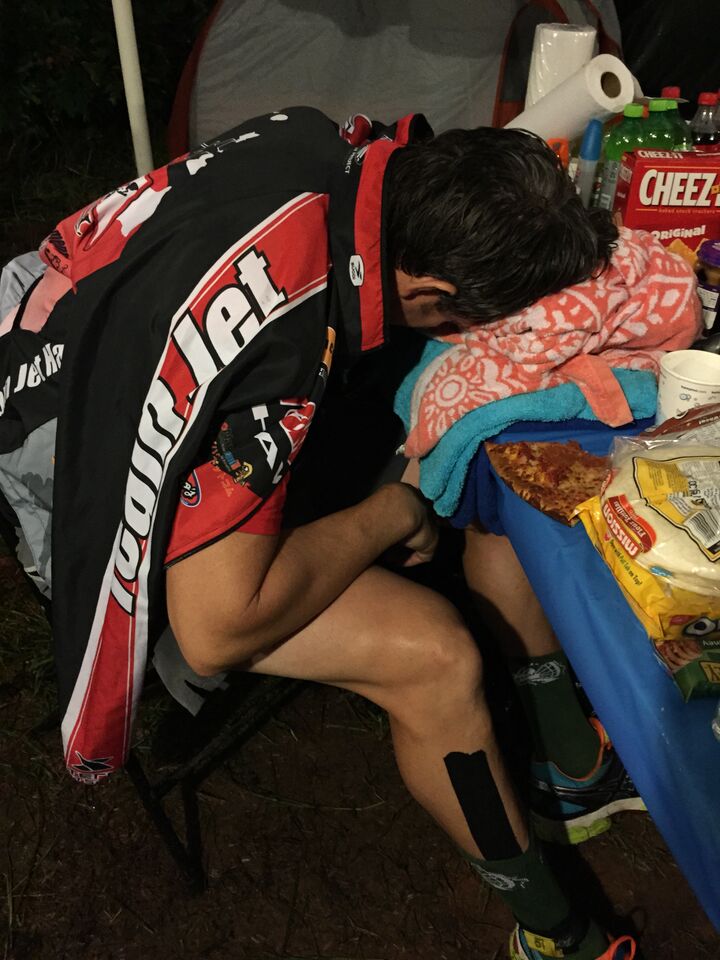
Ultra triathletes expect to encounter pain during the event, especially as the hours mount and take their toll on even well-conditioned bodies.

“On the bike you have saddle sores, achy knees, and achy feet from riding so long,” noted Pruett. “Some people have upper extremities issues because you’ve been gripping the handlebars for such a long period of time.”

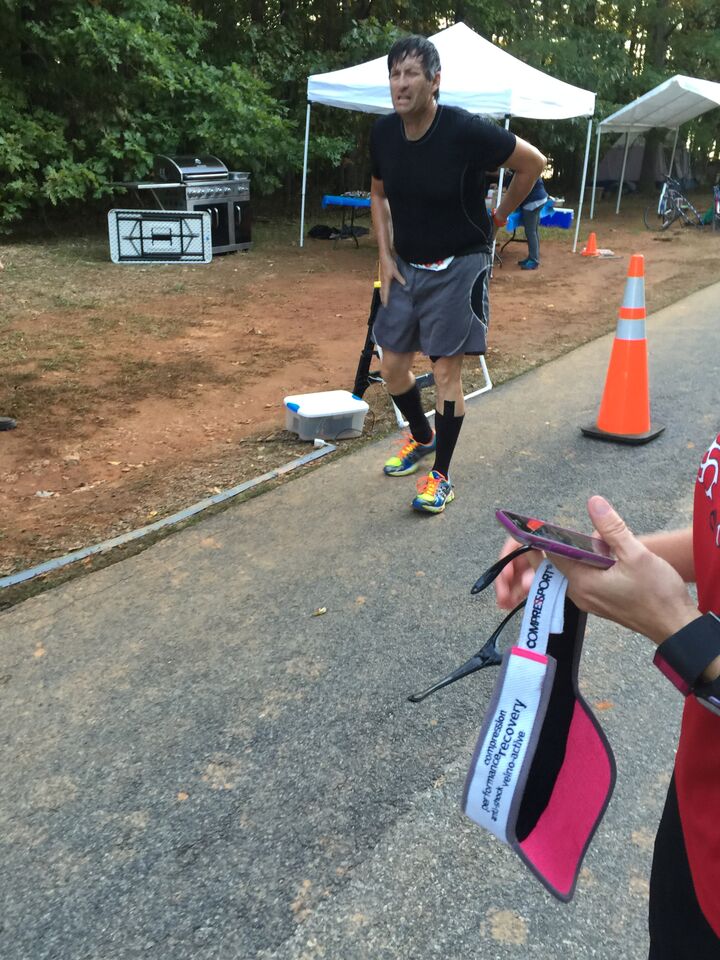
In 2015, Pruett’s main injury troubles again came during the running portion. They threatened to derail his effort, 40+ hours in.

“My feet started to blister after the first marathon. I think I was around mile 30 or so when they started getting bad.”

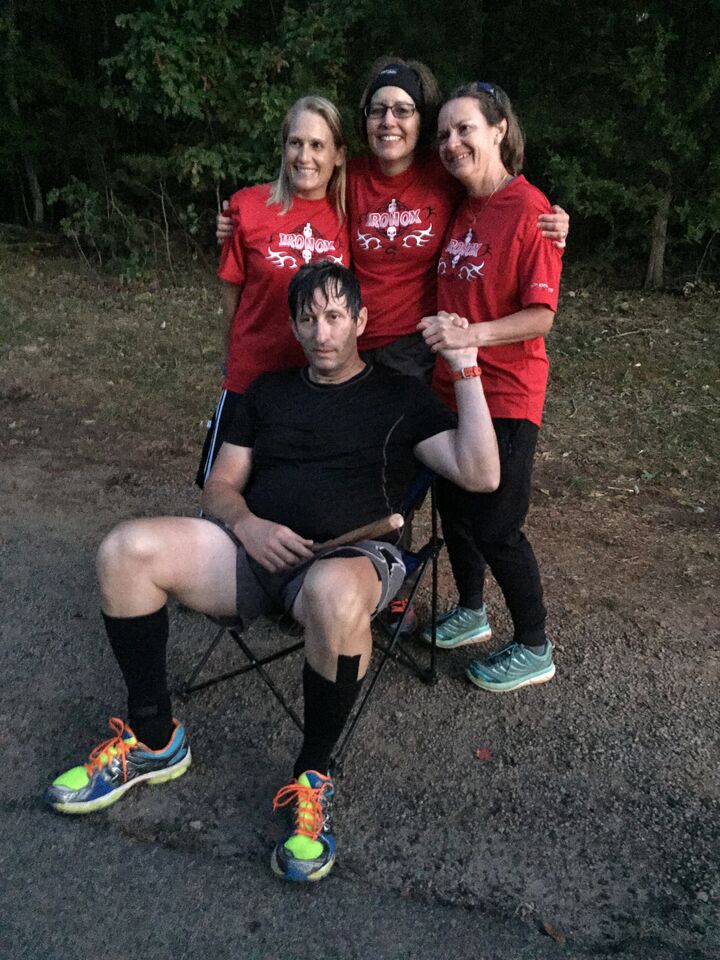
There wasn’t much the race doctor could do for him, so Pruett’s crew wrapped his painful soles in tape, moleskin, and everything else they had to try to keep him on his feet (next time, he vows to bring even more blister-prevention supplies). Long distance racers need a crew to help them make it through their two-and-a-half day ordeal. Pruett’s seasoned support staff included his wife, Donna, a veteran of Pruett’s regular endurance race forays, and experienced triathletes Nancy Henley and Sara Parker Underwood. They made sure Pruett ingested enough performance gels and protein-rich foods to supply the caloric intake the team had predetermined he needed to maintain his energy levels. They also monitored the roughly three total hours of sleep he would get during the race and kept him hydrated.


With only ten miles to go, the crew had to help William find more assistance.

“My back locked up on the run because my lower back was so fatigued,” explained Pruett.


A massage therapist loosened it a little bit, but Pruett didn’t have time for extensive treatment.

“While she was working on my back, the clock was still ticking. I had to cross the timing mat by 6:40 Saturday evening. So we had to really push it.”

Push it he did, as best he could from a hunched position.

“It was still pretty much locked, so I had to bend over at a thirty degree angle to walk/run. The last six miles became very crucial that I couldn’t stop for anything.

Once started, the race clock doesn’t stop for rain, bathroom breaks, or a note from one’s doctor. Pruett trudged, as he put it, to the finish just in time. He actually thought he was under more time pressure than he was.

“My crew didn’t tell that I had banked an extra nine minutes that I’d didn’t realize I had,” he explained.

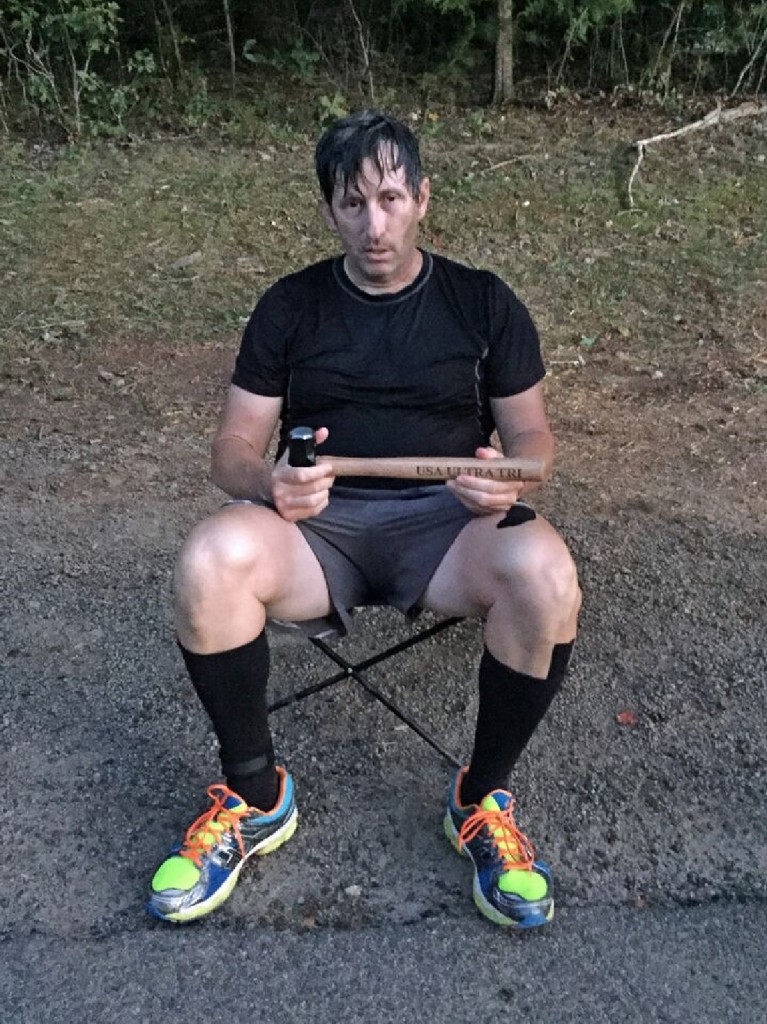
After he got done, the Ironox got to use a hammer to pound three times on the anvil that symbolizes the competition known as the Triple ANVIL. He then spent most of the rest of the evening eating and sleeping.

Once he returned to Texas, his recovery continued.

“Besides consuming tons of calories, I did cryo therapy, massage, and elevating the feet. Catching up on the sleep was the most difficult.”

“It didn’t dawn on me until two days later that I finished. You’re just trying to recover for two days and then it dawns on you that I just accomplished a goal through this fifty nine hours of exercise.”


Pruett’s doctors think he’s nuts.

“They don’t discourage it because they know you’re going to do it anyway,” Pruett said.

Some readers may agree with the physicians. So why does Pruett, who has completed multiple iron distance (2.4-mile swim, 112-mile bicycle ride and 26.2-mile run) triathlons and a double ANVIL, put his body through the rigors his sport demands? For William Pruett, it is, believe it or not, fun.

“The fun part is the journey, the training,” he said. “You have this set goal and it is a mark that is a little beyond your limitation. A goal within your limitation, what fun is that?"

Accomplishing the goal in an environment in which he competes against other contestants and a clock makes the goal even sexier for him.

“My motivation is that you have this certified course with chip timing and you’re monitored with swim, bike, and run. You’re testing yourself against a true measure. Instead of just going out on your own and saying I did this one day, you’re actually measured by these outside forces and referees. If you’re not under 60 hours, you’re not an official finisher. That’s the motivation.”

When Pruett isn’t training, racing, or working at Fort Worth Cycling & Fitness or helping manage a local medical practice, he trains other aspiring racers through his company, CorioVelo. He hopes his experiences completing a triple contribute to making him an elite coach.

“By experiencing this event as an athlete, now I can relate to other athletes when they do iron distance or ultra because I know the same exact feelings they’re going through,” he said.

To deal with the inevitable feelings of anguish, Pruett considers mental training vital.

“Once the mental goes, the physical goes. If you can keep on top of the mental, it helps your physical,” he explained. “For dealing with the pain, I had to do a lot of mental training. I read a lot of positive motivation books. Learning to control the mind in the downtime by changing your thought pattern. Instead of negative thoughts, changing thought patterns to positive thoughts during the event – reading, praying, just any mental activity.”

The physical part is more than swimming, riding, and running a lot, too.


“I trained for sleep deprivation by practicing ten to twelve-minute naps,” he said about one of the crucial aspects of surviving ultra distance races. “Research shows that anything over fifteen minutes, you start to get into REM (rapid eye movement sleep). You don’t want an athlete to get into REM during an event because it becomes harder to wake up.”

Pruett has coached a pair of double iron distance finishers, and numerous other committed amateur athletes. His customers tend to be folks a lot like him.


“Anybody can do triathlon,” he said. “You don’t have to be the skinny jackrabbit.”

If Pruett counts himself closer to the tortoise than the hare, his steady approach seems to be working. He’s already on track for another single iron distance race in November and might try the Quintuple ANVIL next year.

“If you never get out and test yourself, you never know your limit,” he said.

When it comes to testing limits, William Pruett is truly elite.


Disclosure : Pruett’s company, CorioVelo, paid me to produce a promotional video earlier this year. He also gave me a hat and a hoodie, both of which I have worn in public and thought they looked pretty stylin’.


Rush Olson has spent two decades directing creative efforts for sports teams and broadcasters. He currently creates ad campaigns and related creative projects for sports entities through his company, Rush Olson Creative & Sports.


RushOlson.com

Linkedin.com/company/rush-olson-creative-&-sports

Facebook.com/RushOlsonCreativeandSports