Showing posts with label NCAA. Show all posts

Thursday, April 5, 2018

Final Four Stories From Sam Perkins, Sidney Moncrief, and Michael Young

This post originally appeared in the Blotch section of the Fort Worth Weekly's website. To consume it there : https://www.fwweekly.com/2018/04/04/sports-rush-stories-make-a-final-four-memorable/


The NCAA Basketball tournaments finished Monday: What will be their memorable Final Four storylines? The men’s side didn’t have closely contested games, but it did feature a compelling underdog in Loyola of Chicago and some outstanding players. The women’s side had no underdogs, as all four number seeds advanced from regional play. They made up for it with three dramatic finishes, included two semifinals decided in overtime and Notre Dame’s championship-winning buzzer beater Sunday night.
There will be a lot to remember from the weekend – stories that will stick in the minds of those who watched them unfold. Thursday, I got the chance to sit down with three men who had participated in six Final Fours between them, ones that have proven to have had lasting impacts. With this weekend’s stories from Columbus and San Antonio fresh in our minds, I thought I’d share some of the stories from the prequel I emceed in Dallas.
The event was billed as “Sidney, Sam & The Final Four,” and benefitted the charity programs of the National Basketball Retired Players Association’s local chapter. In addition to Sidney Moncrief and Sam Perkins, we added a special guest from the Houston chapter: Michael Young of Phi Slama Jama fame.
Perkins played in two Final Fours at the University of North Carolina. They lost to Isiah Thomas and Indiana his first season, but defeated Patrick Ewing and Georgetown in 1982 to win the title his sophomore year.
Moncrief teamed with Ron Brewer and Marvin Delph in the 1970s – they later became known as the Triplets – to get the University of Arkansas into the NCAA tournament for the first time since 1958. In Moncrief’s junior year, the Razorbacks went to the Final Four, something the team had not done since 1945, when only eight teams made the tournament.
Young went to three consecutive Final Fours with the University of Houston, teaming with the likes of Hakeem Olajuwon, Clyde Drexler, and Larry Micheaux to get to two championship games, including the 1983 game they lost to Jim Valvano’s North Carolina State team on a late Lorenzo Charles putback.
It’s always interesting to see what sticks out for participants years later. I led into the subject with Sam Perkins via an idea my father had broached when we were discussing the event. Dr. Olson wanted to know if Perkins remembered where he was standing when his teammate, a freshman named Michael Jordan, hit the jumper that ultimately proved a game-winner. It turns out Perkins wasn’t standing at all.
“I was on the court, so I wasn’t standing,” he said. “The shot goes up, you go to the boards, so I had somehow slipped in and tried to get the offensive rebound, but, of course, it went in.”
Young’s team lost to that UNC title team in the semis, then got back to the Final Four despite losing their leading scorer, Rob Williams, to the NBA. The sharpshooter remembered offseason preparation being key to his squad’s success.
“Once that year was over, we had a great summer together. Moses Malone took the team under his wing and we used to play down at a place called Fonde (Recreation Center). We would scrimmage against the guys from the Rockets every day, so every day was like a game situation . So that really prepared us for the next year coming up.”
At that point, one of the NBRPA members interrupted Young. Major Jones had played for the Rockets at the time and no doubt took part in some of those pickup games. Jones asked with a smile if playing those games was legal (it probably was). Legal or not, it would have been quite a scene to have been in the gym to watch Jones and company school (or sometimes be schooled by) the future NBA players on the Cougars roster at the time.
Moncrief’s group lost to eventual national champion Kentucky in the 1978 semis, but they still had to play another game because the NCAA staged a third-place game between the losing semifinalists until 1981.
“We played Notre Dame, and back then all the teams were very physical, nothing like you see now,” Moncrief recalled. “I just remember every player being so physically imposing. Every time I would go through the lane, they would just pop me and hit me and the game came down to a last-second shot. Ron Brewer, who’s one of the best players in the history of Arkansas basketball, he gets the ball at the top of the circle, five seconds left, he just cooly backed down, jumped up, turned around, and just made a beautiful shot to win the ballgame.”
The three each played for prominent coaches who left a lasting impression on their players.
“When we found ourselves back into the Final Four, we said we want to win this one for Coach Smith,” Perkins remembered. “It meant a great deal.” At the time, Dean Smith had cached the Tar Heels to six Finals Fours but had never won a title until Perkins, Jordan, and company helped the Hall of Famer secure his first.
All three men remembered their mentors’ impacts extending beyond the court. Young played for Guy V. Lewis. “He really got you prepared for the games and all of that stuff carried over into a lifestyle and a lot of his players that left his coaching and in his teaching, in the way that he did things, a lot of us guys went on to be successful.”
Of Lewis’s physical practices, Young remembered them as “unbelievable – no fouls.” It paid off for the team, though. “That got us ready for the games,” including, apparently the one against Perkins’ team in 1982.
“Sam was out there hacking,” Young suggested. “I know you don’t remember that, buddy. He did elbow me.” Perkins claimed a hazier memory of such conduct (the record does show Perkins as having been charged with a single personal foul in the game).
Moncrief also gave his college coach, Eddie Sutton, credit for later success. “It was love and discipline and it was a set of standards, being accountable to your teammates, to the classroom, to winning, that set the tone for my career. When I got to the NBA, I was so prepared to play at the next level simply because not only basketball, but just a discipline that we acquired by playing for Coach Sutton for four years. You had to do everything right, the right way, and he was tremendous coach. Just love him to death and he is the reason why I became a very good NBA player.”
The three players’ schools were in different situations when each played there, and the Final Four runs they made meant different things to each school.
In Moncrief’s case, the Razorbacks needed something to put them on the basketball map. His teams set the stage for the growth of the program.
“The key to having a good college  program is recruiting. You win with players and I think once we started playing well, people wanted to be a part of the universe of Arkansas, so we got the best players in the state of Arkansas and we started getting some good players from outside of Arkansas and they created an environment that people wanted to be a part of.”
Young cited Phi Slama Jama’s style of play as one that not only inspired its nickname, but also helped the Cougars bring in the players they needed.
“We got up and down the court and we would have bets as players who would have the most dunks,” he recalled. “The other kids that the coaches were recruiting, they really liked that.”
Houston’s program had enjoyed success prior to Young’s time, especially the Elvin Hayes-led teams of the 1960s, but not at the level of tradition-rich North Carolina. For Perkins, the Final Four runs embodied the approach of the coach who had built the program around the important things.  “I think the NBA looked at that as you being prepared being fundamentally prepared to to play the game.” One can be sure that if a program does things that influence the NBA to consider players as draftable, that’s a powerful recruiting tool, too. The Tar Heels have played in ten more Final Fours since Perkins’ heyday, and have had 58 players drafted since he was a freshman (including Perkins himself, fourth overall to the Dallas Mavericks in 1984).
We also discussed the impact of the three-pointer on basketball. It was not widespread in the college game when they played, with only Perkins having shot any threes at all during his university days, and that during a one-year experiment by the Atlantic Coast Conference. He said got a lot of those as a trailer on fast breaks, foreshadowing his future success as a pioneering stretch-four. Michael Young speculated he’d have averaged “at least ten more” points a game if his long-range swishes had counted for an extra point. Moncrief thinks it could have made all the difference for his Razorbacks.
“We would have won the NCAA tournament with a three-point shot, not because of me, but we had two of the greatest shooters. Marvin Delph and Ron Brewer could shoot the basketball as well as any players that I’ve seen on a team, so we would have no doubt been a better team with a three.”
We archived a video of the entire session online, if you want to hear Perkins and Jordan’s tales about Michael Jordan or how all three men stayed in school for four years. All the stories were superb, and I look forward to a time when we’ll hear memorable ones from the participants in this year’s tournament.

Rush Olson has spent more than two decades directing creative efforts for sports teams and broadcasters. He currently creates ad campaigns, television programs, and related creative projects for sports entities through Rush Olson Creative & Sports, Mint Farm Films, and FourNine Productions.

Thursday, January 4, 2018

Why the Bowl System Has Staying Power

This post originally appeared in the Blotch section of the Fort Worth Weekly's website. To consume it there : https://www.fwweekly.com/2018/01/03/sports-rush-college-bowl-system-is-for-geniuses/

The system that produced the Belk Bowl, the TaxSlayer Bowl, and the Cheribundi Tart Cherry Boca Raton Bowl is genius. It always has been.

College football’s postseason system dates to roughly 1902, when Michigan crushed Stanford in the first “Tournament East–West football game” in Pasadena, California (it was yet not known as the “Rose Bowl Game presented by Northwestern Mutual”). It grew from that single contest to a collection more than forty games that annually add hundreds of millions of dollars to the coffers of participating schools.

Short-term revenue isn’t what makes this system brilliant, though. Where it has truly proven itself is in the long term. The sport has gone from being four years away from Theodore Roosevelt supposedly considering banning it to arguably the most popular sport in the country (duly noting the power of the NFL). It attracts tens of thousands of people into stadia every week during the fall and reliably delivers TV ratings when few properties do anymore.
Here’s how I think the bowl system helped make college football successful: However many bowl games are staged, that many teams end their season with a postseason win. No playoff or tournament system can provide that veneer of a successful season.
Only one team wins the NCAA Basketball Tournament. A few schools get to say they’re “Final Four” or “Elite Eight” teams, but not 40-plus squads like in football. Even the ones who lose got a trip somewhere and still get to call themselves “bowl teams.” Players are happy, and so are fans and staff.
The more people who can end a season happy, the more it builds long-term success. Season tickets get renewed and the programs’ brands get a boost. Because the bar is relatively low (win 6 games, basically), even non-traditional programs can get lucky every few years and provide the alums some sustainably good memories (example: “Remember that year we made it to the R+L Carriers New Orleans Bowl? Me neither – must have been really fun!”).

I’ve always thought European professional leagues had some advantages on their U.S. counterparts in this area. If you’re an English soccer team, for instance, your team can leave you feeling good at the end of the season in several ways:
  • Win the league regular season
  • Win the Champions League
  • Win the Europa League
  • Win the FA Cup
  • Win the League Cup
  • Qualify for next season’s Champions League or Europe League
  • Win promotion from a lower league to a higher league
Because they stage knockout tournaments concurrent with their own regular seasons, it creates more chances for success for more clubs. Those teams enjoy some remarkably resilient supporter loyalty – loyalty that reminds me, frankly, of that of college football fans. Only one team gets to be happy if the mentality is “Super Bowl or Bust.”

Multiple competitions don’t work with the sport of American football because of its physical nature. But bowl games? They work and have for decades. Two things could threaten this success.
The College Football Playoff: For the moment, this has been a huge financial positive for the college football landscape. Short-term, everybody, including smaller schools, gets more TV money. The concern comes if, in the long term, the focus shifts so much to this group of four big schools that it results in less overall enthusiasm for the sport at its lower levels. That affects the audience for the entire slate of bowl games, including . . .

Television: A major part of the reason so many bowl games exist is that ESPN can operate them and use them as programming for its networks. Will they retain their value as the TV marketplace grows more fragmented? There’s a chance they will, because live sports seems to have some immunity to the viewership declines of other forms of programming, but trying to predict the future in this industry is at best a daunting challenge. ESPN has been rapidly redefining its business model, so you can be sure they’ll evaluate bowl games, too.

Whenever the powers that be do chart the future of postseason college football, one would think they’d do well to clue in to everything the likes of the IBM OS/2 Fiesta Bowl, uDrove Humanitarian Bowl, and Bacardi Bowl have done for them.

Rush Olson has spent more than two decades directing creative efforts for sports teams and broadcasters. He currently creates ad campaigns, television programs, and related creative projects for sports entities through Rush Olson Creative & Sports, Mint Farm Films, and FourNine Productions.

RushOlson.com
Linkedin.com/company/rush-olson-creative-&-sports
Facebook.com/RushOlsonCreativeandSports

Friday, April 7, 2017

Big Doings in Big D

This post originally appeared at the Fort Worth Weekly's website. To view it there : https://www.fwweekly.com/2017/04/05/a-big-deal-in-big-d/


A big deal in sports happened here over the weekend. We know this because we saw people roaming local streets wearing multiple color schemes not native to the area’s teams. We saw a clear indicator when prominent athletes from other sports, in this case Russell Wilson and Dak Prescott, attended. And we can guess at its national import because ESPN brought 25 cameras to cover it.


The event that sold out the American Airlines Center Friday and Sunday was the NCAA Women’s Final Four. Basketball teams representing Stanford, South Carolina, Mississippi State, and the University of Connecticut competed in the Division I national tournament semifinals.
Could UConn win a fifth straight title and continue a 111-game winning streak? Would the Samuelson sisters (the Cardinal’s Karlie and the Huskies’ Katie Lou) become the first siblings to oppose each other in a national title game? South Carolina prevented the latter with a win in Friday’s opening semi, and MSU stymied both, courtesy of a Morgan William overtime buzzer-beater in the nightcap.

Those results created intriguing new plotlines, including which of two Southeastern Conference schools would become the first from its conference besides Tennessee to win a title. (Current member Texas A&M was still in the Big 12 when it won in 2011.)

Pat Lowry adjusted on the fly to the changing circumstances. She served as one of two coordinating producers for ESPN’s Women’s Final Four broadcasts and had to plan how her crew would convey the weekend’s ebbs and flows. While there is no home team, she still believes the event can have an impact on its host region.

“I think you get exposed to the highest level of women’s basketball,” she said. “If you like basketball, when you see this, it’s going to open a new door for you, because you’re going to see that women’s basketball is a little different than men but equally as entertaining and competitive.”

Getting sports fans to view women’s basketball happenings as significant is an ongoing process. While the men have had a Final Four since 1939, the NCAA didn’t officially sanction women’s basketball or any other sports for female students until 1981, when about 9,500 fans watched Louisiana Tech win the first women’s NCAA title in Norfolk, Va. Since then, those involved in promoting the game have made progress in turning it into a big deal, one that can sell out NBA arenas. That the local venue should host the spectacle is appropriate and overdue, according to basketball pioneer Nancy Lieberman.

“This city deserves the Final Four,” said Lieberman, who played for the Dallas Diamonds of early women’s pro leagues in the 1980s and believes North Texas has been ahead of the curve in embracing women’s hoops. “You should be rewarded for your foresight and rewarded for giving women something before it was the chic thing to do.”

Area fans supported those Diamonds teams, though their leagues folded when other cities failed to muster the same level of patronage. The women’s pro game reappeared in North Texas last year, with the WNBA’s Dallas Wings playing in Arlington’s College Park Center. At a reception Thursday evening, NCAA Vice President of Women’s Basketball Championships, Anucha Browne, said the competition she supervises is likely to return as well.

“If we have an opportunity to bring the Women’s Final Four back to Dallas, we’re coming back, because we love what this community means to women’s basketball,” she said in front of a crowd that included Wings head coach Fred Williams and point guard Tiffani Bias. “When we decided that we would select Dallas, it was because of the history.”

The history of this particular tournament will read that South Carolina won its first-ever NCAA title in the sport of women’s basketball. For those like Browne, who believe “women in sport changes life” when it inspires young girls, the event’s legacy may be whether the area continues to support the women’s game in the manner to which it has become accustomed: like it’s a big deal.

For more of my filings from the 2017 Women’s Final Four, including video interviews with Holly Rowe of ESPN and Aerial Powers of the Dallas Wings, visit Blotch at Fwweekly.com.


Rush Olson has spent two decades directing creative efforts for sports teams and broadcasters. He currently creates ad campaigns, television programs, and related creative projects for sports entities through Rush Olson Creative & Sports and FourNine Productions.


RushOlson.com
Linkedin.com/company/rush-olson-creative-&-sports
Facebook.com/RushOlsonCreativeandSports

Thursday, March 30, 2017

Power of the FInal Four

This post originally appeared at the Fort Worth Weekly's website. To view it there :


I’ve decided I like Aerial Powers. It has nothing to do with her making the WNBA All-Rookie Team for the Dallas Wings last year, though she is certainly an entertaining player to watch play.

No, I like Ms. Powers because when we discussed my name, she compared it to the movie “Rush Hour.” I admitted to owning the film on VHS and she graciously claimed that fact did NOT make me old. With respect for her at an all-time high, this apparently well-preserved reporter proceeded with the interview you can watch in this post.


Powers, along with Wings teammate Tiffany Bias, head coach Fred Williams, assistant coach Taj McWilliams-Franklin, and members of the club’s front office, had come to Arcadia Park in Dallas to witness the dedication of a Dream CourtTM. The event was timed to coincide with the presence of the Women’s Final Four in Dallas this weekend, and the NCAA had worked with Nancy Lieberman Charities and the WorldVentures Foundation to place the court in the Oak Cliff neighborhood.

After the VIPs had done a ribbon-cutting and dedicated the new basketball court, I talked with her about the Final Four, the ceremony, and the upcoming Wings season. We did not discuss movies of (relatively) recent vintage.


Rush Olson has spent two decades directing creative efforts for sports teams and broadcasters. He currently creates ad campaigns, television programs, and related creative projects for sports entities through Rush Olson Creative & Sports and FourNine Productions.

RushOlson.com
Linkedin.com/company/rush-olson-creative-&-sports
Facebook.com/RushOlsonCreativeandSports

Tuesday, March 14, 2017

Fort Worth-Dallas - A Hotbed of Hoops?

This post originally appeared at the Fort Worth Weekly's website. To view it there : https://www.fwweekly.com/2017/03/13/sports-rush-a-hoops-hotbed/

Wow. All of a sudden, basketball is a big deal.

OK, it’s one of the world’s most popular sports, but this area has not necessarily been a college basketball nexus. Until now.

An upset of top-ranked Kansas in the Big 12 tournament, which Texas Christian pulled off Thursday should make one sit up and take notice. Have you checked out Texas-Arlington? How about Southern Methodist? There have been a lot of balls ripping nets this year. If you haven’t been paying attention, the local men’s college basketball teams have been making some noise all season. Historically so, in fact.

TCU lost to eventual champion Iowa State in the Big 12 semis. UTA won the Sun Belt regular season before falling in the tournament semi-finals. SMU won the American Athletic Conference regular season and tournament. Among the area’s Division I teams, only Denton’s University of North Texas had a subpar year, finishing 8-22.

The Frogs, Mustangs, and Mavericks will all take part in the postseason. SMU earned a number six seed in the NCAA Tournament, playing Providence or the University of Southern California on Friday afternoon in Tulsa on truTV. TCU will host Fresno State in the National Invitation Tournament at 8pm Central Wednesday. At that same time, the UTA Mavs have an NIT first-round matchup against Brigham Young in Provo, with the game televised on ESPN2.


Each team has had good seasons in the past, but one can make the case that the area has never before had so much success in the sport all at once. The NCAA and the NIT are the top two postseason tournaments in men’s college basketball, and the North Texas region has participated sporadically. In the 1950s, when UTA was still a two-year institution called Arlington State College, SMU and TCU both had some good teams, but never made it into the postseason at the same time (though there were fewer berths available in those days). The two Southwest Conference schools again posted some winning records in the 1980s, Texas Christian under coach Jim Killingsworth and Southern Methodist under the since-disgraced Dave Bliss. UTA played a game in the 1981 NIT under Bob “Snake” LeGrand. However, 1986 and 1988 were the only previous years in which as many as two local teams made the two big tourneys. In 1986, TCU was defeated by Florida in the second round of the NIT while SMU lost to BYU in the first round of the same competition. In 1988, SMU made the second round of the NCAAs before falling to Duke and UNT also lost to an ACC team, North Carolina, in the first round of the big tournament.

In 2012, UTA dropped a first-round game to Washington in the NIT while TCU made it to the second round of the third-tier College Basketball Invitational (a tournament won, incidentally, by current TCU head coach Jamie Dixon’s University of Pittsburgh team).
Never before, though, have we had three teams qualifying for end-of-season tournaments at once.

In addition to their postseason berths, all three teams have recorded wins over big-time opponents. TCU and UTA went a combined 3-0 against the University of Texas, though admittedly in a down year for the Longhorns. TCU beat Iowa State during the regular season. UTA defeated four NCAA tournament teams. SMU won 30 games, with no losses to teams not in the NCAA or NIT draws. Add to that the fact that Texas Wesleyan made the 32-team NAIA field (they play Cumberland Thursday) and it’s not hard to make the case that there has never been a better men’s college basketball season in North Texas.
So pay attention this week, and hopefully beyond, to the glut of area teams playing in the postseason tournaments. It doesn’t happen very often. Or ever.

On the other hand, the four NCAA teams expect to lose a total of only sixteen players off these rosters. And none of their leading scorers are seniors. So maybe we can expect the same next year. For basketball fans, that probably sounds like a pretty good deal.


Rush Olson has spent two decades directing creative efforts for sports teams and broadcasters. He currently creates ad campaigns, television programs, and related creative projects for sports entities through Rush Olson Creative & Sports and FourNine Productions.

RushOlson.com
Linkedin.com/company/rush-olson-creative-&-sports
Facebook.com/RushOlsonCreativeandSports

Thursday, March 9, 2017

More March Madness Than You Realize

This post originally appeared at the Fort Worth Weekly's website. To view it there : https://www.fwweekly.com/2017/03/06/sports-rush-madness-in-the-third-degree/

There is so much more madness in March than we even realize.

If you think you have to wait for the CBS Selection Sunday Show this coming weekend to start picking a bracket, or for the women’s hoops equivalent on ESPN the following day, you should investigate further. The NCAA basketball playoffs started Friday, and they played a regional in Dallas- Fort Worth.

No, the governing body didn’t add even more play-in games to the Big Dance. It’s just that the NCAA runs more than one dance card. They have multiple divisions, and we had the opportunity to see the Division III women’s tournament get underway locally.
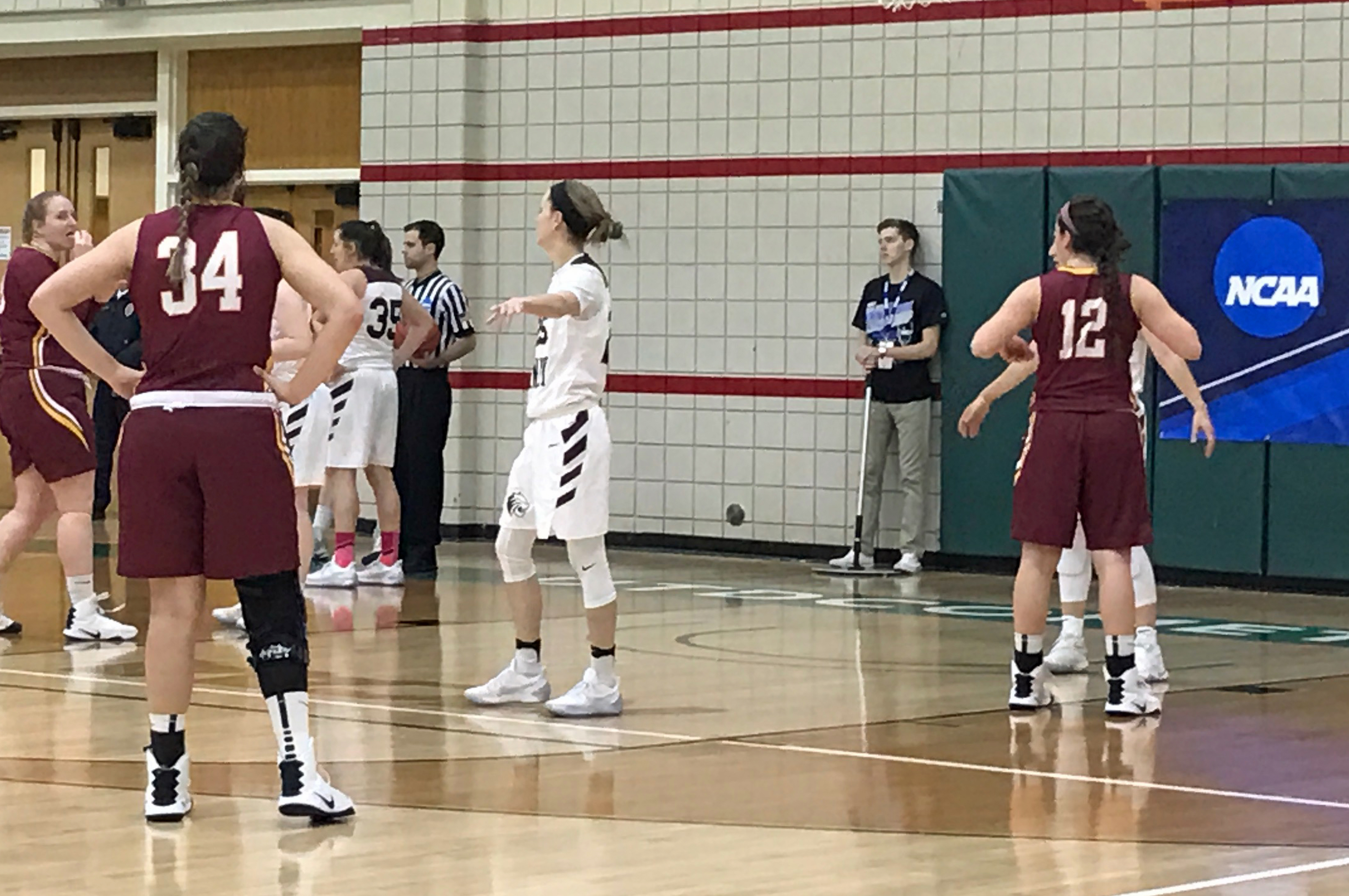
I found myself at a second-round game Saturday between my alma mater, Trinity University, and Claremont-Mudd-Scripps. They played in a regional held at the University of Texas at Dallas. CMS had defeated the hosts the previous night after the Tigers had beaten Hendrix College in the evening’s first game.

TU_On_Defense_1618 

The DIII draws (women’s and men’s) include 64 teams each and not one of them features a player on an athletic scholarship. At this level, students pay their own way or find other forms of financial aid. While they don’t have hype or pedigrees, they otherwise share a great deal with their counterparts who will fill your office pool next week.

These teams won their respective conferences and they know how to compete. Before the tip, I noticed Trinity’s Mollie Hughes sporting a black left eye and CMS’s Quinn Glosniak wearing a large bandage on her right eyebrow. Hughes had gotten hers going for a rebound in an earlier game and said she had gotten called for a foul on the play, apparently having somehow hacked an opponent with her cheekbone. Glosniak’s cut had required stitches, with the team’s athletic trainer preferring to leave the covering in place rather than reapply the stitches when the player inevitably took another blow there. Based on that evidence, one might have expected a physical game, and we got one.

“One of our goals was to get the ball inside this game,” said CMS senior Aly Young, whose team-high 17 points came mostly via a variety of post moves. There was plenty of up-tempo play, too, with Trinity running a full-court press from the get-go. The combination made for an intense contest.

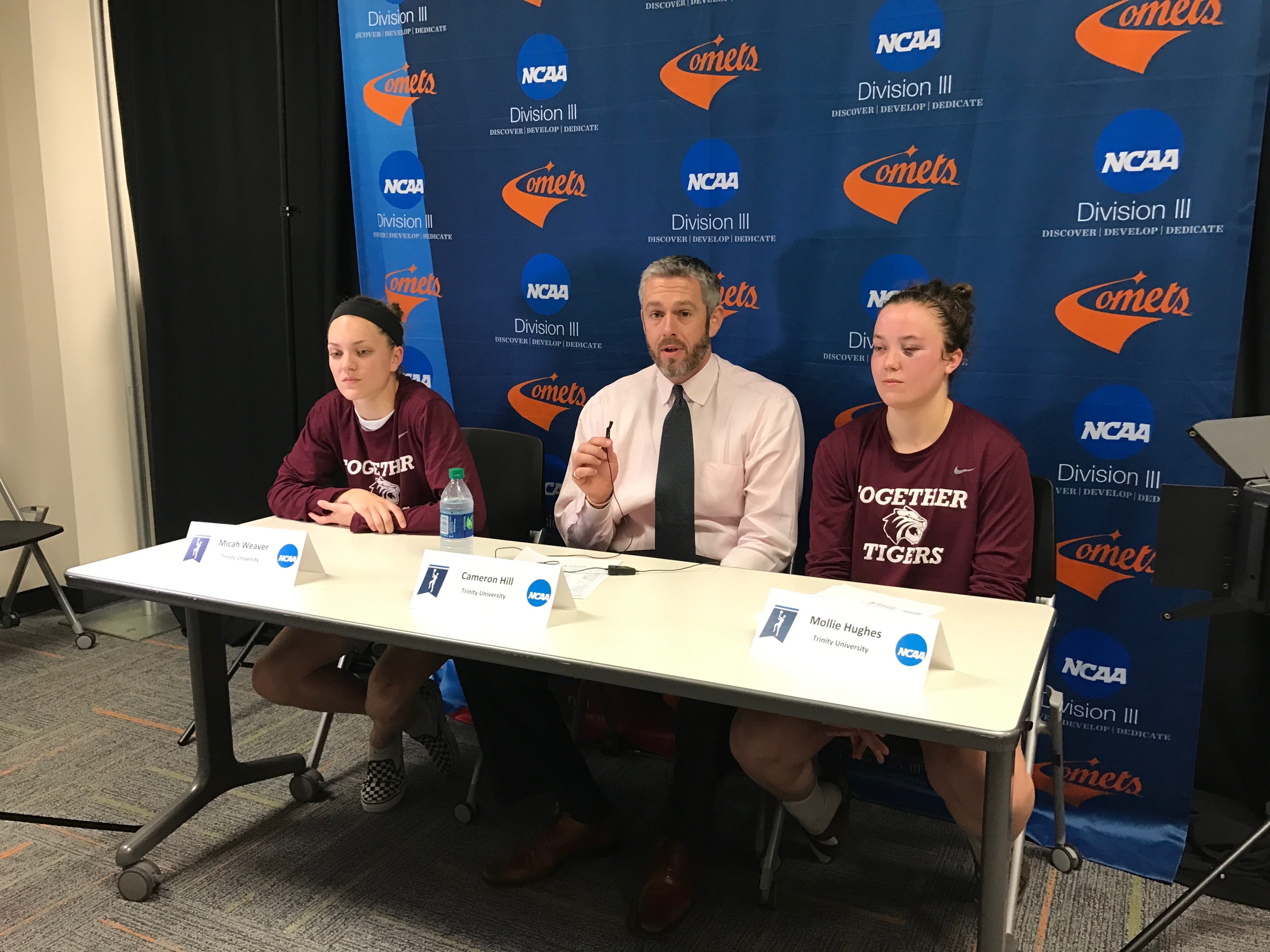
Indeed, the atmosphere felt like you would expect a playoff game should. Claremont-Mudd-Scripps represents an amalgam of three schools whose campuses adjoin each other in Southern California. The Athenas brought a couple of dozen fans, and they made themselves heard. San Antonio-based Trinity filled a good portion of the home side (they also wore the white jerseys and got to have their points recorded as “Comets” on the UTD scoreboard). The Tigers’ head coach, Cameron Hill, even spotted some players from other teams in their conference having come to support their rivals.

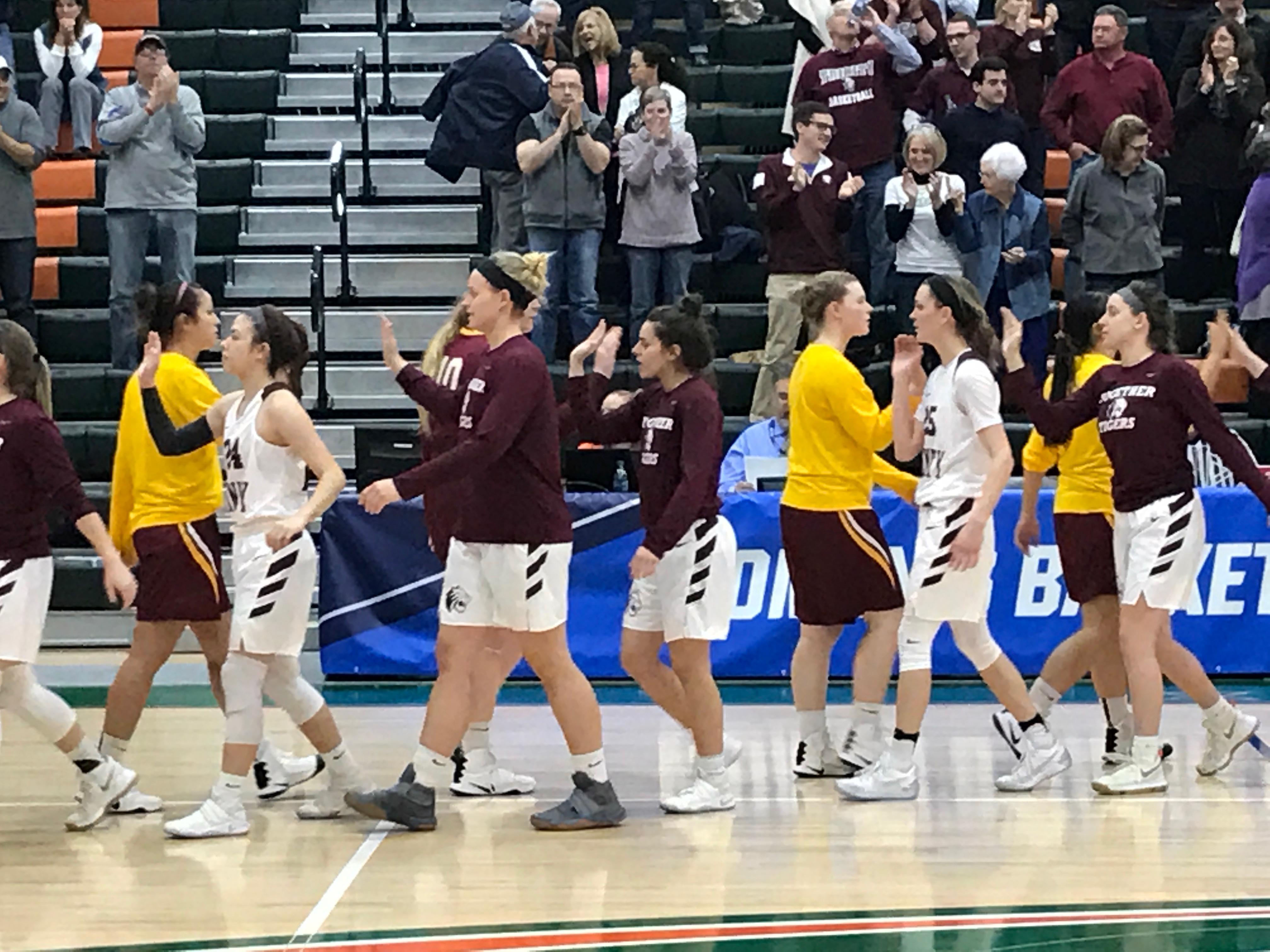
If the stakes weren’t enough, the game itself effectively caffeinated the gym. Trinity got out to a strong start, but the Athenas pulled to within three at halftime. The second half went to-and-fro until the Tigers forced some turnovers late to pull away. The 77-66 win put Trinity into the Division III round of 16.

Hill said afterward of his now 28-1 team, “The key to this whole thing is there’s just not a lot of panic in this group. There’s no doubt in their mind that they can figure out a way to stay competitive and give themselves a chance to win.“

Trinity_PC_7545 

Staying calm in tension-filled situations; self-confidence; problem solving – all abilities that carry over well to the business world these students will shortly enter. What should matter the most in college athletics is the student-athletes and how the experience pays off for them in future endeavors. Any competitive sport experience should provide those benefits, but raised stakes accentuate the pressure and the payoff.

“They sacrifice a ton of stuff, especially Division III student-athletes, so the fact that they get this experience is the best part, besides the team,.” said Claremont-Mudd-Scripps head coach Kristen Dowling. “The team is the best part, but the experience in the national tournament is absolutely a reward for their hard work all year.”

The Athenas’ six seniors made their fourth NCAA tournament appearances this year.
“They’re the best memories I have. There’s nothing like going to a postseason tournament. The excitement, I mean, it’s so incredible to be able to play,” said Young. “There’s nothing that brings us together more than making it this far.”

Turning shared memories into longtime friendships is another benefit of a university experience. The longer your team lasts, the more of those you get to make. Last season, the Athenas were the ones who denied the Tigers that opportunity, defeating them in a first-round matchup in Tyler. This year, it was Trinity who got to prolong the adventure.
“It’s just a really, really nice feeling to know that we get to have practice on Monday,” said Hill.

“Our chemistry is like no other team I’ve ever been on, said TU junior Micah Weaver, who contributed 17 points in the second-round win after scoring 31 in the first round against Hendrix. “I’m just excited to have another week with them.”

TU_CMS_Postgame_9125 

The Tigers will attempt to extend their season another weekend when they play Whitman Friday in Saint Paul, Minnesota. Expect the same intensity, passion, and ultimate payoff as those other games you may watch on the big networks. So whom do you have in your bracket? I’ve got Trinity.

Rush Olson has spent two decades directing creative efforts for sports teams and broadcasters. He currently creates ad campaigns, television programs, and related creative projects for sports entities through Rush Olson Creative & Sports and FourNine Productions.

RushOlson.com
Linkedin.com/company/rush-olson-creative-&-sports
Facebook.com/RushOlsonCreativeandSports