Showing posts with label Dreams. Show all posts

Wednesday, January 10, 2018

Museum of Dreams


This post originally appeared in the Blotch section of the Fort Worth Weekly's website. To consume it there : https://www.fwweekly.com/2018/01/10/sports-rush-museum-of-dreams/

I had a dream the other night and it inspired me to write this column. 

I actually have this dream every so often in various forms, and it involves the idea that the Rangers have scheduled a game back at old Arlington Stadium and I am going. Usually in this dream, I am just a fan at the game, navigating narrow concourses and acres of bleacher seats. Sometimes I am working, trying to remember where the press box entrance is. 

I have no idea why I have this dream (crowd-sourced psychoanalysis welcomed), but I do know I had a lot of fond memories of going there as a kid and watching Major League Baseball.

Of course, the team won’t be scheduling a throwback event at the old stadium because they tore it down when they built a new facility. The Rangers are about to construct their third ballpark, but this time the (tentative) plan involves repurposing the former home rather than demolishing it. 

If they’re going to trade on nostalgia, they should go all in and bring back one of Globe Life Park in Arlington’s former features. They should have a baseball museum.

The current facility would be a great place to house such a thing. How do we know? It already did.

When the place opened in 1994, the Legends of the Game Baseball Museum occupied a storefront facing Randol Mill on the ballpark’s south side. The downstairs portion housed exhibits on the game’s great players, its equipment, its uniforms, broadcasting and more. The displays included artifacts on loan from the National Baseball Hall of Fame and Museum in Cooperstown, New York - not a small thing for a museum to possess.

The second floor told the story of the Texas Rangers and baseball in North Texas. On the third floor, one found interactive areas geared toward young people.

If you loved baseball, you couldn’t help but find the museum absorbing. Objects owned by Babe Ruth and Ty Cobb stood on view alongside videos of Nolan Ryan no-hitters and Mantle/Maris/McGwire/Sosa/Bonds home run chases. If one re-opened such a museum, it would become a must-see for hard-core baseball fans.

But the longtime fans aren’t why the museum should come back. The biggest reason is the need to create the next generation of such people. Those of us who fell for the game at a young age developed a curiosity about it and began to take the deeper dives into its rich heritage. For me, books on the game and stories from my father got me fascinated with the game’s colorful past. That depth of engagement ensured I would want to continue to interact with the game into the present day, and attend games in any ballpark available. 

Before the museum closed after the 2009 season, every school group that toured the ballpark visited it. Schools could justifiably consider it an educational experience and thousands of children had a chance to realize how much there is to the national pastime.

The Rangers need baseball fans. This is a football state, and sports like basketball, ice hockey, soccer, and many others compete for allegiance. No sport has a history as storied as baseball’s. The Rangers should use it to their advantage.

Of course, you’d want to update the presentation, and have a plan for continuing to do so. When you’re competing for loyalty with e-sports and cellphones, the technological setup has to resonate. One issue the previous incarnation had was lack of commitment to keeping the exhibits fresh. As a Rangers employee, it took me years to find the money just to update a few videos so kids wouldn’t think Roger Maris still held the home run record or Oddibe McDowell was the only Ranger to hit for the cycle.

Would a new museum work from a business standpoint? According to museum personnel I talked to before the front office repurposed the space, it was still profitable to the end. The way it made a lot of its money was through events (including my sister’s wedding reception), but the Rangers thought they could make more profit by taking out exhibits and creating a more open floor pattern. The current Rangers Hall of Fame is the result.

Between the new ballpark and whatever is left at the old one, though, the team will have plenty of event space to rent. They could easily retain plenty of short-term profits from parties and corporate functions while also investing in cultivating the long-term fan base. And you could still host the right kinds of happenings at the museum, like the Batty at the Ballpark Halloween event pictured in this post’s featured photo. Note the baseball displays behind my niece‘s cool balloon/flower headdress.


If you want kids to have big league dreams (sometimes literally), you have to help them envision such things. A shrine to baseball would put them in the right frame of mind.


Rush Olson has spent more than two decades directing creative efforts for sports teams and broadcasters. He currently creates ad campaigns, television programs, and related creative projects for sports entities through Rush Olson Creative & Sports, Mint Farm Films, and FourNine Productions.

RushOlson.com
Linkedin.com/company/rush-olson-creative-&-sports
Facebook.com/RushOlsonCreativeandSports

Thursday, January 19, 2017

Baseball’s American Diaspora

This post originally appeared at the Fort Worth Weekly's website. To view it there : https://www.fwweekly.com/2017/01/16/baseball-realizes-dreams/


If you were a young Jewish boy newly arrived in the United States in the early 20th century, you might have looked and talked differently from your schoolmates. You wore a small circular cap on the back of your head. How would you have tried to fit in? 

For many such boys, adjustment to America involved wearing baseball caps as well as yarmulkes.

That’s the message of Chasing Dreams: Baseball and Becoming American, a multimedia exhibit on display through March 5 at Congregation Ahavath Sholom.
“What the immigrants of the early 1900s determined was if you really wanted to be American, you needed to learn about baseball,” explained Rich Hollander, who spearheaded bringing the exhibit to the Fort Worth synagogue from the Philadelphia Museum of American Jewish History.

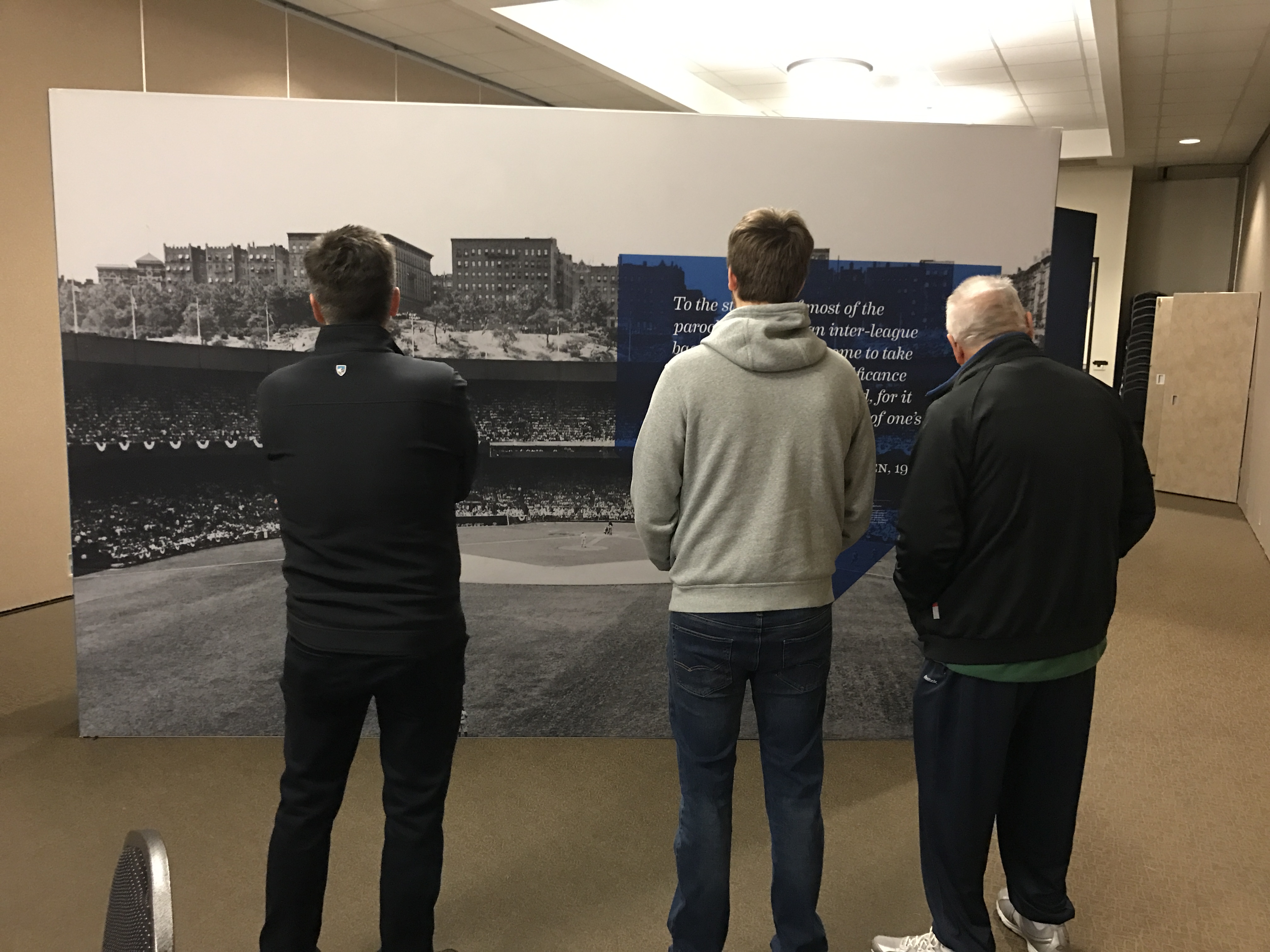
The most prominent portion of the display consists of a series of two-sided panels featuring large photos and text related to the ways Jews and other minorities became a part of baseball. Text from the first panel declares that baseball “represents a shared American identity.” Videos about baseball’s cultural richness reinforce the message. They feature comments from prominent Jewish and minority participants in the game, including the Rangers’ Jewish general manager, Jon Daniels.

Hollander had seen a TV news story about the exhibition and contacted the Philadelphia museum about arranging a showing in Texas. As president of Tarrant County B’nai B’rith, he presented the concept to local chapter of the national Jewish service organization. They decided to provide the money and manpower necessary to bring Chasing Dreams to Cowtown.

An iPad display allows visitors to look up every Jewish player who played in the majors. On Friday, Rick Weintraub of Arlington had come to see the exhibit with his friend and his grandson. He asked Hollander to retrieve the information on his distant cousin Phil Weintraub, who played in the 1930s and 1940s.

Rick was born in 1937 and grew up in New York City as a Brooklyn Dodgers fan. He confirmed that the exhibit got it right about the importance of baseball to Jewish boys his age.

“When you were a kid growing up in Brooklyn, baseball was your second religion,” he said.
The man Hollander considers his baseball hero once placed the religion they share ahead of the game they both love. Sandy Koufax declined to pitch Game 1 of the 1965 World Series when it fell on the same day as Jewish holy day Yom Kippur. He has a prominent place in the exhibit and in Hollander’s memory: “He said to me, ‘If you’re Jewish, you can be a baseball player.’ I wasn’t good enough to be a [professional] baseball player, but you could be a baseball player.”

Hollander took pleasure in noting that Israel had qualified to play in the 2017 World Baseball Classic, the country’s first appearance in the main round of the quadrennial competition. The tournament website indicates some 3,000 Israelis of all ages participate in the sport. It seems that in addition helping immigrants adjust to life in the U.S., baseball makes a pretty good export, too.

On Blotch at Fwweekly.com, you can read my take on why it made sense to write about the exhibit during a week that includes Martin Luther King, Jr. Day and Inauguration Day.

You can find Chasing Dreams: Baseball and Becoming American at 4050 South Hulen Street  Tuesdays – Thursdays from 10 am to 5 pm, Fridays from 10 am to 2 pm, and Sundays from noon to 6 pm. Tickets are $5 each and children under 12 are admitted free. On Sunday, February 12, former Rangers President Tom Schieffer will speak at a bagels and lox brunch that includes a tour of the exhibit. For information about the event, call 817 909 4354.


Rush Olson has spent two decades directing creative efforts for sports teams and broadcasters. He currently creates ad campaigns, television programs, and related creative projects for sports entities through Rush Olson Creative & Sports and FourNine Productions.

RushOlson.com
Linkedin.com/company/rush-olson-creative-&-sports
Facebook.com/RushOlsonCreativeandSports

Monday, January 16, 2017

I Had A Dream

This post originally appeared at the Fort Worth Weekly's website. To view it there : https://www.fwweekly.com/2017/01/16/baseball-realizes-dreams/

Any baseball franchise would want to employ a powerful first baseman with a career OPS (On-base Plus Slugging) over 1.000 who could also play the outfield.

Clubs would also welcome a hard-nosed second baseman who had won a Rookie-of-the-Year Award, an MVP, and a batting title.

Teams would be thrilled to add a smooth center fielder worth nearly 80 career WAR (Wins Above Replacement).

They’d be even more interested if you told them each player was a Hall-of-Famer and had served his country as a soldier in time of actual war.

I learned things about each of the above players at a new exhibit called Chasing Dreams: Baseball and Becoming American. The Congregation Ahavath Sholom on South Hulen hosts it through March 5. You can get more scoop on its contents and how it came to be in Fort Worth by reading my article in the Fort Worth Weekly print edition due on stands this coming Wednesday.

Weintraub Family at Chasing Dreams Exhibit 

It seemed especially appropriate to write about the exhibit as we celebrate Martin Luther King, Jr. Day. King chased dreams, and, indeed we remember one of his most famous speeches as the “I Have A Dream Speech.” He delivered it August 28, 1963 in Washington, D.C., and it contains one of my favorite passages ever:

“I have a dream that my four little children will one day live in a nation where they will not be judged by the color of their skin, but by the content of their character.”

King’s address also spoke of the injustices done to African-Americans of the time and of difficulties they faced in a country whose laws denied them a level playing field. The exhibit talks of the discriminatory obstacles Jewish ballplayers faced, and includes mentions of the struggles and triumphs of black, Hispanic, and even female ballplayers.

We learn, for instance, that while early Jewish ballplayers could at least play in the big leagues (unlike African-Americans), many felt compelled to change their names to something that made their ethnicity less apparent. We also learn that baseball played a role in helping to overcome prejudices, both within the game and without.

“Baseball really became the place for cultural change in America, with Jackie Robinson as the place where America really began its integration,” posited event organizer Rick Hollander.

Jackie Robinson at Chasing Dreams: Baseball and Becoming American 

Robinson was the second baseman I described in this column’s opening paragraph. His status as MLB’s first African-American player in the modern era has deservedly cemented his status as a legend, and Robinson’s performance on the baseball diamond would have earned any player Hall of Fame consideration.

Rick Weintraub, a lifelong baseball fan who attended the exhibit the day I was there told us he had once gotten to meet Jackie Robinson. The nearly 80-year old white Jewish man said, “It now just almost brings tears to my eyes because he was such a great man, much less a baseball player.”
As one of the first Jewish ballplayers to keep his traditional surname, the first baseman/outfielder described above also faced racially-tinged abuse. Detroit Tigers fans, however, liked Hank Greenberg’s two MVP seasons and pair of World Series wins.

Both Greenberg and Robinson used their play on the field and their strength off it to power through much of the flimsy excuse for a mindset that is racism. They left baseball observers with little choice other than to judge them by the contents of their characters. I would submit that such developments have value in the wider world. Once one realizes that a member of a maligned group defies negative stereotypes, it makes it more difficult to project suppositions of inferiority onto other individuals.
Open competition, and sports especially, rewards such rational choices. Fans of that era discovered they would rather brag about their teams winning than obsess over whether the players looked like them or attended their church.

Speaking of winning, there’s another important day on the national calendar this week. Another prominent citizen will have a chance to address the public from the capital. Friday is Inauguration Day, and the incoming POTUS has talked a lot about winning things.

One thing the exhibits explains is how first-generation Americans used baseball to successfully bridge cultural gaps.

“Regardless of what all the politicians say in the world today, we are an immigrant society,” said Hollander. “They came here as young as eight, nine years old. They went back and fought in World War II for their new country and the patriotism was real. They understood the opportunities that America had to offer and baseball was one of those opportunities.”

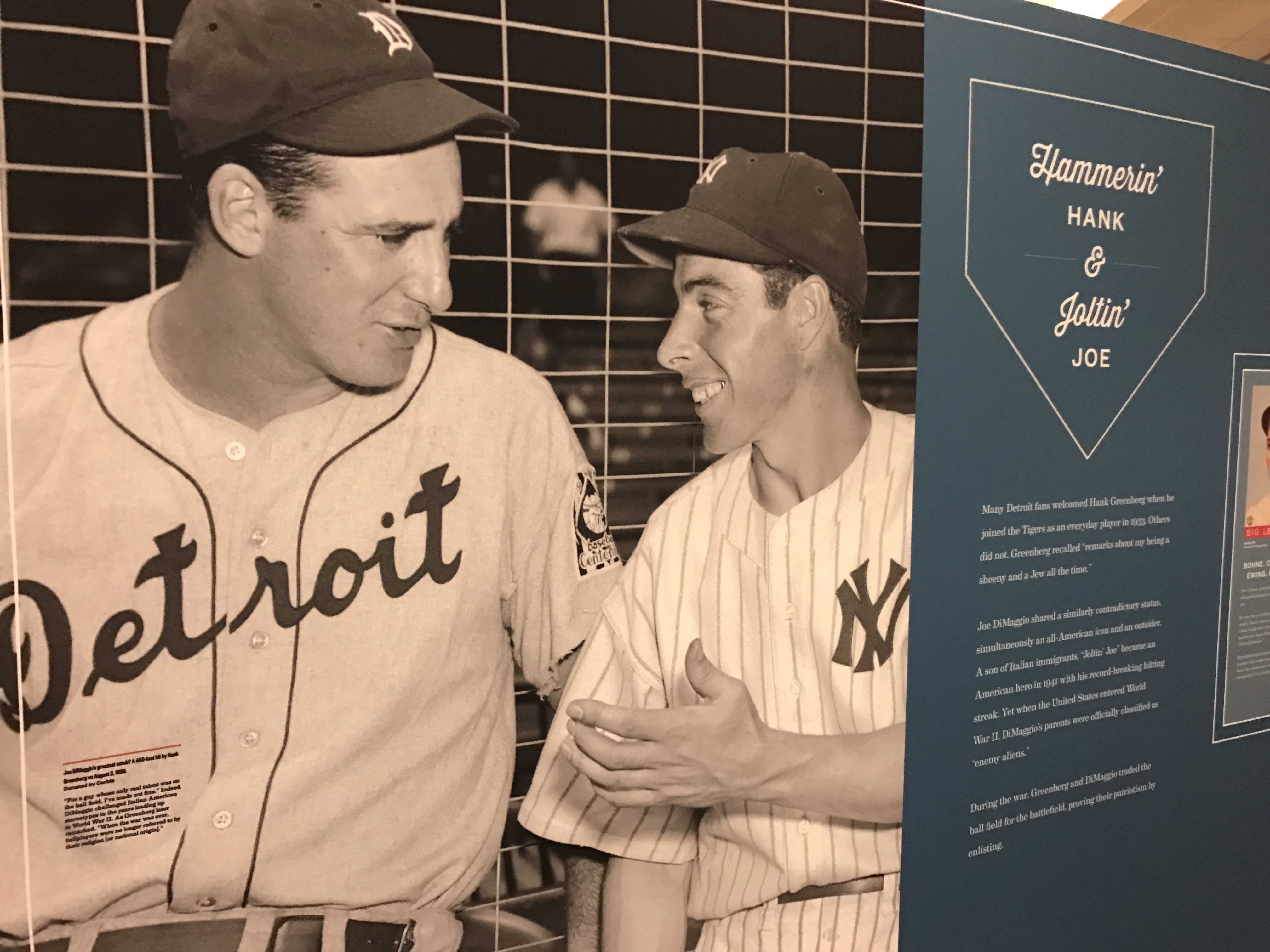
Hank Greenberg and Joe DiMaggio at Chasing Dreams: Baseball and Becoming American 

All three of the men mentioned at the top of the page also served in the armed forces during WWII. One of the exhibition’s panels features a photo of Greenberg with the center fielder I cited. Joe DiMaggio might have been the most revered ballplayer in the world in 1941 and would join the Army from 1943-45. But when war broke out, the authorities wouldn’t allow his Sicilian father to earn a living fishing in San Francisco’s coastal waters because of where Giuseppe DiMaggio was born.

The Franklin D. Roosevelt administration judged a lot of Italians, Japanese, and others of Axis descent by something other than the content of each person’s character. The year after the U.S. government freed the last of the interned Japanese Americans, Jackie Robinson broke baseball’s color barrier. As Hollander pointed out to me, the Major Leagues now feature players from all over, including Central and South America, the Caribbean, Korea, Australia, and, yes, Japan.

Society has made progress, too, since the 1940s. A more open world has resulted in all manner of free exchange of goods, services, music, and food. Indeed, as I walked into the synagogue to view the Chasing Dreams exhibit, a flier on the door caught my eye. This Jewish religious institution was advertising a musical Shabbat featuring the sounds of Latin America.

We’d like it if everyone kept an open mind about such cross-cultural experiences. When you adopt such an attitude, you can look at someone new or different as an individual and judge him or her accordingly.

If one views a person negatively because she shares a country of origin or a religion with billions of peaceful people and a tiny percentage of Bin Ladens, Torequmadas, Castros, or Maos; if one thinks just because a man rises to head a corporation or hedge fund, he therefore has no soul; if one believes that just because someone proved him or herself popular in an election, it automatically makes the official worthy or respect – or derision; In all these cases, one is not rendering judgement based on the content of that person’s character.

Baseball learned long ago how thinking that way prevents you from winning. The teams that employed Robinson, Greenberg, and DiMaggio won a LOT. One hopes that those taking power remember the lessons baseball – and Dr. King’s speech – have taught.