One could characterize Wild Spaces, Open Seasons: Hunting and Fishing in American Art, on display
at the Amon Carter Museum through January 7, as an exhibition about
sport. The paintings and sculptures on display offer American artists’
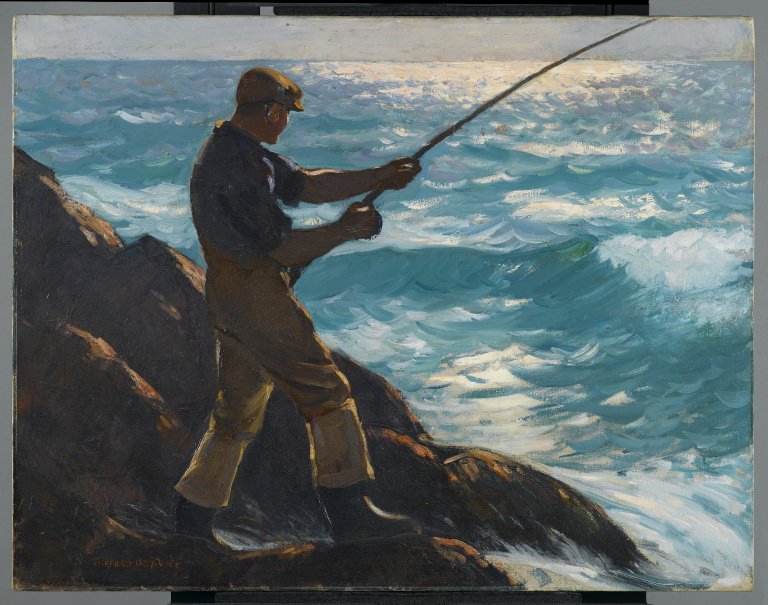
depictions of a pair of prominent outdoor sports. Gifford Reynolds Beal’s The FishermanWe think of sport as something one does for enjoyment, and many
Americans hunt and fish to relax. The U.S. Fish and Wildlife Service estimates
the country’s population contains nearly 36 million anglers and some
11.5 million hunters. Some might enjoy solo recreation, as in Gifford
Reynolds Beal’s The Fisherman.
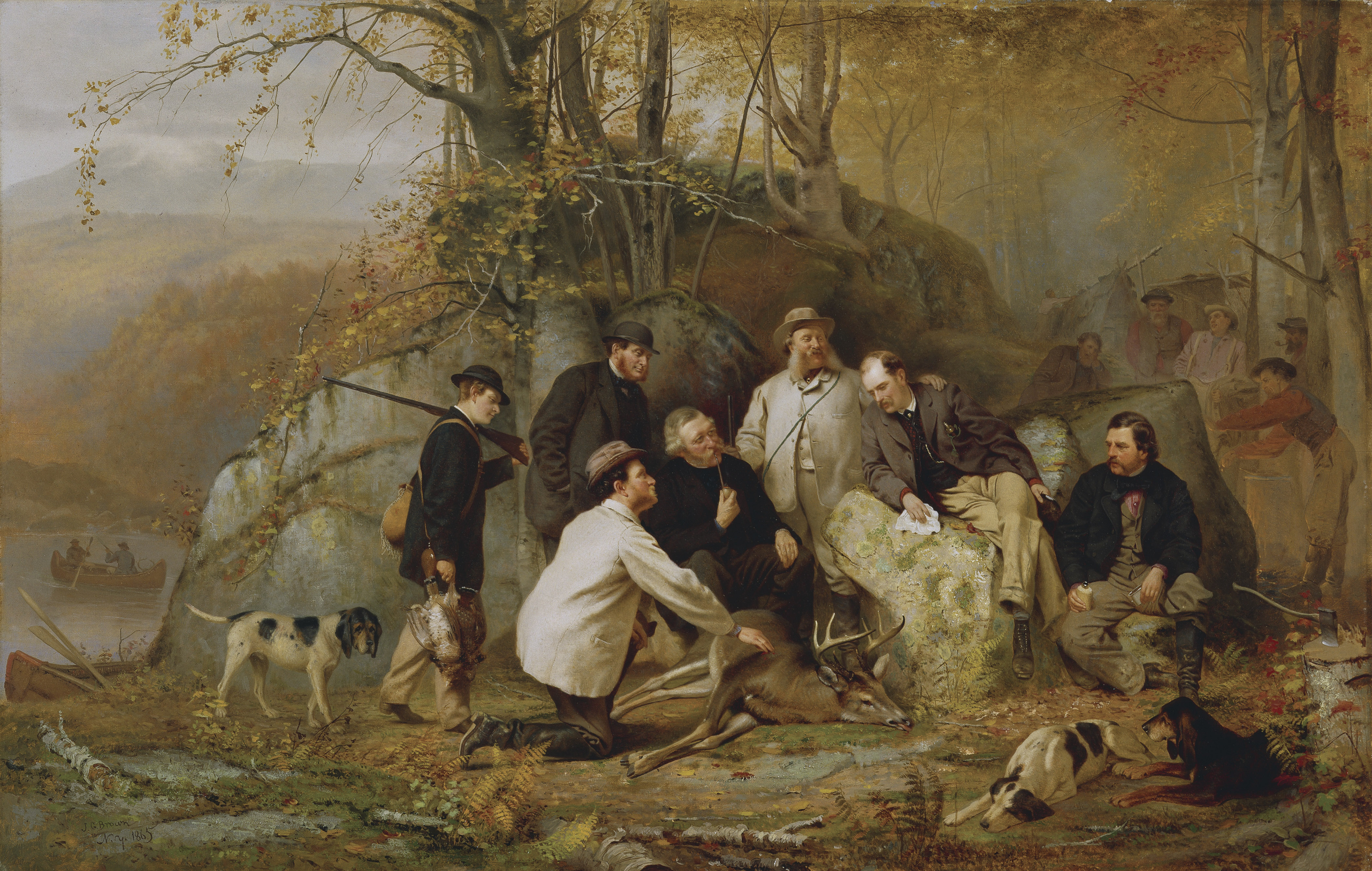
Others prefer a recreational experience with friends, often accompanied
by a round of post-excursion disputation, as seen in John George
Brown’s Claiming the Shot: After the Hunt in the Adirondacks. DTR352683
Claiming the Shot: After the Hunt in the Adirondacks, 1865 (oil on
canvas) by Brown, John George (1831-1913); 81.3×127 cm; Detroit
Institute of Arts, USA; Founders Society Purchase, R.H. Tannahill
Foundation fund Much of the exhibition’s art doesn’t depict what we might think of as
sporting, though. A competitor engaged in a game involving
knife-fighting a bear, as in Arthur Fitzwilliam Tait’s 1856 painting A Tight Fix – Bear Hunting, Early Winter, would have a short career.
In
place of jolly hunting parties, we see men and women pursuing game for
the reasons most humans would have up until the last century: survival.
The tribesmen engaged in Charles Russell’s Buffalo Hunt (or
those in Alfred Jacob Miller’s painting of the same name) no doubt risk
their lives bringing down a great horned beast not for the thrill of the
chase, but because hungry family members await their return. John
Quincy Adams Ward’s The Indian Hunter bears the look of someone who knows he must brave danger to eat (as does his dog).
Charles
M. Russell (1864-1926); The Buffalo Hunt [No. 39]; 1919; Oil on canvas;
Amon Carter Museum of American Art, Fort Worth, Texas; 1961.146In
pre-industrial times, hunters and fishers had to win at their contest
with nature to eat. Only the upper classes hunted for sport. The
well-to-do young man in John Singer Sargent’s Young salmon fisher, Alec McCulloch likely will not go hungry if nothing’s biting. The smiles in The Hunter’s Return by Thomas Cole would have no doubt been panicked frowns had the party returned to the wilderness cabin empty-handed.
During the 19th century, the American experiment had begun to set the
stage for hunting and fishing to transition from subsistence
occupations to widespread recreational pursuits. Agricultural
innovations and the Industrial Revolution made it possible for the
masses to move beyond spending long days at labor just to produce a
day’s food supply themselves. They could now trade a shorter period of
less taxing work for provender generated by a smaller number of more
efficient agricultural producers. Fewer and fewer Americans needed to
pick up their guns, bows, nets, or poles to feed themselves. When they
did so, it was because they enjoyed it.
So if you think of Wild Spaces, Open Seasons: Hunting and Fishing in American Art as an exhibition of sports art (fitting in well with other sporting elements in the Amon Carter’s collection, as documented here and here), that’s fine. While there are still many who work in the commercial fishing industry (and a few who hunt wild game for a living), most of us do have the luxury of viewing hunting and fishing as more pastime than profession.
It’s because we have more time – a lot more time – than our
hunter/gatherer ancestors for fun, including sports (and visiting art
museums). This exhibition thus shows more than just beautiful works by
accomplished artists. It also shows progress. Wild Spaces, Open Seasons: Hunting and Fishing in American Art is on display at the Amon Carter Museum through January 7. Caught on Paper is a supplemental exhibition inspired by Wild Spaces, Open Seasons.
It features 50+ outdoors-themed works on paper from the Amon Carter’s
collection. It will remain on the walls through February 11.
For a world-class art institution, the Amon Carter Museum of American
Art sure has a sporting side. A surprising number of works depict
subjects sprinting, punching, exercising, competing, and otherwise
engaging in sporting pursuits. What many regard as the institution’s
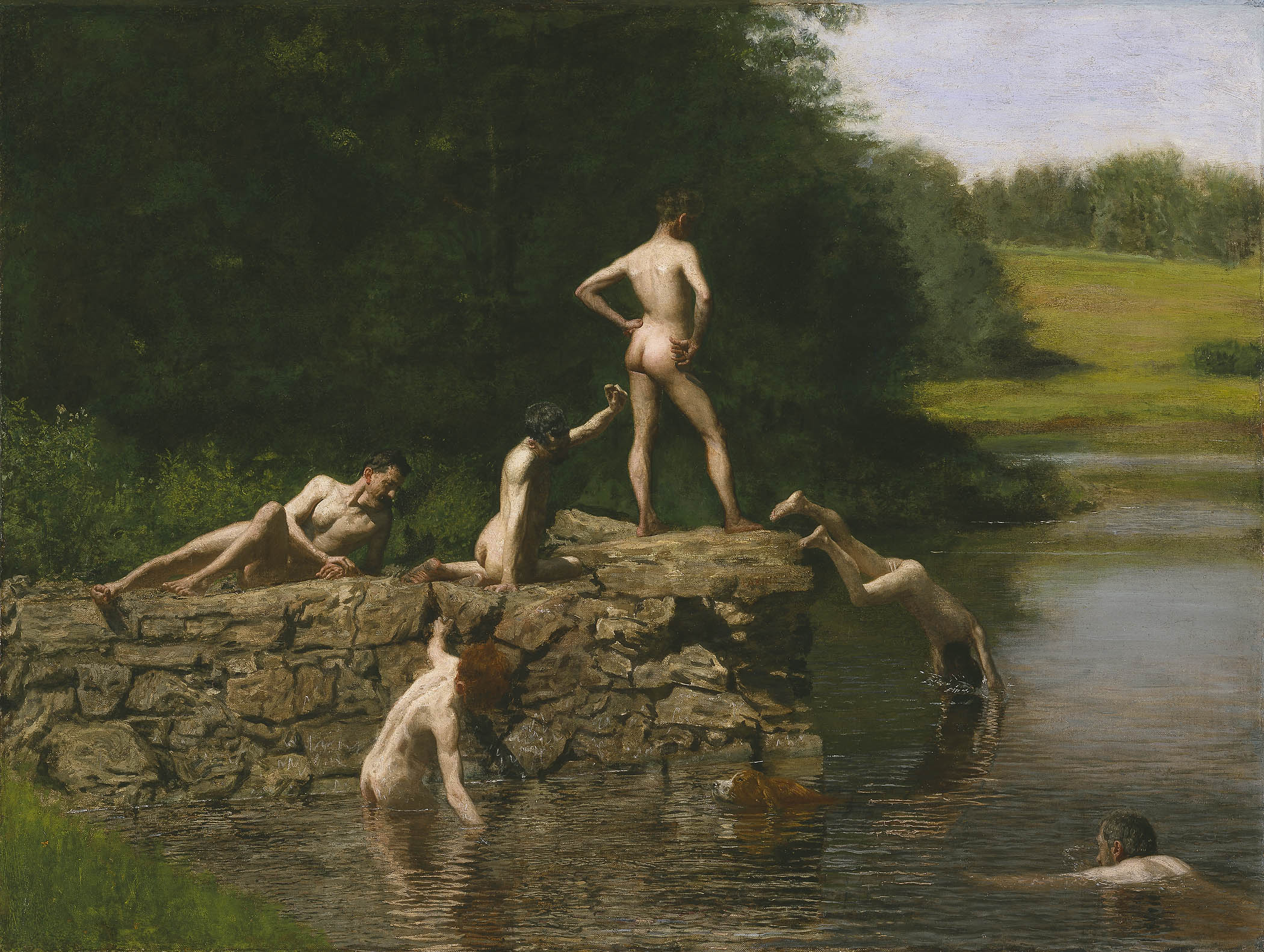
best known work revolves around an aquatic sport. In Thomas Eakins’ “Swimming,”
a half-dozen unclad males gather at a country lake. The painting
created controversy for the artist while he was serving as a professor
at the Pennsylvania Academy of the Fine Arts.
Thomas Eakins Swimming, 1885, Amon Carter Museum of American Art
“You
can see [Eakins] with his dog and clearly identify that these are his
students,” explained Amon Carter associate curator Maggie Adler. “That
was a huge no-no.” Eakins, she continued, “believed that you
should teach art to people using live nude models. That was not allowed
if you had men and women in the classroom.”
Eakins would later
resign his post after his removal of a loincloth from a classroom model
generated more Victorian-era handwringing.
Adler possesses unique
qualifications when it comes to examining the representation of sport in
art. In addition to her masters in art history from Williams College
and experience at multiple museums, the Scarsdale, NY, native excelled
as a competitive archer. She shot well enough to try out for the 1996
U.S. Olympic team. She finds a certain similarity between the two
pursuits. “I feel the same way entering a competition as I do before I
go to give a lecture or talk,” she said, “because you get yourself
psyched up. It takes a certain amount of adrenaline.”
Most of the
Carter’s sports-related objects tend more toward Adler’s style of sport
than stick-and-ball games. Archery figures prominently in a painting
that recalls the museum’s own heritage as an institution focused on the
American West.
George
Catlin; "Archery of the Apachees [sic]"; ca. 1855; Oil on paper mounted
on paperboard; Amon Carter Museum
Around 1855, George Catlin painted a
crowd of Apaches watching fellow tribesmen riding fast-moving horses
while attempting to shoot arrows at targets on the ground, a piece
entitled “Archery of the Apaches.” “That would be really complicated to do,” the expert archer said.
Near
the Catlin painting on the museum’s second floor, there’s another
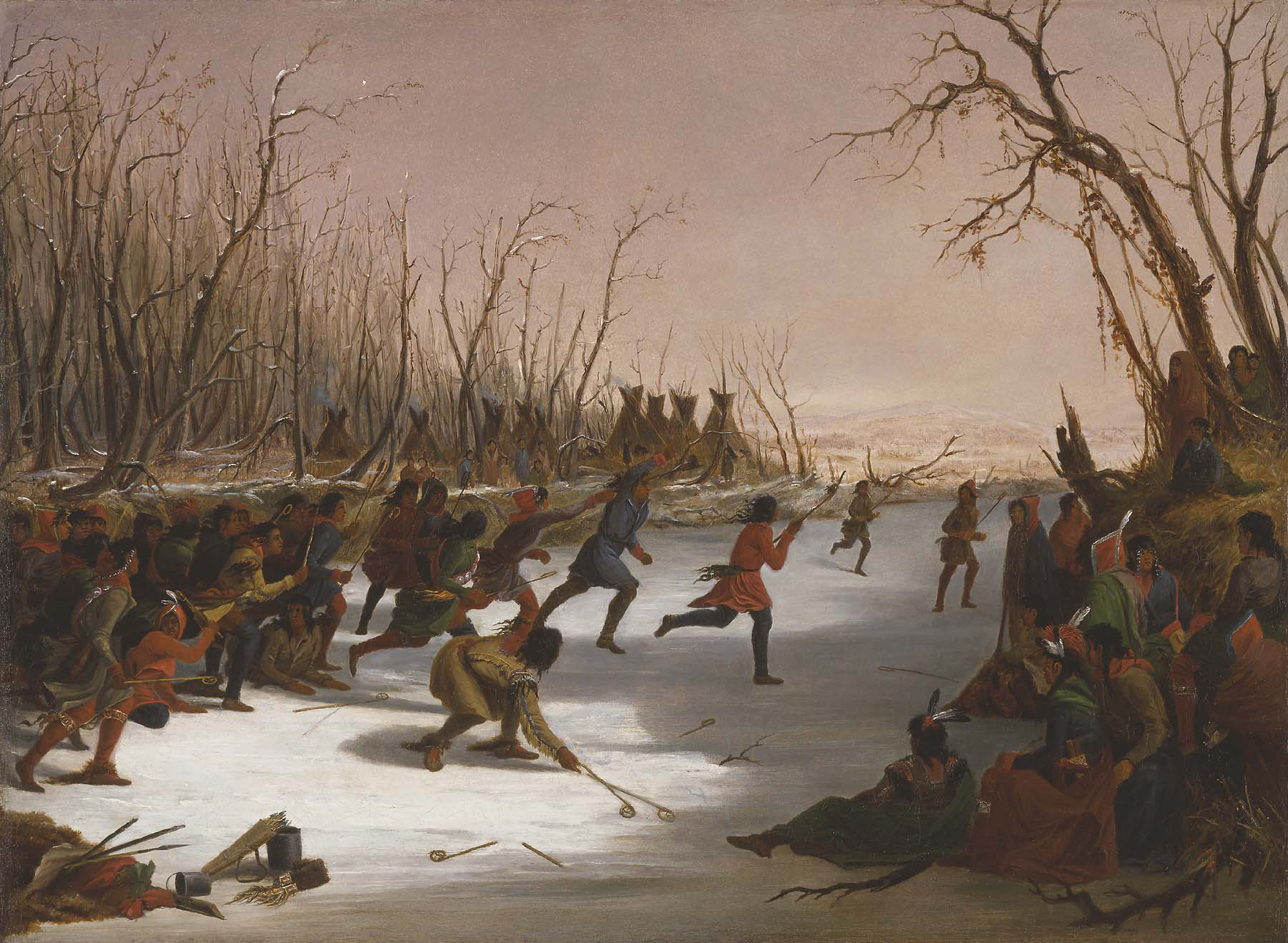
example of Native Americans engaged in sport. In Seth Eastman’s 1848
work “Ballplay of the Dakota on the St. Peter’s River in Winter,”
Sioux athletes play a version of lacrosse. The contest occurs on a
frozen river, and the stakes are high. “We think there was gambling
involved, so this is maybe why this buffalo hide and arrows … are in the
front,” Adler said. “That’s the wager.”
Seth
Eastman; "Ballplay of the Dakota on the St. Peters River in Winter";
1848; oil on canvas; Amon Carter Museum
Adler said Eastman’s wife also
recorded that this full-contact version of lacrosse often resulted in
broken limbs and even deaths.
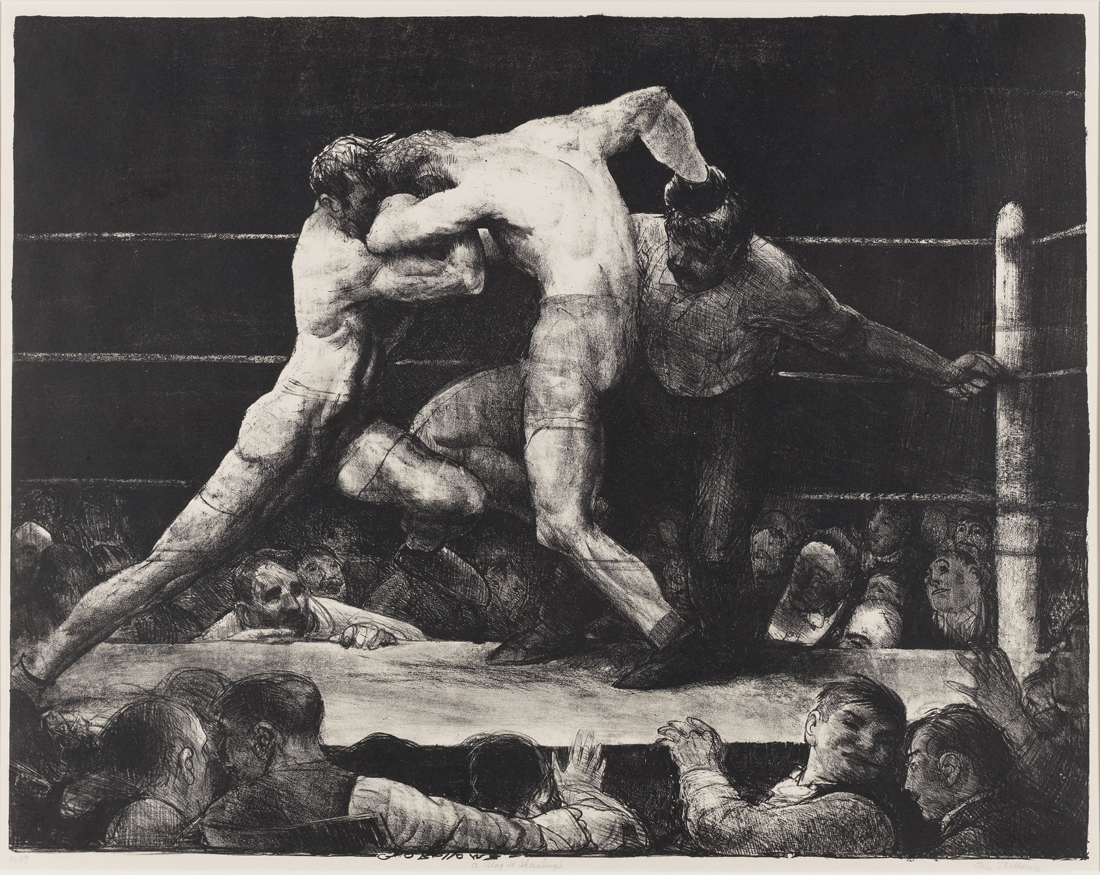
Another athletic pursuit known for
its physicality represents perhaps the museum’s most complete archive of
any single sport: prints by George Bellows. The museum owns 230 of the
former semipro baseball player’s lithographs, including many gritty
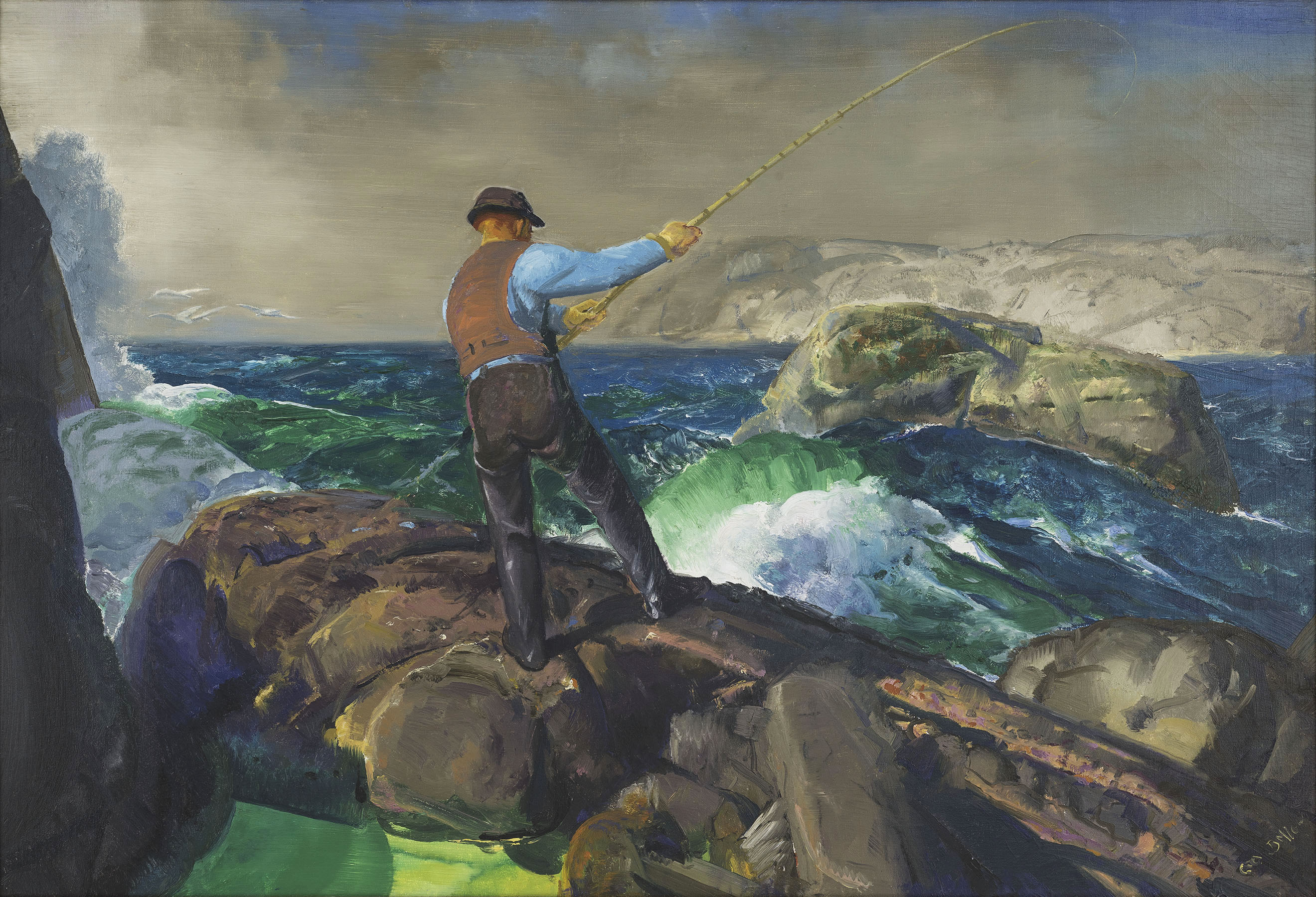
boxing scenes. A seminal work from 1917, “A Stag at Sharkey’s,”
shows two fighters locked in desperate struggle. The museum has the
combat scene displayed next to another of Bellows’ creations, the newly acquired 1917 oil painting “The Fisherman.”
George
Bellows (1882-1925); A Stag at Sharkey's; 1917; Lithograph; Amon Carter
Museum of American Art
Outdoor
sports like fishing and hunting represent much of the museum’s sporting
archive, though several of the works have gone on a road trip. Adler
and collaborators from other museums incorporated a number of the works
into a traveling exhibition. Wild Spaces, Open Seasons: Hunting and Fishing in American Art is on view currently at the Shelburne Museum in Vermont and will be in Fort Worth in October.
George Bellows (1882-1925); The Fisherman; 1917; Oil on canvas; Amon Carter Museum of American Art
Each
Bellows boxing lithograph can remain on display only for a few months
at a time to avoid light-inflicted damage. Like most museums, the Amon
Carter owns more pieces than it can display at any one time, so more of
its sporting art may make its way into the walls in the future.
For more on the Amon Carter and the roots of the sport of rodeo, check out this week’s Sports Rush post in the Blotch section at fwweekly.com.
Sometimes, color matters in sports. Uniforms help us tell the competitors
apart. We express allegiance to our teams by wearing silver and blue or
victory green. Ballparks contrast a dark batter’s eye backdrop against a
white baseball.
In art, color becomes even more essential. A muted palette may
suggest one set of emotions, while bright colors imply something whole
different. Use of color can define an artist.
Sometimes the worlds of sport and art colorfully intersect, as I
noticed on a recent visit to the Dallas Museum of Art. Along an upstairs
wall hangs a painting by Ángel Zárraga called La futbolista. The museum brought it in as part of the exhibitionMéxico 1900–1950: Diego Rivera, Frida Kahlo, José Clemente Orozco, and the Avant-Garde, an installation of nearly 200 works executed in multiple media by early-20th century Mexican artists.
Zárraga’s
painting depicts a female soccer player posed in uniform, seemingly
ready for a match to begin. Dr. Anna Katherine Brodbeck, The Nancy and
Tim Hanley Assistant Curator of Contemporary Art at the DMA, said via
email that “Zárraga, like many other artists in the exhibition, was
interested in portraying strong, modern women, engaged in tasks beyond
what would have been expected of them in the traditional society of
pre-revolutionary Mexico. A woman football player exemplifies this
modernity.”
The 1910-1920 Mexican Revolution, which deposed a long-time dictator
and hoped to shape a more forward-looking and equitable society,
provides context for the artists’ expressions. As their countrymen and
women looked to elevate their nation’s status, the painters, sculptors,
and filmmakers tried to do their part. Brodbeck describes them as “some
of the most sought-after artists in the US and Europe,” with Rivera, for
instance, receiving just the second one-person exhibition at New York
City’s Museum of Modern Art. The art world saw value in the images these
men and women created. It didn’t matter that they came from a Central
American country many might have previously considered culturally
backwards. In sport as in art, performance should, and often does, trump all
else. A Jackie Robinson can show that African-Americans belong in Major
League Baseball; A Doug Williams can prove a black quarterback can win a
Super Bowl; A Dominican, David Ortiz, can pretty much own a New England
city known for bursts of racial intolerance.
It’s tougher to smear a minority group as inferior when members of
that group reveal themselves as world-class practitioners of something.
The idea that governments should limit business or personal contacts
with people solely because of national origin seems less viable when we
can envision those persons being the next Diego or Mariano Rivera.
Brodbeck noted, “The exhibition highlights historical moments of
close cross-cultural exchange between the US and Mexico—times when
pan-Americanism was politically attractive– and is proof that there is
strength in our unity and our similarities vastly outweigh our
differences.”
The DMA’s México 1900–1950 presents an opportunity for visitors to experience, and more importantly, appreciate
a culture sometimes portrayed as second-class. Art devotees know it to
be otherwise – this show debuted in Paris, France, not exactly an
artistic backwater.
Will it succeed in bringing people together? Kimberly Daniell of the
DMA’s public relations staff supplied me with some of the glowing
comments visitors have made about the exhibition, including phrases like
“The show is spectacular” and “It was fabulous!” As I examined some of
the commenters, I spotted surnames like Gomez, Olmos, and Gutierrez. But
I also saw monikers like Feingold, Tran, and Sprague writing things
like “Love Frida!“ While I don’t know the specific backgrounds of any of
those involved, that feels like cross-cultural exchange to me. Based on
the attendance figures Brodbeck supplied, more than 50,000 people have
participated in such exchange so far, and the exhibition will run
through July 16.
Colors often matter in sport and art. But sometimes they don’t. The
color of the hand that wields the paintbrush or shoots the basketball
carries no importance. It’s what ends up on the canvas or in the hoop
that is what we care the most about. That distinction is actually pretty
black and white. Rush Olson has spent two decades directing creative efforts for
sports teams and broadcasters. He currently creates ad campaigns,
television programs, and related creative projects for sports entities
through Rush Olson Creative & Sports and FourNine Productions. RushOlson.com Linkedin.com/company/rush-olson-creative-&-sports Facebook.com/RushOlsonCreativeandSports
![Charles M. Russell (1864-1926); The Buffalo Hunt [No. 39]; 1919; Oil on canvas; Amon Carter Museum of American Art, Fort Worth, Texas; 1961.146](https://www.fwweekly.com/wp-content/uploads/2017/12/Buffalo-Hunt-cat58-russell.jpg)

![George Catlin; "Archery of the Apachees [sic]"; ca. 1855; Oil on paper mounted on paperboard; Amon Carter Museum, Fort Worth, Texas, Gift of Paul Mellon; 1986.40](https://www.fwweekly.com/wp-content/uploads/2017/06/Apache-1986-40_pr.jpg)