Tuesday, July 7, 2015

Winning At Free Agency Is Harder Than It Looks

This post originally appeared in my Blotch blog at the Fort Worth Weekly. To read it on the Weekly's site, go here : http://www.fwweekly.com/2015/07/07/winning-at-free-agency-is-harder-than-it-looks/

You should give Mark Cuban or Donnie Nelson a big high-five the next time you see one of them at the massage parlor or Elk Lodge bingo tournament. They did something really tough. Armed only with piles of money, they signed two in-demand free agents. Trust me, they deserve your congratulations for it. The task is tougher than it seems.
Truthfully, your Dallas Mavericks had more assets than just money to bring to bear in signing DeAndre Jordan and Wesley Matthews. They apparently had top account executives Chandler Parsons and Dirk Nowitzki at their disposal. Plus both signees are native Texans and Jordan was allegedly dissatisfied with the insurance he bought from Cliff Paul, or something like that. Still, Cuban and Nelson did superb work.
Free agency emerged in the 1970s and while some future column may delve into the process’s positives and negatives, it certainly came to stay and teams have had to learn to deal with it. Each sport has different rules governing the process, but at some point every player will get the chance to shop his or her services to teams other than the one for which he most recently played. So that brings us to the first reason why free agency is challenging: there are a lot of teams in these leagues.
If you’re as good a rebounder as Jordan (and you’re not – nobody is), every team in the league could use you. The teams interested in your services have a lot of competition. A lot. And they’re all owned by rich guys flush with TV money.
Ah, yes, that calls to mind reason number two – money. If you want to sign a good player who is a free agent, you have to spend millions of dollars you could have used on other, different players or a fleet of yachts the size of the Danish navy (approximately – I didn’t really check up on the current seaborne prowess of the Danes and their Søværnet). Plus, the money is complicated to spend, because you’ve got salary caps and luxury taxes. It’s not enough to just write a check AND balance the checkbook afterward. You have to do math. Give Cuban and Nelson another high-five for doing MATH.
Reason three contradicts reason number two: money doesn’t matter. That’s especially true when it comes to marquee free agents in the NBA. There’s this thing called a max contract, which is basically the most you can offer a player without an extensive illegal laundering operation. So you can’t even outbid anybody, really. And, in fact, his current team can pay him more than you anyway. So effectively the big guys get to play where they want to play and for Danish navy-sized money. That’s true in any league, too. There is always someone else out there with lots of money, often lots of teams. A player can make his decision based on factors other than money if he wants to and will still be able to afford an entourage for life.
So Cuban, Nelson, and company truly pulled off something here. Whether it was their free throw shooting coach, medical director, or the fluffy towels in the locker room, they did something to convince two prime free agents to come to Dallas.
How do I know this process is so hard? I’ve tried it. When I worked for the Rangers and Stars, my job entailed helping craft pitches to free agents. These usually involved video of some sort and anything else the baseball or hockey operations department could think of that might influence a prospect and overcome reasons 1-3 above.
The greatest success occurred in 2002 when a DVD we did helped impress top targets Bill Guerin, Scott Young, and Philippe Boucher. Stars GM Doug Armstrong went in with a superb plan and a pile of Tom Hicks’ money and it paid off.
The greatest disappointment came at the hands of Zack Greinke. He told the baseball ops guys he loved the pitch and then signed with the Dodgers, who offered him a whole lot of reason number two.
The Rangers have had a reputation for not being able to sign pitching, but it has not been for lack of trying. The care we put into pitches for the likes of Roger Clemens, Barry Zito, and Matt Morris, plus the huge cash Mr. Hicks offered them, made it hurt when they declined the offers. Sometimes it was reason one or two (Yankees or Giants), sometimes, it was reason three (hitters’ ballpark, staying close to home).
I will always count Kevin Millwood as a favorite player. Besides being a quality guy, he signed with the Texas Rangers the year after he won an ERA title. Kevin helped me, and a bunch of others in the organization, enjoy some success in a challenging business. Mark and Donnie, I know how you feel this week. Have a high-five.
Kevin Millwood at a video shoot the day the Rangers announced his signing. Photo courtesy Brad Newton/Texas Rangers

Note :
OK, I had to look it up. Wikipedia says the Danish navy guys have twelve big ships plus other smaller ones. They include three “air defence frigates” built by “Odense Staalskibsværft,” all of which sounds cool.


Rush Olson has spent two decades directing creative efforts for sports teams and broadcasters. He currently creates ad campaigns and related creative projects for sports entities through his company, Rush Olson Creative & Sports.

RushOlson.com
Linkedin.com/company/rush-olson-creative-&-sports
Facebook.com/RushOlsonCreativeandSports


Tuesday, June 30, 2015

A Wild Time at the Ballpark

This post originally appeared in my Blotch blog at the Fort Worth Weekly. To read it on the Weekly's site, go here : http://www.fwweekly.com/2015/06/30/a-wild-time-at-the-ballpark/


As I sat in the visiting dugout before the Rangers game with Oakland last Thursday, talk turned to the world-class athletic abilities of some talent we’d watched on the field a few minutes earlier.
“In five steps, they’re hitting almost 65 miles an hour,” my companion informed me.
I hadn’t gotten to see the prospect in question actually work out, but that sounded like some serious speed to put at the top of a lineup.
“If they had the cheetah as a leadoff hitter,” he continued, “this team – any team – would very much welcome the speed of an animal like that.”
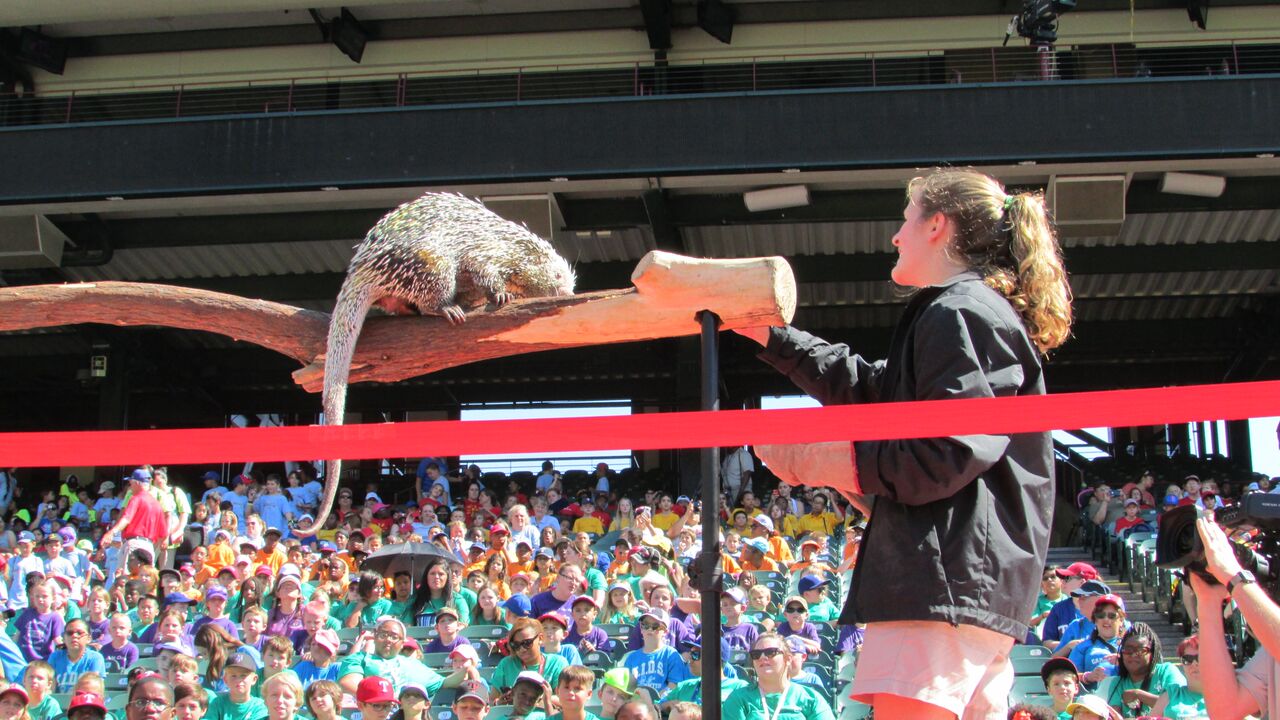
My benchmate wasn’t talking about a ballplayer known by the nickname “The Cheetah.” He was referring to the actual cheetah that had prowled foul territory a little earlier. The scout in question was Sean Greene, Vice President for Guest Experiences at the Dallas Zoo. The zoo’s Animal Adventures Outreach Program ventured to Tarrant County for its annual Wildlife Education Day at Globe Life Park in Arlington.


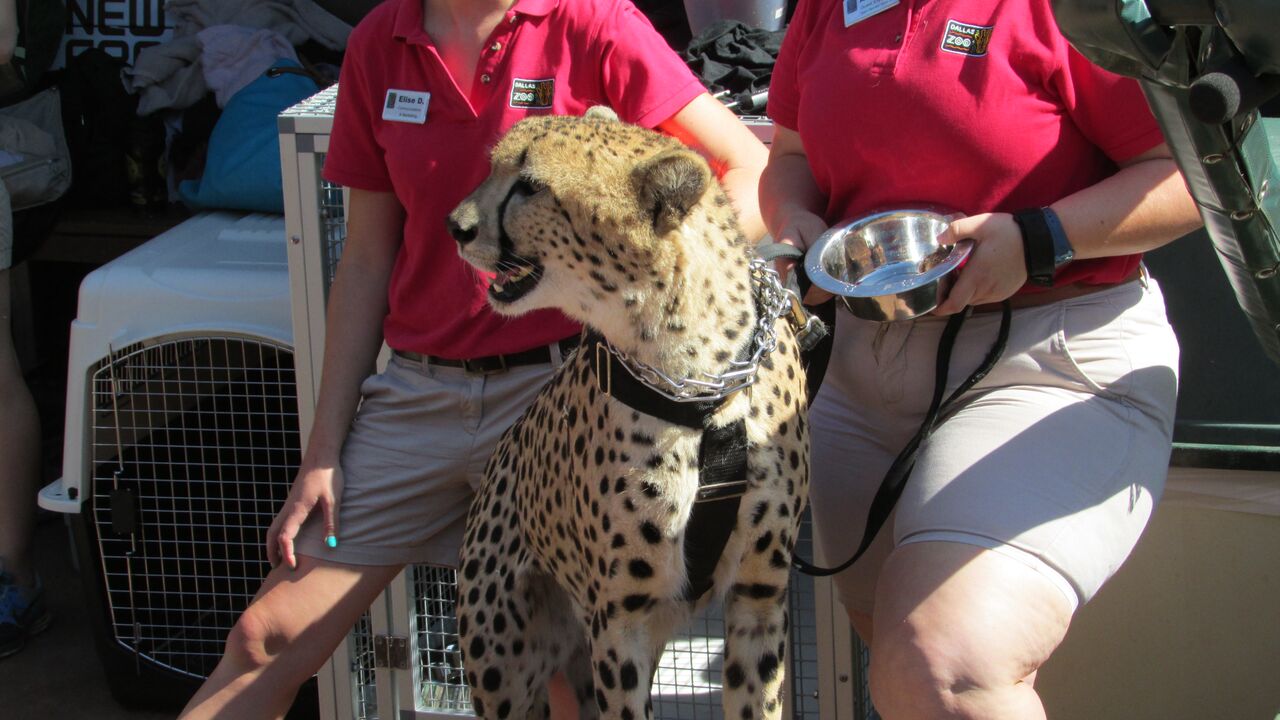
The zoo and the team designed the pregame program to educate young Rangers fans about animals, and Winspear the cheetah took part. He impressed some children, but didn’t get to run the bases and won’t become the successor to former Rangers Andrés “Big Cat” Galarraga or Frank “Cat” Catalanotto (whom Baseball Reference lists as having led off 198 times for Texas).
Theory: You would not want to have a cheetah hitting behind you in the batting order. If you singled and he hit one into the gap, odds are he would catch up to you on the way around the bases. If the cat then saw you less as a teammate and more as a plodding gazelle separated from your herd, failing to score might become the least of your concerns.
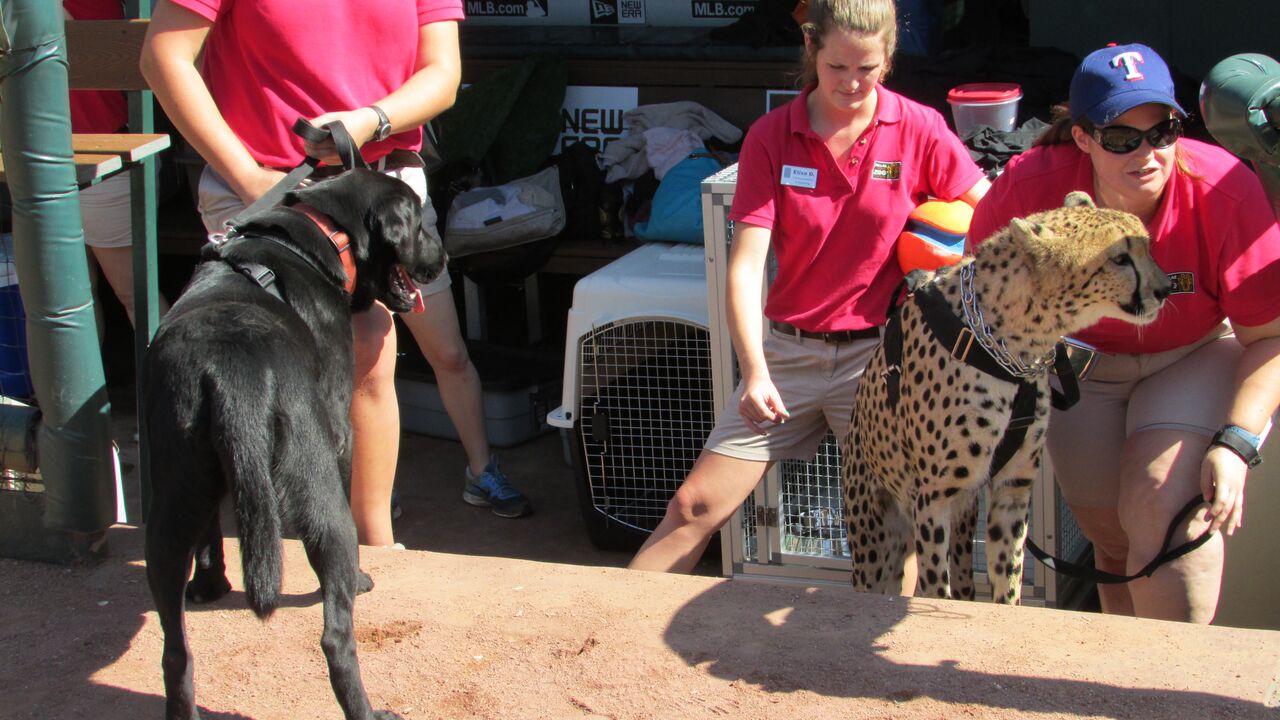
The zoo takes significant precautions to ensure the carnivore presents no danger to others or himself. Winspear’s entourage includes the two humans who handle his multiple safety harnesses and the cat’s best friend.
“That happens to be the black labrador, Amani,” said Greene. “He’s been raised with this cheetah since they were about three weeks of age. The dog is very much a comfort. Cheetahs are very shy in nature and if our cheetah gets a little shy out at a program like this, the dog comes in. The dog’s always wagging his tail because he thinks this great green grass out here is a place to play. The cheetah picks up on those cues from the dog, realizes the dog’s comfortable, and then the cheetah’s comfortable.”
While you may never see a cheetah in the Rangers lineup, a big part of the zoo’s motivation for the program has to do with your ability to ever see one anywhere.
“We brought today a cheetah that’s endangered, less than 10,000 left in the world. They’re seeing an African penguin. There’s less than 50,000 in the world,” Greene explained in the dugout. “These are critically endangered species and if zoos can convey a message to these kids and these parents and teachers today about what impact they’re going to have as they grow older, to protect this environment and the animals that are there, then it’s a really good opportunity for us to share that message.”
The messengers include people to handle the animals and some who enlighten the crowd about the following lineup of Animal Ambassadors:
· Cheetah
· Labrador Retriever
· African Dwarf Crocodile.
· Tamandua, or Lesser, Anteater
· Red Tail Boa
· Ball Python
· Prehensile Tail Porcupine
· Eurasian Eagle Owl
· Virginia Opossum
· African Black-footed Penguin
The kids got to touch some reptiles and we all learned a lot. For instance, I did not realize that while the porcupine smells terrible, lady porcupines apparently are into that. Human females, I have noticed, evolved different sensibilities.
We also learned that while zoo animals are fascinating, they are still wild. You have to remember that fact, even if you’re an animal yourself. Rangers Captain, the Rangers’ official mascot, claims the penguins used to bite him every year (yes, I talk to horses). The penguins had no comment.
Disclosure: The Rangers annually pay me to work with their in-game entertainment staff to warm up the crowd at Wildlife Education Day. I performed the same task when I worked for the club and always felt the event didn’t get the attention it deserved from the fandom. If they do it next year, and your kid likes animals or baseball or both, think about taking the day off to check out some day baseball and some interesting animals.
[All photos by Rush Olson]


Rush Olson has spent two decades directing creative efforts for sports teams and broadcasters. He currently creates ad campaigns and related creative projects for sports entities through his company, Rush Olson Creative & Sports.

RushOlson.com
Linkedin.com/company/rush-olson-creative-&-sports
Facebook.com/RushOlsonCreativeandSports
Wednesday, June 24, 2015

Sports Stuff You Should Do

This post originally appeared in my Blotch blog at the Fort Worth Weekly. To read it on the Weekly's site, go here : http://www.fwweekly.com/2015/06/23/sports-stuff-you-should-do/. I wrote it to appeal to those in Fort Worth-Dallas, but the tips will enhance anyone's sporting life.

You look to this space for sports insight. Today, we’ve decided to offer information you can use to enhance your sports life. Herein lies a bevy of experiences anyone would enjoy.
Sit on the Glass at a Pro Hockey Game
OK, I don’t mean actually “on” the glass. One slip and all the king’s horses and all the king’s men would have no chance of reassembling you. We use the term “on the glass” to mean seats next to the plexiglass mounted on the dasher boards that surround the ice. In other words, you can get no closer to the game unless you’re a player, official, or rogue Ice Girl. Now, I don’t consider these seats the best in the house. It’s often hard to see what’s happening at the other end of the rink and you may have to crane your neck to see replays. But the first time some hulking power forward finishes a check in your face, you’ll agree that you really needed to do this at least once in your life. These seats lean toward the expensive side of the ledger, so you’ll need to raid the piggy bank or do unsavory favors for the right people. Luckily you have both NHL and minor league hockey options in North Texas.
Go to a Sports Bar at an Off-Peak Time
We all think to meet buddies at a sports bar for the big game, but libations and bar food go well with multiple big screens in the middle of the afternoon, too. Thanks to the proliferation of sports channels and availability of international programming, you can almost always find one or more live games on the tube(s) no matter what time you stroll in. You get your drinks quickly and usually have your choice of where to sit. The next time you call in sick because you’re ticked off at the boss, don’t stay at home. Enjoy your holiday with some day baseball, Europa League soccer, or early-round LPGA golf.
Read One (or Two) Book(s) About the Fort Worth Cats
If you live in Fort Worth and you like sports, you should know about the legendary Fort Worth Cats baseball team. The revived Cats franchise made a real effort to celebrate its history, but with them regrettably out of the picture now, you’ll need another source to learn about the team that dominated the Texas League in the 1920s and employed the likes of Duke Snider and Maury Wills in the 1950s. Luckily two informative books exist on the subject:
When Panthers Roared: The Fort Worth Cats and Minor League Baseball by Jeff Guinn and Bobby Bragan
Baseball in Fort Worth by Mark Presswood and J. Chris Holaday

Attend a Rugby Match
You may not know the rules. In fact, if you fake it and tell someone you know the rules, you’ll give yourself away because they call them “laws.” It doesn’t matter. Go and watch people run and hit each other and then enjoy the socializing afterward. The rugby culture encourages players who just beat the heck out of each other to share fellowship and a cold (or at least room-temperature) beverage after the match. I’m not sure any other sport duplicates that rugby ethos.

Find Your Tennis Racquet
Go hit a few balls around, even off a backboard or the walls of a nearby church (watch the stained glass windows) or office building. You need some exercise and the U.S. needs you to discover a hidden talent so someone can win Grand Slam tournaments when Serena retires.
Go See Some Sporting Event at AT&T Stadium
Look, it doesn’t have to be a Cowboys game, but it does need to be an event where they turn on the video screen. That TV is just enormous and it’s big and, um, it’s really, really big. You need to see it.
Eat Some Crazy Food
Sports venues have added all sorts of Kong-sized creations to their menus and you should try one. I’m not saying you have to finish a 2-foot-long chili cheese dog by yourself (although I promise I would still respect you afterward). Split it with your girlfriend or boyfriend or both. At all costs, make sure you get a selfie proving your gastronomic moxie.
Develop a Superstition
I once created a whole ad campaign based on how fun it is to participate in this activity. If your team has won five in a row, something you’ve done may well have fueled the streak. Figure out what seemingly mundane act has pleased the sports gods and continue to do it until the luck has seeped out of it. Eat corn dogs for every meal, wear the ballcap to prom, re-enact the same one-night stand no matter what he looked like the next morning –– do whatever it takes. We’re counting on you.
You can accomplish all of these feats within the area. Feel free to suggest your own in the comments section or on social media. Please restrict your recommendations to activities that are either legal or totally worth the minimum sentence.


Rush Olson has spent two decades directing creative efforts for sports teams and broadcasters. He currently creates ad campaigns and related creative projects for sports entities through his company, Rush Olson Creative & Sports.

RushOlson.com
Linkedin.com/company/rush-olson-creative-&-sports
Facebook.com/RushOlsonCreativeandSports
Wednesday, May 13, 2015

Sad Songs and Waltzes and Content Marketing

If you did Willie Nelson wrong back in 1973, you could get away with it. He had no pop culture recourse.

The lyrics of "Sad Songs and Waltzes,”(1) which Nelson released that year, lamented his inability to soil the reputation of an unfaithful paramour. Though he had written a scathing musical diatribe about her, the song’s narrator notes : “You've no need to fear it, 'cause no one will hear it. 'Cause sad songs and waltzes aren't selling this year.”(2)

A few years later, the success of “Red-Headed Stranger” invalidated another line from the song : "It's a good thing that I'm not a star.” (3) Nelson’s raised profile meant he had communication channels unavailable to most artists of the day. Now if he wanted to let the world know about your “cold, cold heart” or that "you wouldn't even cross the street to say goodbye,” he could do so far more effectively than most jilted sweethearts of his era.

We mention the above because the equation has changed. The musicians and artists of today have lots of ways to get a message out. A recent project illustrated the point.

Luckily the message was not one of bitter retribution, but instead a story of friendship, generosity, and inspired performance.

The Imbroglio Sextet met in Haiti. Talented musicians donate their time there during summers to teach local children. They instruct students filled with the spirit of music but starved for the tools and guidance to make it.


A gathering of musicians inevitably results in their playing together, no matter the configuration of instruments. And so, somehow, a somewhat non-traditional group emerged that summer made up of a trumpet, clarinet, two violins, a viola, and a cello. Five members hailed from Spain, with a trumpeter from Texas and a conductor from Haiti by way of Los Angeles.

A small tour of Spain and England ensued and planning began for an American sojourn. Modern technology made the cross-continent logistics easier to coordinate than they would have been for a 1970s tour manager.

They wanted to use their music to raise awareness about both their group and the need in Haiti, Would that sort of thing be selling this year?

In the 1970s, one had limited options for promoting music, especially as an artist who not achieved stardom. You needed to get on terrestrial radio stations in different markets, work the daily newspapers or national magazines, and maybe get someone from one of the four networks to film (yes, they would have used actual film in that pre-videotape/digital period) a story on you. A combination of regulation and technological limitations not only limited one’s options, they made those who controlled the outlets into tastemakers. If the executives said sad songs, waltzes, or thrash metal weren’t selling that year, then, by golly, they wouldn’t. You couldn’t content market even if you wanted to, and both adulterers and innovative sextets would remain anonymous.


Record labels and traditional media can still serve as tremendous assets to musicians, but success no longer depends on them.

The Imbroglio Sextet started their content marketing push with social media. Their group loved to take photos, and modern technology made sharing the images from their previous confabs simple. They also had compelling backgrounds as high-level musicians. The combination made for great starting places on the likes of Facebook and Google+.

Video no longer requires massive television infrastructure. They commissioned a video for what became a successful online crowdfunding campaign. Would crowdfunding in the 1970s would have consisted of going door-to-door? And would you have contributed if Willie had rung your doorbell in 1973 and asked for some cash for his tour?

The group used video to add to the show’s live experience, too, commissioning a film (not created on actual film) to play along with the performance of one of their signature works. The producer sourced public domain silent film footage online and wrote modern intertitles. Besides a couple lines about Twitter, he could have written the jokes in 1973 (other than the fact that he was 5 years old then). Sourcing the films would have required a nationwide search for preserved reels. Thanks to the internet, people from around the world helped him without even knowing they had.


The effort didn’t ignore traditional media, either.  Press release distribution via email brought attention from actual print publications. Those traditional outlets repurposed their content for online use, extending the potential reach of such coverage far beyond what its 1970s equivalent would have provided.


Imbroglio Sextet trumpet player Cara Pollard worked exceptionally hard to make it all happen. Cara joked that after the tour ended, she wouldn’t look at Facebook for a month (she swiftly reneged on that vow). Industriousness is an asset in any era, but no matter how many 1973 hours one put in, the tools simply didn’t exist to maximize the return on them. The potential rewards from 2015 hours mean more great music available for listeners and more success for musicians (as well any other business that effectively employs modern content marketing). It also means greater potential consequences for doing Willie wrong, so watch yourself.

Imbroglio Sextet information :


Rush Olson has spent two decades directing creative efforts for entertainment and sports entities. He currently creates ad campaigns and related creative projects through his companies, Rush Olson Creative & Sports and FourNine Productions.

RushOlson.com


Footnotes
  

(1) twizzle05 “Willie Nelson - Sad Songs And Waltzes (Chord),” countrytabs.com.

(2) IBID.


(3) Calvin Gilbert “Bro Country Is Still Selling This Year,” CMT. http://www.cmt.com/news/1745866/bro-country-is-still-selling-this-year/ (accessed April 3, 2015)